I was making tea when the telephone rang.
It was a Thursday afternoon in late September. Rain tapped against the kitchen window, and I had just returned from the library after donating several boxes of old books.
I almost let the call go to voicemail.
At seventy, I had learned that most unexpected calls involved insurance, charity requests, or someone trying to sell me a new telephone plan.
But something made me answer.
“Hello?”
A man’s voice came through.
“Is this Margaret Collins?”
“Yes. Who’s calling?”
There was a pause.
“My name is David Andrews. I’m sorry to call you like this, but I found something that belongs to you.”
I stopped stirring my tea.
“Found what?”
“A letter. It was inside a book I bought at a library sale.”
I felt a strange tightening in my chest.
“What does the letter say?”
He took a breath.
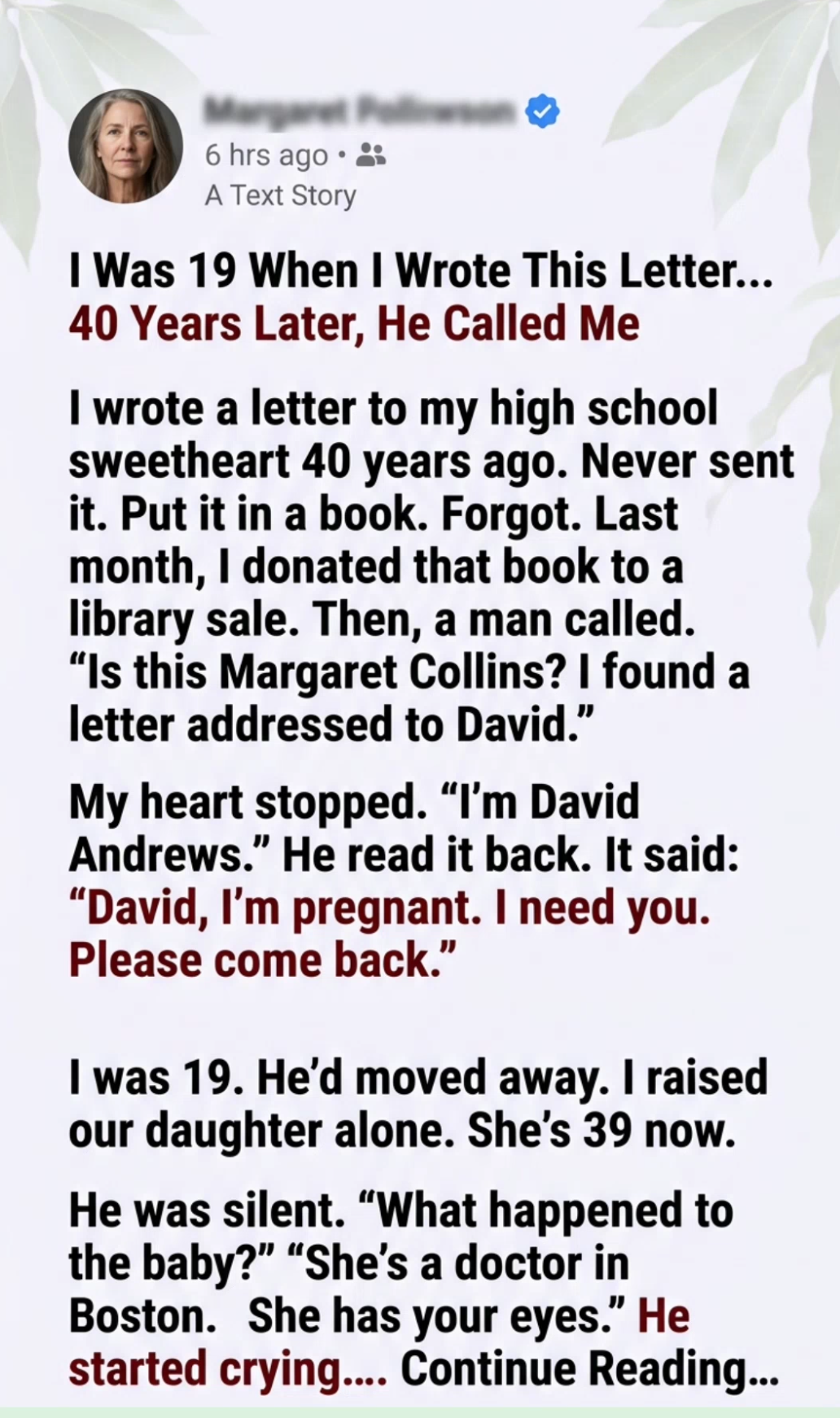
“It begins, ‘David, I’m pregnant. I need you. Please come back.'”
The spoon slipped from my fingers and struck the cup.
For a moment, I couldn’t speak.
Then he said something that made forty years disappear.
“Margaret, I think you wrote this to me when we were nineteen.”
I sat down.
“David?”
His voice broke.
“Yes. It’s me.”
I closed my eyes.
For forty years, I had imagined what I might say if I ever heard his voice again.
I had never imagined that the first thing he would ask was whether our daughter had survived.
I met David when I was seventeen.
He was the boy who sat two rows behind me in English class, always arriving a few minutes late with his hair untidy and a pencil tucked behind his ear.
He wasn’t the most popular boy at school.
He wasn’t particularly athletic, and he didn’t have much money.
But he could make me laugh when I was having the worst day imaginable.
We became friends after he borrowed my notes for an exam and returned them with a little drawing of a cat wearing glasses.
Underneath it, he had written:
This is you when you’re trying to understand Shakespeare.
I laughed so loudly that our teacher sent us both into the hallway.
After that, we spent almost every afternoon together.
We walked home, shared sandwiches, and talked about what we wanted to do after graduation.
David wanted to study engineering.
I wanted to become a teacher.
We made plans that seemed enormous at the time.
We would get married someday.
We would buy a small house.
We would have children.
We would travel somewhere neither of us had ever been.
We were young enough to believe that wanting something badly was the same as knowing how to make it happen.
When I turned eighteen, David gave me a silver necklace with a tiny heart.
It wasn’t expensive.
He had saved money from working weekends at a hardware store to buy it.
I wore it almost every day.
One evening, sitting on the steps behind his parents’ house, he told me he loved me.
I told him I loved him too.
For a while, everything felt certain.
Then his father lost his job.
The family began struggling financially, and David’s parents decided to move to another state where his uncle had offered him work.
David was supposed to leave after graduation.
We promised to make the distance work.
We wrote letters.
We spoke on the telephone whenever we could afford the calls.
He told me he would return as soon as he had saved enough money.
I believed him.
Then, one winter, his letters stopped.
At first, I thought he was busy.
Then I thought something might have happened.
I wrote twice.
I called the number his mother had given me, but it had been disconnected.
Eventually, I heard through a mutual friend that David was working long hours and had begun seeing someone else.
I was devastated.
I was also too proud to chase a boy who had stopped writing.
I told myself that our relationship had ended.
I was nineteen when I discovered I was pregnant.
I remember the morning I took the test.
I was alone in the bathroom, holding a little white stick with shaking hands.
Two lines.
I sat on the edge of the bathtub and stared at them.
I wasn’t sure whether to cry or laugh.
I thought about David.
I thought about the plans we had made.
And I thought about the possibility that he might still love me.
My mother was working at the time, and my father had died several years earlier.
I had no older sister to ask for advice.
I had one close friend, but I was too frightened to tell her.
So I wrote David a letter.
I wrote it by hand at the kitchen table.
I told him I was pregnant.
I told him I didn’t know what to do.
I told him I wasn’t asking him to marry me simply because of the baby, but I needed him to come home so we could talk.
I wrote:
David, I’m pregnant. I need you. Please come back.
Then I wrote about the baby.
I said I had started imagining what our child might look like.
I wondered whether the baby would have his dark eyes or my mother’s smile.
I told him I was frightened, but I wanted to believe we could face it together.
I read the letter several times.
Then I put it in an envelope.
I wrote his name and the address I had been given.
But I never mailed it.
I was afraid it would be returned.
I was afraid he would read it and decide he wanted nothing to do with me.
I was afraid he would tell me he had moved on.
Most of all, I was afraid of receiving an answer that would destroy the little hope I still had.
So I put the envelope inside a book of poetry.
I told myself I would send it later.
Later became another week.
Then another month.
By the time I was ready to make a decision, I had convinced myself that I could raise the baby without him.
I was nineteen.
I didn’t understand how difficult that would be.
But I knew I couldn’t let fear decide whether my child would be loved.
My daughter was born on a warm afternoon in June.
I named her Emily.
She weighed just over seven pounds and had a thick head of dark hair.
When the nurse placed her in my arms, I began crying.
She opened her eyes and looked at me.
I thought of David immediately.
She had his eyes.
I had never seen anything so beautiful.
My mother helped me through the first months.
She watched Emily while I worked at a small office during the day and attended evening classes twice a week.
Money was tight.
I rented a modest apartment and learned how to stretch groceries.
I became very good at repairing clothes, preparing inexpensive meals, and doing homework while Emily slept.
There were difficult days.
There were nights when she had a fever and I was terrified.
There were mornings when I stood at the kitchen sink wondering how I would pay the next bill.
But I never regretted having her.
She grew into a curious, determined little girl.
At four, she wanted to know why the moon followed our car.
At seven, she insisted on learning to read every sign we passed.
At twelve, she began talking about becoming a doctor.
I encouraged her.
“Why a doctor?” I asked once.
She shrugged.
“Because I want to help people when they’re scared.”
I hugged her.
“Then you’ll be a good one.”
She worked hard.
She earned scholarships, attended university, and eventually entered medical school.
When she graduated, I sat in the audience crying so much that I could barely see her walk across the stage.
She became a physician and moved to Boston.
I was proud of her beyond anything I could explain.
I raised her alone, but I never told her that her father had been a villain.
I didn’t know enough about what had happened to make that judgment.
I told her that her father and I had been young, that we had lost contact, and that I hadn’t been able to reach him.
She asked about him occasionally.
I answered what I could.
When she was sixteen, she asked whether I had ever loved anyone besides her father.
I smiled.
“Not in the same way.”
“Do you still think about him?”
I looked out the window.
“Sometimes.”
She didn’t ask more.
And I didn’t tell her about the letter.
The book stayed on my shelf for decades.
It was a collection of poems I had bought as a teenager.
The cover became faded, and the pages yellowed.
I moved it from one apartment to another, then into the house I bought after my mother died.
Sometimes I opened it.
I never looked inside the envelope.
I knew exactly where it was.
I told myself I kept the book because I liked the poems.
But I think I kept it because some part of me was still nineteen, still waiting for a boy to come home.
Eventually, life became full.
Emily grew up.
I worked, made friends, traveled occasionally, and learned to enjoy being on my own.
I never married.
There were men who asked me out, and there were a few relationships, but nothing became permanent.
I wasn’t waiting for David.
At least, that was what I told myself.
Then, last month, I decided to clear out some shelves.
I had accumulated too many books.
Some were textbooks from my teaching years.
Others belonged to my mother.
A few were novels I knew I would never read again.
I packed them into boxes and donated them to the local library’s annual sale.
The poetry book was among them.
I didn’t remember the envelope.
I didn’t even open the cover.
I simply placed it in the box.
And forty years after I had written it, the letter finally left my hands.
David told me he had bought the book because he enjoyed old poetry collections.
He had recently retired and moved back to our hometown after living away for decades.
He said he was sorting through his purchases when the envelope slipped from between the pages.
At first, he thought it was a receipt.
Then he saw his name.
He recognized my handwriting immediately.
He said he sat at his kitchen table for nearly an hour before opening it.
When he read the first lines, he felt as though the room had disappeared.
“Margaret,” he said over the phone, “I need to ask you something.”
I gripped the receiver.
“Go ahead.”
“What happened to the baby?”
I closed my eyes.
“She’s alive.”
He made a sound I will never forget.
A breath caught somewhere between a sob and a laugh.
“She’s alive?”
“Yes.”
“Is she…?”
He couldn’t finish.
“She’s thirty-nine now. She’s a doctor in Boston.”
He was silent.
Then he whispered, “A doctor?”
“Yes.”
“What’s her name?”
“Emily.”
He began crying.
I sat at my kitchen table and cried too.
After a few moments, he asked whether she knew about him.
I told him she knew I had loved someone when I was young, and that we had lost contact.
“Does she know my name?”
I hesitated.
“No. Not really.”
He took a breath.
“Does she know what happened?”
I looked at the letter lying on the table.
“She knows I couldn’t reach you.”
There was a long silence.
Then he said, “Margaret, I never received anything from you.”
I felt my chest tighten.
“What?”
“Your letter. I never received it. I never knew you were pregnant.”
I stared at the envelope.
“David, I never sent it.”
He didn’t speak.
I explained that I had been afraid.
I had written the letter, addressed it, and hidden it inside the book.
I had planned to mail it, but I never found the courage.
He was quiet for a long time.
Then he said something that changed the way I remembered those forty years.
“I waited for you too.”
David explained that after he moved, his father had become seriously ill.
He had taken a job with his uncle and worked long hours to help support his family.
He wrote me several letters, but none received a reply.
He assumed I had moved on.
Later, he met a woman named Susan.
They married in their twenties and had two sons.
The marriage lasted eleven years.
They eventually divorced, not because of a dramatic betrayal, but because they had grown into different people.
David never remarried.
He had worked, raised his sons, and eventually built a quiet life.
He admitted that he had thought about me over the years.
Sometimes he wondered whether I had married someone else.
Sometimes he wondered whether I had children.
He had no idea that a daughter existed.
I listened without interrupting.
Then I asked the question I had carried for forty years.
“Why did you stop writing?”
He sighed.
“I didn’t think you wanted to hear from me anymore.”
I shook my head, although he couldn’t see me.
“I thought you had forgotten me.”
He was silent.
Then he said, “We were nineteen. We both thought silence meant the other person had made a decision.”
I looked at the letter.
It had been sitting inside that book for forty years.
Two young people had each believed they had been abandoned.
Neither had known the other was waiting.
We agreed to meet.
David suggested a small café near the old railway station.
I arrived early.
I wore a blue coat and the silver necklace he had given me when I was eighteen.
I had kept it in a jewelry box all these years.
I wasn’t sure why I wore it.
Perhaps I wanted him to recognize it.
Perhaps I wanted to remember the girl I had been.
When he walked in, I recognized him immediately.
His hair was almost entirely gray.
His face had changed.
There were lines around his eyes, and he walked more slowly than I remembered.
But his eyes were the same.
He stopped when he saw me.
“Margaret.”
I stood.
“David.”
For a moment, we simply looked at each other.
Then he smiled.
“You kept it.”
He was looking at the necklace.
I touched it.
“Yes.”
He looked down.
“I can’t believe you still have that.”
“Neither can I.”
We hugged.
It was awkward at first, then unexpectedly familiar.
We sat at a small table near the window.
He had brought the letter.
It was inside a clear protective sleeve.
I stared at my handwriting.
The paper had yellowed.
The ink had faded slightly.
My nineteen-year-old words were still there.
David looked at me.
“May I read it?”
I nodded.
He opened the sleeve and began.
His voice shook as he read the words I had written in the kitchen forty years earlier.
When he reached the sentence asking him to come back, he stopped.
He looked at me.
“I wish I had known.”
I swallowed.
“So do I.”
He continued reading.
The letter described my fear, my hope, and my excitement about the baby.
When he reached the final paragraph, his eyes filled.
I had written:
I don’t know what our future will look like, David. But I know this child deserves to know that she was wanted. I hope you come home before I have to learn how to do everything without you.
He put the letter down.
Then he covered his face.
I reached across the table.
He held my hand.
For several minutes, neither of us spoke.
We talked for almost three hours.
He told me about his sons.
I told him about Emily.
He asked what she was like as a child.
I described her first bicycle, her obsession with dinosaurs, and the way she used to fall asleep with books open beside her.
I told him about her university years, her medical training, and the first time she called me from the hospital to say she had helped a patient through a difficult night.
David listened to every detail.
Sometimes he smiled.
Sometimes he wiped his eyes.
At one point, he asked whether I had photographs.
I showed him pictures on my phone.
There was Emily at graduation.
Emily in a white coat.
Emily standing beside me on a beach.
David looked at each photograph carefully.
“She has your smile,” he said.
“And your eyes.”
He studied her face.
“She really does.”
Then he asked whether I thought she would want to meet him.
I didn’t answer immediately.
“That’s her decision.”
He nodded.
“I understand.”
I continued.
“She has a life, David. She has a career, friends, and a sense of who she is. I won’t ask her to make room for you because you found a letter.”
He looked down.
“I wouldn’t expect that.”
“But I will tell her the truth.”
He nodded.
“Thank you.”
I called Emily that evening.
She answered while walking home from work.
“Hi, Mom. Everything okay?”
I sat down.
“There’s something I need to tell you.”
She immediately stopped walking.
“What’s wrong?”
“Nothing is wrong. But I found out something about your father.”
There was silence.
Then she asked, “My biological father?”
“Yes.”
I explained the letter, the book, the library sale, and the phone call.
I told her that David had found the letter and had contacted me.
She listened quietly.
When I finished, she asked, “Does he know about me?”
“Yes.”
“What did he say?”
“He cried.”
She was quiet.
Then she asked, “Did he know I existed?”
“No, sweetheart. He never received the letter. I never sent it.”
I could hear her breathing.
“Why didn’t you tell me you had written it?”
I looked at the table.
“Because I didn’t want you growing up believing that someone had abandoned you when I couldn’t prove what happened. And later, when you were older, I didn’t know whether the letter mattered anymore.”
She was silent.
Then she said, “Mom, I think it matters.”
I began crying.
“I know.”
She asked whether David wanted to meet her.
I told her he did, but that he would respect her decision.
She said she needed time.
I told her to take all the time she needed.
Before we hung up, she said something I wasn’t expecting.
“Mom, I want to see the letter.”
A week later, Emily came to visit.
I placed the letter on the dining table.
She read it slowly.
At first, she smiled at the handwriting.
Then she began crying.
When she reached the last paragraph, she put the paper down.
“Grandma would have helped you,” she said.
I nodded.
“She did.”
Emily looked at me.
“You were nineteen.”
“Yes.”
“You were scared.”
“Very.”
She took my hand.
“You shouldn’t have had to do it alone.”
I looked at her.
“I wasn’t completely alone. Your grandmother helped me. And you gave me a reason to keep going.”
She wiped her cheeks.
Then she asked whether I could arrange a meeting with David.
I nodded.
We arranged the meeting for the following month.
David suggested a quiet restaurant.
Emily chose a public garden instead.
She said she wanted somewhere she could walk if she felt overwhelmed.
I agreed.
When we arrived, David was already waiting on a bench.
He stood when he saw us.
For the first time, he was looking at the daughter he had never known.
Emily stopped a few steps away.
David looked at her face.
Then he said her name.
“Emily.”
She nodded.
“Hello, David.”
He swallowed.
“Thank you for coming.”
She looked at him carefully.
“I have a lot of questions.”
“I understand.”
“And I don’t know what I want our relationship to be.”
He nodded.
“You don’t have to decide today.”
Emily looked at me.
I stepped back.
This was their conversation.
David began by telling her about the years after he moved.
He explained that he had written letters, but had never received replies.
Emily asked whether he had searched for me.
He admitted that he had tried once through an old mutual friend but had been told I had moved away.
He had assumed I was married.
Emily asked why he hadn’t tried harder.
He didn’t offer excuses.
“I was young and afraid,” he said. “I thought I had lost you, and I didn’t know how to find you. I should have tried harder.”
She asked about his family.
He told her about his sons.
He showed her photographs.
Emily listened.
Then she asked the question that had been waiting in her heart.
“Did you ever wonder whether you had a child?”
David looked at her.
“Yes. Sometimes. But I never knew.”
She nodded.
“I wondered what you were like.”
He smiled sadly.
“I wondered what you were like too.”
They sat together for nearly two hours.
There were no dramatic declarations.
No immediate father-daughter embrace.
No promise that everything would be perfect.
But there was conversation.
There was honesty.
And there was a beginning.
Over the next several months, David and Emily spoke occasionally.
At first, their conversations were short.
He asked about her work.
She asked about his sons.
They exchanged photographs and stories.
He learned that she was a doctor who worked long shifts and drank too much coffee.
She learned that he enjoyed woodworking and had recently started volunteering at a community workshop.
They discovered they both loved old movies.
They also discovered they had a similar habit of tapping their fingers when thinking.
One afternoon, Emily called me laughing.
“Mom, he does the exact same thing you do when you’re nervous.”
I laughed.
“Your father used to do that in school.”
She was quiet for a moment.
Then she said, “I’m glad I know him.”
I closed my eyes.
“Me too.”
David and I continued seeing each other occasionally.
We were careful.
Neither of us was nineteen anymore.
We had lived entire lives without one another.
He had been married, raised sons, and built a career.
I had raised Emily, worked for decades, and learned to be independent.
We were not trying to recreate the future we had imagined as teenagers.
We were simply getting to know the people we had become.
One afternoon, he brought me a small wooden box.
He had made it himself.
The lid had a tiny heart carved into the corner.
“I thought you might like this,” he said.
I opened it.
Inside was the original silver necklace.
I had given it to him to repair after the chain broke during one of our meetings.
He had polished it and replaced the clasp.
I looked at him.
“Thank you.”
He smiled.
“I kept thinking about the girl who wore this.”
I touched the necklace.
“She’s still here somewhere.”
He nodded.
“I think so.”
Then he said something I will never forget.
“I spent forty years thinking you had forgotten me. I didn’t realize you had kept my letter inside a book all that time.”
I looked at him.
“I spent forty years thinking you had forgotten me too.”
He reached across the table.
This time, I took his hand.
People sometimes ask whether I wish I had mailed that letter.
Of course I do.
I wonder how different our lives might have been if I had placed it in the mailbox.
Perhaps David would have returned.
Perhaps we would have raised Emily together.
Perhaps we would have discovered that young love wasn’t enough to build a lasting marriage.
There is no way to know.
I don’t believe every lost relationship is meant to be restored.
And I don’t believe the passage of time automatically makes everything right.
But I have learned that some truths deserve to be spoken, even when they arrive forty years late.
David and I cannot recover the years we missed.
We cannot give Emily the childhood she might have had with both parents.
We cannot go back and change the fear that kept a nineteen-year-old girl from mailing a letter.
But we can choose what happens now.
Emily has a father who wants to know her.
David has a daughter he never knew existed.
And I have finally put down a question I carried for most of my life.
Last week, I took the old poetry book from the shelf.
It was no longer the same book I had donated.
David had returned it to me after making a copy of the letter.
I opened it to the page where the envelope had been hidden.
For a long time, I simply stared at the empty space.
Then I placed the original letter inside a new protective sleeve and put it in a small box with photographs of Emily.
I don’t intend to hide it again.
It is part of our story.
A painful part.
A beautiful part.
And a reminder that sometimes the words we are too frightened to send are the very words someone has spent a lifetime wishing they could hear.
THE END.