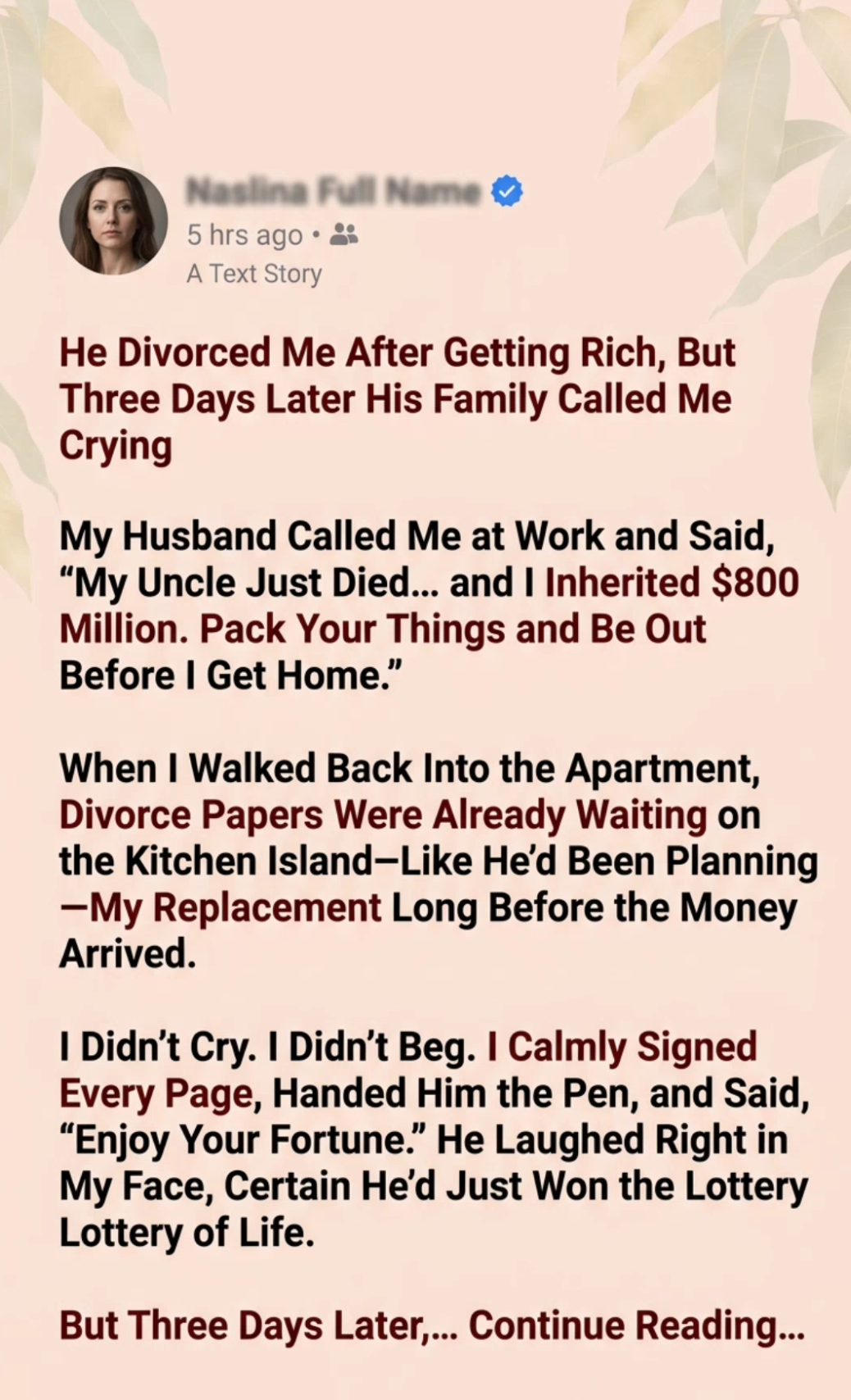
The phone rang at 10:17 on a Tuesday morning.
I was sitting at my desk, reviewing invoices for a small architecture firm in Chicago, when my husband’s name appeared on the screen.
“Daniel? Is everything okay?”
He didn’t say hello.
“My uncle Victor died last night.”
I sat up straight. “Oh, Daniel. I’m sorry. I know how much he meant to you.”
There was a pause.
Then he laughed.
Not the nervous laugh of someone struggling with grief. It was a sharp, breathless sound I had never heard from him before.
“Do you know what else happened?” he asked. “He left me everything.”
“Everything?”
“Eight hundred million dollars, Claire. Eight hundred million.”
For a moment, I couldn’t find words.
Daniel and I had been married for eleven years. We had started with almost nothing. When we first moved into our apartment, we owned a secondhand sofa, two mismatched plates, and a coffee table Daniel had found beside a dumpster.
I remembered eating instant noodles on the floor because we couldn’t afford a dining table.
I remembered working late while Daniel studied for his financial licensing exams. I remembered lending him my savings when his first investment business failed. I remembered taking extra freelance projects when he was struggling to pay his share of the rent.
I had believed we were building a life together.
“That’s incredible,” I finally said. “But Daniel, are you okay? What happened to your uncle?”
“Claire, listen carefully. I don’t want you misunderstanding the situation.”
His voice had changed.
The excitement remained, but something colder had replaced the warmth.
“I’ve been thinking about our marriage. We haven’t been happy for a long time.”
I stared at the spreadsheet on my computer.
“What are you talking about?”
“I want a divorce.”
I thought I had misunderstood him.
“Right now?”
“Yes. I’m not going to pretend anymore. My life is changing, and I don’t want to carry old baggage into it.”
“Old baggage?”
“You know what I mean. We married when I had nothing. That was a different time. I need someone who fits the life I’m about to have.”
I gripped the edge of my desk.
“Daniel, we’ve been married eleven years.”
“And I’m grateful for what you did. But that doesn’t mean we have to spend the rest of our lives together.”
Then he delivered the sentence that finally made everything clear.
“Pack your things and be out before I get home.”
He hung up.
I sat motionless for several minutes.
My coworkers were talking in the hallway. Someone laughed near the printer. A delivery driver knocked on the office door.
The world continued as if my marriage hadn’t just ended during a five-minute phone call.
I asked my supervisor if I could leave early.
When I reached our apartment, I found a thick envelope on the kitchen island.
Divorce papers.
Beside them was a black fountain pen Daniel had received as a birthday gift from his uncle.
I opened the envelope.
The documents had already been prepared. His attorney’s name appeared at the bottom. The proposed settlement offered me a modest amount to leave the apartment and waive any future claims beyond what the agreement specifically provided.
There was no mention of the years I had supported him.
No mention of the money I had contributed when his business was failing.
No mention of the sacrifices we had made together.
I read every page twice.
Then I called the attorney whose number appeared on the documents. I told him I needed independent legal advice before signing anything.
He agreed to meet me the following morning.
Daniel came home that evening wearing a smile that seemed permanently attached to his face.
He was carrying a bottle of expensive champagne.
“You’re still here?” he asked.
“I live here, Daniel.”
“Not for much longer.”
I looked at the bottle.
“Celebrating already?”
He placed it on the counter.
“There’s no reason to make this unpleasant. I’ll make sure you’re comfortable. You’ll get enough to start over.”
“That’s generous.”
He seemed pleased by my response.
“See? This is why I’ve always said you’re practical.”
I almost laughed.
He genuinely believed my silence meant I accepted his version of events.
I placed the papers in their envelope.
“I’ll review everything.”
“Don’t drag this out. My attorney has prepared a straightforward agreement.”
“I said I’ll review it.”
His smile disappeared for a second.
Then he shrugged.
“Fine. Just remember, Claire, this is the best outcome for both of us.”
I looked at the man I had once trusted with every part of my life.
“No, Daniel. It’s the outcome you chose.”
That night, I slept in the guest room.
The next morning, I met my attorney, a woman named Rebecca Shaw.
She listened without interrupting while I explained what had happened.
When I finished, she folded her hands.
“First, don’t sign anything yet.”
“I wasn’t planning to.”
“Good. Second, we need to understand the financial picture. How much of your marital property is in joint accounts? Did you contribute to his business? Were any assets transferred during the marriage?”
I gave her everything I could remember.
Rebecca spent the next several hours reviewing the documents and asking questions.
She explained that the inheritance itself might be treated differently from marital property depending on how it was received, held, and handled under the applicable law. But that didn’t automatically mean Daniel could ignore the rights I might have in assets accumulated during our marriage.
“We need records,” she said. “Bank statements, tax returns, business documents, loan records, anything showing what you contributed and how the finances were handled.”
I nodded.
“There’s something else,” I said.
Rebecca looked up.
“Daniel’s uncle.”
“What about him?”
“He was the reason Daniel’s business survived.”
I told her about the years when Victor had helped Daniel. The introductions, the early loans, the business advice, and the occasional emergency payment.
Rebecca made a note.
“Did your husband ever tell you why his uncle was so involved?”
“Not really. Daniel always said Victor believed in him.”
I paused.
“But I knew Victor better than Daniel thought I did.”
That surprised her.
Victor had never been particularly affectionate, but he was observant. During family dinners, he often asked me about my work. He remembered details about projects I had mentioned months earlier. He also knew that I handled most of the household finances because Daniel hated paperwork.
Once, while Daniel was outside taking a phone call, Victor had said something that stayed with me.
“Claire, people who can manage money without letting money manage them are rare.”
I had laughed and told him I was simply organized.
He had looked toward the garden where Daniel was standing.
“Make sure you stay that way.”
At the time, I hadn’t understood.
Three days after Daniel told me to leave, I received the first call.
It was from his mother, Margaret.
I almost didn’t answer.
“Claire?”
Her voice was trembling.
“Yes?”
“Where are you?”
“At my apartment. Why?”
She began crying.
“Please, sweetheart. I need you to come over.”
“What’s happened?”
“It’s Daniel. He’s in trouble.”
I closed my eyes.
“What kind of trouble?”
“I don’t know how to explain it over the phone. Please. Your father-in-law is here too. We need to talk.”
I hesitated.
Then I said, “I’ll come, but I’m bringing my attorney.”
Margaret went quiet.
“Your attorney?”
“Yes.”
“Of course,” she whispered. “Just please come.”
When I arrived at their house, I found Margaret sitting at the dining table with her husband, Robert. Daniel was standing near the window, pacing.
He looked different.
The confidence was gone. His shirt was wrinkled, his hair uncombed, and his phone was pressed so tightly against his palm that his knuckles had turned white.
The moment he saw me, he stopped.
“Claire.”
I didn’t answer.
Margaret stood up.
“Thank you for coming.”
Rebecca sat beside me and opened her notebook.
Robert cleared his throat.
“We’ve had some unexpected developments.”
Daniel began speaking before anyone else could.
“My uncle’s estate isn’t what we thought.”
I looked at him.
“You told me you inherited eight hundred million dollars.”
“I did.”
“Then what is the problem?”
He rubbed his forehead.
“It’s complicated.”
Rebecca leaned forward.
“Then perhaps you should explain the legal structure.”
Daniel glanced at her.
“Who invited her?”
“I did,” I replied.
Margaret reached for a glass of water.
“Victor’s estate is managed through a trust. Daniel was named the primary beneficiary, but there are conditions.”
“What conditions?” I asked.
Robert looked at his son.
“Victor appointed independent trustees. They have authority over distributions, business interests, and certain major decisions.”
Daniel interrupted.
“They’re treating me like a child.”
“Perhaps you should explain what happened,” Rebecca said calmly.
Daniel’s jaw tightened.
He finally admitted that the inheritance wasn’t an immediate transfer of eight hundred million dollars into his personal bank account.
The estate included private company shares, commercial property, investment funds, and other assets. Some were held in trusts. Some were subject to existing agreements. Some could not be sold or distributed without approval.
The money was real, but it wasn’t his to spend however he wanted.
That alone wasn’t enough to explain the panic.
The real problem was a document Victor had left behind.
A letter addressed to Daniel.
It had been read by the estate’s trustees that morning.
Daniel pulled a folded sheet of paper from his jacket.
“I want you to read this,” he said.
I didn’t reach for it.
“Why?”
“Because you’re mentioned.”
That made me look at him.
He placed the letter on the table.
Rebecca picked it up and read silently before sliding it toward me.
Victor’s handwriting was unmistakable.
The letter wasn’t a sentimental goodbye. It was a set of instructions explaining why he had structured the inheritance as he had.
Victor had written that he had spent years observing Daniel’s decisions. He had watched him become increasingly concerned with status, appearances, and the company he kept.
He had also watched me.
Victor knew I had worked while Daniel pursued opportunities. He knew I had helped keep the household financially stable. He knew I had encouraged Daniel to seek professional advice rather than gamble the family’s savings on risky ventures.
Most importantly, Victor knew something Daniel had never told me.
Two years earlier, Daniel had attempted to sell a significant portion of his business to a private investment group.
The deal had failed after the buyers discovered irregularities in the company’s financial records.
Daniel had blamed the collapse on a disagreement over valuation.
But Victor’s letter described it differently.
He said Daniel had approved certain financial arrangements without fully understanding their consequences. Victor had stepped in to prevent a damaging transaction from going forward.
The letter continued:
I am leaving Daniel the opportunity to manage what I built, but I am not giving him unrestricted control immediately. The trustees must be satisfied that he can act responsibly, transparently, and with consideration for the people affected by his decisions.
Then came the sentence that made Daniel look away.
I have also instructed the trustees to consider the independent judgment of Claire Bennett, whose conduct during the years I observed was consistently more responsible than that of the person she married.
I read it again.
“What does that mean?” I asked.
Rebecca examined the following pages.
“It appears Victor created an advisory review process. Claire is not automatically entitled to the inheritance, but the trustees may consult her regarding certain decisions involving the family business and its existing obligations.”
Daniel shook his head.
“That was never supposed to happen.”
I turned toward him.
“What wasn’t supposed to happen?”
He didn’t answer.
Robert spoke quietly.
“Victor was worried about the company. He wanted someone involved who understood how it operated and wasn’t personally dependent on Daniel’s decisions.”
Margaret wiped her eyes.
“Your uncle believed you were good for him, Claire.”
I looked at her.
“Then why did your son ask me to leave the apartment before his inheritance was even settled?”
No one spoke.
Daniel finally stepped forward.
“Look, I made a mistake. I was overwhelmed. I thought I was doing what was best.”
“You told me I was baggage.”
“I was angry.”
“You told me to pack my things.”
“I didn’t mean it like that.”
“You left divorce papers on the kitchen island.”
He lowered his voice.
“Can we talk privately?”
“No.”
His face hardened.
“Claire, don’t turn this into a war. You know I still care about you.”
I looked at him for a long moment.
“You didn’t call because you missed me. You called because something went wrong.”
He had no answer.
Rebecca closed her notebook.
“Any discussion about the divorce will go through the attorneys. We also need to review the financial records before either party agrees to a settlement.”
Robert nodded.
“That seems reasonable.”
Daniel looked at his father.
“Dad, this is between Claire and me.”
Robert’s expression changed.
“No, son. You made it everyone’s business when you decided to throw away your marriage over an inheritance you hadn’t even received.”
It was the first time I had heard Robert openly challenge him.
I stood.
“I came because Margaret asked me to. I hope the family resolves whatever problems exist with the estate. But I won’t be returning to the marriage simply because the money is more complicated than you expected.”
Margaret began crying again.
Daniel stared at me.
“Are you really going to walk away from all this?”
I gave him a tired smile.
“I walked away three days ago. You just didn’t notice because you were too busy counting money.”
I left with Rebecca.
Over the following weeks, the situation became more complicated.
The trustees began reviewing the business records. Daniel’s attorneys had to provide documentation related to the failed sale and several outstanding obligations. The company continued operating, but major decisions required approval.
My divorce proceedings moved forward separately.
Rebecca uncovered evidence that I had contributed substantially to several assets acquired during the marriage. Some of the money had come from my salary. Some came from savings I had accumulated before we married. There were also joint accounts and business expenses that needed to be properly accounted for.
Daniel’s original settlement offer was no longer on the table.
His attorney eventually agreed to negotiate a fair division of the marital assets. The process took months, not days. There were meetings, financial disclosures, disagreements, and more than one occasion when Daniel tried to contact me directly.
I kept everything professional.
I wasn’t interested in punishing him.
I wanted a clean ending.
Meanwhile, Victor’s trustees continued their review.
They eventually discovered that Daniel had been planning to use the inheritance as leverage to restructure his company and push out several longtime employees. He had already spoken with advisers about replacing senior management and selling properties that supported the company’s operations.
The trustees refused to approve the plan.
They weren’t trying to humiliate him. They were protecting an estate that had taken decades to build.
Daniel was required to work with an experienced executive team and provide transparent financial reporting before receiving broader authority.
He hated every minute of it.
One afternoon, Margaret called again.
“Claire, would you meet me for lunch?”
I almost declined, but something in her voice made me reconsider.
We met at a quiet restaurant near the river.
She looked older than she had a month earlier.
“I owe you an apology,” she said before the menus arrived.
“You don’t owe me anything.”
“I do. I knew Daniel was becoming difficult. I saw how he spoke to you sometimes. I told myself it was stress. I told myself he would grow out of it.”
She looked down.
“When he received that call about Victor’s inheritance, he started talking about changing everything. New house, new friends, new life. I should have told him that money doesn’t make someone better. It only gives them more room to show who they already are.”
I didn’t know what to say.
Margaret reached across the table.
“I don’t expect you to forgive him. I just don’t want you to think everyone in this family believes what he did was acceptable.”
I gently squeezed her hand.
“Thank you.”
She hesitated.
“There’s something else. Victor left a recording for the family. The trustees played it at a meeting last week.”
I looked up.
“What did he say?”
Margaret smiled sadly.
“He said he hoped Daniel would eventually understand that being wealthy and being worthy of wealth were two different things.”
For the first time in weeks, I felt something close to peace.
Not because Daniel had been stopped.
Not because his family had finally recognized what happened.
But because I no longer needed anyone to agree with me before I could move forward.
The divorce was finalized several months later.
I received a fair settlement based on the assets and contributions established during the marriage. I didn’t receive a share of Victor’s inheritance, and I hadn’t expected one.
Daniel kept his inheritance subject to the trust’s terms.
He also kept the business, though he no longer had the unrestricted control he had imagined.
I moved into a smaller apartment with large windows and a little balcony. I bought a dining table made of oak and two comfortable chairs.
For the first time in years, I chose furniture because I liked it, not because Daniel thought it looked impressive.
I returned to architecture full-time and began working on a community housing project. It wasn’t glamorous, but I enjoyed seeing something useful take shape.
About eight months after the divorce, Daniel sent me a message.
I know I hurt you. I was wrong. I hope someday you can forgive me.
I read it twice.
Then I put my phone down.
I didn’t hate him.
I didn’t wish him poverty or failure.
But forgiveness didn’t mean reopening a door I had spent months learning to close.
A week later, I received another message.
I keep thinking about what Uncle Victor said. I think I finally understand.
I didn’t respond.
Some lessons arrive too late to save a marriage.
Nearly a year after the inheritance, I attended a small memorial event for Victor. His foundation had begun supporting apprenticeships for young people entering construction, engineering, and design.
Margaret invited me.
Daniel was there, standing near the back of the room.
We exchanged a brief greeting.
He looked healthier, but quieter. The trustees had gradually given him more responsibility after he completed the required reviews and demonstrated better judgment. He was still extraordinarily wealthy, but he seemed less eager to announce it.
During the event, one of Victor’s longtime colleagues spoke about him.
“He believed money was useful only when it gave people the ability to build something that outlasted them.”
I thought about the man who had once sat across from me at family dinners, quietly watching how people treated one another.
After the speeches, Daniel approached.
“Claire, can I say something?”
I nodded.
“I was wrong to divorce you that way.”
“Yes, you were.”
He swallowed.
“I thought the inheritance meant I could start over as someone important. I convinced myself that the life we had built was holding me back.”
“And now?”
“Now I understand that I was the one holding it back.”
I didn’t rush to comfort him.
He looked toward the room where his family and Victor’s friends were talking.
“I know you won’t come back. I’m not asking you to. I just wanted to say that I understand what I lost.”
For a moment, I remembered the young man who had sat on the floor of our first apartment, eating instant noodles and telling me he would make something of himself.
I had loved that man.
But the person standing in front of me had made choices that could not be undone by regret.
“I hope you become someone your uncle would be proud of,” I said.
Daniel nodded.
“Thank you.”
We went our separate ways.
Outside, the evening air was cool. I walked toward my car, passing a row of young trees planted along the sidewalk.
My phone buzzed.
It was a message from Margaret.
Thank you for coming. Victor would have been glad.
I smiled and slipped the phone into my bag.
Daniel had inherited eight hundred million dollars.
But the greatest thing his uncle had left behind wasn’t the money, the properties, or the company.
It was the truth about the people around him.
And the truth had arrived just in time for me to stop confusing being needed with being loved.
I had once believed that the end of my marriage meant the end of the life I had worked so hard to build.
Instead, it became the beginning of a life that belonged entirely to me.
THE END.