The phone rang at 10:42 on a Thursday morning.
I was halfway through a budget meeting when my daughter’s teacher’s name appeared on my screen.
I almost let it go to voicemail.
Then I remembered Emma had been unusually quiet at breakfast, so I excused myself and answered.
“Hello, Mrs. Bennett?”
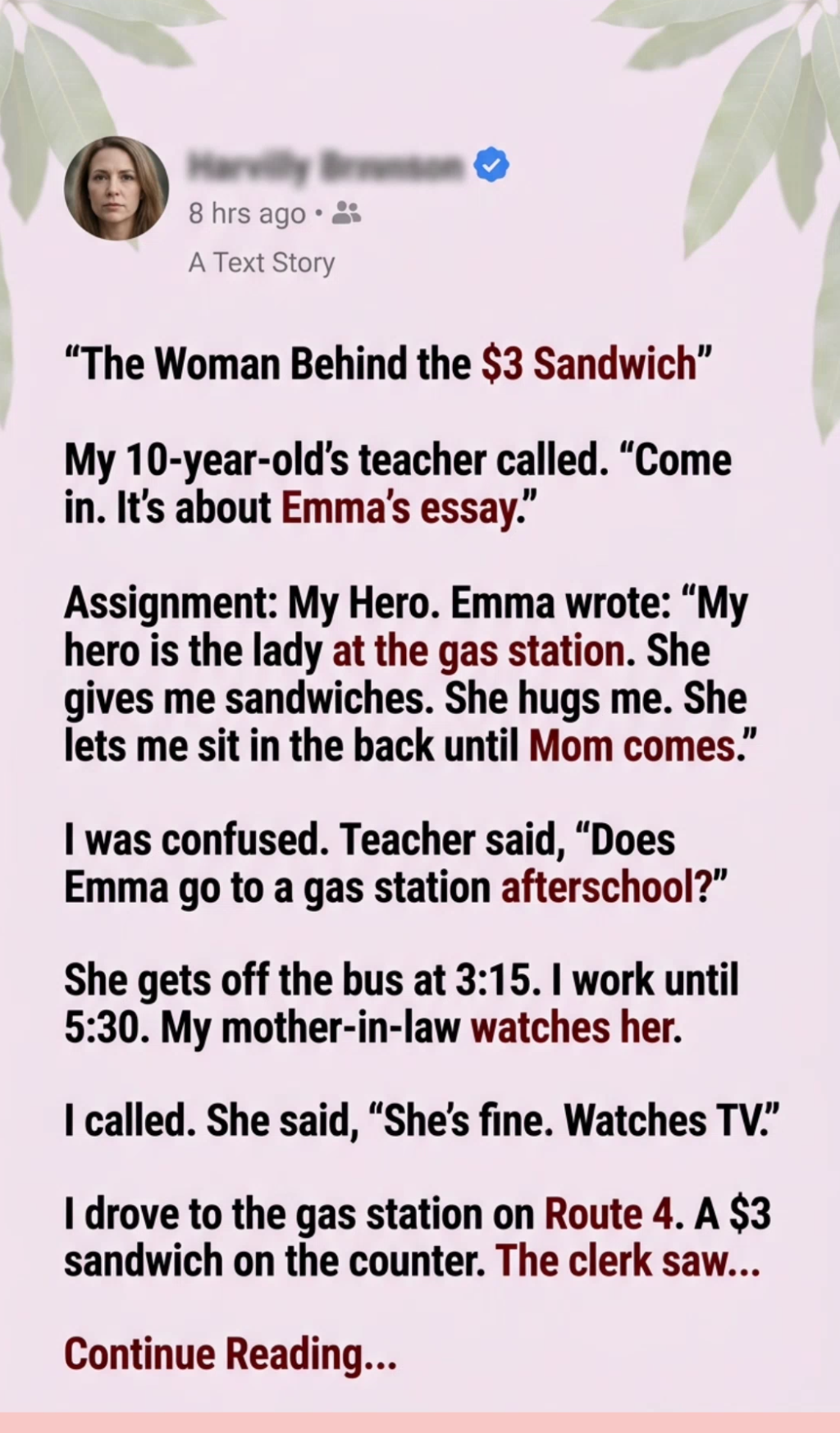
“Hi, Laura. I’m sorry to interrupt your workday, but could you come in sometime today? It’s about Emma’s writing assignment.”
My stomach tightened.
“Is something wrong?”
“Not exactly. I think you should see what she wrote.”
Her voice was gentle, but there was something unusual in it.
“What was the assignment?”
“My Hero.”
I smiled a little.
“Oh. I imagine she wrote about her grandmother or maybe her father.”
There was a pause.
“Actually, she wrote about a woman who works at a gas station.”
I stopped walking.
“A gas station?”
“Yes. She calls her the lady who gives her sandwiches.”
I looked through the office window at the parking lot.
“I’m sorry. What?”
“Could you come in? I think it would be better if we talked in person.”
I told my supervisor I had a family matter and drove to Emma’s school.
Her teacher, Mrs. Collins, was waiting outside the classroom.
She was holding a sheet of lined paper.
“Before you read this,” she said, “I want you to know that Emma wasn’t upset while writing it. She seemed happy. But some of the things she mentioned made me wonder whether she was spending time somewhere without your knowledge.”
I took the paper.
Emma’s handwriting was uneven, with several letters leaning in different directions.
The title read:
MY HERO
Then she had written:
My hero is the lady at the gas station.
She is nice to me. She gives me sandwiches when I am hungry. They cost $3 but she says I don’t have to pay because she has a special rule.
She gives me hugs when I feel sad.
Sometimes I sit in the back until Mom comes. She lets me color pictures and she gives me a blanket when it is cold.
She knows I don’t like being alone.
I wish my mom could meet her because she is a good person.
I think she is like a grandma but she is not old.
I read it twice.
Then I looked up.
“Does Emma go to a gas station after school?”
Mrs. Collins shook her head.
“I don’t know. That’s why I called.”
I tried to explain.
“Emma gets off the school bus at 3:15. My mother-in-law watches her until I finish work at 5:30. She’s been doing that since September.”
Mrs. Collins nodded.
“Perhaps you should speak with your mother-in-law.”
I thanked her and left.
My hands were shaking before I reached the car.
My mother-in-law, Patricia, had always been reliable. She was seventy years old, retired, and lived only ten minutes from us. When my husband died four years earlier, she had been the one who encouraged me to return to work.
“You can’t spend every day alone with your grief,” she had told me. “I’ll help with Emma. You need to rebuild your life.”
I had never forgotten that.
She picked Emma up from school every afternoon and watched her until I got home.
At least, I thought she did.
I called her.
“Hi, Patricia. Is Emma with you?”
“Of course. She’s watching television.”
“Can I ask you something?”
“What is it?”
“Does Emma ever go to the gas station on Route 4?”
There was a pause.
Then Patricia laughed.
“Why would she go there?”
“I’m asking because she wrote an essay about a woman at a gas station who gives her sandwiches and lets her sit in the back room.”
The silence that followed was longer.
“Children make things up,” Patricia finally said.
“Did you take her there?”
“No.”
“Are you sure?”
“Laura, I have better things to do than drive around buying sandwiches.”
Her voice sounded irritated.
I looked at the clock.
It was 11:18.
“I’m coming to pick Emma up early today.”
“There’s no need.”
“I’ll be there.”
I ended the call.
Then I drove toward Route 4.
The gas station was an old independent store between a hardware shop and a tire repair garage. It had a faded blue sign, two working pumps, and a small convenience store with a bell above the entrance.
I had passed it hundreds of times.
I had never given it a second thought.
I parked outside and went in.
A woman stood behind the counter.
She looked to be in her late fifties, with short gray hair, reading glasses, and a green cardigan over her uniform.
She was arranging sandwiches in a refrigerated display.
“Can I help you?” she asked.
I took Emma’s essay from my handbag.
“I’m looking for someone who works here. My daughter mentioned a woman who gives her sandwiches after school.”
The woman’s hands stopped moving.
She looked at the paper.
Then she looked at me.
“What’s your daughter’s name?”
“Emma Bennett.”
Her expression changed.
Not dramatically.
Just enough for me to understand that she recognized the name.
“Oh,” she said quietly. “You’re Emma’s mother.”
My throat tightened.
“You know her?”
The woman came around the counter.
“Yes.”
“Why is my daughter coming here?”
She glanced toward the back hallway.
“Would you like to sit down?”
I didn’t move.
“Please just tell me what’s happening.”
She sighed.
“My name is Ruth. Emma comes here after school sometimes.”
“Sometimes?”
“Most weekdays.”
I felt the floor shift beneath me.
“Who brings her?”
Ruth looked uncomfortable.
“Usually she walks from the bus stop.”
“She’s ten years old.”
“I know.”
“Why is she walking here?”
Ruth lowered her voice.
“I thought you knew.”
I stared at her.
She shook her head slowly.
“I’m sorry. I never meant to keep anything from you.”
“Then explain it.”
Ruth led me toward a small table near the back of the store.
There was a children’s coloring book on it, a box of crayons, and a folded blanket on a chair.
A little paper bag sat beside the coloring book.
On it, someone had written:
EMMA’S $3 SANDWICH
I couldn’t speak.
Ruth sat opposite me.
“The first time she came, it was raining,” she began. “She was standing outside near the newspaper box. Her backpack was soaked, and she looked frightened.”
“What day was this?”
“Late October.”
I remembered that week.
I had been working overtime because our department was preparing for a major audit.
“Did you call someone?”
“I asked where her grandmother was. She said Grandma was busy and told her to wait.”
My chest tightened.
“What did you do?”
“I brought her inside. She was cold, so I gave her a towel and something to eat.”
Ruth looked down at her hands.
“She told me she hadn’t eaten since breakfast.”
I stared at the paper bag.
“Why didn’t she go to her grandmother’s house?”
Ruth hesitated.
“She said she wasn’t supposed to.”
“What does that mean?”
“I don’t know exactly. She said Grandma didn’t like her making noise, and she wasn’t allowed to touch the television remote. She also said she had to sit quietly until you came home.”
I felt a wave of anger rise in my chest.
“Patricia told me Emma watched television at her house.”
Ruth didn’t answer.
“Does my daughter come here every day?”
“Most days. Sometimes she stays only twenty minutes. Sometimes longer.”
“And you let her sit in the back?”
Ruth nodded.
“There’s a little storage room behind the counter. It’s clean, and I keep a chair there. I let her color until you arrive.”
I pressed my fingers against my forehead.
“Why didn’t you call me?”
Ruth looked genuinely ashamed.
“I asked Emma for your number the first time. She said she didn’t know it by heart. I asked her to bring it the next day, but she forgot.”
I closed my eyes.
Emma knew my phone number.
She had called me from school before.
But perhaps she had been too embarrassed or frightened to tell Ruth what was happening.
Ruth continued.
“She told me you worked very hard. She said you were trying to pay for the house and that she didn’t want to make you worry.”
That sentence hurt more than anything else.
My ten-year-old daughter had decided that protecting me from worry was more important than telling me she was being left alone.
“Has anyone ever come looking for her?”
Ruth nodded.
“Her grandmother came once.”
“When?”
“About two weeks ago.”
“What happened?”
Ruth hesitated.
“She told Emma to hurry up and stop embarrassing the family.”
I felt my face grow hot.
“Did she take her?”
“Yes. Emma looked upset, but she left with her.”
I stood.
“Can I see the room?”
Ruth led me down the narrow hallway.
The storage room was small but tidy. There were shelves of paper towels and cleaning supplies. A chair sat beside a little table. On the table were crayons, a notebook, and several drawings.
One showed a woman with gray hair standing beside a little girl.
Above them, Emma had written:
RUTH AND ME
Another showed a house with a yellow sun and three people.
I recognized Emma.
I recognized myself.
The third person was a man.
My husband, Daniel.
He had been dead for four years.
At the bottom, Emma had written:
DADDY IS IN HEAVEN. I WISH HE COULD PICK ME UP.
I sat down.
I couldn’t hold back the tears.
Ruth placed a box of tissues beside me.
“I think she misses him more than she lets on,” she said.
I wiped my face.
“Does she talk about him?”
“Sometimes. She tells me he used to make pancakes on Sundays. She says he always let her put too many chocolate chips in them.”
I laughed through my tears.
“That sounds like him.”
Ruth smiled.
“She also tells me that you work hard and that you get tired. She says she wants to be good so you don’t have more problems.”
I covered my mouth.
I had spent four years trying to make sure Emma had everything she needed after losing her father.
I had paid for activities, clothes, school supplies, and birthday parties.
I had made sure she had a comfortable bedroom and food in the refrigerator.
But somewhere along the way, I had mistaken providing for her for knowing how she was doing.
And my mother-in-law had been hiding the truth from me.
I looked at Ruth.
“Why the sandwiches?”
She gave a small smile.
“Emma always asked how much they cost. I told her three dollars because that’s what the basic ones cost. She started bringing coins from her backpack.”
“Did you take her money?”
“Never.”
“Why not?”
“Because she was hungry, and I wasn’t going to charge a child for eating.”
She paused.
“After a while, she began insisting on leaving the three dollars on the counter. I realized it made her feel better if she could pretend she was buying it herself. So I let her.”
I looked at the little paper bag again.
Three dollars.
That was what my daughter believed a sandwich and a safe place were worth.
I reached into my purse and took out a few bills.
Ruth shook her head.
“Please don’t.”
“I want to pay you.”
“You don’t owe me anything.”
“I know. But I want to.”
She finally accepted the money, though I could tell she was uncomfortable.
Then I asked the question I had been avoiding.
“Does Emma ever tell you why she doesn’t want to stay at Patricia’s?”
Ruth nodded.
“She says her grandmother gets angry when she asks questions. She says she’s told to stay in the guest room and not bother her.”
I stood up.
“I’m going to get my daughter.”
Ruth walked me to the front door.
Before I left, she touched my arm.
“Mrs. Bennett?”
I turned.
“Emma is a lovely little girl. She’s polite, and she tries very hard not to be a burden.”
I nodded.
“I know.”
But I realized I hadn’t known nearly enough.
When I arrived at Patricia’s house, Emma was sitting on the living room carpet with a tablet.
Patricia was in the kitchen.
“Laura?” she said. “What are you doing here?”
“I came to get Emma.”
“She still has an hour before you finish work.”
“She’s coming home with me.”
Emma looked up.
“Mom?”
I smiled at her.
“Hi, sweetheart.”
She got up slowly.
“Are you mad?”
That question nearly broke me.
“No, baby. Why would I be mad?”
She looked at Patricia.
“Grandma said I shouldn’t tell you.”
The room went completely still.
I turned toward Patricia.
“What did you say to her?”
Patricia folded her arms.
“Don’t start.”
“Did you tell Emma not to tell me she was going to the gas station?”
“I told her not to make a fuss.”
“Why was she going there?”
Patricia sighed as if I were asking something ridiculous.
“I needed some time to myself.”
I stared at her.
“You agreed to watch her.”
“And I did. She was safe.”
“She was walking to a gas station alone after school.”
“It’s only a few blocks.”
“She is ten years old.”
Patricia’s expression hardened.
“Laura, I raised two children. I know how to handle a child.”
“Then why did she have to find somewhere else to eat?”
Patricia looked away.
I stepped closer.
“Did you refuse to feed her?”
“No.”
“Did you tell her to stay quiet in the guest room?”
“She was always asking questions. I have a headache, you know. I can’t have a child talking constantly.”
I looked at Emma.
She was standing near the sofa, holding her backpack against her chest.
“Did Grandma tell you to go to the gas station?”
Emma shook her head.
“Not exactly.”
“What did she say?”
Emma’s eyes filled.
“She said I was old enough to wait by myself and that I shouldn’t bother her until you came.”
Patricia made an impatient sound.
“She is exaggerating.”
Emma flinched.
I felt something inside me become very still.
I turned to Patricia.
“This arrangement is over.”
“You can’t be serious.”
“I am.”
“You need my help.”
“I needed you to look after your granddaughter. Not send her somewhere else because she was inconvenient.”
Patricia’s face turned red.
“You have no idea how exhausting she can be.”
“She is a child.”
“And I’m seventy years old!”
I took Emma’s hand.
“Then you should have told me you couldn’t do it anymore.”
Patricia opened her mouth, but I was already walking toward the door.
Emma followed me.
In the car, she sat quietly.
I waited until we were a few streets away before asking, “Sweetheart, can you tell me what happens after school?”
She looked out the window.
“I get off the bus and go to Grandma’s.”
“And then?”
“Sometimes she says I can watch television. Sometimes she tells me to go to the guest room.”
“Do you get a snack?”
She shrugged.
“Sometimes.”
“Are you hungry?”
“Sometimes.”
I tightened my grip on the steering wheel.
“Why didn’t you tell me?”
Emma looked down at her hands.
“Because you already work a lot.”
I felt tears gathering again.
“Emma, listen to me. My job is to take care of you. You never have to hide something because you’re afraid I’ll be tired.”
She nodded.
Then she whispered, “I didn’t want you to be sad.”
I pulled into a quiet parking lot and stopped the car.
I turned toward her.
“Sweetheart, I get sad sometimes. Adults do. But you are never responsible for protecting me from the truth.”
She began crying.
I unbuckled my seat belt and reached across the console.
She climbed into my arms.
For several minutes, we stayed there.
I held her as tightly as I could without hurting her.
That night, we ate sandwiches at the kitchen table.
Not because we had nothing else.
Because I wanted to ask her about Ruth.
Emma’s face brightened.
“She’s really nice, Mom.”
“I know.”
“She lets me use the purple crayons.”
“That’s important.”
“And she doesn’t get mad if I ask questions.”
I smiled sadly.
“You’re allowed to ask questions at home, too.”
Emma nodded.
Then she looked at me carefully.
“Can Ruth be my friend?”
“Of course.”
“Can we visit her?”
“Yes.”
She smiled.
It was the first completely unguarded smile I had seen from her in weeks.
The following morning, I called my supervisor and explained that I needed to change my schedule.
It wasn’t easy.
I couldn’t simply stop working, and I couldn’t afford full-time childcare without changing several things in our budget.
But my manager agreed to let me work from home three afternoons a week while I arranged a reliable after-school program.
I also contacted the school and asked about supervised transportation and childcare options.
The school counselor helped me find a local program that had space available.
Emma would attend three afternoons a week, and I would pick her up on the other two.
It wasn’t perfect, but it was safe.
I also made an appointment with a family counselor.
Emma had experienced more than I initially understood. Losing her father, adjusting to my long work hours, and feeling unwanted at her grandmother’s house had left her with a fear of being a burden.
The counselor helped us talk about those feelings without making Emma feel responsible for fixing anything.
As for Patricia, I stopped using her as childcare.
She called several times.
At first, she was angry.
Then she accused me of turning Emma against her.
Finally, she said she had only been trying to help.
I told her that I was willing to discuss a relationship with her granddaughter, but only if she treated Emma with patience and kindness.
Patricia didn’t apologize immediately.
It took months.
The first time she asked to see Emma again, I arranged a short visit at my house while I was present.
She brought a coloring book and a small stuffed rabbit.
Emma accepted the gift politely, but she stayed close to me.
Patricia looked disappointed.
I didn’t force Emma to hug her.
Trust couldn’t be demanded from a child.
It had to be earned.
Three weeks after the meeting with Mrs. Collins, Emma asked whether we could visit the gas station.
I agreed.
We stopped on a Saturday morning.
Ruth was behind the counter, arranging a delivery.
When she saw Emma, her face lit up.
“Well, look who came to visit!”
Emma ran toward her.
Ruth came around the counter and gave her a hug.
Then she looked at me.
“I’m glad you two are here.”
I thanked her again.
She waved away my gratitude.
“She’s a good kid.”
Emma reached into her backpack and pulled out a folded piece of paper.
“I made you something.”
It was a drawing of the gas station.
There was a little girl standing beside a woman with gray hair. Above them, Emma had written:
THE PLACE WHERE I WAS NOT ALONE.
Ruth stared at it.
Her eyes filled with tears.
“Oh, sweetheart.”
She hugged Emma again.
I stood nearby, trying not to cry.
Then Ruth did something I hadn’t expected.
She took a small envelope from beneath the counter.
“I was going to give this to you next time you came.”
Inside was a photograph.
It showed Ruth standing beside a young man in a graduation gown.
“That’s my son,” she said. “He was about Emma’s age when his father and I separated. I worked here evenings for years. There were days when I couldn’t afford much, but I always made sure he ate.”
She looked at Emma.
“When I saw her standing outside that first rainy afternoon, I remembered what it felt like to worry about a child who had nowhere comfortable to wait.”
I nodded.
“Thank you for seeing her.”
Ruth shook her head.
“Sometimes children don’t need someone to solve their whole lives. They just need one person to notice when they’re hungry.”
I never forgot that sentence.
A few months later, Mrs. Collins invited me to another school meeting.
This time, she had Emma’s latest writing assignment.
The topic was still My Hero.
I opened the page.
Emma had written:
My hero is my mom.
She works hard and sometimes she is tired. But now she listens when I tell her things.
My mom says I don’t have to hide when something is wrong.
She also says being brave means telling the truth, even when you are scared.
I have another hero named Ruth. She helped me when I needed a safe place to wait.
She gave me sandwiches, but the best thing she gave me was a place where I didn’t feel like I was bothering anybody.
I read the last sentence twice.
Mrs. Collins smiled.
“She’s doing well.”
I nodded, unable to speak.
That afternoon, I brought the essay home and placed it on the refrigerator.
Emma stood beside me.
“Do you like it?”
I knelt and hugged her.
“I love it.”
She looked at the paper.
“Can I still say Ruth is my hero?”
“Absolutely.”
Emma smiled.
“Good. Because she really is.”
That evening, I thought about the $3 sandwiches.
I had spent years worrying about the big things: the mortgage, school fees, insurance, and saving enough money for Emma’s future.
I had believed that providing a stable home meant I was doing everything a mother should do.
But my daughter hadn’t needed a perfect house.
She had needed to feel welcome somewhere.
She had needed an adult who noticed when she was hungry, who listened when she spoke, and who didn’t make her feel like her presence was a problem.
Ruth had given her that in a little room behind a gas station counter.
I couldn’t change the afternoons Emma had spent feeling unwanted.
I couldn’t give her father back.
But I could make sure she never again believed that she had to disappear to make life easier for the adults around her.
And I could remember that sometimes the person who shows your child the greatest kindness isn’t the person you expected to trust.
Sometimes it’s a stranger behind a counter, handing over a simple sandwich and quietly saying:
“You don’t have to sit outside, sweetheart. Come in. You’re welcome here.”
THE END.