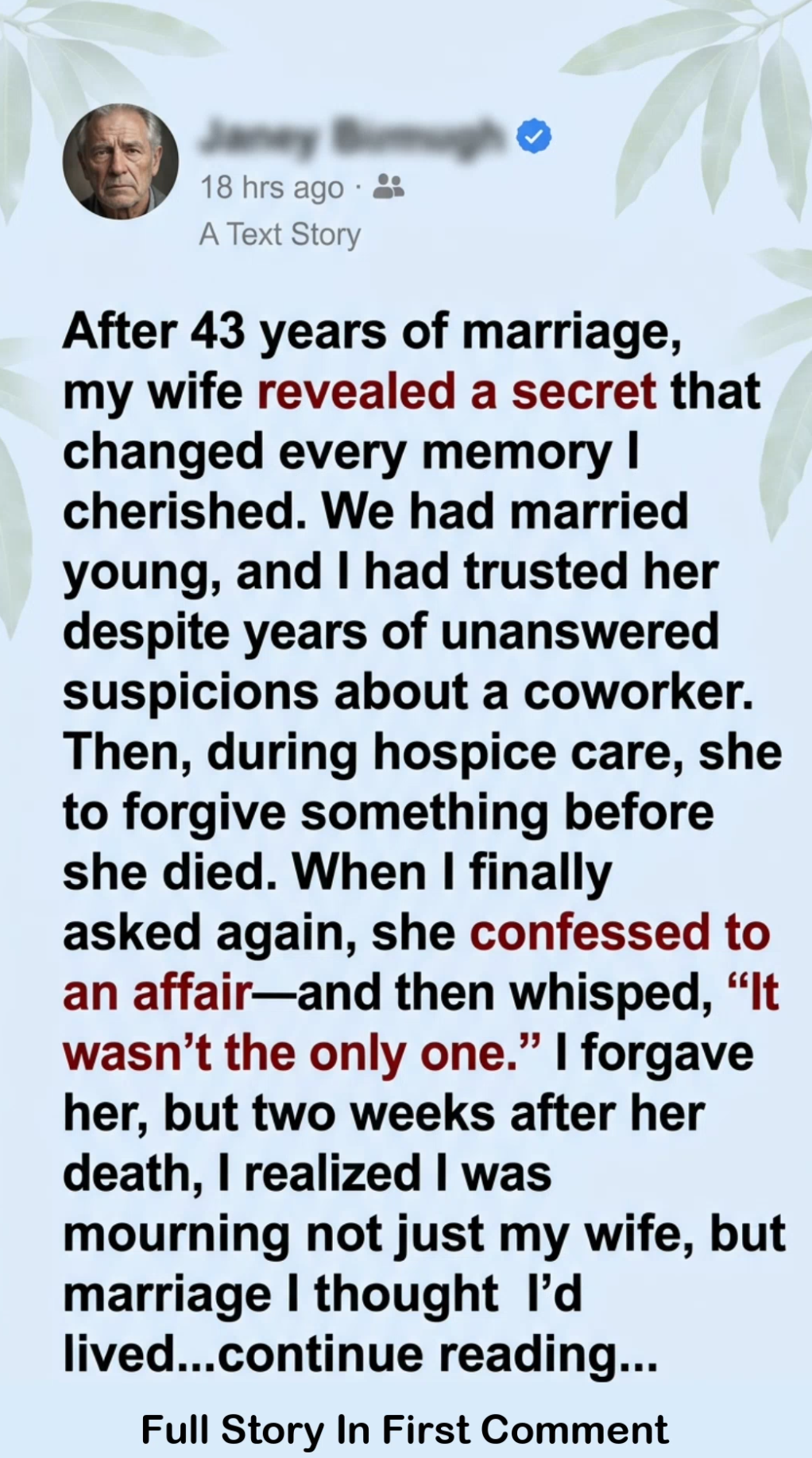
My wife waited until she was dying to tell me the truth.
For forty-three years, I had believed our marriage was imperfect but honest. We had raised two children, paid off a mortgage, survived layoffs, buried parents, celebrated birthdays, and grown older beside each other.
We had the ordinary arguments that come with sharing a life. We disagreed about money, disagreed about the children, and occasionally went to bed angry. But I had always believed there was one thing we never questioned.
Our loyalty.
Her name was Elaine. We met when I was twenty-four and she was twenty-two. She worked at a small insurance office, and I was an apprentice electrician. We married eighteen months later in a church hall decorated with white flowers borrowed from her aunt.
I still remembered her walking toward me in a simple ivory dress, smiling as if the whole room had disappeared.
I had loved that smile for decades.
There had been moments when I wondered whether I knew everything about her, but I always found a reason to dismiss my suspicions.
The first was a man named Peter.
He worked in the same office as Elaine. They often stayed late during the end-of-month reporting period, and sometimes he called our house after dinner.
At first, I thought nothing of it.
Then I began noticing how Elaine changed whenever his name appeared on the caller display. She would lower her voice, move into the kitchen, and sometimes take the call outside.
Once, when I asked why he called so frequently, she laughed.
“He’s married, David. Don’t start imagining things.”
I didn’t.
Or at least, I tried not to.
Peter eventually transferred to another branch. His calls stopped, and our life continued.
Years passed.
Our daughter, Rebecca, was born first. Our son, Michael, followed three years later. Elaine was a devoted mother. She remembered school appointments, knew which teacher worried Rebecca, and could recognize Michael’s footsteps on the stairs.
She was also the person who remembered my father’s medication, arranged our holidays, and kept every family photograph in labeled albums.
When I worked late, she left dinner covered on the stove.
When I was sick, she sat beside the bed and changed the cold cloth on my forehead.
I never thought of her as a woman living a double life.
I thought of her as the person who knew me better than anyone.
There were other small moments that I occasionally remembered.
A weekend training course she attended in another city. A former supervisor who sent her a Christmas card with a handwritten message. A hotel receipt I found in an old coat pocket, although she had explained that it belonged to a work conference.
None of those things proved anything.
I didn’t want to become a suspicious husband who searched through his wife’s belongings. I believed trust was a choice, and I chose it repeatedly.
Then, in the autumn of our forty-third year together, Elaine was diagnosed with an aggressive illness.
The first months were filled with hospital appointments, medication schedules, and difficult conversations about treatment. We learned the names of doctors we had never expected to meet and became familiar with waiting rooms where nobody looked directly at the clock.
Eventually, the treatments stopped helping.
Her doctor explained that further intervention would likely cause more discomfort than benefit.
Elaine listened quietly.
When we returned home, she asked me to sit beside her.
“I don’t want to spend whatever time I have left in hospitals,” she said.
I took her hand.
“Then we won’t.”
We arranged hospice care at home.
A nurse visited regularly. A hospital bed was placed in our bedroom, and the children began taking turns coming over. Rebecca brought groceries and helped with medication schedules. Michael handled the practical jobs I struggled to manage.
I became Elaine’s full-time companion.
I learned how to adjust her pillows, prepare food she could tolerate, and help her wash without making her feel embarrassed.
Some nights she slept for hours.
Other nights she woke and asked me to hold her hand.
One evening, about six weeks before she died, she said something I couldn’t understand.
“David, there’s something I need you to forgive me for.”
I looked at her.
“What?”
She closed her eyes.
“Something from a long time ago.”
“Did you hurt someone?”
She shook her head.
“I hurt you.”
I leaned closer.
“Elaine, we’ve been married for forty-three years. If there’s something you need to say, tell me.”
She began crying.
“I can’t tonight.”
I assumed she was frightened, confused, or overwhelmed by medication.
“All right,” I whispered. “We don’t have to talk about it now.”
But the conversation stayed with me.
A few days later, she brought it up again.
“Do you remember Peter?”
I felt my shoulders stiffen.
“Your old coworker?”
She nodded.
“Yes.”
“What about him?”
She looked toward the window.
“I wasn’t honest with you.”
I waited.
She didn’t continue.
I wanted to ask whether she had been having an affair. The question had lived somewhere in the back of my mind for years, but saying it aloud felt like opening a door I could never close.
Instead, I asked whether she wanted water.
She said yes.
I brought it to her, and we never returned to the subject that day.
The following week, Elaine was weaker.
Her breathing had become more difficult, and she spent most of the day resting. The nurse explained that the final stage could come gradually or change suddenly.
I began sleeping in the chair beside her bed.
One afternoon, while the house was quiet, she asked me to close the bedroom door.
“David, I need to tell you something before I can’t.”
I sat beside her.
“Then tell me.”
She stared at our joined hands.
“Peter and I had an affair.”
I didn’t move.
For several seconds, I could hear only the faint hum of the oxygen equipment.
“An affair?” I finally asked.
She nodded.
“When?”
“Thirty-one years ago.”
I stood up, walked to the window, and looked outside.
The garden needed trimming. A delivery van was parked across the street. Someone was walking a small dog.
Ordinary things.
The world hadn’t changed.
But something inside me had.
“How long?” I asked.
“Almost a year.”
I turned toward her.
“Almost a year?”
She started crying.
“It began as friendship. Then it became something else. I ended it.”
“Did you love him?”
She looked down.
“I thought I did at the time. I don’t know what I thought anymore.”
I felt a pressure in my chest.
“Why did you stay with me?”
“Because I loved you. Because I loved our family. Because I knew I had made a terrible mistake.”
I sat down again.
“Did it happen only once?”
She hesitated.
Then she whispered:
“It wasn’t the only one.”
The words seemed to arrive from a great distance.
I asked her to explain.
She told me about another man, someone she had met during a work conference several years after the affair with Peter ended.
That relationship had lasted only a few months, but it had been physical.
There had been no promises, no plans to leave me, and no future together.
She described it as a period when she felt lonely and wanted attention.
I listened without interrupting.
Then she mentioned a third man.
That one had been later, when our children were teenagers.
It had lasted less than a month, she said. She had ended it after realizing how close she had come to destroying our family.
I looked at her.
“Three?”
She nodded.
“Three affairs?”
“Yes.”
I felt as if the room had become too small.
“Did you ever stop loving me?”
“No.”
“Did you ever think about leaving?”
She shook her head.
“Then what was I supposed to be all those years? The husband who didn’t know?”
She began to cry harder.
“I know I don’t deserve your forgiveness.”
I stood and walked into the hallway.
I didn’t slam the door. I didn’t shout.
I simply needed to be somewhere she couldn’t see my face.
I sat on the bottom step and covered my mouth with my hand.
Forty-three years.
I remembered our first apartment, the little blue car we bought when Rebecca was born, the night Michael broke his arm, the holidays, the arguments, and the quiet evenings when we sat together watching television.
Now every memory seemed to carry a question.
Had she been thinking about another man when she kissed me?
Had she lied when she said she was working late?
Were there other moments I had never questioned because I trusted her?
When I returned to the bedroom, she was crying quietly.
“Please say something,” she whispered.
I sat beside her.
“I don’t know what to say.”
“I understand.”
“Do you understand what you’ve done to my memories?”
She closed her eyes.
“I know.”
“Why tell me now?”
“Because I don’t want to die with another lie between us.”
I wanted to tell her that she had already left me with enough lies.
Instead, I held her hand.
Not because everything was forgiven.
Not because I knew what I felt.
But because she was still my wife, and she was dying.
Over the next several days, I asked questions.
Some she answered. Others she couldn’t remember clearly. She told me that she had never become pregnant by another man and had never knowingly risked my health. She said she had used protection, although she admitted she couldn’t remember every detail.
I asked whether anyone else knew.
She told me that one friend had known about Peter. Another had known about the conference relationship.
I asked whether she had ever discussed leaving me with them.
“No,” she said. “I was selfish, David. I wanted the excitement and then I wanted to come home to you.”
That sentence hurt more than I expected.
I had spent years believing our home was the one place where nothing needed to be hidden.
Apparently, it had been a place she could return to after hiding things elsewhere.
Still, I couldn’t bring myself to hate her.
There were too many years between us.
There were mornings when she made my coffee exactly the way I liked it. There were nights when she sat awake waiting for me to return from work. There were decades of ordinary care that had been real, even if the marriage had contained lies.
I told her I forgave her.
But I also told her the truth.
“I don’t know whether I can forgive what happened inside me. I can stop punishing you for it, but I can’t promise that I’ll ever understand.”
She squeezed my fingers.
“That’s more than I deserve.”
Elaine died on a rainy Tuesday morning.
Rebecca was sitting on one side of the bed, and I was on the other. Michael arrived just before dawn and stood quietly near the doorway.
Her breathing became slower.
I kissed her forehead.
“I’m here,” I whispered.
She opened her eyes briefly.
“I love you, David.”
“I love you too.”
Those were the last words we exchanged.
After she died, the house filled with relatives, flowers, sympathy cards, and food people brought because they didn’t know what else to do.
The funeral was beautiful.
Rebecca spoke about her mother’s patience. Michael talked about the way she made every birthday feel important. I stood at the front and told everyone that Elaine had been my partner for most of my adult life.
That part was true.
I didn’t mention the affairs.
I didn’t think it belonged in a room full of grieving children and relatives.
For two weeks, I moved through the house like a visitor.
I slept badly. I left the television on at night. Sometimes I woke expecting to hear Elaine calling from the bedroom.
Then, one afternoon, I began sorting the paperwork in her desk.
I found insurance documents, old bank statements, warranty papers, and a folder containing photographs.
At the bottom was a small notebook.
It wasn’t a diary exactly. It contained dates, short reflections, and lists of things she wanted to remember.
I opened it without thinking.
The first pages were ordinary.
A note about Rebecca’s school performance.
A list of birthday gifts.
A reminder to call the dentist.
Then I found an entry dated thirty-one years earlier.
It mentioned Peter.
My hands began to shake.
I read the page carefully.
Elaine wrote that she had ended the relationship and had promised herself never to put our family at risk again.
Then I found another entry from several years later.
It described the conference affair.
The words were brief, but they confirmed what she had told me.
I turned another page.
There was an entry about the third man.
It was dated when Michael was still in secondary school.
I closed the notebook.
For a while, I simply sat there.
I had known the confessions were real. But seeing them in her handwriting made them harder to dismiss as something said under the pressure of illness.
I continued sorting the desk.
Behind a stack of old photographs, I found a sealed envelope addressed to me.
On the front, Elaine had written:
For David, if you ever need to understand why I stayed.
I opened it.
The letter was several pages long.
She wrote about the beginning of our marriage, how young we had been, and how frightened she sometimes felt by the responsibilities of adulthood.
She admitted that during the first affair, she had convinced herself she was missing something in her life.
She described Peter as someone who made her feel interesting and admired.
She also wrote that she had hated herself whenever she came home.
But the part that hurt most came later.
I told myself that because I never wanted to leave you, I was not really betraying our marriage. I know now how convenient that lie was. I wanted the security of our life and the excitement of being wanted by someone else. I wanted both, and I let you believe you had given me everything.
I put the letter down.
I had expected her to blame loneliness, youth, stress, or circumstances.
Instead, she admitted that she had wanted things she knew would hurt me.
The letter continued.
I stayed because I loved you, but love was not the only reason. I loved our children. I loved our house. I loved our routines. I was afraid of losing the life we had built. I also knew you were a good man, and I did not want to face what leaving would mean.
I read that paragraph several times.
It was the closest she had come to explaining the truth without asking me to make it easier for her.
Then I reached the final page.
I hope you don’t decide that every good thing between us was false. I remember the night you drove through a snowstorm because I was frightened to give birth. I remember you sitting beside my father when he could no longer recognize people. I remember our first holiday after Michael left home, when we laughed until midnight because neither of us knew what to do with a quiet house.
Those things happened. I was there. I loved you in those moments. My betrayals were real too. I cannot ask you to choose one truth and ignore the other.
I folded the letter.
For the first time since her confession, I cried.
Not because I had discovered another secret.
Because I finally understood that I didn’t have to choose between remembering the good years and acknowledging the terrible ones.
Both belonged to my life.
The following weekend, Rebecca came over to help me sort her mother’s clothes.
She found me sitting at the kitchen table with the notebook beside me.
“Are you all right, Dad?”
I considered lying.
Then I told her that I had found Elaine’s letter.
She sat down.
“Did Mom write about what she told you?”
I nodded.
Rebecca stared at the table.
“Was it true?”
“Yes.”
She covered her face.
For a while, neither of us spoke.
Then she asked the question I had been expecting.
“Does that mean our whole childhood was a lie?”
I looked at my daughter.
“No.”
“But how can you say that?”
“Because you were loved. I know that. Your mother was there for you. She cared about you. Those memories belong to you, and nobody gets to take them away.”
Rebecca began crying.
“But she hurt you.”
“Yes.”
“Are you angry?”
“Very.”
“Do you hate her?”
I thought about the woman I had married at twenty-four. The woman who had held our newborn daughter. The woman who had sat beside me when my father died. The woman who had confessed three betrayals while lying in a hospice bed.
“No,” I finally said. “I don’t hate her. But I wish she had trusted me enough to tell the truth when there was still time for us to decide what to do with it.”
Rebecca reached across the table and took my hand.
That evening, Michael came over.
I showed him the letter and explained what I had found. He became angry, not at me, but at the idea that his mother had carried secrets for so long.
“Why didn’t she tell us?” he asked.
“Because it was between your mother and me.”
“But she was our mother.”
“She was. And she was also a person who made choices she regretted.”
Michael shook his head.
“I don’t know what to think about her now.”
“You don’t have to decide today.”
That became my answer whenever either of my children struggled with the truth.
They were allowed to love their mother.
They were allowed to be disappointed in her.
They didn’t have to defend her or condemn her to make me feel better.
A month after Elaine’s death, I met with an old friend named Martin.
We had known each other since our twenties. He had been at our wedding and had spent countless holidays with our family.
I told him what had happened.
He listened without interrupting.
When I finished, he asked whether I was planning to sell the house.
“I don’t know.”
“Are you angry every time you walk into a room?”
“Sometimes.”
“Then don’t make any big decisions yet.”
He was right.
I stayed in the house.
I began taking walks in the mornings and cooking simple meals. I moved Elaine’s hospital bed out of our bedroom, but I kept her photographs.
I also stopped pretending that forgiveness had made everything simple.
Some days I missed her terribly.
Other days I felt angry that she had left me with so much uncertainty.
Occasionally, I wondered whether there had been another affair she had never confessed.
I had no evidence of one, and I decided I would not spend the rest of my life inventing new reasons to suffer.
I would live with what I knew.
Three months after her death, I took the old wedding album from the cupboard.
There we were.
Elaine in her ivory dress, laughing as she held my arm.
I looked at the photograph for a long time.
For years, I had thought that picture represented the beginning of a beautiful and faithful marriage.
Now I understood that it represented something more complicated.
It was the beginning of a life that contained genuine love, deep companionship, ordinary happiness, and serious betrayal.
I couldn’t change any of it.
I couldn’t go back and ask the younger Elaine to make different choices. I couldn’t return to the years when I had wondered about Peter and tell myself what I now knew.
But I could decide what to do with the years I had left.
I placed the wedding photograph on the shelf.
Not as proof that our marriage had been perfect.
Not as a tribute to a woman who had never hurt me.
I kept it because the young man in that photograph had loved her honestly, and I didn’t want to punish him for something he couldn’t have known.
I still mourn Elaine.
I mourn the woman who sat beside me during thunderstorms because she knew I disliked them. I mourn the mother who remembered every small detail about our children. I mourn the companion who knew how I took my coffee and could tell from my footsteps whether I had had a difficult day.
But I also mourn the marriage I thought I had lived.
That marriage had been built partly on truths and partly on things I was never allowed to know.
Perhaps the hardest part of losing someone isn’t discovering that they were imperfect.
It’s discovering that the person you loved had an entire part of their life that you were never invited to see.
I forgave Elaine before she died.
I don’t regret that.
But forgiveness didn’t restore the past, and it didn’t make the questions disappear.
It simply allowed me to say goodbye without spending her final days trying to punish her.
Now, when people ask how long we were married, I still say forty-three years.
I don’t lower my voice.
I don’t pretend the years were meaningless.
I simply know more about them than I once did.
And sometimes, when I look at that wedding photograph, I wish I could speak to the young man standing beside Elaine.
I would tell him to love her.
I would tell him to build a home with her, raise children with her, laugh with her, and treasure the ordinary days.
But I would also tell him something I wish I had understood sooner:
Love can be real even when the person you love has lied to you.
And the truth, however painful, does not have to erase every good thing that came before it.
THE END.