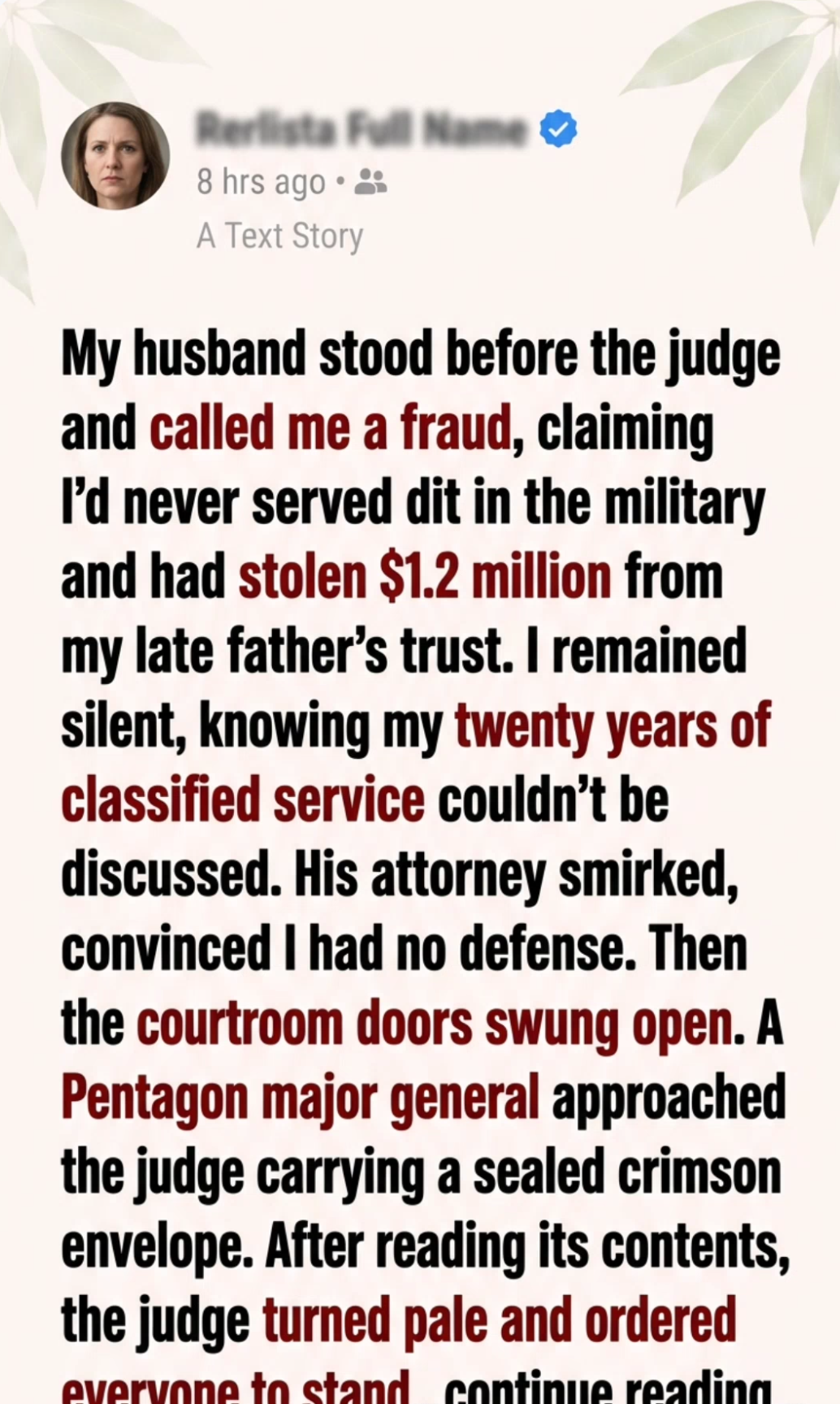
My husband smiled when he called me a fraud.
He stood beside his attorney in a crowded courtroom, wearing the navy suit I had bought him for our tenth anniversary. His voice was confident, almost amused, as he told the judge that I had invented an entire military career to manipulate my family and steal money from my late father’s estate.
He claimed I had never served in the armed forces.
He claimed the medals in my study were purchased.
He claimed the $1.2 million transferred from my father’s trust had disappeared into accounts I secretly controlled.
And he claimed I was mentally unstable enough to believe my own lies.
I sat quietly beside my attorney.
I didn’t interrupt.
I didn’t defend my service record.
I didn’t explain why certain parts of my career could not be discussed in an ordinary courtroom.
My husband, Richard, mistook my silence for fear.
His attorney, Mr. Caldwell, seemed equally pleased.
Then the courtroom doors opened.
A uniformed officer entered, followed by a major general carrying a sealed crimson envelope.
The general approached the judge, identified himself, and requested permission to submit a classified verification document through the proper security procedure.
The judge examined his credentials.
Then he opened the envelope.
His expression changed.
He read the first page.
Then the second.
Finally, he looked directly at my husband.
“Mr. Hayes,” he said, “I suggest you sit down.”
Richard’s smile disappeared.
But that was only the beginning.
My name is Katherine Hayes.
I was forty-seven years old, and until that morning, I had spent most of my adult life believing that marriage meant standing beside someone even when the world became difficult.
Richard and I had been married for fourteen years.
We met at a charity dinner in Virginia. He was a financial consultant with an impressive client list and an easy laugh. I had recently returned from an overseas assignment and was working in a military administrative position that required me to travel frequently.
I told him I worked in defense operations.
I never claimed to be a celebrity or a hero. I rarely discussed my work at all.
Some assignments were confidential. Others involved responsibilities that were difficult to explain without revealing information I was not authorized to share.
Richard initially admired my discretion.
“You must have an interesting life,” he once said.
I smiled.
“Sometimes. Mostly it’s paperwork and long flights.”
He laughed.
We married two years later.
For a while, we were happy.
Richard had a daughter, Olivia, from his first marriage. I never tried to replace her mother. I simply tried to be someone she could trust.
When Olivia was sixteen, she began spending more time at our house. I helped with college applications, drove her to appointments, and sat through school performances even when I had returned from travel only hours earlier.
I thought we were building a family.
But Richard gradually became interested in the parts of my life I had never discussed.
He asked about my pension.
He asked whether I received special allowances.
He asked how much money I had saved.
When I answered generally, he became irritated.
“Why do you always speak as if we’re strangers?”
“Because some things are private.”
“We’re married, Katherine.”
“I know.”
He didn’t like that answer.
The tension increased after my father died.
My father, Arthur Bennett, had been a civil engineer who spent most of his career working on public infrastructure projects.
He was not wealthy in the extravagant sense, but he had invested carefully. He owned a modest commercial property, several long-term investments, and a portfolio that had grown steadily over the years.
Before his death, he established a trust for me.
The trust was worth approximately $1.2 million.
It wasn’t an unexpected fortune. My father had discussed it with me several times and had explained that the money was intended to provide financial security after his death.
He had also appointed an independent trustee.
I was a beneficiary, but I did not control every transaction.
The money was distributed gradually according to the trust terms.
Richard knew about it.
At first, he congratulated me.
Then he began asking why the money wasn’t being moved into our joint accounts.
I explained that the trust had its own structure and that I wasn’t going to change it simply because he wanted access.
He accused me of treating him like a stranger.
I told him the money came from my father and needed to be managed according to his wishes.
The arguments became more frequent.
Six months later, Richard suggested we invest in a private development company owned by one of his associates.
He described it as a low-risk opportunity.
I asked for the financial documents.
He became defensive.
“Do you trust me or not?”
“I trust you as my husband. That doesn’t mean I invest without reviewing the paperwork.”
He slammed his hand on the table.
“You’re impossible.”
I refused to invest.
A few weeks later, I discovered that Richard had been discussing the trust with his attorney.
I asked him why.
He said he was trying to protect our marital interests.
I told him there was nothing to protect because the trust was not a joint investment.
He didn’t respond.
The first sign that Richard was preparing something serious came when I received a letter from a law firm.
It stated that he intended to challenge the management of my father’s trust.
The letter alleged that I had transferred funds without proper authorization.
I was confused.
I contacted the trustee.
She reviewed the records and confirmed that all distributions had been made according to the trust agreement.
There had been no unauthorized transfer.
I forwarded the information to my attorney, Helen Morris.
Helen had handled my father’s estate and understood the trust structure.
After reviewing the letter, she asked me something.
“Has Richard ever had access to your financial documents?”
“Some of them.”
“Has he ever used your signature on anything?”
“Not that I know of.”
She paused.
“Then we need to examine everything.”
The following week, she discovered that Richard had submitted an application to a private lender using a document that appeared to authorize him to manage a portion of my trust assets.
The signature looked similar to mine.
But it wasn’t mine.
I had never signed the document.
The lender had not released any money because the trustee had refused to verify the authorization.
Richard had been informed that the application was incomplete.
Instead of withdrawing it, he began building a different argument.
He claimed I was hiding money and lying about my employment history.
He even suggested that my military career had been invented to explain unexplained periods when I was away from home.
That accusation was particularly dangerous.
I could not simply produce every record from my service.
Some of my assignments were protected by confidentiality rules, and certain records required formal verification through authorized channels.
Richard knew that.
I began to suspect he was counting on my inability to answer publicly.
The court hearing was scheduled for a Tuesday morning.
Richard’s petition requested financial control over disputed assets and claimed that I had misrepresented my military service to obtain credibility with my family and the trustee.
His attorney, Caldwell, argued that I had used vague references to classified work as an excuse to avoid scrutiny.
He also claimed that my father’s trust had been mismanaged.
My attorney objected repeatedly.
The judge allowed the hearing to proceed but warned both sides that unsupported allegations would not be treated as evidence.
Richard took the witness stand.
He spoke about our marriage as though he had spent fourteen years living with a stranger.
He said I disappeared for months without explaining where I had gone.
He said I refused to share my employment records.
He said I had never shown him a legitimate military identification document.
Then he made the accusation that changed the atmosphere in the room.
“My wife has created a fictional military identity to make people believe she has authority and access to money. She has never served in the military. I believe she used that story to conceal what happened to my father-in-law’s trust.”
I watched him carefully.
He didn’t look nervous.
He looked satisfied.
Caldwell stood beside him, arranging papers.
“Your Honor, my client has been patient for years. He believes the court must finally examine this deception.”
Helen stood.
“Your Honor, the respondent’s service record cannot be discussed in open court in the manner requested. We have asked the appropriate military office to provide authorized verification.”
Caldwell smiled.
“Convenient.”
Helen ignored him.
“We have also submitted the trust statements and independent trustee records.”
Caldwell waved his hand.
“Those documents do not establish that Mrs. Hayes served in the military.”
The judge looked toward me.
“Mrs. Hayes, do you wish to respond to your husband’s allegations?”
I stood.
“Your Honor, I have served my country. I cannot discuss every assignment or operation, but I have never misrepresented my service.”
Richard gave a small laugh.
Caldwell leaned toward him.
I sat down.
Then the doors opened.
The major general introduced himself as Major General Thomas Whitaker.
He was accompanied by a military legal liaison who carried an authorization letter.
The general approached the bench.
“Your Honor, I have been directed to provide an official verification concerning the respondent’s service and to explain the limitations on disclosure.”
The judge asked him to proceed.
The general handed over the crimson envelope.
It contained an official service verification, a summary of authorized assignments, and a letter explaining why some details could not be placed into the public record.
The judge read the documents carefully.
He asked several questions about authenticity and the authority under which the information had been provided.
The military legal liaison answered.
Then the judge looked at Richard.
“Mr. Hayes, you testified that your wife never served in the military.”
Richard swallowed.
“That’s what I believe.”
The judge lifted the verification letter.
“Your belief is contradicted by official records.”
Caldwell stood.
“Your Honor, we would like an opportunity to examine the document.”
“That is appropriate,” the judge replied. “The relevant portions will be made available to authorized counsel under the applicable procedure.”
The general remained standing.
He did not offer details about classified assignments. He did not describe operations or disclose information that did not belong in open court.
He simply confirmed that my service was genuine and that the official record supported the years I had stated.
Then he added:
“Mrs. Hayes served with distinction. Her assignments included responsibilities requiring restricted disclosure. The fact that she cannot publicly discuss certain details should not be treated as evidence that those details do not exist.”
For the first time that morning, Richard looked frightened.
But the general had not come only to verify my service.
He had brought another document.
A separate letter addressed to the court concerned the misuse of my identity in connection with a financial application.
The military office had received a request for verification after a third party attempted to use my service information to support a financial claim.
The letter did not determine whether Richard had committed a crime.
That was a matter for the appropriate investigators.
But it confirmed that I had not authorized anyone to use my military records or official credentials for a private financial transaction.
The judge looked at Caldwell.
“Your client’s allegations appear to be based on information that is not merely unsupported, but contradicted by official evidence.”
Caldwell asked for a recess.
The judge granted it.
Richard turned toward me as the courtroom began to empty.
“You planned this,” he whispered.
I looked at him.
“No, Richard. You planned this.”
During the recess, Helen explained what had happened.
The military verification had been requested through the proper channels after Richard’s attorney challenged my service.
The military office had reviewed the request and determined what information could be released.
The crimson envelope was simply the formal delivery method used for the protected documentation.
There was no secret military order.
No dramatic intervention.
No authority to decide the financial dispute.
The general’s presence was limited to confirming official records and explaining the disclosure restrictions.
But that was enough to dismantle Richard’s central accusation.
The trust issue remained.
And Helen had been preparing for it.
She showed me a set of bank records and correspondence from the independent trustee.
The documents revealed that the $1.2 million had never been stolen.
The trust had made three authorized distributions over the previous eighteen months.
One had paid for repairs to my father’s former property.
Another had covered taxes and administration costs.
The remaining funds were still held in the trust.
Richard’s allegation that I had secretly transferred the entire amount was false.
But there was more.
The lender’s records showed that Richard had submitted a financial proposal seeking access to trust assets.
He had attached a document containing my signature.
A handwriting examiner retained by the lender had questioned its authenticity.
The lender had frozen the application and requested confirmation from the trustee.
When the trustee refused to verify it, Richard changed his approach.
Instead of admitting that the authorization was invalid, he accused me of concealing the money.
Helen had obtained the records through the legal process.
The evidence was now before the court.
Richard’s attorney read the documents during the recess.
I watched his expression change.
He turned toward Richard.
They spoke in low voices.
Then Caldwell walked over to Helen.
“We need to discuss a possible resolution.”
Helen shook her head.
“Not until your client answers the outstanding questions.”
When the hearing resumed, Richard’s confidence had disappeared.
The judge reviewed the trust records.
He confirmed that the distributions were authorized by the independent trustee and that the remaining assets had not been transferred to me personally.
He also noted that the disputed authorization document required further examination.
The judge did not declare Richard guilty of fraud. That would have required a separate legal process and evidence beyond the hearing.
But he refused Richard’s request for control over the trust.
He also ordered that neither party could use the disputed document to obtain financial access while the authenticity review continued.
Finally, he instructed both parties to preserve all financial communications and records.
Richard’s attorney asked to withdraw several allegations.
The judge refused to let the withdrawal erase the statements already made under oath.
“Mr. Hayes made specific claims about his wife’s service and the trust,” the judge said. “Those claims have been contradicted by the evidence presented today. The court will consider the accuracy of those statements when determining the appropriate next steps.”
Richard stared at the table.
I looked at him for the first time without trying to recognize the man I had married.
He was no longer the person who had promised to stand beside me.
He was someone who had been willing to question my entire life because he wanted access to money that did not belong to him.
The next several months were difficult.
The court proceedings continued, but the immediate request for control over the trust was dismissed.
The lender completed its review and confirmed that the application had never been approved.
The disputed signature was referred for further examination.
Richard eventually admitted through his attorney that he had prepared the authorization document using a signature image taken from an old financial form.
He claimed he believed I would approve it later.
I had never given him permission.
The admission became part of the financial dispute.
The appropriate authorities reviewed the evidence, and Richard was required to cooperate with the investigation.
I did not celebrate.
I had spent fourteen years building a marriage, and now I was spending my days reviewing documents that explained how carefully my husband had tried to undermine my credibility.
The divorce process began shortly afterward.
Richard initially asked for a generous financial settlement.
He argued that he had supported my career and that he deserved a share of the trust.
Helen reminded him that the trust had been established by my father and was governed by its own terms. Its treatment in the divorce would depend on the applicable law and the evidence, not simply on Richard’s demands.
After negotiations, we reached a settlement concerning our jointly owned property and other marital assets.
The trust remained separate, subject to its governing terms and the court’s findings.
Richard moved into a rented apartment.
Olivia, his daughter, contacted me several weeks later.
She was twenty-two by then.
“I don’t know what happened,” she said.
I sat quietly.
“Your father and I have been having problems for a long time.”
“Did you really steal the money?”
“No.”
“Did you really serve in the military?”
“Yes.”
She looked down.
“Then why did he say those things?”
I couldn’t answer for him.
“I think he wanted people to doubt me.”
Olivia began crying.
“I don’t know who to believe.”
I reached for her hand.
“You don’t have to decide everything today. Look at the evidence. Ask questions. Make up your own mind.”
She nodded.
I didn’t want her to feel forced to choose sides.
She had lost a family structure too, even if she hadn’t caused its collapse.
About six months after the hearing, I received a letter from Major General Whitaker.
It was a short personal note.
He thanked me for allowing the military office to provide the necessary verification and said he hoped the legal process would now proceed without further misuse of my service history.
At the bottom, he had written:
Your service record speaks for itself. You do not owe every person an explanation of every assignment you were trusted to perform.
I placed the letter in a drawer.
I didn’t frame it.
I didn’t want my home to become a museum of everything Richard had tried to deny.
My medals remained in their cases.
My father’s photographs remained on the shelf.
And the crimson envelope was returned through the proper official channel.
One year after the hearing, I visited my father’s grave.
I brought white flowers, the kind he used to buy for my mother on their anniversary.
I sat on the bench nearby and thought about the last conversation we had.
He had been weak, but still sharp enough to ask whether I was looking after myself.
I had told him yes.
He had smiled.
“Don’t spend your whole life proving yourself to people who have already decided not to believe you.”
At the time, I thought he was talking about work.
Now I understood that he had been talking about something much bigger.
I had spent years believing that if I remained patient, honest, and loyal, the people closest to me would eventually understand.
But honesty cannot force someone else to be honest.
And loyalty cannot repair a relationship when only one person is protecting it.
I stood, brushed the dirt from my trousers, and placed the flowers beside his headstone.
Then I returned to my car.
I was no longer waiting for Richard to apologize.
I was no longer trying to convince his attorney that my life had happened.
I had the official records.
I had the court documents.
I had the truth.
But the most important thing I had recovered wasn’t the trust money or the reputation Richard had tried to damage.
It was my ability to stop defending myself to someone who had made a decision to betray me.
The courtroom had been the place where my husband tried to erase twenty years of my service and turn my father’s final gift into evidence against me.
The general’s arrival had changed the hearing.
The records had protected my name.
But the decision that truly changed my life happened afterward.
I stopped asking why the man who had promised to stand beside me had chosen to stand against me.
I began building a life in which I no longer needed his approval to know who I was.
And that was the one thing he could never take away.
THE END.