The first thing I remember was the sound of a monitor.
A steady electronic beep.
Then the smell of disinfectant.
Then a man’s voice saying, “She’s awake.”
I opened my eyes slowly.
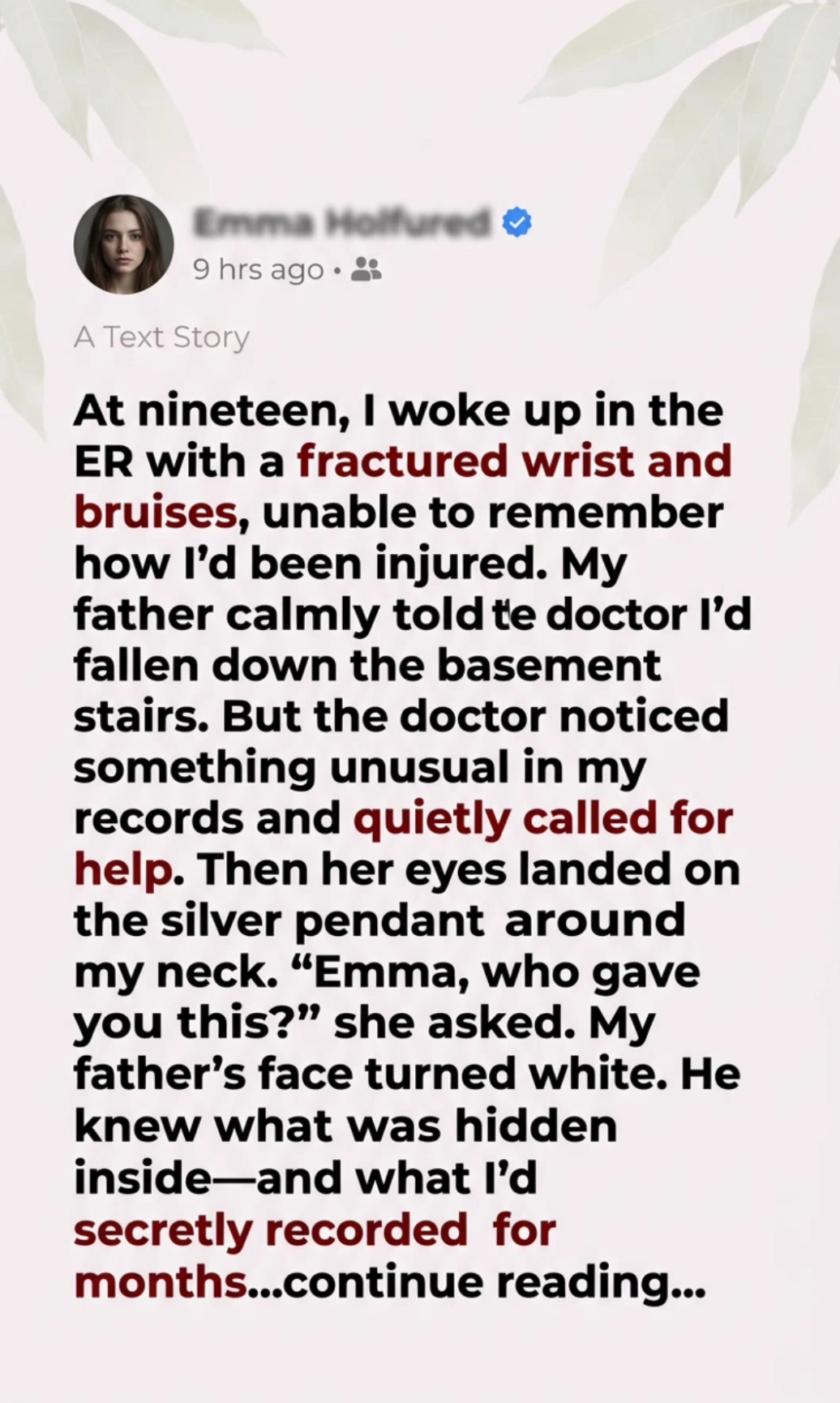
The ceiling was white. A fluorescent light flickered above me, and my left wrist was wrapped in a thick plaster cast.
My head hurt.
My ribs hurt.
When I tried to sit up, a sharp pain ran through my shoulder.
“Don’t move, sweetheart.”
My father stood beside the hospital bed.
He looked worried, but not frightened. His shirt was neatly tucked in, his hair was combed, and he held a paper cup of coffee as if he had been waiting for an ordinary doctor’s appointment.
“What happened?” I whispered.
He glanced at the doctor.
“You fell down the basement stairs, Emma.”
I stared at him.
“The basement?”
“Yes. You must have missed a step. You’ve been clumsy lately.”
I tried to remember.
There was something.
A door closing.
A voice.
The smell of rain on someone’s coat.
Then nothing.
“I don’t remember.”
My father placed his hand on my shoulder.
“That’s because you hit your head. Don’t worry. You’re safe.”
But the doctor wasn’t looking at him.
She was examining my wrist, then checking the bruising along my upper arm.
Her name was Dr. Miriam Foster. She looked to be in her early forties, with tired eyes and a calm manner.
She asked me several questions.
Did I remember falling?
Did I lose consciousness?
Had I felt dizzy before the accident?
Had I been drinking?
I answered no to everything.
My father answered for me whenever I hesitated.
“She doesn’t always remember things when she’s upset.”
“She’s been under stress.”
“She’s always been a little accident-prone.”
Dr. Foster finally turned toward him.
“Mr. Collins, I’d like to speak with Emma alone for a few minutes.”
My father smiled politely.
“Of course. I’ll get another coffee.”
He walked out.
The moment the door closed, the doctor’s expression changed.
“Emma, I want you to listen carefully. You are not in trouble.”
I nodded.
She checked my wrist again.
“Do you feel safe going home with your father?”
I stared at her.
The question seemed to make the room smaller.
“I… I don’t know.”
She looked at the medical chart.
Then she looked at my neck.
I was wearing a small silver pendant on a thin chain. It was shaped like a teardrop, with a tiny engraved flower near the top.
Dr. Foster leaned closer.
“Emma, who gave you this?”
I instinctively touched it.
“My mother.”
The doctor’s eyes remained on the pendant.
“Your mother?”
“She died when I was twelve.”
Dr. Foster took a breath.
“Does it open?”
I frowned.
“What?”
“The pendant. Does it open?”
I looked down.
I had worn it almost every day since my mother died. My father had told me it was a sentimental gift and that I should never take it off.
I had never tried to open it.
“Not that I know of.”
Dr. Foster looked toward the door.
Then she said something that made my stomach turn.
“I need to ask you something, and I need you to answer honestly. Has anyone told you what happened to your mother?”
I swallowed.
“She died in a car accident.”
“Who told you that?”
“My father.”
The doctor nodded slowly.
“All right.”
She stepped outside.
A few minutes later, I heard her speaking quietly to someone in the hallway.
Then two hospital security officers appeared.
My father returned with his coffee.
He stopped when he saw them.
“What is this?”
Dr. Foster stood beside my bed.
“Mr. Collins, we need to speak with you.”
His face changed.
And for the first time in my life, I saw my father look genuinely afraid.
My name is Emma Collins.
I was nineteen when I woke up in that emergency room.
For most of my childhood, I believed my father was a good man who had sacrificed everything to raise me.
My mother, Laura, died when I was twelve. My father said she had lost control of her car on a wet road while driving home from work.
There was a funeral.
There were flowers.
There were relatives who hugged me and told me how sorry they were.
Then my father took me home and told me we needed to be strong.
He never spoke about her much after that.
If I asked questions, he became quiet.
If I asked to see photographs, he sometimes brought out an old album.
If I asked about her family, he said they had moved away and preferred not to stay in contact.
I grew up believing that grief had made him distant.
I thought his strictness was his way of protecting me.
He controlled almost everything.
He checked my phone.
He decided which friends were trustworthy.
He wanted to know where I was going and who would be there.
When I got a part-time job at a bakery, he insisted on driving me both ways.
He said the world was dangerous.
I believed him.
But there were moments when his concern felt more like surveillance.
When I was sixteen, I came home twenty minutes late because the bus had broken down.
He took my phone for a week.
When I was seventeen, I mentioned applying to a university in another city.
He became furious.
“Why would you want to leave me?”
I explained that I wanted to study nursing.
He said I was too young to live alone.
Eventually, I stopped discussing it.
My friends noticed.
One of them, Sophie, once asked why I always checked with my father before making plans.
I laughed.
“He’s just protective.”
She didn’t laugh back.
The first time I became truly frightened of my father was eight months before the hospital incident.
I had been cleaning the hallway cupboard when I found a photograph of my mother.
It was not one I had seen before.
She was standing beside a woman I didn’t recognize, holding a small child.
On the back was a handwritten note:
Laura and Emma. Spring picnic, 2008.
I turned the photograph over several times.
Then I asked my father who the other woman was.
He took it from my hand.
“An old friend.”
“What’s her name?”
“Why?”
“I was just wondering.”
He placed the photograph in a drawer.
“Some people from your mother’s past aren’t worth remembering.”
That evening, I noticed the drawer was locked.
It had never been locked before.
A few days later, I found a message on our home computer from someone named Helen.
The message was short.
Emma deserves to know what happened. Please let her contact me.
My father was standing behind me when I read it.
He shut the computer.
“Don’t answer strangers.”
“Who is Helen?”
“Nobody.”
“Was she Mom’s friend?”
He looked at me for a long moment.
Then he said:
“Your mother had people around her who wanted to destroy our family.”
I didn’t ask again.
But I remembered the name.
Helen.
After that, small things began to bother me.
My father sometimes received calls late at night and stepped outside to answer them.
He kept a metal filing cabinet in his home office.
The cabinet was locked, and he carried the key on his own key ring.
When I asked what was inside, he said old tax documents.
Once, I heard him arguing on the phone.
“She doesn’t know anything,” he said.
Then:
“She’s not going anywhere.”
I stood outside the office, holding a laundry basket.
He ended the call and opened the door.
“What are you doing?”
“Putting these away.”
He looked at the basket.
Then at me.
“Don’t listen to conversations that aren’t meant for you.”
I walked away.
That night, I searched the internet for Helen.
I found a woman with the same first name who lived in a nearby town. Her profile included photographs of a small garden and an elderly golden retriever.
I sent her a message.
Hello. I’m Emma Collins. Did you know my mother, Laura?
She replied the next morning.
Yes. I was her closest friend. I’ve been trying to reach you for years.
I stared at the screen.
Then another message appeared.
Are you safe?
I didn’t answer immediately.
I was afraid my father might see the messages.
Eventually, I wrote:
I think so. Why?
Helen responded:
Your mother asked me to make sure you knew the truth when you were old enough.
I felt my hands go cold.
Before she could explain, the computer shut down.
My father had switched off the power from the hallway.
He stood in the doorway.
“Who were you talking to?”
I couldn’t speak.
He walked toward me.
“Emma, I asked you a question.”
I closed the laptop.
“Nobody.”
He looked at the screen.
Then he looked at me.
“Don’t lie to me.”
I began keeping a private record.
At first, it was only a notebook.
I wrote down dates, conversations, and things that didn’t make sense.
I recorded the times my father left the house.
I wrote down the names of people he mentioned.
I saved messages from unknown numbers.
I wasn’t sure what I was trying to prove.
I only knew that my childhood memories were beginning to feel like pieces of a story someone else had arranged.
A few weeks later, I found a small voice recorder in an old drawer.
It belonged to my mother.
I remembered her using it when she worked on community projects. She used to record interviews and ideas.
The recorder still worked.
I started using it to record conversations in which my father made statements that frightened me.
I never placed it somewhere private or recorded anyone in a place where they reasonably expected privacy without understanding the law. I kept the device with me and used it only during conversations I was part of.
I also saved copies of the recordings on a password-protected account my father didn’t know existed.
The first recording was ordinary.
My father complaining about the grocery bill.
The second was different.
He was on the phone.
“She keeps asking about Laura,” he said. “I told her to stop.”
A pause.
“No, Helen. You are not coming here.”
Another pause.
“Because I said so.”
Then he ended the call.
I listened to the recording several times.
Helen had been trying to contact him.
Why?
What did she know?
The incident that sent me to the hospital happened on a rainy Sunday evening.
I had returned from work and found my father in the kitchen, holding my phone.
He had discovered the messages from Helen.
“Who is this woman?”
I tried to remain calm.
“She’s someone who knew Mom.”
“She has no reason to contact you.”
“She says Mom asked her to.”
His expression hardened.
“Your mother is dead. Stop allowing strangers to fill your head with stories.”
I reached for my phone.
He pulled it away.
“Give it back.”
“Not until you explain what you’re doing.”
“I’m allowed to talk to people.”
“Not people who want to hurt you.”
“How do you know she wants to hurt me?”
He didn’t answer.
I tried to walk past him.
He blocked the doorway.
“You’re not leaving.”
I stepped back.
He grabbed my arm.
I told him to let go.
He tightened his grip.
I remember pulling away.
I remember hitting the edge of the kitchen counter.
Then I remember the basement door.
After that, my memory became confused.
I had no clear recollection of the fall or how I ended up on the floor.
The next thing I remembered clearly was the hospital.
Back in the emergency room, Dr. Foster had asked the security officers to remain nearby while she spoke with my father.
He insisted that he had done nothing wrong.
He said I had fallen.
He said I had been emotionally unstable.
He said I had been investigating private family matters and had become confused.
The doctor did not argue with him.
She asked him to wait outside.
Then she returned to me.
“Emma, I want to explain why I asked about the pendant.”
She carefully examined the small silver teardrop.
“There’s a tiny seam here.”
I touched it.
She pointed to the flower engraving.
“Your mother may have intended this to open.”
With my permission, she asked a hospital staff member to help examine it.
The pendant opened with a small click.
Inside was a folded piece of paper, so tiny that I had never noticed it was there.
It contained a name and a telephone number.
The name was Helen Ward.
The doctor looked at me.
“Is that the person you mentioned?”
I nodded.
“Yes.”
She didn’t ask me to explain further.
Instead, she contacted the hospital’s safeguarding team.
A social worker arrived shortly afterward.
Her name was Janet.
She sat beside my bed and explained that the hospital had concerns about the injuries and the circumstances surrounding my arrival.
She asked whether I felt safe returning home.
I began to cry.
“No.”
Janet nodded.
“Thank you for telling me. We can help you make a safe plan.”
For the first time in years, someone had asked me a question and believed my answer.
The hospital contacted the appropriate authorities.
Because I was an adult, I was able to speak privately with the safeguarding team and decide what support I wanted, although the medical staff also had duties to report concerns about possible abuse.
A police officer took my statement.
I explained what I remembered about the argument and the basement door.
I showed him the messages from Helen.
I told him about the locked filing cabinet.
Then I mentioned the recordings.
The officer asked how I had made them and whether I had preserved the originals.
I explained that they were recordings of conversations I had participated in.
He advised me not to edit or delete anything and arranged for the files to be copied through the appropriate process.
The next morning, I was transferred to a private room.
My father was not allowed to visit while the hospital and authorities assessed the situation.
I was frightened.
But I was also relieved.
Then Helen arrived.
She was older than I expected, perhaps in her late fifties.
Her hair was silver at the temples, and she carried a brown handbag that looked as though she had owned it for years.
When she saw me, she stopped in the doorway.
For a moment, neither of us spoke.
Then she began crying.
“Oh, Emma.”
I looked at her.
“You’re Helen?”
She nodded.
“I am.”
“Did you know my mother?”
Helen sat beside the bed.
“Your mother was my closest friend.”
I showed her the tiny paper from the pendant.
“Why did she put your number inside this?”
Helen took a breath.
“Because she was afraid your father would prevent us from contacting you.”
I stared at her.
“Why would he do that?”
Helen looked toward the door.
“Because your mother discovered something about him before she died.”
My heart began beating faster.
“What?”
Helen hesitated.
Then she said:
“Your mother did not die in the accident the way your father told you.”
I felt the room tilt.
“What do you mean?”
Helen reached into her handbag and took out a small envelope.
Inside were photocopies of letters, an old photograph, and a document bearing my mother’s signature.
She placed them on the blanket.
“Your mother had been trying to separate from your father. She had spoken to a lawyer and was preparing to move out with you.”
I shook my head.
“No. Dad said they were happy.”
Helen looked at me sadly.
“They weren’t.”
She explained that my mother had become increasingly frightened of my father during the final year of her life.
He had become controlling. He monitored her phone calls, questioned where she went, and became angry whenever she visited friends.
My mother had confided in Helen.
She wanted to leave, but she was afraid of how my father would react.
Then came the accident.
Helen said that after my mother’s death, my father had told everyone she lost control of her car on a wet road.
But my mother had left a letter explaining that she was worried about being followed.
The letter didn’t prove that my father caused the accident.
Helen was careful about that.
She said the circumstances had never been properly explained to her, and she had always wondered whether my mother had been in danger before she died.
I looked at the documents.
“Why didn’t you tell me when I was twelve?”
Helen’s eyes filled.
“I tried. Your father changed your school, moved house, and told people I was unstable. I was advised not to approach you without a safe way to do it. I kept trying, but I couldn’t reach you.”
She took my hand.
“Your mother wanted you to know that you were loved. She didn’t want you growing up believing that her silence meant she had abandoned you.”
I began to cry.
For seven years, I had thought my mother had simply disappeared from my life.
Now I learned that she had tried to leave something behind for me.
The investigation took months.
The police reviewed my medical records, the photographs of my injuries, the recordings, and the statements from people who knew my family.
They also reopened the review of my mother’s death.
The old accident file contained inconsistencies.
A witness had reported seeing a vehicle following my mother’s car shortly before the crash, but the information had never been fully pursued.
There was no immediate proof that my father had caused the accident.
However, investigators found that he had given different accounts of the evening to different people.
They also discovered that he had removed several of my mother’s personal documents from the house after her death.
The locked filing cabinet contained old correspondence, financial records, and copies of documents related to my mother’s attempt to separate.
Some records suggested that my father had monitored her communications.
Others showed that he had contacted a lawyer shortly after her death to ask about his legal position regarding my mother’s property.
None of those facts alone established responsibility for the accident.
But together, they gave investigators reasons to continue examining the case.
My father’s explanation of my injuries also became harder to accept.
The hospital’s medical report documented injuries that required further investigation. The doctor had noted bruising in different stages of healing and patterns that were not easily explained by a single fall.
My father was interviewed.
He denied hurting me.
He said I had fallen while upset.
But the recordings included a conversation from several weeks earlier.
In it, he told me:
“You have no idea what I had to do to keep this family together.”
I had asked him what he meant.
He replied:
“Your mother would have ruined everything.”
The investigators did not treat that sentence as proof of a crime by itself.
But it became part of the wider evidence.
I moved into a small apartment with support from a local domestic abuse service.
At first, I couldn’t sleep.
Every time I heard footsteps outside my door, I expected my father to be there.
I kept the curtains closed.
I changed my phone number.
I began attending counseling.
My first sessions were difficult because I had spent years believing that protecting my father was part of being a good daughter.
My counselor, Ruth, helped me understand that I had been taught to confuse obedience with safety.
“You were a child,” she told me. “You were not responsible for keeping your father calm.”
I cried when she said that.
For years, I had blamed myself for asking questions, making plans, or wanting to leave home.
Now I was beginning to understand that wanting independence was not betrayal.
I also began studying again.
I applied to a nursing program in another city.
It felt frightening to imagine a future without my father’s permission.
But I submitted the application anyway.
The recordings eventually became important in the case against my father.
One recording captured him telling me that if I contacted Helen again, I would regret it.
Another included him admitting that he had hidden my mother’s documents because he didn’t want people “asking questions about the past.”
The authorities also found messages between him and a former family solicitor discussing how to prevent Helen from contacting me.
Those messages did not prove that my father had caused my mother’s death, but they helped establish a pattern of controlling behavior and concealment.
The case involving my injuries proceeded separately.
My father was charged after the investigation concluded that there was sufficient evidence to support the allegations.
He denied the charges.
The legal process took time.
There were hearings, interviews, and days when I had to answer questions about things I wished I could forget.
I did not attend every proceeding.
My counselor helped me decide when I was ready.
Eventually, the court found my father guilty of assaulting me and interfering with evidence connected to the investigation.
The case concerning my mother’s death remained under review because the evidence did not establish beyond reasonable doubt that he had caused the crash.
I was disappointed that there wasn’t a simple answer.
But I also understood that justice required evidence, not just suspicion.
The court could punish what had been proven.
It could not turn every unanswered question into a fact.
Nearly a year after the night I woke in the emergency room, I returned to the hospital.
My wrist had healed, although it still ached when the weather changed.
Dr. Foster recognized me immediately.
“Emma. It’s good to see you.”
I smiled.
“I wanted to thank you.”
She shook her head.
“You don’t owe me anything.”
“You asked me whether I felt safe. Nobody had asked me that before.”
She looked at me quietly.
“Sometimes the most important question is the one people are afraid to ask.”
I touched the silver pendant.
I had repaired the chain, but I had left the tiny compartment empty.
The paper with Helen’s number was now stored safely with my mother’s letters.
I didn’t need to keep the number around my neck anymore.
I knew how to reach her.
And I knew how to ask for help.
My twentieth birthday came a few months later.
Helen invited me to her house.
She had kept a box of my mother’s belongings for years, hoping that one day she could return them to me.
Inside were photographs, a recipe book, a scarf, and several letters.
The final letter was addressed simply:
For Emma, when she is old enough.
I opened it slowly.
My mother’s handwriting was unmistakable.
She wrote about the first time she held me, how I used to fall asleep with one hand curled around her finger, and how she hoped I would grow into someone who never apologized for wanting a life of her own.
Then came the sentence that made me cry.
If you ever find yourself afraid to ask questions, remember that you deserve the truth. You are not responsible for protecting adults from the consequences of their choices.
I read it twice.
Then I held the letter against my chest.
For years, my father had told me my mother was gone because of a tragic accident.
He had used that story to keep me quiet, to make me dependent, and to convince me that the outside world was dangerous.
But my mother’s letter told me something different.
She had wanted me to be free.
And although she hadn’t lived long enough to see it, she had left a path for me to find the truth.
I eventually began my nursing studies.
The first time I entered a hospital classroom, I remembered the emergency room.
I remembered waking up confused.
I remembered my father’s calm explanation.
I remembered Dr. Foster looking at the pendant and asking who had given it to me.
For a long time, I thought that moment had saved my life.
Now I understand that it was the beginning of something larger.
It was the moment I stopped accepting someone else’s explanation of my own experience.
I still don’t know every detail of what happened to my mother.
I may never know.
But I no longer allow that uncertainty to control my life.
My father once told me that he was the only person who would ever protect me.
He was wrong.
The doctor protected me by listening.
The social worker protected me by helping me leave safely.
Helen protected me by keeping my mother’s letters.
And I protected myself by finally telling the truth.
The silver pendant still hangs around my neck.
Not because I need a secret to keep me safe.
Because it reminds me that my mother loved me enough to leave a way for me to find her, even when she could no longer be there.
The day I woke up in the emergency room, I thought I had lost my memory of what happened.
What I eventually discovered was that someone had spent years trying to make me forget who I was.
I didn’t recover every memory.
I didn’t solve every mystery.
But I recovered my voice.
And that was enough to begin again.
THE END.