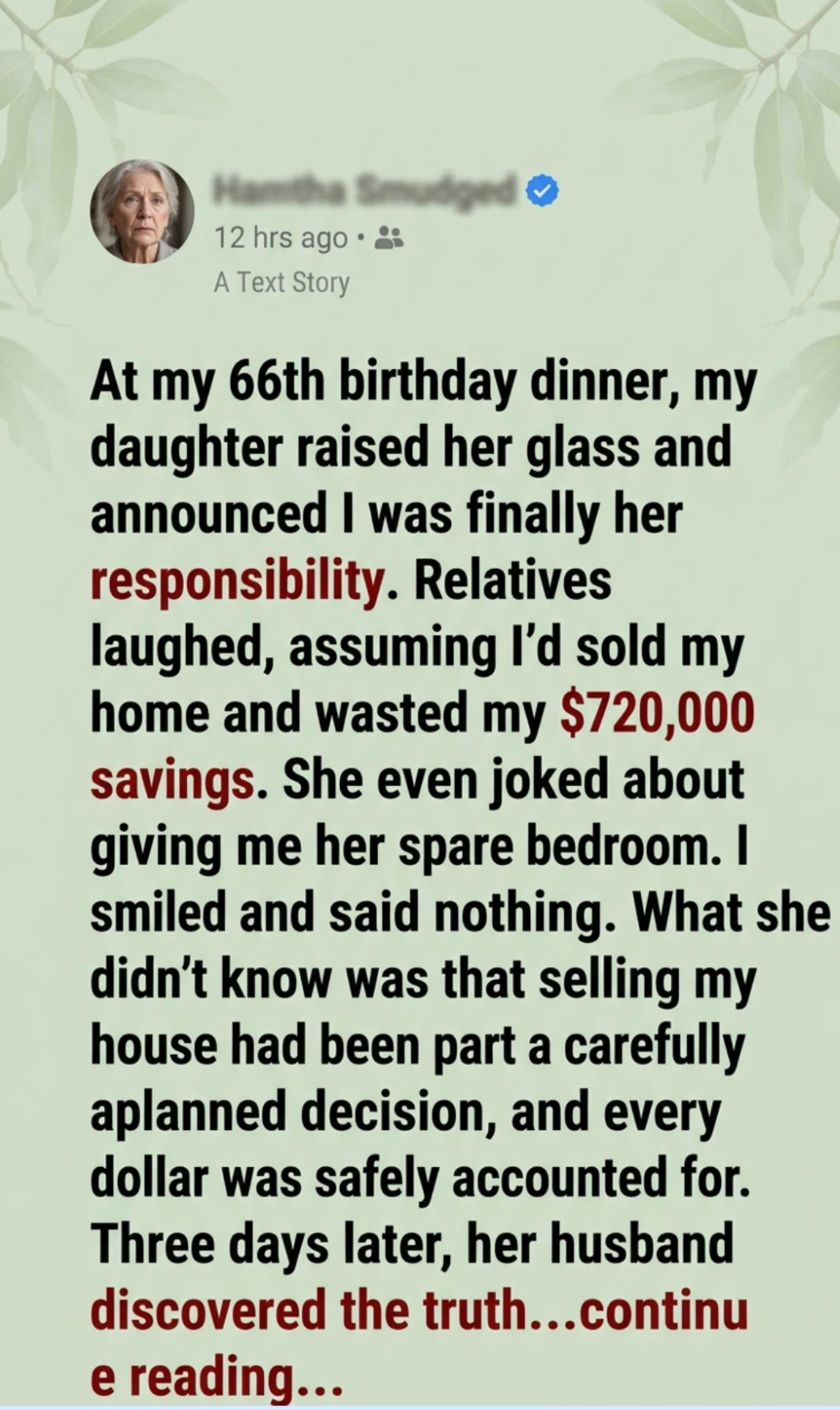
My daughter raised her wineglass halfway through my birthday dinner and announced that I was finally her responsibility.
Everyone laughed.
I was sixty-six years old, sitting at the head of a table in a restaurant overlooking the river, surrounded by relatives who had known me for decades. There was a birthday cake behind me, a bouquet of yellow roses beside my chair, and a small envelope containing a gift card from my son-in-law.
My daughter, Natalie, stood with her glass raised.
“To Mom,” she said. “She’s finally joining the rest of us in the real world. No more big house, no more pretending she’s independent. She can come live with us now. We even have a spare bedroom!”
More laughter.
Her husband, Peter, smiled politely.
My younger sister looked uncomfortable.
I lifted my water glass.
“Thank you, sweetheart.”
Natalie sat down, apparently satisfied.
She had spent the previous six months telling people that I had made a terrible financial decision. She believed I had sold my house, wasted my savings, and was now preparing to depend on her.
What she didn’t know was that I had planned the sale carefully.
The $720,000 I had accumulated over a lifetime had not disappeared.
It had been divided, protected, and placed exactly where it needed to be.
And three days later, when Peter opened the folder I had left with him, he discovered something that made him call his wife immediately.
But before I explain what was inside that folder, you need to understand how my daughter came to believe I was helpless.
My name is Margaret Ellis.
I was widowed at fifty-eight.
My husband, Robert, had worked as a civil engineer for thirty-four years. We weren’t wealthy when we married. We lived in a small rented apartment, drove old cars, and saved carefully.
When Natalie was born, Robert took extra shifts. I worked in a school office and later became an administrator.
We bought our first house when Natalie was six.
It wasn’t beautiful, but it had a garden, a narrow driveway, and a kitchen where we spent most evenings together.
Robert renovated it one room at a time.
He built the shelves in the living room, repaired the fence, and planted an apple tree near the back wall.
When he died, I couldn’t imagine selling the house.
It was where Natalie had learned to ride a bicycle.
It was where Robert had made Christmas breakfast.
It was where I had watched my daughter leave for university and return with her first serious boyfriend.
For years, I stayed there alone.
I maintained the garden, paid the bills, and occasionally invited friends for dinner.
Natalie visited, but less often than she once had.
She had a busy life with Peter and their two children, Sophie and Lucas.
I understood that.
I never expected her to organize her life around me.
But as the years passed, I began noticing a change in her attitude.
She asked increasingly detailed questions about my finances.
“How much is the house worth now?”
“Have you updated your will?”
“Do you still have all Dad’s investments?”
At first, I answered honestly.
Then she began offering opinions.
“You shouldn’t be living in such a large house.”
“That garden is too much work for you.”
“You need to think about moving closer to us.”
I agreed that the house required maintenance.
But I didn’t agree that selling it was automatically the right decision.
Then, one afternoon, I fell while carrying a box of books down the stairs.
I bruised my hip and spent several days moving slowly.
Natalie came over and looked around the house.
“This is exactly what I’ve been talking about,” she said.
“What?”
“You can’t manage all this alone.”
“I’m managing.”
“Until you aren’t.”
I didn’t respond.
She walked into the kitchen and opened the refrigerator.
“Peter and I have been discussing it. You could sell the house and move in with us.”
I stared at her.
“Move in with you?”
“Just until we figure something out.”
“Where would I sleep?”
“We have the spare room.”
I knew the spare room.
It was a small bedroom at the back of their house. It contained a folding desk, exercise equipment, and several boxes of children’s toys.
It wasn’t really a bedroom.
It was a storage room with a bed.
“I’ll think about it,” I said.
Natalie smiled.
“Good. We can start looking at estate agents.”
She spoke as if the decision had already been made.
The real change began when I met a financial adviser named Helen Brooks.
A friend from my walking group had recommended her.
Helen was in her early fifties, direct, patient, and not easily impressed by dramatic stories.
I explained that I was considering selling my house.
She asked why.
I told her about the maintenance, the stairs, and the increasing cost of repairs.
Then I told her about Natalie.
Helen listened carefully.
“Do you want to move in with your daughter?”
I shook my head.
“Not particularly.”
“Do you want to sell the house?”
I thought about that.
“I think I do. But I don’t want to spend the rest of my life feeling like a guest in someone else’s home.”
Helen nodded.
“Then we should plan around what you want, not what your daughter expects.”
We reviewed my finances.
Between the house, savings, retirement accounts, and investments, my total net worth was approximately $720,000.
The house represented the largest part of it.
Helen explained the costs of selling, possible taxes, and the need to understand how the sale would affect my retirement income.
We also discussed housing options.
I could buy a smaller property.
I could rent.
I could move into a retirement community.
Or I could sell the house and remain independent while taking time to decide what came next.
I chose the last option.
But Helen insisted on something important.
“Before you sell, we need a clear plan for where the money goes. You don’t want a large amount sitting in one ordinary account while everyone knows you’ve received it.”
I agreed.
We reviewed my existing accounts, updated my estate documents with an independent solicitor, and arranged appropriate protections for my finances.
I also appointed a professional as a backup decision-maker for certain financial matters if I ever became unable to manage them.
My daughter was not involved.
That wasn’t because I wanted to punish her.
It was because I wanted independent advice.
I listed the house in early spring.
The first few weeks were emotional.
I found Robert’s old toolbox in the garage, a box of Natalie’s school drawings, and a stack of photographs from our first holiday together.
I sat on the kitchen floor one afternoon and cried.
Not because I had changed my mind.
Because I was saying goodbye to a life that had already ended in some ways.
The house eventually sold for a little more than expected.
After the mortgage balance, fees, and other costs, I had a substantial amount available to add to my existing investments and retirement savings.
Helen helped me structure everything according to a plan that included:
-
A secure cash reserve for everyday expenses and emergencies.
-
A diversified investment portfolio intended to support my retirement.
-
Money set aside for future housing costs.
-
A separate amount for healthcare and long-term care needs.
-
An estate plan reflecting my own wishes.
I didn’t put the money into a secret overseas account.
I didn’t hide it from the authorities.
I didn’t gamble it on an unusual investment.
I simply stopped discussing my finances with relatives who had no responsibility for managing them.
Then I rented a comfortable apartment near the park.
It had two bedrooms, a small balcony, and an elevator.
I could walk to the grocery store, visit friends, and attend my weekly book club.
For the first time in years, I felt as if I was choosing my life rather than defending it.
Natalie was not pleased.
When I told her I had sold the house, she called immediately.
“You actually did it?”
“Yes.”
“Where are you going?”
“I’ve rented an apartment.”
There was a pause.
“An apartment?”
“Yes.”
“Why didn’t you tell me?”
“I didn’t think I needed permission.”
She sighed.
“Mom, I’m trying to help you.”
“I know.”
“Then why would you rent? You should have moved in with us.”
“I don’t want to.”
She became quiet.
Then she asked:
“What happened to the money?”
I looked out at the balcony.
“It’s being managed.”
“Managed how?”
“Properly.”
“How much do you have left?”
I didn’t answer.
“Mom, I’m serious.”
“So am I.”
She ended the call.
A few days later, my sister told me that Natalie had been telling relatives I had made a terrible mistake.
According to her, I had sold a valuable family home and was now renting because I had spent too much of the proceeds.
She said I was too proud to admit I needed help.
She even told one cousin that she and Peter were preparing to take me in when my money ran out.
I didn’t correct the story.
I was tired of explaining decisions I had made carefully.
Then came my birthday dinner.
Natalie organized the dinner at a restaurant called The Riverside Room.
She invited my sister, two cousins, Peter’s parents, and several family friends.
I thought it was kind of her.
I wore a dark blue dress and the small pearl earrings Robert had given me on our twentieth anniversary.
The dinner started pleasantly.
We talked about the grandchildren, the weather, and a recent holiday.
Then Natalie stood and raised her glass.
“To Mom,” she said. “She’s finally joining the rest of us in the real world. No more big house, no more pretending she’s independent. She can come live with us now. We even have a spare bedroom!”
Everyone laughed.
I looked at her.
She continued.
“Honestly, I think this will be good for her. She can help with the children, and we can make sure she doesn’t waste whatever money she has left.”
Peter shifted in his chair.
“Natalie,” he said quietly.
She ignored him.
“What? I’m joking.”
I smiled.
“Thank you, sweetheart.”
Then I took a sip of water.
I could see that my sister wanted to say something, but she remained silent.
Peter looked uncomfortable.
After dinner, Natalie hugged me and told me she would come by on Sunday to discuss the next steps.
I thanked her.
Three days later, Peter arrived at my apartment alone.
He was carrying a folder.
I had given Peter the folder after the birthday dinner.
It contained no dramatic secret inheritance or hidden fortune.
It contained something much more ordinary.
The truth.
There was a letter from Helen confirming that my financial plan had been completed and that my assets were sufficient to support my expected retirement expenses under the assumptions we had reviewed.
There was a summary of my current housing costs, retirement income, and available reserves.
There was also a document showing that I had purchased a small two-bedroom apartment in a nearby retirement-friendly development.
I had completed the purchase several weeks earlier.
It was not a luxury property.
It was a practical home with an elevator, secure entry, a small garden courtyard, and a residents’ association that handled much of the exterior maintenance.
The apartment was close to my doctor, the library, and a bus route.
I had chosen it because I wanted to remain independent without being responsible for an entire house.
The final document was a letter from my solicitor.
It confirmed that I had updated my estate plan and appointed independent professional support for certain future decisions.
Natalie was not named as a financial controller.
Peter read everything twice.
Then he looked at me.
“Margaret, why didn’t you tell us?”
I smiled.
“I told Natalie I was managing.”
He sat down.
“She thinks you’ve spent the money.”
“I know.”
“She thinks you’re going to need us to support you.”
“I know that too.”
Peter looked at the financial summary again.
“You’re in a much stronger position than she realizes.”
I nodded.
“I am comfortable.”
He was quiet for a moment.
Then he said something that surprised me.
“She was planning to sell the spare room furniture and turn it into a proper bedroom.”
I looked at him.
“Why?”
“She thought you’d move in permanently.”
I put my teacup down.
“Did she ask me?”
He shook his head.
“No.”
I looked toward the window.
That was the part that hurt.
My daughter had not simply misunderstood my financial position.
She had begun planning my future without asking what I wanted.
Peter stayed for almost two hours.
He told me that Natalie had been discussing my finances with him for months.
She believed the house had been sold for less than its value and that I had no real plan for the proceeds.
He admitted that he had encouraged her to stop making assumptions.
“She thinks you’re hiding something,” he said.
“I am.”
He looked up.
I smiled.
“I’m hiding my private financial information from people who don’t need it.”
He laughed softly.
Then his expression became serious.
“Margaret, I need to tell you something. Natalie has been counting on the idea that you would eventually move in with us.”
“Why?”
He hesitated.
“She thinks it would make things easier for everyone.”
“Everyone?”
He looked uncomfortable.
“She has been talking about how you could help with the children after school. She also thinks it would be good to have someone around when we’re both working.”
I understood.
The spare bedroom wasn’t being offered purely as a place for me to live.
It was part of a plan.
I would have housing.
They would have childcare.
And Natalie would have the comfort of believing she had taken responsibility for her mother.
I didn’t object to helping with my grandchildren.
I loved them.
But I didn’t want to become an unpaid household employee in exchange for a bed.
Peter looked at me.
“I think she has confused helping you with making decisions for you.”
I nodded.
“That’s exactly what happened.”
Natalie called that evening.
“Peter says you’ve bought another apartment.”
“Yes.”
“Why didn’t you tell me?”
“I didn’t think you wanted to hear about it.”
“That’s ridiculous.”
“Is it?”
She sighed.
“Mom, I was trying to make sure you were looked after.”
“I appreciate concern. I don’t appreciate being told what my life will look like.”
She became defensive.
“You made us look foolish at my birthday dinner.”
I almost laughed.
“How?”
“Everyone thinks we don’t help you.”
“Then perhaps you shouldn’t have announced that I was dependent on you.”
She went silent.
I continued.
“I sold the house because I wanted less maintenance. I bought a smaller place because I wanted to remain independent. I have enough money for my retirement, and I’ve made arrangements for the future.”
“You should have told me.”
“I told you I was managing.”
“That’s not the same.”
“No, Natalie. It isn’t. Because I am not required to provide you with a full report of my finances.”
Her voice became sharper.
“After everything we’ve done for you?”
I closed my eyes.
“What exactly have you done for me?”
She didn’t answer immediately.
Then she said:
“We invited you to live with us.”
“Without asking whether I wanted to.”
“We were trying to help.”
“I know. But help that ignores what the other person wants can become control.”
She ended the call.
The following Sunday, Natalie came to my new apartment.
She arrived with a box of pastries and an expression that suggested she had prepared an argument.
I made tea.
For a while, we discussed ordinary things.
Then she looked around.
“It’s nice.”
“Thank you.”
“Smaller than the old house.”
“Much smaller.”
“Do you miss it?”
I thought about Robert’s garden and the apple tree.
“Sometimes.”
She nodded.
Then she asked:
“Are you really financially secure?”
I looked at her.
“Yes.”
“Could I see the documents?”
“No.”
She frowned.
“Why not?”
“Because they’re private.”
“Mom, I’m your daughter.”
“And I’m your mother. That doesn’t mean either of us owns the other’s decisions.”
She looked down.
I could see she was angry, but beneath the anger was something else.
Embarrassment.
She had told the family I was nearly broke.
Now she had to face the possibility that she had been wrong.
“I thought you were making a mistake,” she said.
“Then you could have asked questions.”
“I did.”
“You asked how much money I had. You didn’t ask what I wanted.”
She looked toward the balcony.
“I suppose I didn’t.”
We sat quietly.
Then I told her about the birthday dinner.
“I wasn’t offended because you joked about the spare bedroom. I was hurt because you spoke as though I had already become your responsibility. You made a decision about my life in front of everyone, without asking me.”
Natalie began to cry.
“I didn’t mean to embarrass you.”
“But you did.”
“I’m sorry.”
I waited.
She wiped her face.
“I thought if you lived with us, we could keep an eye on you. I worry about you being alone.”
“I understand that.”
“And I thought it would help us with the children.”
There it was again.
I smiled gently.
“I love Sophie and Lucas. I will always help when I can. But I am not moving into your home to become your childcare arrangement.”
She looked ashamed.
“I know.”
We didn’t resolve everything that afternoon.
But it was the first time she had listened without immediately defending herself.
Over the following months, our relationship slowly improved.
Natalie began visiting without bringing up my finances.
Sometimes she came for coffee.
Sometimes she brought the children.
I helped Sophie with a school project and took Lucas to the park.
But I also kept my own schedule.
I joined a gardening group.
I started attending a weekly history lecture at the library.
I traveled with two friends to a coastal town for a long weekend.
I made plans without asking whether Natalie needed me.
And I discovered something wonderful.
I liked being sixty-six.
I liked having mornings that belonged to me.
I liked choosing what to cook.
I liked knowing that if I wanted to spend a Saturday reading, nobody would tell me I should be doing something more useful.
The apartment wasn’t the home Robert and I had built.
But it was my home.
A year after my birthday dinner, Natalie invited me to Sunday lunch.
This time, she didn’t make a speech.
She simply placed a plate in front of me and asked whether I wanted more vegetables.
After lunch, she came into the kitchen while I was washing dishes.
“Mom?”
“Yes?”
“I’ve been thinking about what happened last year.”
I turned off the tap.
She looked uncomfortable.
“I treated your house sale like it was a problem I needed to solve. I made jokes because I thought you were being stubborn. I didn’t really listen.”
I dried my hands.
“Thank you for saying that.”
“I also think I was embarrassed because I told everyone you were moving in with us before you had agreed.”
I smiled.
“That was a rather important detail.”
She laughed weakly.
“I know.”
Then she asked:
“Do you think you’ll ever need us?”
I looked at my daughter.
“Of course. Everyone needs people sometimes. But needing help isn’t the same as surrendering control of your life.”
She nodded.
“I understand that better now.”
I hugged her.
Not because everything had been forgotten.
Because she had finally begun to understand.
Three days after my sixty-sixth birthday, Peter had opened a folder and discovered that I had not wasted my savings.
But the most important thing he discovered was not the value of my investments or the apartment I had purchased.
It was that I had made plans without needing anyone’s permission.
My daughter had believed selling my house meant I was becoming dependent.
She had mistaken a smaller home for a smaller life.
She had assumed that because I was getting older, I was gradually losing the right to decide what happened next.
She was wrong.
I didn’t sell my home because I had failed.
I sold it because I wanted a different kind of life.
I didn’t protect my money because I distrusted everyone.
I protected it because I had spent decades working, saving, and planning, and I wanted the freedom to make my own choices.
And I didn’t refuse my daughter’s spare bedroom because I didn’t love her.
I refused because love should not require me to give up my independence.
On my next birthday, Natalie raised her glass again.
This time, she didn’t make a joke.
She looked at me and said:
“To Mom. She taught me that getting older doesn’t mean giving up your choices.”
I smiled.
Peter lifted his glass.
My sister smiled across the table.
And for once, nobody laughed at the idea of me needing a place to live.
Because I already had one.
A home I had chosen.
A life I had planned.
And enough money to make my own decisions.
At sixty-seven, I finally understood that one of the greatest gifts a parent can give an adult child is the chance to love them without making them responsible for every part of their life.
And one of the greatest gifts an adult child can give a parent is the respect to let them remain themselves.
THE END.