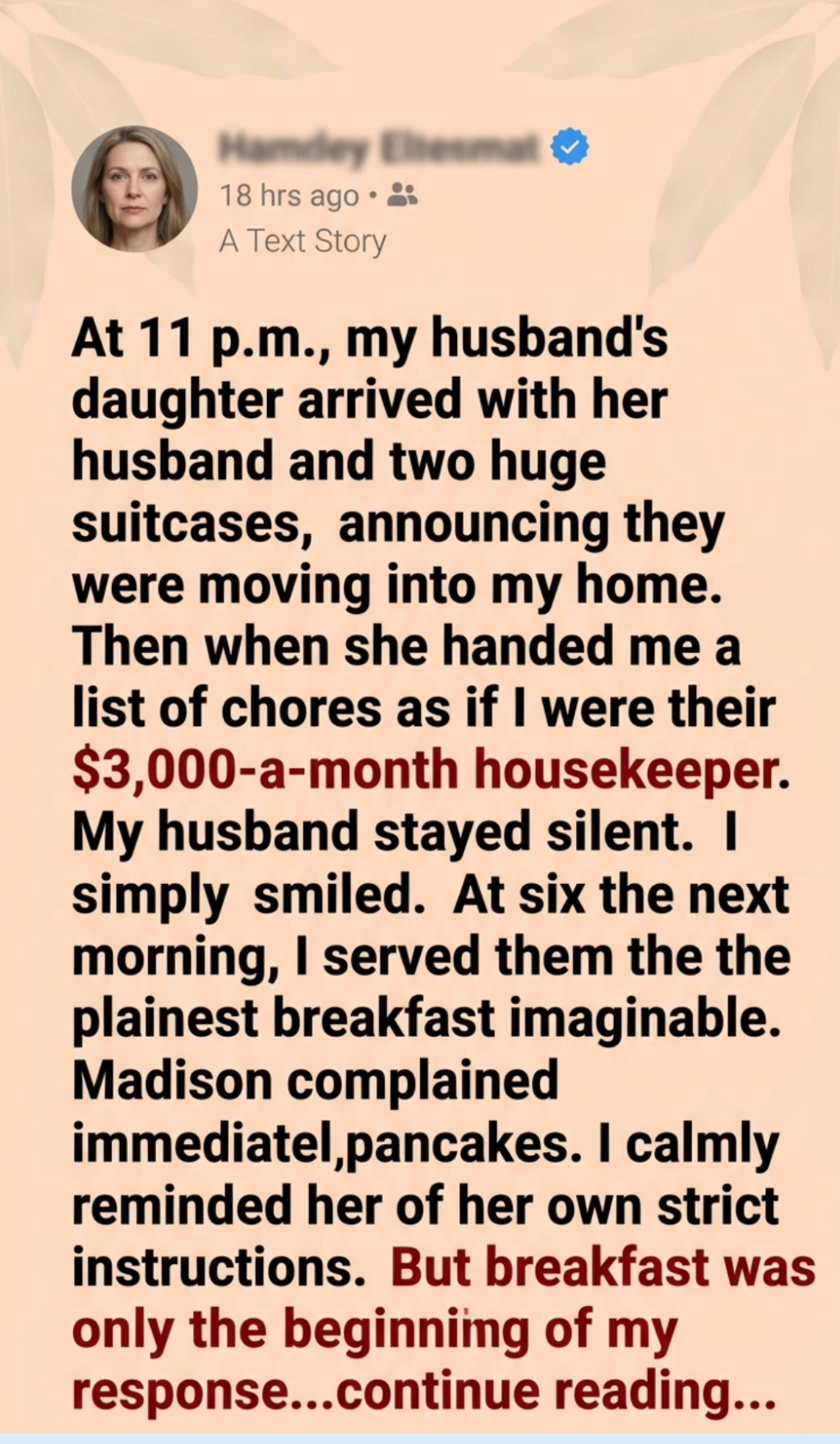
At 11:07 on a Thursday night, someone rang my doorbell three times.
I was already in my nightgown, sitting on the edge of the bed and reading a book, when my husband, Robert, glanced at the clock.
“Who could that be at this hour?” he muttered.
I heard the front door open.
Then a woman’s voice filled the hallway.
“Dad! We’re here!”
It was Madison, Robert’s thirty-two-year-old daughter from his first marriage.
I had met Madison many times during the eight years Robert and I had been married. She was charming when she wanted something, impatient when she didn’t get it, and particularly skilled at making her father feel guilty.
Her husband, Kyle, followed her into the house carrying two enormous suitcases.
I walked into the hallway.
“Madison? Is everything all right?”
She barely looked at me.
“Everything’s fine. We’re moving in.”
I thought I had misunderstood.
“Moving in where?”
She gestured toward the living room.
“Here. Obviously.”
Kyle placed his suitcases beside the sofa and stretched his arms.
“It’s been a long drive.”
Robert stood behind them, looking uncomfortable.
I turned toward him.
“Did you know about this?”
He rubbed the back of his neck.
“They’ve been having some trouble with their apartment.”
“That doesn’t answer my question.”
Madison sighed dramatically.
“Can we please not make this difficult? Our lease ended, and the new place won’t be ready for a while.”
“How long is a while?”
“Maybe three months.”
Three months.
They had arrived with enough luggage to suggest they were preparing for a much longer stay.
I looked at Robert again.
He avoided my eyes.
“Let’s discuss everything in the morning,” he said.
Madison smiled as if the matter had already been settled.
“Great. I knew you’d understand.”
Then she handed me a folded sheet of paper.
At first, I thought it was a list of things they needed from the grocery store.
Instead, it was a schedule.
At the top, in large printed letters, it read:
HOUSEHOLD SUPPORT EXPECTATIONS
Below it were several numbered instructions.
-
Breakfast must be ready by 7:00 a.m.
-
Laundry must be washed, folded, and placed in the bedroom.
-
Kitchen counters must be cleaned after every meal.
-
Bathroom towels must be replaced daily.
-
Grocery shopping must be completed before 10:00 a.m.
-
Dinner must be prepared according to Madison’s preferences.
-
The guest bedroom must remain organized.
-
No personal visitors without prior approval.
-
The living room must be kept available for their use after 6:00 p.m.
At the bottom, Madison had written:
Monthly household contribution: $3,000.
I read the page twice.
Then I looked up.
“What’s this?”
Madison shrugged.
“Just some basic expectations. We both work, and we’ll be busy getting settled. You have more flexibility than we do.”
I looked at the paper again.
“You expect me to do all these things?”
“Well, you’re home most of the day.”
“I work from home.”
She waved her hand.
“That’s not really the same thing as having a full-time job outside the house.”
Kyle chuckled.
“She’s just trying to keep things organized.”
I turned toward Robert.
He was studying the floor.
“Robert?”
He finally spoke.
“Madison has always been particular about routines. Maybe we can work something out.”
I felt something inside me grow very still.
For eight years, I had helped Robert build a peaceful home.
I had welcomed his daughter at holidays, remembered her birthday, listened when she complained about work, and made room for her husband at family dinners.
I had never asked her to love me like a mother.
I had only expected basic respect.
Apparently, that had been too much.
I folded the paper carefully.
Then I smiled.
“All right,” I said.
Madison looked relieved.
“See? I knew you wouldn’t make a big deal out of it.”
I walked back toward the bedroom.
“Good night, everyone.”
I didn’t argue.
I didn’t raise my voice.
And I didn’t tell them what I was thinking.
Because by then, I had already decided that the following morning would be very educational.
At 5:45 a.m., I got out of bed.
Robert was sleeping beside me.
I showered, dressed, and went downstairs.
I didn’t prepare pancakes.
I didn’t make eggs.
I didn’t fry bacon or toast bread.
Instead, I took four slices of plain bread from the pantry, placed them on a plate, and set out a jar of peanut butter.
I filled a pitcher with water and placed it in the center of the dining table.
Then I took Madison’s list from the kitchen counter.
I read it again.
Breakfast by 7:00 a.m.
Dinner according to Madison’s preferences.
Kitchen counters cleaned after every meal.
I nodded to myself.
At exactly six, I went upstairs and knocked on their bedroom door.
“Breakfast is ready.”
Madison opened it wearing a silk robe.
She looked at me, then toward the kitchen.
“Already?”
“Yes.”
She walked downstairs with Kyle behind her.
When they saw the table, Madison stopped.
“What is this?”
“Breakfast.”
She stared at the bread.
“Where are the pancakes?”
I took a sip of coffee.
“Your list says breakfast must be ready by seven. It doesn’t specify pancakes.”
Madison frowned.
“I don’t eat plain bread.”
“Then you may prepare something else.”
She looked at Kyle.
He gave a short laugh.
“Is this supposed to be a joke?”
“No.”
Madison crossed her arms.
“Dad said you would help us.”
“I am helping you. The kitchen is available.”
She stared at me as if I had spoken another language.
Then she looked toward the staircase.
“Dad!”
Robert appeared a moment later, wearing his dressing gown.
“What is it?”
“She’s giving us bread!”
Robert looked at the table.
Then he looked at me.
I calmly placed a copy of Madison’s list beside his coffee cup.
“I followed the instructions.”
He picked up the paper.
“Madison, perhaps you could have been a little more specific.”
She looked furious.
“Dad, don’t start taking her side. I told her what we needed.”
I folded my napkin.
“Actually, Madison, I think we should discuss what you need.”
She rolled her eyes.
“Fine. I need someone to cook, clean, and help us while we’re here.”
“Then you should hire someone.”
She blinked.
“We’re paying $3,000.”
I looked at her.
“To whom?”
She hesitated.
“What?”
“Who exactly are you paying $3,000 to?”
She looked at Robert.
He cleared his throat.
“Madison, we haven’t discussed money yet.”
“Dad, we talked about this!”
I leaned back in my chair.
“Your list says monthly household contribution. I assumed you were offering to pay for the additional space, utilities, and groceries.”
Madison’s expression changed.
“That’s what it means.”
“Then we agree.”
I stood and picked up my coffee cup.
“Your $3,000 can go toward the household expenses. It does not purchase my labor.”
The room became silent.
Madison’s cheeks turned red.
“You’re being ridiculous.”
“No. I’m being clear.”
She pushed her chair backward.
“I can’t believe this. We came here because we’re family.”
I looked at her.
“Exactly. Family shouldn’t arrive at eleven at night and hand another family member a job description.”
Robert finally stepped between us.
“Let’s all calm down.”
I looked at him.
“I am calm.”
And I was.
But breakfast was only the beginning.
At 8:30, I brought a notebook into the living room.
Madison was on her phone, while Kyle was watching television.
Robert sat in his usual chair.
I placed the notebook on the coffee table.
“We need to discuss the living arrangements.”
Madison sighed.
“Can this wait?”
“No.”
I opened the notebook.
“I have three questions.”
She stared at me.
“First, how long do you intend to stay?”
“Three months, like I said.”
“Second, are you both prepared to contribute toward the additional expenses?”
“Obviously.”
“Third, do you understand that this is Robert’s and my home, not a hotel?”
Kyle turned down the television.
“Why are you making this so formal?”
“Because you arrived with two suitcases and a list of duties for someone who never agreed to provide them.”
Madison crossed her arms.
“We didn’t mean it like that.”
I slid her paper across the table.
“You wrote it.”
She looked away.
Then Robert spoke.
“Maybe we should just give them a few weeks and see how it goes.”
I closed the notebook.
“Robert, before we discuss a few weeks, I want to know why you agreed to this without speaking to me.”
He opened his mouth, then closed it.
Madison jumped in.
“He’s my father. He shouldn’t need permission to help his own daughter.”
I nodded slowly.
“He doesn’t need permission to love you. But he does need to discuss a decision that changes both our living arrangements.”
She looked offended.
“You make everything about yourself.”
I almost laughed.
Instead, I said, “That’s an interesting observation from someone who arrived expecting the entire household to revolve around her.”
Kyle stood up.
“Okay, this is getting hostile.”
I looked at him.
“You have a bedroom, a bathroom, a kitchen, and a roof over your head. Nobody has asked you to leave today. But the rules are going to be reasonable.”
Madison picked up her phone.
“I’m calling my mother.”
I didn’t stop her.
She walked into the hallway.
A few minutes later, I heard her voice.
“Mom, you won’t believe what she’s doing. She’s acting like we’re strangers.”
I continued writing.
When Madison returned, she looked even angrier.
“Mom says you have no right to treat us this way.”
I smiled faintly.
“Your mother is welcome to offer you a room.”
Madison’s mouth fell open.
Kyle stared at me.
Robert looked as though he wished the floor would swallow him.
Then I said something that changed the entire conversation.
“I called our housing adviser this morning.”
Robert turned toward me.
“What housing adviser?”
“The person who handles our property and insurance arrangements.”
I opened the notebook to a printed page.
“Before anyone moves into a home, there are practical matters to consider. Our insurance policy has occupancy conditions. Our utility expenses will change. We also need to understand whether this is a temporary guest arrangement or something more permanent.”
Madison frowned.
“Why would insurance care?”
“Because policies have rules. And because I won’t pretend those rules don’t exist simply because someone is related to us.”
Kyle looked at Robert.
“Is this really necessary?”
“Yes,” I answered.
Robert finally spoke.
“I think she’s right about discussing the arrangements.”
Madison stared at him.
“Dad!”
He raised his hands.
“I didn’t know she was going to prepare a list of chores.”
Madison scoffed.
“It was just a suggestion!”
I looked at her.
“Then you won’t mind if I make a suggestion of my own.”
I turned the page.
“Each of you will handle your own laundry, clean up after yourselves, and take responsibility for your meals. Shared spaces will be kept tidy by everyone who uses them. The guest room is yours temporarily, but the office and the rest of the house remain shared spaces.”
Madison looked disgusted.
“And what about breakfast?”
“You’re welcome to make it.”
“Dinner?”
“Whoever cooks doesn’t have to cook every night.”
She looked at Kyle.
He shrugged.
“I can make pasta.”
For the first time that morning, I smiled genuinely.
“Wonderful. I like pasta.”
Madison wasn’t finished.
“And the $3,000?”
“Let’s discuss that with Robert and agree on a fair contribution based on the actual costs and the length of your stay. It won’t be payment for my services.”
She shook her head.
“I can’t believe you’re treating us like tenants.”
I looked at her carefully.
“Tenants usually agree to terms before moving in.”
That ended the discussion.
Or so I thought.
Over the next four days, the real problem became obvious.
Madison and Kyle didn’t actually want a place to stay temporarily.
They wanted a place where they could live without responsibilities.
They left dishes in the sink.
They used my expensive laundry detergent without asking.
Kyle left his gym clothes on the bathroom floor.
Madison complained that the guest bedroom didn’t have enough closet space.
She also began inviting friends over without checking with either of us.
When I asked her to let us know before bringing guests into the house, she said, “It’s not like we’re strangers.”
I reminded her that the house belonged to two people, not four.
She rolled her eyes.
One evening, I returned from the grocery store and found three friends sitting in the living room.
They had moved my reading chair into the corner and placed a large television box beside the fireplace.
Madison greeted me casually.
“Oh, you’re back. We’re having people over.”
I looked at the strangers.
“Hello.”
One of them smiled awkwardly.
“Hi. We’re Madison’s friends.”
“Welcome.”
I placed the groceries on the kitchen counter.
Then I turned toward Madison.
“We didn’t discuss having guests tonight.”
She waved her hand.
“It’s only for a few hours.”
I nodded.
“Then you can all enjoy yourselves. Just remember to clean up afterward.”
She smiled as though she had won.
But when I returned to the living room later, I discovered that one of her friends had spilled red wine on my cream-colored rug.
Madison looked at it.
“Oops.”
I took a breath.
“Who spilled it?”
One of the women raised her hand.
“I’m sorry. I didn’t see the glass.”
“Thank you for telling me.”
I fetched a cloth and cleaning solution.
Madison watched me.
“You don’t need to be so dramatic. It’s just a rug.”
I looked at her.
“It’s my rug.”
She shrugged.
“Dad can replace it.”
I stopped cleaning.
Then I looked at Robert, who had just entered the room.
“Can he?”
Robert looked uncomfortable.
“Madison, that’s enough.”
She laughed.
“What’s wrong with you two?”
I returned to the kitchen.
That night, I made a decision.
I wasn’t going to spend the next three months arguing about towels, dishes, and television volume.
The next morning, I contacted a local property attorney to understand the proper way to end a temporary guest arrangement if it became necessary. I also reviewed our household budget and spoke with Robert about what had happened.
He listened quietly.
Finally, he said, “I think I made a mistake.”
I looked at him.
“You did.”
He rubbed his face.
“Madison called me crying. She said they were in trouble. I didn’t know how to say no.”
“I understand wanting to help your daughter. I don’t understand why you didn’t tell me.”
He nodded.
“I thought you’d be upset.”
“I am upset, Robert. But not because your daughter needed help. I’m upset because you made a decision about our home and left me to deal with the consequences.”
He looked down.
“I should have talked to you.”
“Yes.”
He reached for my hand.
“I’m sorry.”
I didn’t pull away.
But I didn’t immediately forgive him either.
“I need you to understand something,” I said. “Being a good father doesn’t require you to make your wife invisible.”
He nodded slowly.
That evening, he spoke to Madison and Kyle.
He told them that their stay needed to have clear boundaries and a firm end date. He also told them that the household chores would be shared and that no one was entitled to my time.
Madison reacted badly.
“So you’re choosing her over me?”
Robert looked tired.
“I’m choosing to treat both of you fairly.”
She stood up.
“You’ve changed.”
“No,” he said quietly. “I should have handled this differently from the beginning.”
Madison stormed into the guest room.
Kyle followed.
For two days, they barely spoke to us.
Then something unexpected happened.
On Sunday afternoon, Madison came into the kitchen while I was preparing vegetables.
“Can we talk?”
I put down the knife.
“Of course.”
She looked uncomfortable.
“Mom says I should apologize.”
I waited.
Madison sighed.
“I shouldn’t have given you that list.”
“No, you shouldn’t have.”
“And the rug…”
“Yes?”
“I’ll pay for the cleaning.”
I nodded.
“Thank you.”
She looked toward the window.
“I’ve been under a lot of stress.”
“I understand.”
“Our apartment situation has been awful. We lost the deposit on the place we were supposed to move into, and Kyle’s job has been uncertain.”
I listened.
For the first time since she had arrived, she wasn’t speaking as though I owed her something.
She was explaining.
“Why didn’t you tell us?” I asked.
“Because Dad said you might think we were irresponsible.”
I looked at her.
“Madison, people can make mistakes. People can struggle. That doesn’t mean they get to turn someone else’s home into a service.”
She nodded.
“I know.”
I took a breath.
“You’re welcome to stay while we work out a reasonable plan. But I won’t be your housekeeper, and I won’t be treated like one.”
She looked at me.
“Okay.”
It wasn’t a perfect apology.
It wasn’t a complete transformation.
But it was the first honest conversation we’d had in years.
Over the following weeks, the atmosphere improved.
Kyle began cooking dinner twice a week. Madison did her own laundry. They contributed toward groceries and utilities according to an amount Robert and I agreed was fair.
There were still disagreements.
Madison occasionally forgot to clean up after herself. Kyle sometimes left his shoes in the hallway.
But I stopped quietly fixing everything.
If they left dishes in the sink, they found them there when they returned.
If their laundry remained in the machine, they had to move it.
I wasn’t punishing them.
I was allowing adults to take responsibility for their own lives.
By the end of the second month, Madison and Kyle had found a smaller apartment.
It wasn’t the luxury building they had originally wanted, but it was within their budget.
On the morning they moved out, Madison carried one of her suitcases toward the front door.
Then she stopped.
“Thank you for letting us stay.”
I looked at her.
“You’re welcome.”
She hesitated.
“And I’m sorry about the list.”
I nodded.
“I appreciate that.”
She looked down at her hands.
“I thought because you were home more, you had more time.”
“I understand why you thought that. But being home doesn’t mean someone is available to serve everyone else.”
She smiled weakly.
“I know that now.”
Kyle came downstairs carrying the second suitcase.
He shook my hand.
“Thanks for putting up with us.”
I laughed.
“Good luck in the new place.”
After they left, the house became quiet again.
Robert stood beside me in the hallway.
“Feels strange, doesn’t it?”
“A little.”
He put his arm around my shoulders.
“I should have stood up for you that first night.”
I looked at him.
“Yes, you should have.”
He nodded.
“I won’t make that mistake again.”
I wanted to believe him, and this time, his actions over the following months gave me reason to.
He began discussing family decisions with me before making promises. When Madison needed help with something, he offered support without assuming I would provide the labor.
Our home returned to being a place where I could relax.
A few months later, Madison invited us to dinner at her new apartment.
She had prepared pasta with roasted vegetables and a simple salad.
The kitchen was a little messy, but she was smiling.
“I made too much,” she said. “I thought you might want to take some home.”
I looked at the food.
“Thank you. It looks lovely.”
During dinner, she laughed about the morning I served plain bread.
“I still can’t believe you actually did that.”
I smiled.
“You gave me a list. I followed it.”
She laughed, too.
Then her expression softened.
“I really was embarrassed when you called me out.”
I took a sip of water.
“Sometimes embarrassment is how people realize they’ve crossed a line.”
She nodded.
“I think I needed that.”
On the drive home, Robert reached over and held my hand.
“You handled everything better than I did.”
I looked out at the passing streetlights.
“I didn’t need to win an argument, Robert. I needed my home to remain my home.”
He squeezed my hand.
And I realized that was the lesson I had wanted everyone to understand from the beginning.
Kindness is not an unlimited contract.
Helping family doesn’t mean surrendering your privacy, your time, or your dignity.
A home can be shared.
Responsibilities can be divided.
People can be welcomed even when they’re struggling.
But nobody should walk through your front door at eleven at night, hand you a list of chores, and mistake your patience for permission.
The plain bread at six in the morning had never been about breakfast.
It was about reminding everyone at that table that respect had to come before expectations.
And, from that day forward, it finally did.
THE END.