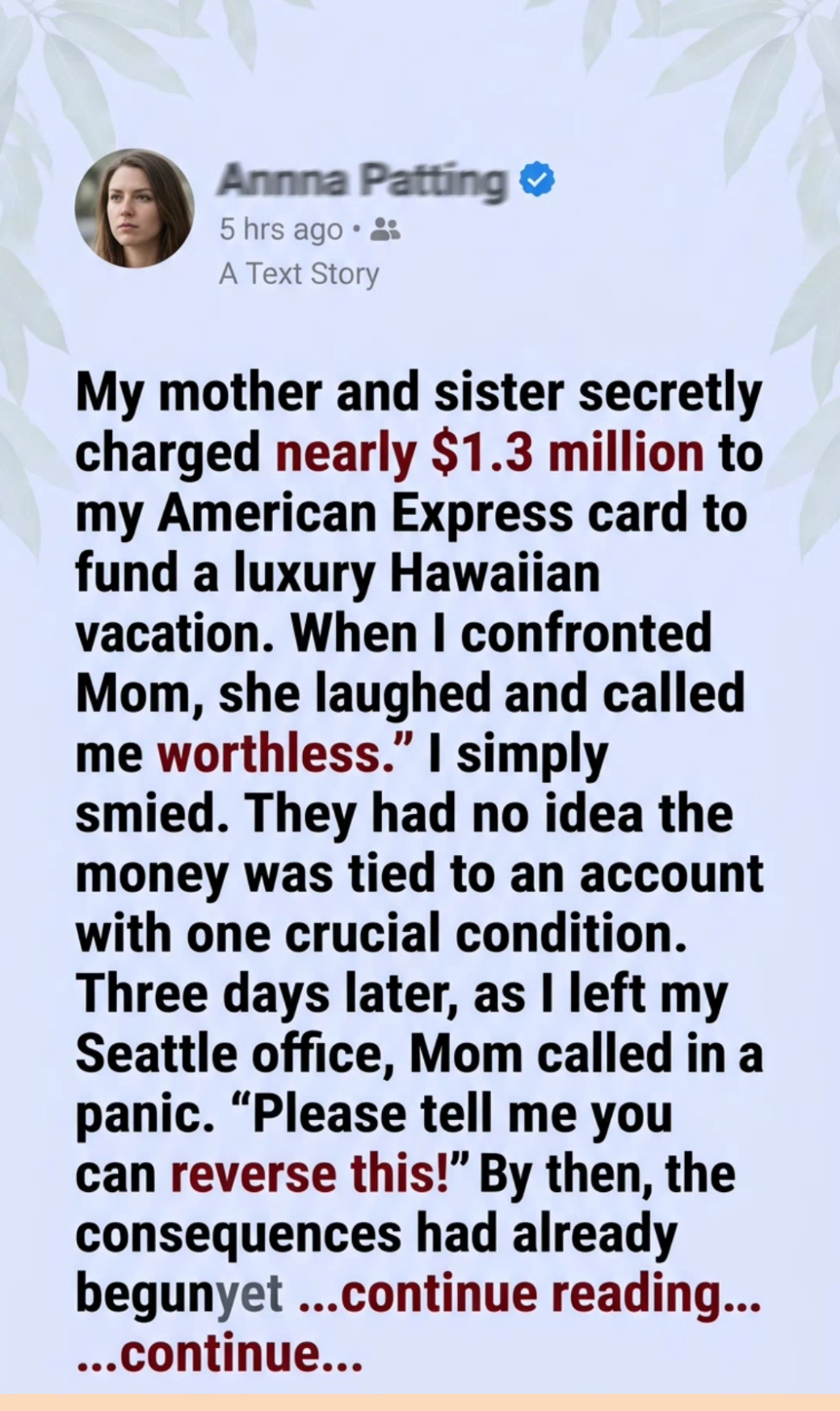
The first sign that something was wrong was a notification on my phone at 6:42 on a Monday morning.
I was standing in my kitchen in Seattle, waiting for the coffee machine to finish, when my American Express account displayed a transaction I couldn’t understand.
$184,700 — Royal Hawaiian Resort.
I stared at the number.
Then another notification appeared.
$96,400 — Pacific Charter Aviation.
Then another.
$312,000 — Luxury Island Villas.
Within fifteen minutes, I had received eleven separate transaction alerts totaling more than $1.2 million.
I opened the account.
My stomach tightened.
The charges included private flights, oceanfront villas, jewelry boutiques, luxury transportation, restaurant reservations, spa packages, and an enormous deposit to a private event company.
The names attached to several reservations were familiar.
My mother, Diane.
My younger sister, Vanessa.
And Vanessa’s husband, Mark.
I called my mother.
She answered after the fourth ring.
“Good morning, sweetheart.”
“Mom, why are there charges on my American Express account from Hawaii?”
There was a brief silence.
Then she laughed.
“Oh, you’ve noticed.”
I gripped the phone.
“What did you do?”
“We’re on vacation.”
“I can see that. Why are you using my card?”
“Because it was convenient.”
“Convenient?”
Vanessa’s voice came from somewhere in the background.
“Mom, tell her we’re at breakfast!”
My mother laughed again.
“Your sister deserves a nice vacation. She’s had a difficult year.”
I stared at the screen.
“You charged more than a million dollars to my account.”
“Don’t exaggerate. It’s a family vacation.”
“The charges are already over a million.”
My mother sighed.
“Honestly, Evelyn, you always have to make everything about money.”
I closed my eyes.
“Mom, I need you to tell me exactly how you got access to my account.”
She sounded irritated.
“You gave us the card information years ago.”
“For emergencies.”
“Well, this is an emergency. Vanessa needed a break.”
I couldn’t believe what I was hearing.
“Did you use my card without permission?”
My mother laughed.
“Don’t be dramatic. You’re doing very well for yourself. You have your business, your apartment, and no children to support. What exactly do you need all that money for?”
I said nothing.
Then she added the words I would remember long after the call ended.
“Vanessa has a family. You have nothing. Stop being so selfish.”
I looked at the transaction list.
Then I smiled.
Not because it was funny.
Because my mother had just confirmed something I had suspected for years.
She still believed that being family meant she could take whatever she wanted.
And this time, she had made a mistake that couldn’t be fixed with another apology.
“Enjoy Hawaii, Mom,” I said.
She seemed surprised.
“See? I knew you’d understand.”
I ended the call.
Then I contacted American Express.
I reported the transactions as unauthorized, requested that the account be secured, and asked the fraud department to preserve the transaction records.
I also contacted my attorney.
Because there was something my mother and sister didn’t know.
The account they had used wasn’t an ordinary personal credit card.
And the money behind it wasn’t mine to give away.
My name is Evelyn Carter.
I’m thirty-nine years old, and I run a commercial property management company in Seattle.
I started the business with one small office and three clients.
For years, I worked evenings, weekends, and holidays. I handled tenant disputes, reviewed maintenance contracts, and negotiated with vendors who assumed a young woman couldn’t understand commercial real estate.
Eventually, the company grew.
I hired employees, expanded into neighboring counties, and began managing properties for several institutional clients.
My income became comfortable, but I never lived extravagantly.
I drove a reliable car, lived in a modest apartment, and kept my financial affairs organized.
My mother never understood that.
To her, success meant visible spending.
A large house.
Designer handbags.
Expensive vacations.
Photographs that made other people jealous.
My younger sister, Vanessa, had inherited that philosophy.
She was thirty-four, married to Mark, and had two children.
She often complained about money despite living in a beautiful home and frequently buying things she couldn’t afford.
Whenever I tried to offer practical advice, she accused me of judging her.
My mother always took her side.
“Vanessa has a family to think about,” she’d say.
“You’re lucky you only have yourself.”
I had heard those words so often that I barely reacted anymore.
For years, I had helped them financially.
I paid for my mother’s roof repair after a storm damaged her house. I covered a portion of Vanessa’s medical bills when her insurance dispute delayed reimbursement. I helped with school expenses for her children.
I never kept a record of every favor.
I believed family should help family.
But after several uncomfortable incidents, I became more careful.
Three years earlier, I had given my mother an additional card connected to an account used for approved family travel and emergency purchases.
It had strict limits and required authorization for major expenses.
That account was not the one she had used this time.
The card information she had accessed belonged to a corporate purchasing arrangement established through my company’s financial institution.
It was designed for specific business expenses, with transactions monitored by an independent account administrator.
The arrangement had been created when my company acquired a portfolio of commercial properties.
A large reserve had been placed in a custodial structure to cover approved property acquisitions, renovations, and contractual obligations.
The credit facility was secured by that reserve.
I was an authorized company officer, but the funds were not personal money.
They belonged to the business structure and were subject to strict spending rules.
Every transaction above a specified threshold required supporting documentation and approval.
The account had been set up to prevent exactly the kind of unauthorized spending my mother had just attempted.
Unfortunately, several years earlier, I had allowed her to keep an old supplementary card for a legitimate family emergency.
I had forgotten that she still had the physical card.
She had apparently found it in a drawer and used the stored payment information.
I had not given her permission to use it for a vacation.
And she certainly had no authority to use the business facility.
That was why I smiled when she told me to stop being selfish.
She had not merely spent my money.
She had created a serious financial and legal problem involving an account she was never authorized to access.
At 9:15 that morning, I met with my attorney, Laura Bennett.
I showed her the transaction list.
She read it silently.
Then she looked at me.
“Did you authorize any of these purchases?”
“No.”
“Did you give your mother permission to use the corporate account?”
“Absolutely not.”
“Does she have any authority to act on behalf of your company?”
“No.”
Laura nodded.
“Then we need to keep this very clear. We don’t make assumptions about how the transactions were processed. We document what happened, notify the relevant financial institution, and let the appropriate investigators determine the details.”
She asked me to provide every available record.
I sent her the original account agreement, the supplementary card history, the transaction alerts, and the list of authorized users.
She immediately noticed something important.
The transactions had been submitted under multiple merchant accounts, but several of them used the same billing profile.
That suggested the purchases had been coordinated through one travel planner.
Laura advised me not to contact the travel agency or attempt to cancel anything myself.
The financial institution needed to handle the dispute.
She also warned me not to post about the incident or threaten my family.
“Let the records speak,” she said.
I agreed.
By the end of the day, the account administrator had suspended the compromised card credentials and opened a formal review.
The institution placed disputed transactions under investigation.
Some merchants were contacted for supporting documentation.
Others were asked to preserve reservation and payment records.
The company also reviewed whether any business funds had actually been transferred or whether the transactions were merely attempted charges against the facility.
That distinction mattered.
I wanted to know exactly what had happened before making accusations beyond what I could prove.
At 4:30, Vanessa sent me a photograph.
She was standing beside a private pool overlooking the ocean.
Her husband held a glass of champagne.
My mother sat on a lounge chair wearing a designer hat.
The caption read:
Finally living the life we deserve. Some people should learn how to share.
I stared at the photograph.
Then I forwarded it to Laura.
I didn’t respond.
The following morning, my mother called again.
“Evelyn, there’s a little problem.”
I looked at the phone.
“What problem?”
“The hotel says the payment needs to be verified.”
“That’s between you and the hotel.”
She laughed nervously.
“Don’t be difficult. Just call them and confirm the charges.”
“I didn’t make those charges.”
“But you’re the account holder.”
“I have already reported the transactions as unauthorized.”
Silence.
Then her voice rose.
“You did what?”
“I reported the card as compromised.”
“Evelyn, you can’t do that! We’re in Hawaii!”
“I didn’t send you there.”
Vanessa grabbed the phone.
“You’re embarrassing us!”
I kept my voice calm.
“You used a corporate account without authorization.”
“Oh, please. It’s not like you can’t afford it.”
“That isn’t the point.”
Vanessa scoffed.
“You’ve always been jealous of me.”
I almost laughed.
“Jealous of what?”
“Of my family. Of my life. Of the fact that Mom loves me more.”
I looked out at the gray Seattle sky.
“Vanessa, I hope you enjoy your vacation. But I won’t be paying for it.”
She shouted something I couldn’t understand.
Then the call ended.
That afternoon, my company received a request from the account administrator.
They wanted a written statement confirming whether the transactions were connected to legitimate company activity.
I provided it.
I also authorized a review of the entire transaction history.
The preliminary report showed that several charges had been approved by merchants but were still awaiting final settlement. Other transactions had been declined after the account was secured.
The total exposure was significant, but the final amount remained under review.
My attorney reminded me that the dispute process could take weeks or longer.
I didn’t care how long it took.
I wanted it handled properly.
On Wednesday morning, three days after the first charges appeared, I was leaving my Seattle office when my phone began vibrating.
My mother’s name appeared.
I answered.
“Hello?”
“Evelyn!”
Her voice was frantic.
“Please tell me you can reverse this!”
I stopped beside my car.
“What happened?”
“The hotel says they won’t release our deposit. The travel company says the payments are under investigation. Vanessa’s reservation has been canceled, and Mark is arguing with someone at the front desk.”
I said nothing.
My mother began crying.
“Please call them. Tell them it was a mistake.”
“Was it a mistake?”
She went quiet.
“Of course it was.”
“Did you have permission to use my card?”
“Evelyn, this isn’t the time.”
“It is exactly the time.”
She began speaking rapidly.
“Your sister planned this for months. She told everyone we were coming. The children are upset. We have nowhere to go tomorrow.”
I looked at the office building behind me.
“Mom, you booked a luxury vacation using an account that wasn’t yours.”
“We thought you would be happy to help.”
“You didn’t ask.”
“You always help Vanessa!”
“I help when I choose to.”
She began crying harder.
“Please, sweetheart. I know I shouldn’t have done it. But can you just call and explain?”
I took a slow breath.
“I’m not going to tell a financial institution that unauthorized purchases were authorized.”
Her voice changed.
“Are you really going to do this to your own mother?”
“No, Mom. I’m going to let the investigation follow its course.”
Then I ended the call.
By Thursday, the situation had become much more serious.
The travel company had provided records showing that my mother and Vanessa had arranged the trip through a private concierge service.
The records included emails, booking confirmations, and messages discussing the use of my card.
One email from Vanessa read:
Evelyn won’t mind. She has more than enough money, and Mom says she owes us after everything we’ve done for her.
Another message from my mother said:
Use the card we have. She won’t notice until we’re already there.
I read those messages in Laura’s office.
For a moment, I couldn’t speak.
It wasn’t simply that they had spent money without permission.
They had planned to do it.
They had discussed how to avoid asking me.
They had assumed that I would be too embarrassed or too attached to family to challenge them.
Laura placed the documents on the table.
“These records are important,” she said. “We’ll preserve them and provide them to the financial institution through the proper channels.”
I nodded.
“Will they have to pay it back?”
“That depends on the investigation, the contractual arrangements, the applicable law, and what the evidence establishes. We shouldn’t promise a particular outcome.”
I appreciated her honesty.
I didn’t want an imaginary victory.
I wanted accountability.
Over the following weeks, the institution completed its review of the disputed activity.
The company determined that the transactions were not authorized business expenses.
Some charges had never settled. Others were reversed through the merchant dispute process after the merchants received documentation.
A smaller group required additional investigation because the payment processor had treated the original card credentials as valid at the time of authorization.
The company also referred the suspected unauthorized use for further review.
My mother and sister were asked to provide explanations.
They initially claimed I had given them permission.
But the messages they had sent to the travel planner contradicted that explanation.
The matter eventually became part of a civil recovery process.
The financial institution pursued the responsible parties for amounts it could establish had been improperly charged, while the remaining disputed transactions were resolved through the merchant and card network procedures.
My attorney handled the communications.
I did not call my mother to threaten her.
I did not send Vanessa angry messages.
I simply stopped allowing them to use my accounts.
Three months later, I received a letter from my mother.
It was handwritten.
The first paragraph contained an apology.
The second paragraph explained how embarrassed she was.
The third paragraph asked whether I could help Vanessa with the money she now owed.
I read it twice.
Then I placed it on my desk.
For years, I had believed that if I helped enough, my family would eventually understand that I wasn’t an endless source of money.
But the truth was that my generosity had become something they expected.
They had confused my willingness to help with an obligation to provide.
And when I finally said no, they treated it as betrayal.
I wrote a short reply.
Mom, I love you, but I will not pay for purchases I did not authorize. I am willing to have a relationship based on honesty and respect. If that is possible, we can begin there.
I mailed it.
Vanessa never apologized.
For several months, she told relatives that I had ruined her family’s vacation.
Some believed her.
Others knew enough about the situation to remain silent.
Eventually, she and Mark sold several expensive items and moved into a smaller home while they worked through their financial obligations.
My mother stopped calling.
I missed her sometimes.
I missed the version of our relationship I had hoped we might have.
But I did not miss being treated like a bank account with a birthday.
A year later, I was invited to a family dinner at my aunt’s house.
I almost declined.
But my aunt had always been kind to me, and I didn’t want my mother’s actions to determine every relationship I had.
When I arrived, Vanessa was already there.
She looked different.
Her clothes were simpler, and she seemed quieter than I remembered.
She avoided my eyes at first.
Later, while everyone else was in the dining room, she approached me near the kitchen.
“Can we talk?”
I nodded.
She folded her arms.
“I know you probably think I’m a terrible person.”
I didn’t answer.
She looked down.
“I shouldn’t have used your card.”
“No, you shouldn’t have.”
She swallowed.
“Mom said you would be fine with it.”
“That doesn’t make it acceptable.”
“I know.”
For a moment, she looked as though she might cry.
Then she said something I hadn’t expected.
“I was angry that you had built a life without needing anyone. I kept telling myself you had more than enough, so it didn’t matter if we took a little.”
I looked at her.
“It wasn’t a little.”
“I know.”
She wiped her eyes.
“I don’t expect you to forgive me immediately.”
I nodded.
“That’s probably wise.”
She gave a small, uncomfortable laugh.
Then she asked whether we could try to rebuild our relationship.
I told her we could start with honest conversations.
But I also made one thing clear.
“I will never give you access to my financial accounts again.”
She nodded.
“I understand.”
We returned to the dining room.
Nothing was magically repaired.
My mother and I still had difficult conversations. Vanessa and I were polite but cautious. Trust would take longer than a single apology.
And perhaps it would never return to what it had been.
But I no longer felt responsible for fixing every problem in their lives.
I had learned that helping someone should be a choice, not a debt they collect from you.
That night, I drove home through the quiet Seattle streets.
My phone was silent.
My accounts were secure.
My company was protected.
And for the first time in years, I didn’t feel guilty about saying no.
The Hawaiian vacation had cost my family far more than they expected.
Not because I had some secret fortune or a magical condition that allowed me to destroy their plans.
The real consequence was simpler.
They had finally discovered that my success did not give them ownership of my life.
And I had finally discovered that I could love my family without financing their disrespect.
THE END.