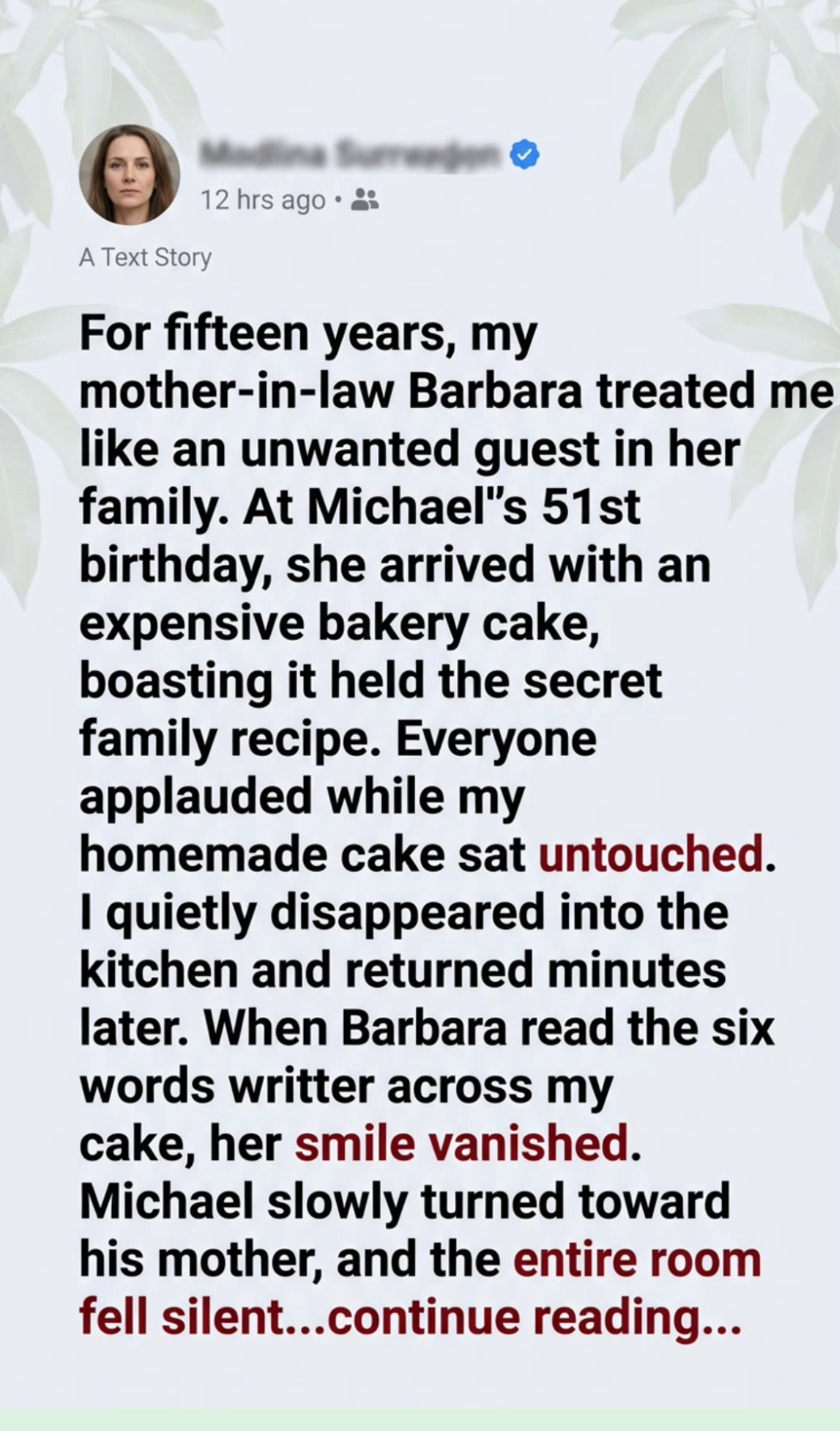
For fifteen years, my mother-in-law, Barbara, had made it clear that I was never quite good enough for her son.
My cooking was too ordinary.
My clothes were too simple.
My job wasn’t impressive enough.
And whenever Michael and I hosted family gatherings, she somehow found a way to remind everyone that he could have married someone more suitable.
I learned to smile through it.
Not because it didn’t hurt, but because I loved my husband and didn’t want every family occasion to become another argument.
Michael was fifty-one when everything finally changed.
His birthday celebration was supposed to be a happy evening. We had invited twenty-six relatives and close friends to our home outside Seattle. There were flowers on the dining table, candles along the patio, and a buffet of food I had spent most of the day preparing.
I had also baked Michael’s favorite chocolate cake.
It wasn’t fancy.
It had three layers, dark chocolate frosting, and a thin layer of raspberry filling. I had decorated it with small chocolate curls and a few fresh berries.
Michael loved it.
Every year since our second anniversary, I had made him the same cake.
He always said it tasted like the one his grandmother used to make.
I was putting the final touches on it when the doorbell rang.
Barbara had arrived.
She entered carrying a large white bakery box tied with a gold ribbon.
“Happy birthday to my wonderful boy!” she announced.
Michael hugged her.
“Thanks, Mom.”
Barbara held up the box.
“I brought something special. The family recipe, made by the finest bakery in town.”
She placed it on the dining table, directly beside my homemade cake.
Then she turned toward the guests.
“I thought Michael deserved something made properly this year.”
A few people laughed politely.
I felt my cheeks grow warm.
Michael looked at me.
I gave him a small smile.
Barbara removed the lid.
Inside was a beautiful cake covered in white frosting, decorated with gold lettering and delicate sugar flowers.
Everyone admired it.
“Oh, Barbara, that looks incredible.”
“Such a beautiful cake!”
“You really went all out.”
Barbara smiled proudly.
“It’s our family’s traditional recipe. It’s been passed down for generations.”
Then she glanced at my chocolate cake.
“Of course, some recipes take years to perfect.”
I lowered my eyes.
I had heard versions of that sentence for fifteen years.
But this time, something was different.
Because Barbara wasn’t merely insulting my baking.
She was claiming something that had belonged to Michael’s grandmother.
And I knew exactly what was written in the original recipe book.
I met Michael when I was thirty-one.
He was thirty-six, recently promoted to regional operations manager for a manufacturing company, and the kind of man who remembered small details.
He remembered my favorite coffee.
He remembered that I disliked crowded restaurants.
He remembered the name of my childhood dog.
When he proposed, I believed I was marrying someone who would always make me feel safe.
I knew his mother could be difficult.
Barbara had been a widow for several years and had raised Michael largely on her own.
She was proud of him, fiercely protective, and accustomed to having the final word.
At first, I tried hard to build a relationship with her.
I invited her to lunch.
I asked about her childhood.
I listened to stories about Michael growing up.
She was polite, but there was always a distance.
After our wedding, that distance became more obvious.
At our first Christmas together, Barbara gave me a kitchen towel while presenting Michael with an expensive watch.
When I thanked her, she said, “Well, Michael has always appreciated quality.”
At our second anniversary dinner, she told our guests that her son had once been engaged to a woman from a wealthy family.
She described the former girlfriend’s education, career, and elegant manners in unnecessary detail.
Then she smiled at me.
“But life doesn’t always turn out the way we imagine.”
Michael told her afterward that she had been rude.
She cried.
He apologized to her.
And somehow, I became the person who had caused the problem.
The pattern continued.
Whenever Barbara visited, she inspected my house.
She commented on the curtains, the furniture, the food, and the way I arranged the guest bedroom.
If I cooked something she didn’t like, she announced that Michael had grown up eating better.
If I bought something new, she asked how much it cost.
If I wore a dress she disliked, she suggested I should choose clothes more suitable for my age.
I learned not to react.
Michael occasionally defended me, but he often followed it with the same sentence.
“That’s just how Mom is.”
I began to understand that those words were not an explanation.
They were permission.
The cake story began years earlier.
Michael’s grandmother, Rose, had been a wonderful baker.
She died when Michael was twenty-three, but he often spoke about her kitchen.
He remembered the smell of cinnamon, the old wooden table, and the way she let him lick the mixing spoon.
Her chocolate cake was his favorite.
When Michael and I first married, I asked Barbara whether she had the recipe.
She told me it was a family secret.
I didn’t press her.
A few years later, I was helping clean out some boxes at Barbara’s house when I found an old notebook among Rose’s belongings.
It was filled with handwritten recipes.
The pages were yellow, and several had small stains from butter and flour.
One page contained the chocolate cake recipe.
At the bottom, Rose had written:
For Michael, who always asks for another slice.
I smiled when I read it.
Barbara saw the notebook in my hands.
“Those old things are mine,” she said sharply.
“I was just looking at the recipes.”
“Put it back.”
I did.
But before returning it, I had taken a photograph of the cake recipe because I wanted to preserve it for Michael.
I never told Barbara.
Over the following years, I made that cake several times.
I adjusted the frosting slightly and added raspberry filling because Michael liked the combination.
Whenever I served it, he said it reminded him of his grandmother.
I never claimed it was my invention.
I simply said I had learned it from Rose’s old notebook.
Barbara hated that.
She insisted that only she knew the authentic family recipe.
When I asked her once whether she had the original recipe, she replied that she had memorized it.
I didn’t challenge her.
I had no reason to turn a cake into a family dispute.
Until Michael’s birthday.
The party continued.
Barbara stood near the kitchen island, telling two of Michael’s cousins about the bakery.
She explained how she had personally supervised the decoration.
She also mentioned that the recipe was so special that she rarely allowed anyone else to make it.
I heard her say, “Some things should stay within the family.”
I looked at Michael.
He was talking to his uncle, unaware of what was happening.
Then Barbara approached me.
“Claire, would you mind cutting my cake first?”
I looked at her.
“Why?”
“Because everyone should try it while it’s fresh.”
I glanced at my own cake.
“Michael usually cuts his birthday cake himself.”
Barbara smiled.
“I’m sure he’ll make an exception.”
Before I could respond, she called across the room.
“Michael, darling! Come and cut Grandma Rose’s cake.”
Michael walked over.
“Grandma Rose’s?”
“Of course,” Barbara said. “The old family recipe.”
He looked at the cake.
“Mom, I thought you didn’t have the original recipe.”
Barbara laughed.
“I’ve always known it.”
I watched Michael’s expression.
He seemed pleased.
He picked up the knife.
Then Barbara turned toward me.
“Perhaps you can serve the chocolate cake later. We don’t want too many desserts at once.”
I felt something inside me tighten.
I had spent the entire afternoon preparing his favorite meal.
I had decorated the house.
I had invited his friends.
And now his mother was treating my cake like an unnecessary afterthought.
Michael glanced at me.
“Claire, we’ll cut yours too.”
I smiled.
“Of course.”
Then I walked into the kitchen.
The old notebook was in my desk drawer.
I had brought it out earlier that afternoon because I wanted to check the exact baking temperature.
After making the cake, I had placed it back in its protective sleeve.
I took it from the drawer.
Then I looked at the small photograph I had printed years earlier.
The handwriting was unmistakable.
Rose had written the recipe herself.
I opened my phone and searched for an old message from Michael.
It was from five years earlier, after I had baked the cake for his birthday.
This tastes exactly like Grandma’s. I wish she could have seen you make it.
I read it again.
Then I looked at the birthday cake sitting on the kitchen counter.
I had decorated it with six simple words written in dark chocolate.
They were words I had decided to add only that afternoon.
I took a breath.
Then I carried the cake into the dining room.
Barbara was standing beside her bakery cake, accepting compliments.
When she saw me, she smiled.
“Ah, the other cake.”
I placed mine on the table.
“Yes. The other cake.”
She glanced at the writing.
Her smile vanished.
The six words across the top read:
ROSE’S RECIPE. ROSE’S HANDWRITING.
For a moment, nobody spoke.
Barbara stared at the cake.
Then she looked at me.
“What is that supposed to mean?”
I placed the old notebook beside the cake.
“It means the recipe came from Rose’s original notebook.”
Barbara’s face tightened.
“Where did you get that?”
“From the box of her belongings. I photographed the recipe years ago, and I kept the original notebook safe after you asked me to return it.”
Barbara looked around the room.
“You had no right to take that.”
“I returned it to you. I never kept it.”
Michael slowly turned toward his mother.
“Mom, what is she talking about?”
Barbara forced a laugh.
“It’s nothing. Claire is trying to embarrass me.”
I opened the notebook to the relevant page.
“Would you like to read it?”
Michael stepped closer.
He looked at the handwriting.
Then he looked at the small note at the bottom.
His expression changed.
“That’s Grandma’s handwriting.”
I nodded.
“Yes.”
He read the recipe again.
Then he turned toward Barbara.
“You said you had memorized this.”
Barbara’s voice became sharp.
“I have made that cake for years.”
“But this is Grandma’s notebook.”
She folded her arms.
“I don’t see what the problem is.”
Michael looked at the bakery cake.
“Where did you get this recipe?”
Barbara hesitated.
Then she said, “I told you. It’s the family recipe.”
I looked at her.
“It’s not.”
She stared at me.
I continued.
“The bakery told me where the recipe came from.”
Barbara’s expression changed.
A week before the party, I had called the bakery.
I had wanted to order a small dessert tray as a backup in case I ran out of time.
During the conversation, the manager mentioned that Barbara had already placed an order for a cake using an old recipe card.
I asked what recipe card.
The manager explained that Barbara had brought in a handwritten copy and insisted it was a private family recipe.
The bakery had scanned it to preserve the instructions.
When I asked whether the card contained a name, the manager said it was signed by Rose.
I asked whether I could see the scan.
The manager declined to share a customer’s private order information, but after I explained that I was trying to verify the origin of a recipe from my husband’s grandmother, she agreed to ask Barbara whether she would authorize it.
Barbara refused.
That refusal made me suspicious.
I later compared the cake’s ingredient list, which Barbara had mentioned publicly, with Rose’s notebook.
They were almost identical.
But there was one unusual detail.
Rose’s recipe included a small amount of strong brewed coffee in the chocolate mixture.
Barbara’s bakery cake did not.
I knew because I had made Rose’s cake for years.
The coffee deepened the chocolate flavor without making the cake taste like coffee.
Michael had always noticed that difference.
I looked at him.
“Take a bite of mine.”
He did.
He chewed slowly.
Then he looked at the bakery cake.
He tasted a small piece.
His face became thoughtful.
“This isn’t Grandma’s cake,” he said.
Barbara’s mouth tightened.
“Of course it is.”
“No,” Michael said. “Grandma always used coffee.”
Barbara looked at me.
“You changed the recipe.”
I shook my head.
“Rose did.”
Michael picked up the notebook again.
He turned several pages.
Then he found a note written in the margin.
It read:
Always add the coffee while the chocolate is still warm. Michael likes it this way.
He stared at the page.
“Mom, why did you tell everyone you had the secret recipe?”
Barbara looked toward the guests.
“Because I’m your mother.”
Michael’s expression hardened.
“That doesn’t answer the question.”
For the first time that evening, Barbara seemed unable to control the conversation.
She looked at the relatives around her.
“You all know how much I loved Rose. I was the one who cared for her.”
Michael nodded slowly.
“I know.”
“I was the one who stayed with her.”
“I know that, too.”
“Then why are you questioning me?”
Michael closed the notebook.
“Because Claire has been making this cake for years, and you keep telling everyone she doesn’t know anything about our family.”
Barbara’s eyes narrowed.
“She doesn’t.”
Michael looked at my cake.
“Apparently, she knows more about Grandma’s recipe than you do.”
A few relatives lowered their eyes.
My aunt gently moved the bakery cake away from the center of the table.
Barbara noticed.
Her cheeks flushed.
“You’re all making me look ridiculous.”
Michael shook his head.
“Mom, nobody made you claim something that wasn’t true.”
She looked at him as though he had slapped her.
Then she turned toward me.
“You’ve been waiting to do this.”
I took a breath.
“No, Barbara. I’ve been waiting for you to stop treating me like an outsider.”
Her expression hardened.
“You’ve never understood what it means to be part of this family.”
I looked at Michael.
Then I answered.
“I’ve been part of this family for fifteen years. I don’t need to prove that by letting you take credit for someone else’s memories.”
The room fell silent.
Barbara left shortly afterward.
She didn’t take the bakery cake.
She didn’t say goodbye to the guests.
She simply picked up her handbag and walked out.
Michael followed her to the front door.
I stayed in the dining room.
I didn’t want to turn the evening into a victory celebration.
I wanted my husband to have his birthday.
A few minutes later, Michael returned.
He looked upset.
“I’m sorry,” he said.
I began clearing the plates.
“For what?”
“For letting her talk to you like that for so long.”
I looked at him.
“You’ve known how she treats me.”
He nodded.
“I did.”
“Why didn’t you stop it?”
He sat down.
“Because every time I tried, she made me feel like I was abandoning her. She would cry, say I had changed, and remind me that she raised me alone.”
I placed a plate in the sink.
“I understand that she raised you. But being grateful to your mother doesn’t mean you have to agree with everything she does.”
He looked down.
“I know.”
Then he picked up the notebook.
“Can I ask you something?”
“Of course.”
“Why didn’t you tell me you still had this?”
I smiled faintly.
“I did tell you. You just didn’t realize how important it was to me.”
He looked at the recipe.
Then he said something I hadn’t expected.
“Can you teach me to make it?”
I stared at him.
“You want to bake?”
He laughed.
“I’m fifty-one. I should be able to make one cake.”
I laughed, too.
“Then you’ll have to learn how to measure properly.”
The following morning, Michael called his mother.
They spoke for nearly an hour.
I didn’t hear every word, but I heard him say that the way she had treated me was unacceptable.
He also told her that he wanted a relationship with her, but not one built on insults, comparisons, or public humiliation.
Barbara became defensive.
She said I had embarrassed her.
She said the cake had been a harmless gesture.
She said Michael was taking my side because he was afraid of upsetting me.
He finally told her that he wasn’t choosing sides.
He was asking her to tell the truth.
She hung up.
For several weeks, she didn’t contact us.
I was relieved.
But I also knew the situation wasn’t truly resolved.
About two months later, Barbara sent Michael a message.
She asked whether she could visit.
He asked me how I felt.
I told him I was willing to meet her, but I wanted the conversation to be honest.
She arrived on a Sunday afternoon.
She brought no gifts.
No cake.
No flowers.
She sat at our kitchen table and looked uncomfortable.
“I owe you an apology,” she said.
I waited.
She looked at Michael.
“I shouldn’t have said those things at the birthday party.”
He nodded.
“No, you shouldn’t.”
Barbara turned toward me.
“I’ve been afraid of losing my place in Michael’s life.”
I listened.
She continued.
“After Rose died, I felt as though everything familiar was disappearing. Michael grew up, married, started his own home. I didn’t know where I belonged anymore.”
I understood grief.
I understood loneliness.
But I also knew those feelings did not excuse years of cruelty.
“Barbara,” I said quietly, “you didn’t have to compete with me.”
She looked down.
“I know.”
“You could have been part of our family without making me feel like I was taking your place.”
Her eyes filled.
“I didn’t know how to do that.”
I nodded.
“Then you need to learn.”
She wiped her cheek.
“I will try.”
It wasn’t a perfect apology.
It didn’t erase fifteen years.
But it was the first time she had spoken to me without comparing me to another woman.
I accepted her apology cautiously.
Michael did, too.
Six months later, we invited Barbara for dinner.
I made Rose’s chocolate cake.
This time, Michael helped.
He measured the flour too generously, spilled cocoa powder on the counter, and nearly forgot to add the coffee.
I laughed so hard that my hands shook.
“Michael, you cannot simply guess the measurements!”
He grinned.
“I’m learning.”
Barbara watched us from the dining table.
When we served the cake, she took a small bite.
Then she looked at me.
“It’s very good.”
“Thank you.”
She hesitated.
“Rose would have liked it.”
I smiled.
“I think so.”
Michael placed the old notebook beside her.
“I thought we should keep this somewhere safe.”
Barbara touched the cover.
For a moment, she seemed close to tears.
Then she said, “I suppose I was wrong about who should keep the recipe.”
I looked at her.
“It’s not about who owns it.”
She nodded.
“No. It’s about remembering where it came from.”
That evening, we ate the entire cake.
Nobody compared it to the bakery version.
Nobody announced that one person was better than another.
And nobody treated me like an unwanted guest.
On Michael’s fifty-second birthday, I made the same chocolate cake again.
This time, he stood beside me while I decorated it.
He wrote the message himself.
It wasn’t particularly neat.
The letters leaned in different directions, and the final word was slightly too large.
But I loved it.
Across the top, he had written:
MADE WITH LOVE, NOT PRIDE.
He stepped back and smiled.
“Think Mom will understand?”
I looked at the cake.
“I hope she does.”
Barbara arrived that evening carrying a small box of candles.
She saw the cake and smiled.
Then she looked at Michael.
“You made that?”
“With help.”
She nodded.
“Good job.”
It was a small moment.
Not a dramatic transformation.
Not a complete repair of fifteen years.
But it was a beginning.
And as we gathered around the table, I realized that the six words on my cake had never really been meant to humiliate Barbara.
They were meant to remind everyone that family traditions were not trophies.
They were memories passed down with love.
The recipe belonged to Rose.
The cake belonged to the family.
And I no longer needed Barbara’s approval to know that I belonged there, too.
THE END.