The restaurant was louder than I expected.
A family with three children sat near the windows. Someone at the bar laughed so loudly that half the dining room turned to look. A waiter carried a tray of steaming plates past our table, and the smell of garlic butter drifted through the air.
My wife, Elaine, was studying the menu.
“I’m getting the Admiral’s Feast,” she said. “We only have thirty years once.”
I smiled, though my stomach felt as if I’d swallowed a stone.
Thirty years.
Three decades of mortgage payments, school meetings, Christmas mornings, arguments over money, vacations that cost more than we planned, and ordinary evenings when we sat on opposite ends of the couch watching television.
I had imagined our anniversary dinner would be romantic.
Instead, I had brought a confession.
The bill would eventually come to $92 before the tip. It was more than we usually spent on dinner, but I had insisted on celebrating somewhere nice.
Elaine ordered her seafood platter. I ordered a steak.
We talked about our daughter, who had recently moved to Oregon, and our son, who had just started a new job. We discussed the roof repairs, the neighbor’s new dog, and whether we should finally replace the old washing machine.
Then the food arrived.
Elaine picked up a crab leg, cracked it with the small metal tool, and carefully removed the meat.
That was when I decided I couldn’t wait any longer.
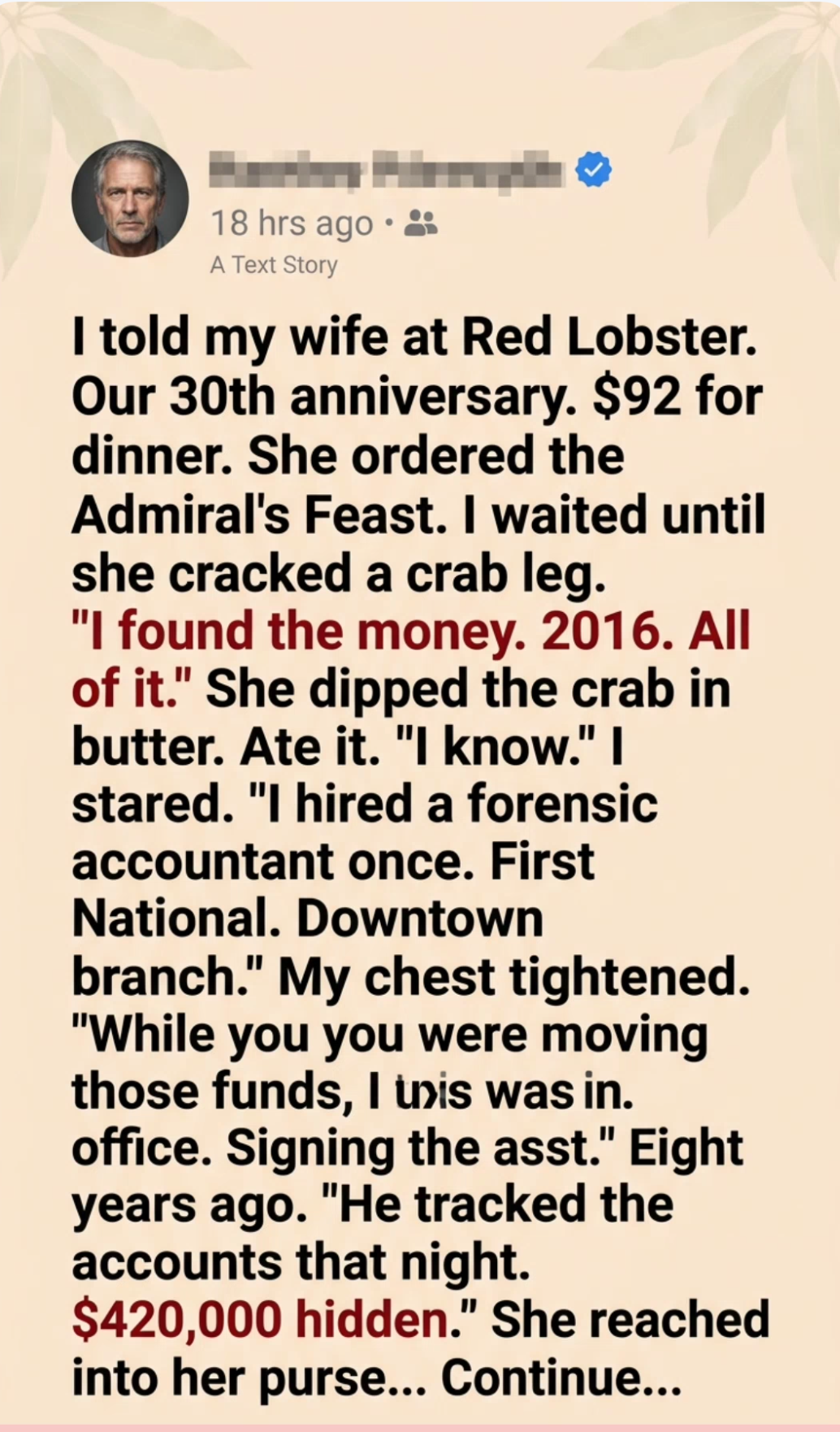
“I found the money,” I said.
She didn’t look up.
“What money?”
“The money from 2016. All of it.”
Her fingers paused briefly.
Then she dipped the crab meat into melted butter and ate it.
“I know,” she said.
For a moment, I thought I had misunderstood her.
“You know?”
Elaine placed the shell on her plate.
“I hired a forensic accountant once. First National. Downtown branch.”
My chest tightened.
“What?”
“While you were moving those funds, I was in the office signing the asset lock.”
I stared at her.
Eight years earlier, I had discovered that $420,000 had disappeared from our joint financial picture.
At first, I thought it was a mistake. Then I found transfers, unfamiliar account numbers, and statements that didn’t match the records I had kept for our household.
I had confronted Elaine.
She denied knowing anything about it.
We argued for weeks. I became suspicious of every phone call and every withdrawal. She accused me of treating her like a criminal.
Eventually, the money became something we stopped discussing.
Or so I had believed.
I leaned closer.
“You knew where it went?”
Elaine wiped her fingers with a napkin.
“I knew where some of it went. I didn’t know everything.”
“Then why didn’t you tell me?”
She looked at me for several seconds.
“Because I was trying to find out whether you had taken it.”
The words landed harder than I expected.
“Me?”
She nodded.
“Your name was on the transfer authorization.”
“I told you. I didn’t make those transfers.”
“I know that now.”
I lowered my fork.
“Elaine, what are you talking about?”
She opened her purse and removed a small envelope. It was cream-colored, slightly worn around the edges, and sealed with a strip of clear tape.
She placed it between our plates.
“I brought this because I knew you would eventually tell me what you found.”
I didn’t touch it.
“What’s inside?”
“Something I should have shown you eight years ago.”
I looked at the envelope, then at my wife.
She wasn’t angry. She wasn’t crying. She seemed exhausted in a way I had never noticed before.
I opened it.
Inside were photocopies of bank records, a letter from an attorney, and a handwritten note dated September 14, 2016.
The bank records showed the same account numbers I had spent months investigating.
But there was something else.
A transfer authorization bearing my signature.
Except it wasn’t my signature.
It was close enough to fool someone glancing at it, but the final stroke of the letter R was wrong. I always finished my signature with a small upward hook.
This one ended abruptly.
“Who signed this?” I asked.
Elaine took a breath.
“Your brother.”
My brother, Martin.
I hadn’t spoken to him in almost two years.
Back in 2016, Martin had been running a small construction company. He was charming, persuasive, and perpetually short of money. He had borrowed from me several times, always promising to repay everything.
I had helped him because he was family.
Then he asked me to guarantee a business loan.
I refused.
He told me I would regret treating him like a stranger.
Two months later, the money disappeared.
I looked at the paperwork again.
“Why would Martin have access to our accounts?”
“He didn’t have access to the accounts,” Elaine replied. “He had access to the documents you left in your home office.”
I remembered those documents.
Years earlier, I had allowed Martin to help organize some paperwork while I was recovering from surgery. He knew our bank, our account numbers, and the names of our financial advisers.
I felt sick.
Elaine continued.
“I noticed the first transfer because the balance was wrong. I thought you had moved the money into another investment. When I asked, you became defensive.”
“I was defensive because I hadn’t moved anything!”
“I know.”
“Then why didn’t you tell me what you suspected?”
She looked down at her plate.
“Because Martin called me before I could speak to you.”
I stopped breathing for a second.
“What did he say?”
“He told me you were having financial problems. He said you had authorized him to move the money temporarily because you were worried about a lawsuit involving your business.”
“That was a lie.”
“Yes.”
Elaine’s voice remained quiet.
“He also told me that if I confronted you, I would destroy your relationship with your brother. He said you had made promises to him that I didn’t understand.”
I stared at her.
Martin had always been good at making his problems sound like emergencies that everyone else was obligated to solve.
But this was different.
He hadn’t merely borrowed money.
He had forged my signature.
“How much did you know?” I asked.
“Enough to understand that someone had taken money from us. Not enough to know where it all went.”
“And the forensic accountant?”
“I hired him after I found the second transfer.”
She explained that she had contacted an attorney and arranged for an independent review. The accountant traced the transactions through several accounts, but the investigation took time because some of the money had been moved through a business account connected to Martin.
The accountant advised her not to confront him until the records were complete.
During that period, she had signed documents with the bank to restrict certain transactions and protect what remained in our accounts.
The asset lock had not been a way to punish me.
It had been an attempt to prevent further losses.
“Why didn’t you tell me?” I asked again.
Elaine finally looked directly at me.
“Because the accountant found something else.”
She turned over the handwritten note.
It was written in Martin’s handwriting.
I recognized the uneven letters immediately.
The note was short.
Elaine, I know you think you’re protecting him. But if he learns what happened, he’ll never forgive me. I can return the money when the company sells. Please don’t involve him yet.
I read it twice.
Then a third time.
“He wrote this to you?”
“He left it in our mailbox.”
“When?”
“October 2016.”
I put the note down.
“Why would you keep this from me for eight years?”
Elaine’s eyes filled with tears, but she didn’t let them fall.
“Because I was afraid you would go after him without thinking. I was afraid you’d lose your business, your savings, and your relationship with your brother all at once.”
“He stole from us!”
“I know.”
“He forged my signature!”
“I know.”
“Elaine, you let me spend eight years wondering whether I had somehow forgotten moving $420,000!”
Her face tightened.
“You weren’t the only person who spent eight years wondering what happened.”
The anger in my chest suddenly had nowhere to go.
She reached for her glass of water.
“I spent those years wondering whether I had made the right decision. Whether protecting you from the truth had only made everything worse.”
I looked at the envelope.
The attorney’s letter was dated January 2017. It described a formal demand for repayment and a proposed agreement involving Martin’s company.
There were several pages of financial records, including a schedule of transfers.
The total was $420,000.
All of it had been traced.
But the final page showed that only $86,000 had been recovered.
“What happened to the rest?” I asked.
“Martin’s company failed.”
I closed my eyes.
“He went bankrupt?”
“Not immediately. He sold equipment, closed his office, and moved. The attorney recovered what he could. After the legal fees and other expenses, the amount we received was much smaller than what was taken.”
“Did he ever contact you again?”
“Twice.”
“What did he say?”
“That he was sorry. That he had made mistakes. That he wanted to make things right.”
I looked at her.
“Did you believe him?”
“No.”
She said it without hesitation.
Then she took a small sip of water.
“I didn’t want an apology that depended on him needing something from us.”
I sat silently while the restaurant continued around us.
A waiter passed our table and asked whether everything was all right.
Elaine smiled politely.
“Everything’s fine, thank you.”
When he walked away, I looked at her.
“You said you knew I found the money. How?”
She reached into her purse again and removed a folded document.
It was a statement from an account I recognized.
My personal savings account.
The one I had opened after we discovered the missing money.
I had gradually rebuilt it through overtime, careful spending, and several years of postponing vacations.
The statement showed a deposit of $12,500.
I frowned.
“I didn’t put this in.”
“I did.”
“What?”
Elaine folded her hands.
“It’s money I had kept aside from my consulting work. I wanted to replace some of what we lost.”
“You didn’t have to do that.”
“I know.”
“Why didn’t you tell me?”
“Because I wanted to do it without making you feel that I was paying you back for something I hadn’t done.”
I stared at the statement.
For eight years, I had believed my wife had been hiding something from me.
She had been hiding something.
But it wasn’t another account filled with stolen money.
It was her own fear, her own investigation, and her own attempt to repair a financial wound that neither of us knew how to discuss.
I looked at her across the table.
“Did you ever think I took it?”
Elaine didn’t answer immediately.
“During the first month, yes.”
That hurt.
She continued.
“I didn’t want to think that. But the paperwork had your name on it, and Martin insisted you had approved everything. I didn’t know what to believe.”
“And now?”
“Now I know.”
“How?”
She gently touched the envelope.
“Because I watched you spend eight years trying to replace money you didn’t lose. You never asked me to cover it. You never blamed me for the missing funds. You worked extra shifts, canceled trips, and repaired things instead of replacing them.”
She looked at my hands.
“You even kept the old car after the transmission started slipping because you thought we needed to rebuild our savings.”
I felt my throat tighten.
“I thought I was doing the responsible thing.”
“You were.”
She reached across the table and placed her hand over mine.
“But you were doing it alone.”
That sentence hurt more than the accusation.
I had been so consumed by proving I hadn’t stolen our money that I had stopped asking what my wife was experiencing.
And she had been so determined to protect me from the truth that she had made herself my only witness and my only suspect.
We sat quietly.
Eventually, Elaine pushed her plate away.
“I need to tell you one more thing.”
I looked up.
“There’s no more money missing, is there?”
“No.”
“Then what?”
She reached into the envelope and removed a final sheet.
It was a copy of an email from Martin, dated just three weeks earlier.
He had written to her.
He was living in Arizona now. His construction company was gone, and he had been working for a building supplier. He said he had recently become a grandfather.
He wanted to visit.
He wanted to see me.
And he wanted to explain.
I read the message slowly.
The final paragraph said:
I know I don’t deserve forgiveness. I just don’t want to die with my brother believing I never cared about him.
I placed the page on the table.
“Did you answer him?”
“No.”
“Why not?”
“Because I couldn’t answer for you.”
I looked toward the restaurant windows.
Outside, cars moved through the parking lot beneath the streetlights. People were arriving for dinner, carrying flowers and gift bags.
I thought about Martin when we were boys.
He had taught me how to ride a bicycle. He had defended me when older children teased me. He had once walked three miles through the rain to bring me a jacket I had forgotten at school.
Those memories didn’t disappear because he had stolen from me.
But they didn’t make what he had done any smaller.
“I don’t know if I can forgive him,” I said.
Elaine nodded.
“You don’t have to decide tonight.”
I turned back toward her.
“And I don’t know if I can forgive you for keeping this from me.”
Her eyes finally filled.
“I understand.”
I reached for her hand.
“But I don’t want to spend another eight years pretending we don’t have something to talk about.”
She squeezed my fingers.
“Neither do I.”
We didn’t finish the conversation that night.
We didn’t suddenly become the perfect couple.
We paid the bill, drove home, and sat in the kitchen for another hour while the coffee machine made noises it had been making for fifteen years.
We discussed the missing money, the investigation, and the years of silence.
For the first time, I heard the parts of the story Elaine had carried alone.
She heard mine, too.
I told her about the embarrassment of seeing my brother’s name on the records. I told her how I had questioned my own memory and how I had quietly wondered whether she believed me.
She told me how frightened she had been when Martin threatened to make our marriage his next casualty.
Neither of us was entirely right.
Neither of us was entirely innocent.
But we were finally speaking honestly.
Two weeks later, Martin called.
I recognized his number immediately.
For several seconds, I watched the phone ring.
Then I answered.
“Hello?”
There was a pause.
“It’s me.”
“I know.”
He sounded older than I remembered.
His voice was thinner, and he spoke slowly, as though every sentence required preparation.
“I heard you got the records.”
“Elaine showed me.”
Another pause.
“I should have told you.”
“Yes,” I said. “You should have.”
“I was desperate. The company was failing. I thought I could borrow the money, fix things, and put it all back before anyone noticed.”
“You forged my signature.”
“I know.”
“You let me believe I had done something wrong.”
“I know.”
“You let Elaine carry the truth.”
He didn’t answer.
I waited.
Finally, he said, “I’m sorry.”
I had imagined hearing those words for years.
I thought they would make me feel better.
They didn’t.
“Martin, I don’t know what happens next.”
“I understand.”
“I won’t lend you money. I won’t guarantee anything. And I won’t pretend what happened was a misunderstanding.”
“I wouldn’t ask you to.”
“But if you want to speak to me, you can do that. Slowly. And honestly.”
He began crying.
I didn’t tell him everything was forgiven.
I didn’t tell him we were brothers and that family always comes first.
Some things are too important to repair with a sentence.
Instead, I said, “I’ll talk to you again next week.”
And I meant it.
The following Sunday, Elaine and I walked through the neighborhood after breakfast.
The trees were beginning to lose their leaves. She slipped her arm through mine, and we walked without rushing.
At the corner, she asked, “Do you regret telling me that night?”
I thought about the restaurant, the crab shells, the envelope, and the money.
“No,” I said. “I regret waiting eight years.”
She leaned her head against my shoulder.
“Me too.”
Thirty years of marriage hadn’t made us immune to fear, mistakes, or silence.
It had simply given us enough shared history to understand that love wasn’t always about protecting each other from painful truths.
Sometimes love meant sitting across a dinner table, opening an envelope, and finally allowing the other person to know what had happened.
The $420,000 was never fully recovered.
My brother and I never returned to the relationship we had before 2016.
And Elaine and I still had difficult conversations ahead of us.
But something changed after that anniversary dinner.
We stopped treating silence as a form of protection.
Because the most expensive thing we had lost in 2016 wasn’t the money.
It was eight years of believing we had to carry the truth alone.
THE END.