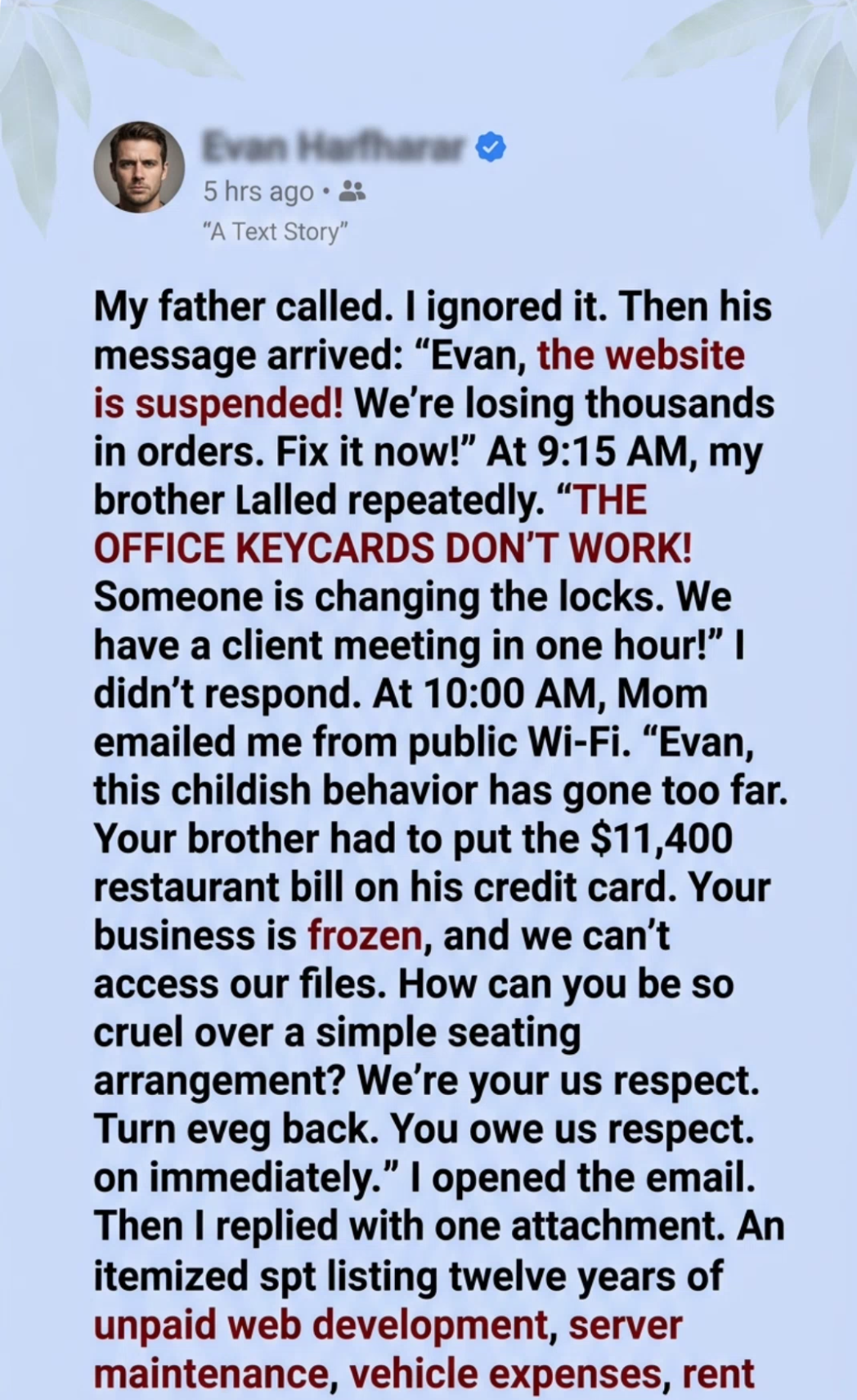
My father’s first call came at 8:42 on a Monday morning.
I watched his name appear on my phone while I sat at my kitchen table, eating toast and reviewing a proposal for a new client.
I didn’t answer.
A voicemail arrived less than a minute later.
Then a text.
Evan, the website is suspended! We’re losing thousands in orders. Fix it now!
I read it twice.
Then I put my phone facedown.
At 9:15, my younger brother, Logan, called.
I ignored him too.
He called again.
And again.
Finally, a message appeared.
THE OFFICE KEYCARDS DON’T WORK! Someone is changing the locks. We have a client meeting in one hour!
I took another sip of coffee.
At 10:00, my mother emailed me from what appeared to be a public Wi-Fi connection.
Her subject line was:
YOUR BEHAVIOR HAS GONE TOO FAR.
The message was even worse.
Evan, this childish behavior has gone too far. Your brother had to put the $11,400 restaurant bill on his credit card. Your father’s business is frozen, and we can’t access our files.
How can you be so cruel over a simple seating arrangement?
We’re your family. You owe us respect. Turn everything back on immediately.
I read the email without moving.
Then I opened a folder on my computer.
Inside was a spreadsheet I had spent three evenings preparing.
It contained twelve years of work, payments, unpaid invoices, personal expenses, and financial assistance I had provided to my parents’ company.
I attached it to a reply.
My message contained only one sentence.
Since you believe this is about a seating arrangement, I thought you should see what our family arrangement has actually cost me.
Then I pressed send.
But to understand why my family’s business had suddenly stopped functioning, I need to explain what happened at my brother’s engagement dinner the previous Saturday.
Because it wasn’t really about a seating arrangement.
It was about twelve years of being treated as the person who fixed everything, paid for everything, and quietly disappeared whenever the family wanted to celebrate someone else’s success.
My father, Richard, owned a commercial printing and promotional products company called Carter Creative.
He had started it in a rented garage when I was twelve.
At first, it was just him, one used printing machine, and a handful of local customers.
My mother handled invoices.
My brother, Logan, helped during school holidays.
And I was the child who liked computers.
When I was sixteen, I built my father’s first website.
It was basic, but it worked.
Customers could see the company’s services, request estimates, and send files for printing.
My father was delighted.
“That’s my boy,” he said, patting my shoulder. “One day, you’ll run all the technology for this place.”
I believed him.
After high school, I studied information systems. I worked part-time, built websites for local businesses, and gradually developed enough experience to earn a decent living.
My father asked me to help Carter Creative whenever something broke.
At first, it was occasional.
A printer couldn’t connect to the network.
An employee forgot a password.
The website needed an update.
I never charged him.
He was my father.
Then the company grew.
It moved into a larger office, hired more employees, and began accepting online orders.
I built a new website with a custom ordering system.
I connected the payment processor, configured the email notifications, organized the customer database, and set up automatic backups.
My father called it a miracle.
“You’ve saved us thousands,” he said.
I smiled.
I thought we were building something together.
But as the years passed, the requests became bigger.
The website needed maintenance.
The server needed monitoring.
The office network needed replacing.
The company needed new computers.
My father wanted a secure file-sharing system so customers could upload large print designs.
Logan wanted a mobile-friendly ordering portal.
My mother needed help recovering accounting records.
I handled all of it.
Sometimes I worked late into the night.
Sometimes I drove across town because an employee couldn’t access a file.
Sometimes I paid for software subscriptions because my father said the company’s bank account was temporarily tight.
“Put it on your card,” he would tell me. “I’ll reimburse you next month.”
Next month became the following month.
Then the following year.
I didn’t complain.
I had a good job, and I believed the business was something I was helping my family build.
I also believed my father remembered every favor.
I was wrong.
By the time I turned thirty-four, Carter Creative was generating substantial revenue.
My father had purchased a larger building.
Logan had become operations manager.
My mother handled the accounts.
I had my own technology consultancy and several regular clients.
But Carter Creative still relied on systems I had built and maintained.
I had never received a formal salary from the company.
I had never been given shares.
I had never signed an employment agreement.
My father always said we would work everything out later.
“Family doesn’t need paperwork,” he liked to say.
That sentence eventually cost me more than I could calculate.
The trouble began when Logan announced his engagement to a woman named Brooke.
My parents were thrilled.
They planned a large celebration at an expensive restaurant.
I received the invitation in a family group chat.
The dinner was scheduled for Saturday evening.
I arrived twenty minutes early.
My mother was already there, checking the table arrangements with the restaurant manager.
My father stood near the entrance, talking about the guest list.
Logan was in the private dining room with Brooke.
I walked over to the seating chart.
My name was printed near the far end of the table.
Not beside my parents.
Not beside my brother.
I was seated next to two employees from the company whom I barely knew.
I looked at the chart again.
My younger sister, Olivia, was seated beside Logan and Brooke.
My parents were directly opposite them.
I assumed there had been a mistake.
I found my mother.
“Mom, I think my seat is wrong.”
She glanced at the chart.
“No, that’s where you’re sitting.”
“Why am I at the end?”
“Because we’re keeping the important family members together near Logan and Brooke.”
I stared at her.
“I’m not an important family member?”
She sighed.
“Evan, don’t start.”
I lowered my voice.
“I built the company’s website. I still manage the systems. I helped pay for the office equipment. And I’m sitting beside two people I barely know?”
My mother looked around to see whether anyone was listening.
“It’s Logan’s night.”
“I understand that.”
“Then let him have his moment.”
I wanted to argue.
Instead, I walked outside.
My father found me near the entrance.
“What are you doing out here?”
“Trying to understand the seating arrangement.”
He shook his head.
“Your mother already explained it.”
“Dad, I’m not asking to sit beside Logan. I’m asking why I’m being treated like an outsider.”
My father looked annoyed.
“Don’t make this about yourself.”
“It’s not about the chair. It’s about everything.”
He stepped closer.
“Everything what?”
I took a breath.
“Twelve years of work. Twelve years of fixing the company’s problems. Twelve years of paying for things that were supposed to be reimbursed.”
His expression changed.
“Here we go.”
“I’m serious.”
“So am I. This is a family celebration. If you can’t put your ego aside for one evening, maybe you shouldn’t come.”
I stared at him.
Then I said, “Maybe I shouldn’t.”
I walked back inside.
I didn’t make a scene.
I didn’t shout.
I simply collected my coat and left.
I drove home and sat in my car for almost twenty minutes.
I had spent years convincing myself that my family’s behavior was temporary.
That my father was under pressure.
That Logan was young.
That my mother was trying to keep everyone happy.
But I had finally realized something.
They didn’t see me as someone who had helped build the business.
They saw me as a service they could summon whenever they needed something.
And services were expected to work.
They weren’t expected to sit at the important table.
That night, I opened my laptop.
I reviewed my contracts, account records, server agreements, and expense statements.
I also contacted my business lawyer.
I wanted to know exactly what I was responsible for and what I could legally stop providing.
There was an important distinction.
I did not own Carter Creative’s business data.
I did not own its customer database.
I did not own the office.
And I had no intention of taking anything that belonged to the company.
But I did own my independent software, my consultancy’s server infrastructure, and the accounts through which I provided certain contracted services.
Some services were covered by written agreements.
Others were informal arrangements that had never been properly documented.
My lawyer advised me to separate everything carefully.
He also told me not to delete, hold hostage, or interfere with company records.
If I wanted to end my services, I needed to give appropriate notice, preserve access to company-owned information, and arrange a proper handover.
That was exactly what I planned to do.
The following Monday, I sent my father a formal notice.
I explained that I would no longer provide unpaid technical support.
I gave him a transition schedule, listed the company-owned accounts, and offered to help transfer administrative access to a qualified replacement.
I also informed him that my personal subscriptions and privately owned systems would be separated from the company’s accounts.
My father didn’t reply.
My mother sent a message.
You’re being emotional. We’ll talk when you calm down.
Logan wrote:
Don’t be ridiculous. We have orders to process.
I didn’t respond.
I contacted the hosting provider and began the process of transferring the company website to an account controlled by Carter Creative.
I did not suspend it.
The suspension that happened later was related to an unpaid hosting renewal on an account my consultancy had previously paid for.
I had notified my father of the renewal date and the amount due.
He hadn’t arranged payment or transferred the account.
When the provider suspended the service, it did so under its standard billing policy.
The office keycards were another matter.
The building belonged to a property company that my consultancy had been paying on behalf of Carter Creative under a temporary facilities arrangement.
My father had repeatedly delayed reimbursing those payments.
When I ended the arrangement, the property company requested that Carter Creative establish its own lease account and provide updated authorized-user information.
The access issue was caused by an administrative change during that process.
I had not secretly changed the locks.
I had not entered the office.
I had not touched the company’s records.
But my family didn’t know that.
Or perhaps they knew and simply preferred a different story.
At 8:42 on Monday morning, my father called.
I ignored it.
His message arrived.
Evan, the website is suspended! We’re losing thousands in orders. Fix it now!
At 9:15, Logan started calling.
Then came the email from my mother.
And finally, I sent the spreadsheet.
It was forty-seven rows long.
Every item had a date, description, amount, and supporting record.
The first section covered web development.
-
Original company website: $6,800.
-
Complete ordering platform redesign: $14,500.
-
Customer upload system: $7,200.
-
Online payment integration: $3,400.
-
Mobile ordering improvements: $5,600.
The second section covered twelve years of maintenance.
-
Server monitoring.
-
Security updates.
-
Software licenses.
-
Backup management.
-
Emergency support.
-
Database repairs.
-
Email configuration.
-
Network troubleshooting.
The third section covered personal expenses I had paid for the company.
-
Replacement office computers.
-
Network equipment.
-
Software subscriptions.
-
Emergency hardware purchases.
-
Temporary hosting payments.
The fourth section was the one I knew would upset my father most.
It listed personal assistance.
Rent payments I had made when the company was struggling.
Two vehicle repairs for the delivery van.
A temporary insurance payment.
A supplier invoice I had covered because the company account had been overdrawn.
And several months of emergency cash advances.
I had supporting documents for nearly everything.
At the bottom, I included three totals.
Documented services and development: $126,400.
Expenses and payments made on behalf of the company: $38,750.
Payments received from Carter Creative: $11,200.
The outstanding balance was not presented as an automatic legal debt. Some items were informal family assistance, and some would require review to determine whether they were properly recoverable.
But the spreadsheet showed the scale of what I had contributed.
The final line read:
Total documented value provided over twelve years: $165,150.
I had received $11,200.
The rest had either been unpaid work, unreimbursed expenses, or assistance I had never formally billed.
I sent the spreadsheet.
For twenty-three minutes, nobody responded.
Then my phone rang.
My father.
This time, I answered.
“What is this?” he demanded.
“An accounting.”
“You expect me to pay you one hundred and sixty-five thousand dollars?”
“I expect you to understand what I’ve been doing for twelve years.”
“You never told me you were keeping track!”
“I sent invoices. I sent expense summaries. I sent renewal reminders. You told me we’d settle everything later.”
“Those were family favors!”
“Then why did you put the company orders through systems I built and maintained?”
He went quiet.
I continued.
“I am not asking you to pay every amount immediately. I’m asking for an independent review of the records and a proper agreement going forward.”
He scoffed.
“You’re holding the business hostage.”
“No. I’m ending an arrangement that was never properly defined.”
“The website is down!”
“The hosting provider suspended it after the renewal wasn’t paid. The company has the information needed to transfer the account. I can assist with the handover under a written agreement.”
“You can fix it in five minutes!”
“Then hire someone who can.”
He hung up.
I thought that would be the end of it.
It wasn’t.
That afternoon, Logan called again.
His voice was different.
Less angry.
More anxious.
“Evan, we need to talk.”
“About what?”
“The office access.”
“I don’t control the building.”
“Dad says you arranged it.”
“I ended the temporary payment arrangement. The property manager needs a new lease account and authorized-user list.”
“You could have warned us.”
“I did. The notice was sent two weeks ago.”
He went quiet.
Then he said, “We have a client meeting tomorrow.”
“Then contact the property manager.”
“Dad doesn’t know how.”
“Then he should ask.”
Logan exhaled sharply.
“You’re really doing this?”
“Yes.”
“Over a seating arrangement?”
I closed my eyes.
“No, Logan. Over twelve years of being treated like I don’t matter unless something breaks.”
He didn’t respond.
Then he said, “Mom thinks you’re trying to destroy the company.”
“I’m not.”
“Dad thinks you want shares.”
“I want a fair agreement for the work I do. If the company doesn’t want to pay for it, it can hire someone else.”
Logan was silent for a moment.
Then he asked, “How much of the website can we access?”
“All company-owned customer records and files are available through the existing backup. The administrator credentials are listed in the handover document I sent.”
“Why didn’t you just give us everything?”
“I did.”
He ended the call.
Two days later, my father asked for a meeting.
I agreed, but only after my lawyer confirmed that the meeting would be limited to the business arrangements.
We met in a conference room at a neutral office.
My father arrived with my mother and Logan.
They looked tired.
My father placed the spreadsheet on the table.
“I don’t accept these numbers.”
“That’s why I included the supporting records.”
He turned several pages.
“You can’t charge us for every phone call.”
“I’m not.”
“Some of this was helping your family.”
“Some of it was. That’s why I separated the expenses and services.”
My mother interrupted.
“Your father gave you opportunities. He helped you when you were young. You can’t put a price on everything.”
I looked at her.
“I haven’t.”
She frowned.
“You’re making it sound as if we owe you for raising you.”
“I never charged you for raising me.”
The room became quiet.
I continued.
“I built the company’s systems because I wanted to help. I maintained them because Dad kept promising we’d formalize the arrangement. I paid expenses because I believed the company would reimburse me. But I never agreed to provide twelve years of professional work for free.”
My father folded his arms.
“So what do you want?”
“A proper handover, an independent review of the documented expenses, and a written agreement for any future work.”
“And the website?”
“Your company can own and operate its customer data. The software I developed under my consultancy needs to be handled according to the contracts and licensing arrangements. My lawyer has outlined the options.”
Logan looked at the spreadsheet.
“Could you just come back and manage everything for a salary?”
I almost laughed.
“Why would I do that?”
“Because you know the systems.”
“I also know how much work they require.”
My father looked angry.
“You’re my son.”
I met his eyes.
“And I was your son at the dinner, too.”
Nobody spoke.
That was the first time I had mentioned the seating arrangement since leaving the restaurant.
I didn’t need to say more.
The meeting ended without an agreement.
But something had changed.
My father could no longer pretend that the business had grown without my contribution.
Over the next six weeks, Carter Creative hired an independent IT firm.
The transition was expensive.
The new firm had to document the systems, move the website to company-controlled hosting, replace several outdated integrations, and establish proper access controls.
The website eventually returned.
Orders resumed.
The office access was restored once the property agreement was updated.
The company had lost several days of online sales and paid for emergency technical support.
The $11,400 restaurant bill turned out to be unrelated to the technical problems.
Logan had charged the engagement dinner to his personal card because he had forgotten to arrange the company payment card.
My mother had included it in her email because she believed it proved that the family was suffering financially.
It proved nothing of the kind.
But the most surprising development came from my father’s accountant.
After reviewing my records, he confirmed that several expenses had been improperly recorded as personal contributions rather than company costs.
He also found that my father had repeatedly approved payments to me for small reimbursements but had failed to process the larger invoices I had submitted.
The accountant recommended that the company negotiate a settlement for the expenses that could be substantiated.
Some of the development work was disputed because there had never been a formal contract.
Rather than spend years fighting, I agreed to a negotiated settlement for documented expenses and a portion of the professional services.
The final amount was $42,600.
It was less than the total value I had documented.
But it was a meaningful acknowledgment that the company had benefited from work it had never properly paid for.
I didn’t use the money to punish my parents.
I used it to pay down my business loan, replace my aging laptop, and build an emergency fund.
I also stopped providing informal support.
If Carter Creative needed my services, it would need a contract like any other client.
My father didn’t like that.
For several months, we barely spoke.
My mother sent messages about birthdays and family gatherings.
Logan occasionally asked technical questions.
I answered only when the request came through the company under its new agreement.
Then, about eight months after the engagement dinner, my father called.
“Evan, can we have lunch?”
I almost said no.
But something in his voice sounded different.
We met at a small restaurant near his office.
He arrived early.
For a while, we talked about ordinary things.
The weather.
His health.
My consultancy.
Then he put down his fork.
“I owe you an apology.”
I didn’t respond immediately.
He continued.
“I thought because you were my son, you would always help. I didn’t realize how much I was asking.”
I looked at him.
“You knew I was doing the work.”
“Yes.”
“You knew I wasn’t being paid properly.”
He nodded.
“I kept telling myself we’d settle it later.”
I waited.
He looked down.
“And I shouldn’t have let your brother treat you like that at dinner.”
That was the apology I hadn’t expected.
Not a speech about how families should forgive each other.
Not an excuse about stress or business.
Just an acknowledgment.
“I didn’t need the best seat, Dad,” I said.
“I know.”
“I needed to feel like I mattered when there wasn’t a problem for me to fix.”
He nodded slowly.
“I understand that now.”
I wasn’t ready to say everything was forgiven.
But I was willing to keep talking.
Our relationship improved gradually.
My father learned to ask instead of assume.
Logan hired a proper IT company and began learning the basics of managing the systems himself.
My mother stopped sending messages about respect whenever I refused a favor.
We still had disagreements.
But the old arrangement was over.
The following year, Logan hosted another family celebration.
This time, it was his wedding.
The seating chart arrived by email.
My name was beside my parents.
I looked at it for a moment.
Then I replied that I would attend.
At the reception, my father raised his glass.
He thanked everyone who had supported the family over the years.
Then he looked at me.
“And I want to thank Evan. He helped build the systems that kept our company running for a long time. I didn’t always recognize what that meant, and I should have.”
The room applauded.
I didn’t stand up.
I didn’t make a speech.
I simply nodded.
For years, I had believed that being useful was the same as being valued.
I had believed that if I kept fixing things, paying for things, and making life easier for everyone else, eventually my family would recognize what I meant to them.
But that wasn’t how respect worked.
Respect wasn’t a reward for being available.
And family wasn’t a lifetime contract requiring one person to carry everyone else’s responsibilities.
My father once told me that I owed him respect because he was my father.
I finally understood that respect could be given without surrendering my boundaries.
I still love my family.
I just don’t run their business for free anymore.
And whenever my phone rings now with a request to fix something, I ask one question before I agree.
“What’s the agreement?”
Because sometimes the most important thing you can build isn’t a website, a business, or a family company.
It’s a boundary that allows you to remain part of your family without losing yourself in the process.
THE END.