The first thing I noticed was that nobody asked where I was going to live.
I was standing in my father’s study, holding a folder containing the latest draft of my will. My mother, Linda, was sitting on the leather sofa. My younger brother, Jason, was scrolling through his phone, and my sister, Rebecca, was discussing the renovation of the house she had recently purchased.
They were talking about my money.
Again.
My mother wanted me to increase the monthly allowance because the mortgage had become more expensive. Rebecca wanted help furnishing her new kitchen. Jason wanted to replace his truck.
Nobody asked whether I was happy.
Nobody asked whether I was tired.
Nobody asked whether the business I had spent twenty years building was still doing well.
They simply assumed the money would continue arriving.
For nearly six years, I had sent my family $30,000 every month.
It wasn’t one payment to one person. It was divided among several accounts.
My parents received $12,000 for their household expenses and mortgage.
Rebecca received $8,000 to help with her home and children.
Jason received $5,000 to support his business.
The remaining $5,000 covered insurance, occasional medical bills, and other family expenses.
I also paid for their additional credit cards, travel arrangements, vehicle insurance, and several unexpected purchases.
At first, I had been happy to help.
My father had worked hard to raise us. My mother had sacrificed a great deal. Jason and Rebecca had struggled financially at different points in their lives.
I had been fortunate.
After years of working, taking risks, and building a successful consulting company, I had more money than I needed for an ordinary life.
I wanted my family to enjoy some of the security I had worked so hard to achieve.
But somewhere along the way, helping them had become an obligation.
And the more I gave, the less they seemed to notice.
That afternoon, I had brought my updated will to my father’s house because my attorney had asked me to review a few family provisions.
I had been considering leaving a substantial portion of my estate to my parents and siblings.
I thought it was the right thing to do.
Then I heard my mother speaking.
“Once the new will is signed, we should be able to organize everything properly,” she said.
Jason looked up.
“Are you leaving the house to us?”
My mother shrugged.
“Your father and I should be taken care of first. The children can divide whatever is left.”
Rebecca laughed.
“Honestly, I don’t see why we need to wait. He already gives us enough every month.”
Jason nodded.
“Exactly. It’s not like he has children or anyone else depending on him.”
I stood in the doorway.
Nobody had noticed me.
My mother continued.
“He has plenty of money. It’s not as though thirty thousand makes a difference to him.”
Rebecca added, “He probably spends more than that on his company.”
Then Jason said something that made me stop breathing for a moment.
“He’s always been like this. He needs to feel needed. If we stopped asking him for things, he’d probably get lonely.”
They laughed.
Not cruelly.
Not even angrily.
They laughed as if they were discussing something obvious.
I looked at the folder in my hands.
For years, I had believed my family depended on me because they loved me.
Standing there, I finally wondered whether they had simply learned that I would always pay.
My mother turned and saw me.
“Oh, you’re here.”
I nodded.
“I am.”
She looked at the folder.
“Did you bring the will?”
“Yes.”
“Good. Your father wants to know whether you’ve included the house.”
I walked into the room and placed the folder on the table.
“I’ll review it with my attorney.”
Jason frowned.
“Why? We already discussed what everyone needs.”
I looked at him.
“When did we discuss what I want?”
Nobody answered.
My mother gave a small sigh.
“Don’t make this difficult. We’re family.”
I picked up my coat.
“I know.”
Then I left.
I didn’t argue.
I didn’t tell them what I had heard.
I didn’t cry in front of them.
I drove home, placed the will back in my safe, and sat in my office for almost an hour.
That night, I made a decision.
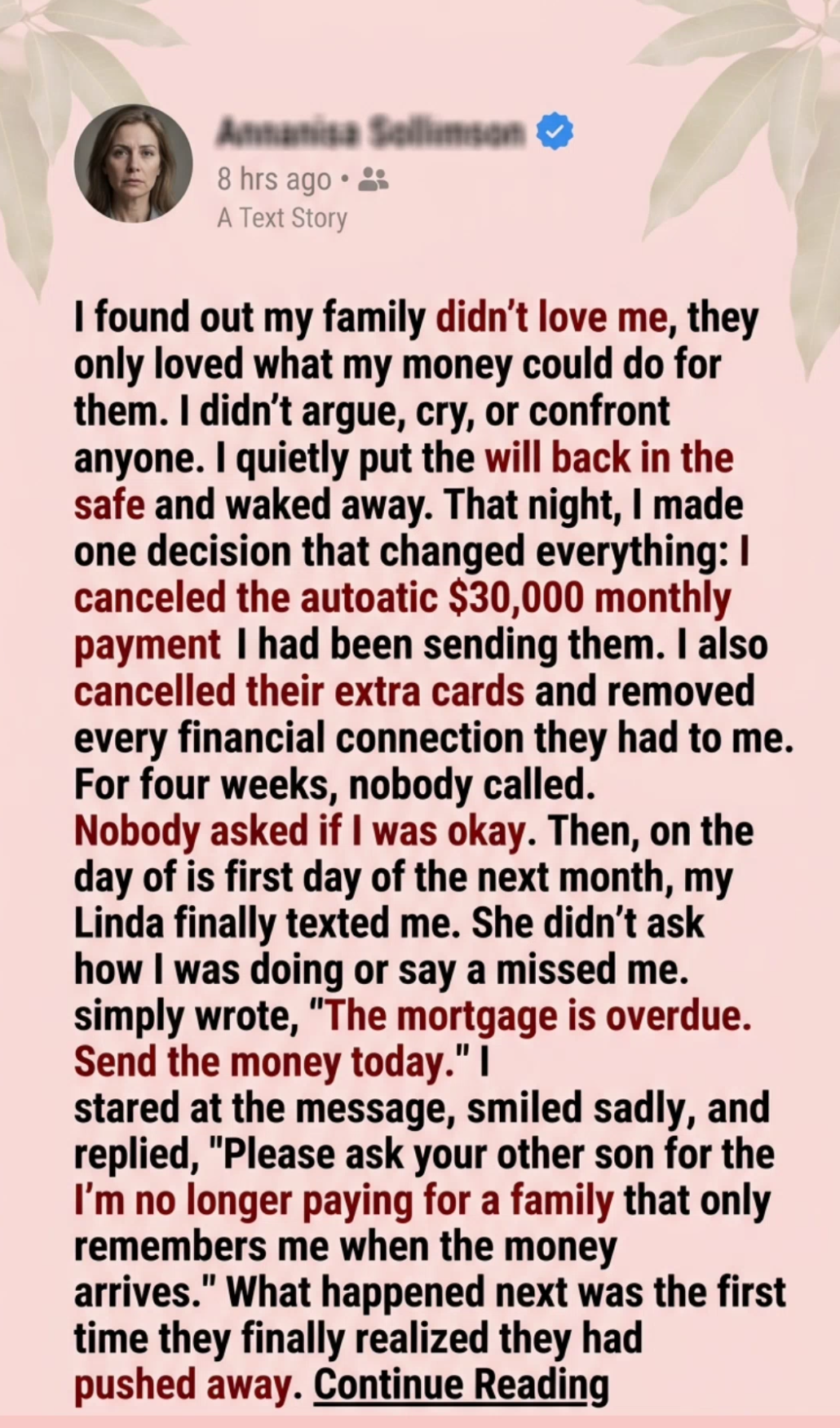
I canceled the automatic $30,000 monthly transfer.
I contacted the credit card company and removed my family members as authorized users.
I canceled the additional cards linked to my accounts.
I removed the automatic payments for their insurance premiums and household expenses, making sure any necessary notices were sent so nobody would be left without coverage unexpectedly.
I also contacted my attorney and asked her to review every financial connection between me and my relatives.
Some arrangements required formal notice.
Others could be ended immediately.
I wanted everything handled properly.
I wasn’t trying to punish anyone.
I simply wanted to stop funding a relationship that no longer felt like one.
For the first week, nothing happened.
I went to work.
I met with clients.
I had dinner with a friend.
I went for walks in the evening.
I slept better than I had in months.
I kept checking my phone, though.
Part of me expected my mother to call.
Not to ask about the money.
Just to ask whether I was all right.
But the phone remained silent.
The second week passed.
Then the third.
I began to understand how much of my family life had been organized around money.
My mother used to call every few days.
Rebecca usually sent photographs of the children.
Jason would ask about business advice or invite me to dinner when he needed help with something.
Without the automatic payments, all those conversations disappeared.
On the twenty-eighth day, I realized nobody had contacted me once.
Not even to ask why.
Then came the first day of the next month.
At 9:06 in the morning, my phone vibrated.
It was a message from my mother.
I opened it immediately.
The mortgage is overdue. Send the money today.
That was all.
No greeting.
No question.
No explanation.
I stared at the screen.
Then I smiled sadly.
I typed:
Please ask your other son for the money. I’m no longer paying for a family that only remembers me when the money arrives.
I pressed send.
Within five minutes, my phone began ringing.
My mother called first.
I let it ring.
Then Jason.
Then Rebecca.
Finally, my father.
I answered his call.
“What is going on?” he demanded.
“Good morning, Dad.”
“Your mother says you stopped the payments.”
“Yes.”
“Why?”
“Because I decided to.”
He sounded irritated.
“You can’t just do that without telling anyone.”
“I gave notice where notice was required.”
“That’s not what I mean. Your mother has a mortgage payment due.”
“I know.”
“And you expect us to pay it?”
I leaned back in my chair.
“Yes.”
There was a long pause.
Then he said, “You’re being selfish.”
I almost laughed.
“Dad, I’ve been sending you money every month for six years.”
“That doesn’t mean you can suddenly abandon your responsibilities.”
“What responsibilities?”
“Your family!”
I looked out the window.
“I’m still your son. I’m still their brother. I’m not refusing to speak to anyone. I’m refusing to pay for everything.”
He lowered his voice.
“Your mother is very upset.”
“Did she ask whether I was okay?”
Silence.
I continued.
“She didn’t ask why I stopped. She didn’t ask whether something happened. She just demanded the mortgage payment.”
My father sighed.
“You know how your mother is.”
“Yes. I do.”
Then I ended the call.
That afternoon, Rebecca sent me a long message.
She said the children were confused because they had been expecting me to help pay for a family holiday.
She said I was putting everyone under unnecessary stress.
She also reminded me that I had promised to help with her kitchen renovation.
I replied that I would review any written commitments and honor legitimate obligations, but I would not continue making open-ended payments.
She answered:
I can’t believe you’re doing this over one conversation.
I didn’t reply.
Jason was more direct.
He arrived at my office the following morning.
My assistant called to say he was waiting in reception.
I almost told her to send him away.
Instead, I agreed to see him.
He entered carrying a folder.
“What’s this?” I asked.
He placed it on my desk.
“Business expenses.”
I looked at him.
“You want money?”
“I need a short-term loan.”
I closed the folder without reading it.
“Jason, I just stopped paying your monthly allowance.”
“This is different.”
“How?”
“My company has cash-flow problems.”
“Then you need to speak with your bank.”
He stared at me.
“You’re really going to let your own brother fail?”
I leaned forward.
“Do you remember what you said at Dad’s house?”
His expression changed.
“What?”
“You said I needed to feel needed. You said if everyone stopped asking me for things, I’d get lonely.”
He looked away.
“I was joking.”
“I wasn’t laughing.”
He shifted in his chair.
“Look, we didn’t mean it like that.”
“Then what did you mean?”
He didn’t answer.
I pushed the folder back toward him.
“I hope your business works out. But I can’t keep funding it.”
He stood.
“You’ve changed.”
I nodded.
“I hope so.”
He left without saying goodbye.
For the first time, I didn’t feel guilty.
I felt sad, but the sadness was different.
It wasn’t the sadness of being rejected.
It was the sadness of finally accepting what had been happening.
Two weeks later, my mother arrived at my house.
She didn’t call first.
I found her standing on the front porch with a handbag and a paper envelope.
I opened the door.
“Mom.”
She looked at me.
“Can I come in?”
I stepped aside.
She walked into the living room and sat on the sofa.
For a few moments, neither of us spoke.
Then she placed the envelope on the coffee table.
“Your father and I have been reviewing our expenses.”
I nodded.
“We need to know what you’re planning to do.”
“About what?”
“The monthly payments.”
“I’m not restarting them.”
Her mouth tightened.
“Your father thinks you should at least continue paying the mortgage.”
“Why?”
“Because we’ve lived in that house for thirty years.”
“I understand.”
“And we can’t afford it without your help.”
I looked at her.
“Then perhaps it’s time to make a different financial plan.”
She stared at me.
“You want us to sell our home?”
“I want you to live somewhere you can afford.”
Her eyes filled.
“Your father will never agree.”
“Then you need to discuss it with him.”
She looked down at her handbag.
After a moment, she said, “You have no idea how difficult things have become.”
I almost asked whether she had any idea how much I had carried.
Instead, I said, “Mom, I need to ask you something.”
She looked up.
“When was the last time you called me just to talk?”
Her expression changed.
“What do you mean?”
“When was the last time you called without needing money, help, a payment, or a favor?”
She opened her mouth.
Then closed it.
I waited.
She looked at the envelope.
“I suppose we’ve all become used to you helping.”
“That’s not an answer.”
She began crying.
“I didn’t realize you felt this way.”
I looked at her.
“You never asked.”
She wiped her cheeks.
“Your father and I thought you were happy.”
“Why?”
“Because you always said yes.”
I sat across from her.
“I said yes because I loved you. I didn’t say yes because I wanted to become responsible for everyone’s financial life.”
She nodded slowly.
Then she said something I hadn’t expected.
“Your father told me you had changed your will.”
I felt my stomach tighten.
“Who told him?”
“He found the draft in the study.”
I looked at her.
“The draft was not final.”
“Does it still leave everything to us?”
I sat quietly.
There it was again.
Not whether I was happy.
Not whether I was lonely.
Not whether I wanted a relationship with my family.
The will.
I answered honestly.
“No.”
Her face fell.
“Then what happens to everything you’ve built?”
“That’s for me and my attorney to decide.”
She stared at me for a long time.
Then she stood.
“I don’t know how we got here.”
I walked her to the door.
“Neither do I.”
She left the envelope on the coffee table.
I opened it after she was gone.
It contained a list of monthly household expenses.
Mortgage.
Utilities.
Insurance.
Groceries.
Property taxes.
The total was less than half the amount I had been sending them.
I realized that the $30,000 payment had never been properly reviewed.
Some of the money was being saved.
Some was being spent on things I hadn’t known about.
And some had gone toward expenses that weren’t my parents’ at all.
I called my attorney.
We reviewed the financial arrangements.
The mortgage was in my parents’ names, not mine.
I had no legal responsibility to keep paying it.
I had also never promised to provide unlimited financial support.
The attorney recommended that I keep all communication in writing and avoid making emotional promises.
I agreed.
Over the following month, I discovered that my family had been using my financial support to maintain a lifestyle they couldn’t afford independently.
My parents had taken expensive trips.
Rebecca had paid for private school activities and a vehicle upgrade.
Jason had expanded his business without a clear plan for profitability.
None of those choices were necessarily wrong.
But they had been made on the assumption that I would always cover the difference.
That assumption had to end.
I also discovered something more painful.
My mother had told relatives that I was financially supporting the family because I wanted to control them.
She had described the monthly payments as money I gave willingly in exchange for being included in family decisions.
I read the message from an aunt who had forwarded it to me.
Linda says you’re upset because they won’t let you make decisions about the house. She thinks you want everyone to depend on you.
I stared at the screen.
For years, I had believed I was helping my family.
Now I was being described as someone who used money to control them.
I didn’t respond to the relatives.
I simply stopped explaining myself.
Then something unexpected happened.
My father called one evening.
He sounded quieter than usual.
“Your mother and I are going to sell the house.”
I sat down.
“Are you sure?”
“We’ve spoken to an agent. The mortgage is too much for us without the monthly payment.”
“Where will you go?”
“We’re looking at a smaller place.”
I nodded.
“That’s probably sensible.”
He paused.
“Your mother doesn’t like it.”
“I understand.”
He cleared his throat.
“Your brother is going through some problems. His business may have to close.”
“I’m sorry to hear that.”
“He thinks you should help him one last time.”
I closed my eyes.
“Dad, I can’t.”
“I know.”
It was the first time he had said those words.
He continued.
“I suppose we’ve all relied on you too much.”
I didn’t know how to answer.
Then he said, “I should have asked how you were doing.”
My throat tightened.
“Thank you.”
He was quiet.
Finally, he asked, “Would you come for dinner sometime? No business. No money. Just dinner.”
I thought about it.
Then I said, “Yes. But let’s take it slowly.”
We had dinner two weeks later.
My parents chose a modest restaurant near their home.
Nobody mentioned the mortgage.
Nobody asked about the will.
My father asked about my business, and for the first time in years, he listened to the answer without turning the conversation toward something he needed.
My mother asked whether I was seeing anyone.
I told her I had started dating a woman named Sarah.
She smiled.
“I’m glad.”
It wasn’t a perfect evening.
There were awkward silences.
There were moments when I wondered whether the conversation would turn into another request.
But it didn’t.
Jason didn’t come.
Rebecca sent a message saying she was busy.
I accepted that.
Over the next six months, my parents sold their house and moved into a smaller property.
The sale covered their remaining mortgage and left them with enough to establish a more manageable budget.
I helped them review the moving costs once, as a one-time arrangement with a clearly defined limit.
I did not restart the monthly payments.
Jason’s business eventually closed.
He found a job managing operations for another company.
It wasn’t what he had imagined for himself, but it gave him a stable income.
Rebecca adjusted her spending and stopped expecting me to cover her children’s activities.
Our relationships became more distant, but also more honest.
Sometimes we spoke.
Sometimes we didn’t.
I learned not to confuse distance with failure.
A few months after my parents moved, my mother invited me over for lunch.
When I arrived, she had prepared my favorite meal.
There was no envelope on the table.
No list of expenses.
No discussion about money.
After we ate, she handed me a small photograph.
It was from when I was ten years old.
I was standing beside my father in the garden, holding a broken toy airplane.
My father was kneeling beside me, helping me repair it.
My mother smiled.
“You always liked fixing things.”
I looked at the photograph.
“I guess I still do.”
She took a breath.
“I don’t want you to think we only loved your money.”
I looked at her.
“I don’t want to think that either.”
She nodded.
“I know we made you feel that way.”
For the first time, she didn’t explain it away.
She didn’t blame my father.
She didn’t say that family was complicated.
She simply acknowledged it.
I placed the photograph in my jacket pocket.
Then I told her something I had been thinking about for months.
“I don’t need you to pay me back for everything. I don’t need an apology every time we speak. I just need to know that I can be your son without being your financial plan.”
She reached across the table and held my hand.
“I understand.”
I hope she did.
My will is different now.
I no longer leave large unrestricted amounts to relatives simply because they share my surname.
I’ve arranged for most of my estate to be distributed through a carefully structured plan, including charitable gifts and provisions for people and causes that have mattered to me.
My parents will be treated fairly, but my money will not be used to guarantee anyone a lifestyle they cannot afford.
I still help when I genuinely choose to.
I still buy birthday gifts.
I still pay for dinner sometimes.
But every decision is mine.
The $30,000 monthly payment is gone.
So are the extra credit cards and automatic transfers.
What remains is something I should have protected years ago: the ability to give without being expected to give.
Sometimes I think about that afternoon in my father’s study.
I remember hearing my brother say I needed to feel needed.
At the time, I thought it was the cruelest thing I had ever heard.
Now I understand that the real tragedy wasn’t that my family had become comfortable with my money.
It was that I had become so comfortable buying their happiness that I forgot to ask whether they enjoyed my company.
The first month without my payment, my mother texted me about the mortgage.
The first month without my money, I finally heard how quiet my phone could be.
And in that silence, I discovered something worth more than the fortune I had spent years building.
I discovered who was willing to stay when there was nothing left to send.
THE END.