Cliff had always been good at making unreasonable demands sound like sensible decisions.
He could turn an argument into a financial discussion, a criticism into advice, and a demand into something he insisted was for my own protection.
That was why, when he announced that he would be taking control of my paycheck, he didn’t shout.
He simply placed his coffee mug on the kitchen counter, straightened the newspaper, and spoke as if he were explaining a new household routine.
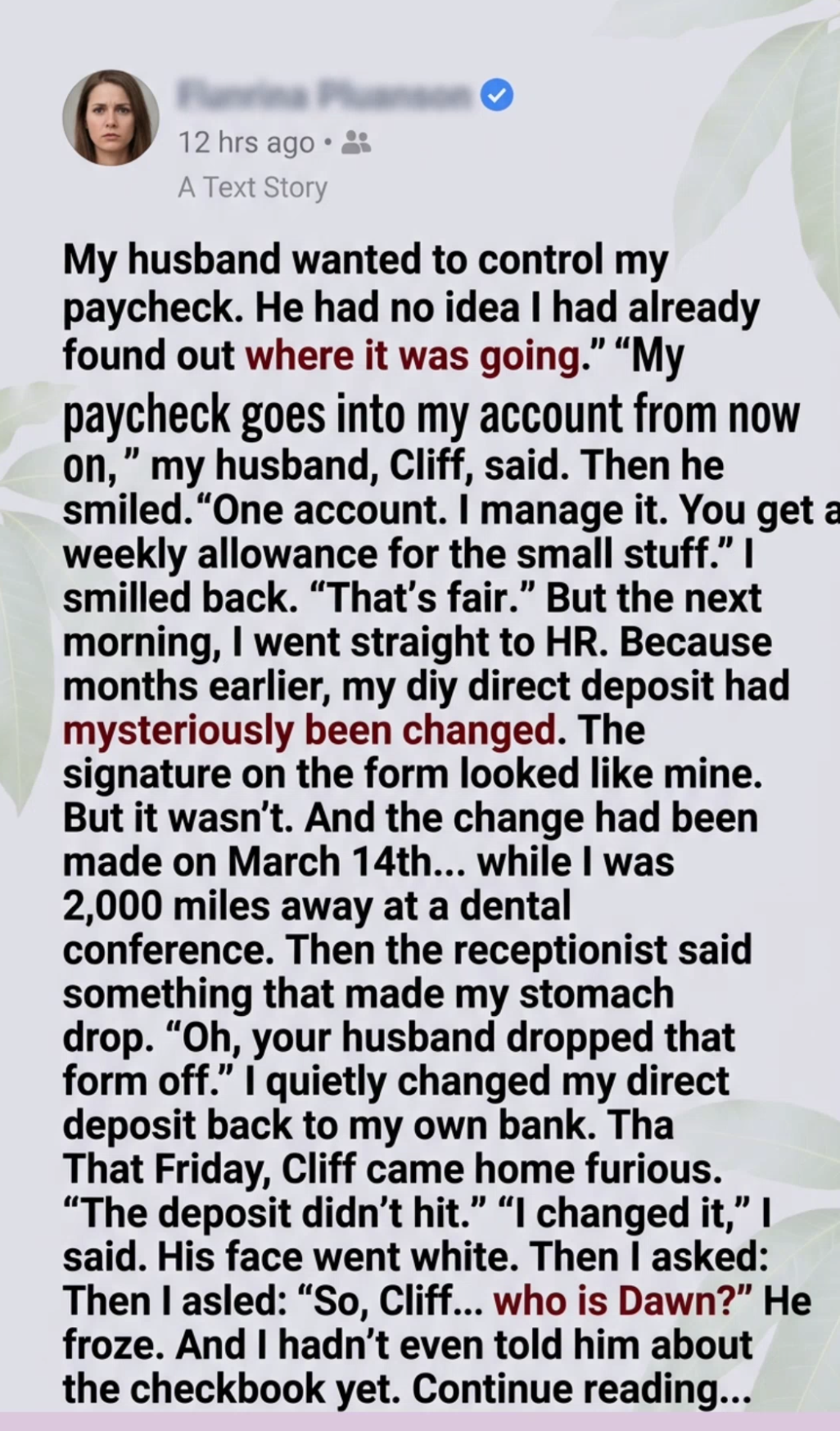
“My paycheck goes into my account from now on,” he said. “One account. I manage it. You get a weekly allowance for the small stuff.”
I looked up from the lunch I was packing.
“An allowance?”
“Don’t make it sound insulting, Claire. It’s just budgeting.”
He smiled.
“You’re good at your job, but you don’t think about money the way I do. We have bills, savings, insurance, and long-term plans. It makes sense for one person to manage everything.”
For fourteen years, I had worked as a dental hygienist. I had a steady salary, health insurance, retirement contributions, and a reputation for being careful with money.
Cliff worked in commercial property maintenance. His income fluctuated, but he had always presented himself as the financial expert in our marriage.
He knew interest rates, investment terminology, and the names of expensive watches.
I knew how much our electricity bill cost every month.
I also knew that six months earlier, my paycheck had mysteriously stopped arriving in my personal checking account.
At the time, Cliff had told me the payroll department must have made a mistake.
He had offered to handle it.
I had believed him.
That was before I discovered the form.
I smiled at him.
“That’s fair.”
His shoulders relaxed.
“Good. I knew you’d understand.”
He kissed my forehead, picked up his keys, and left for work.
I stood in the kitchen for several minutes after the front door closed.
Then I took my laptop out of the bedroom and opened the folder where I had saved copies of my old banking documents.
The form was still there.
And I knew exactly where I needed to go.
Six months earlier, I had noticed that my usual direct deposit hadn’t appeared.
I checked my banking app twice.
Nothing.
When I asked Cliff whether he had seen anything unusual, he barely looked up from his phone.
“Payroll probably changed something. Give it a day.”
The next morning, he handed me $400.
“Here. Use this for groceries and whatever you need.”
I stared at the money.
“Where did you get this?”
“From the household account.”
“But my paycheck?”
“Claire, it’s being sorted out. Stop worrying.”
I should have called payroll immediately.
Instead, I let him reassure me.
A few weeks later, the missing deposit became a recurring mystery. Every payday, Cliff transferred money into my account. Sometimes it was enough. Sometimes I had to ask for more.
He called it simplifying our finances.
I called it an inconvenience.
Then I received an email from our payroll department.
The message was routine: confirmation that my direct deposit instructions had been updated.
I hadn’t requested any changes.
I contacted payroll and asked for a copy of the authorization form.
The woman in HR, Melissa, sent it to me the next day.
When I opened the attachment, my hands went cold.
The form contained my name, employee number, bank information, and a signature that looked almost identical to mine.
Almost.
The final letter of my surname curved in the wrong direction. The first letter of my signature was too narrow. Whoever had copied it knew how I signed my name, but they hadn’t understood the small habits that made it mine.
The new account belonged to a bank I didn’t recognize.
I called the bank and asked whether an account had been opened using my information.
They couldn’t disclose details about an account that wasn’t mine, but they advised me to report the unauthorized payroll change to my employer and secure my personal information.
I took the form to the HR office in person.
Melissa studied it carefully.
“Did you authorize this?”
“No.”
“Are you certain?”
“Completely.”
She checked the electronic submission record.
Then she looked at me.
“This was delivered in person.”
“By whom?”
She turned her monitor slightly.
“The receptionist recorded the visitor’s name. Your husband, Cliff.”
For a moment, I couldn’t hear anything except the air conditioner humming above us.
“You’re sure?”
Melissa nodded.
“He said you had asked him to drop it off because you were busy at a conference.”
I had been 2,000 miles away at a dental conference on March 14.
Cliff knew that.
He had even driven me to the airport.
I looked down at the form again.
“Can I have a copy of the visitor record and the original submission?”
Melissa hesitated.
“We can provide the records permitted under our internal procedures. I’ll also flag the change as disputed and help you restore your verified banking instructions.”
I thanked her.
I didn’t cry.
I didn’t call Cliff.
I went home, opened my personal laptop, and started checking everything I could access legally.
The account number on the payroll form led nowhere useful at first. It wasn’t connected to any account I recognized, and the bank wouldn’t give me another person’s private information.
But I had something else.
A bank statement Cliff had accidentally left in the printer tray two weeks earlier.
It showed a checking account ending in 4816.
I remembered the number because it appeared on a payment confirmation he had once asked me to print.
The account wasn’t our joint account.
It wasn’t his regular business account.
And it wasn’t listed among the accounts we used to pay household expenses.
I began to wonder whether my salary had been going there.
I contacted the bank through its fraud department and explained that I believed my wages were being diverted through an unauthorized direct deposit instruction.
They couldn’t tell me who owned the receiving account, but they could document my report and advise me on next steps.
I also contacted payroll.
By the end of the week, my direct deposit was restored to my original account.
I didn’t tell Cliff.
Not yet.
The first thing I did after restoring my deposit was arrange a consultation with a family-law attorney.
Her name was Rebecca.
She listened without interrupting while I explained the forged signature, the payroll change, and the strange account.
When I finished, she asked one question.
“Do you feel safe at home?”
I thought about it.
Cliff had never hit me. He had never threatened me with a weapon. But he had started checking my purchases, asking why I needed certain things, and criticizing me whenever I made a financial decision without consulting him.
“I don’t know,” I admitted.
Rebecca nodded.
“Then don’t confront him until you’ve thought through your safety and financial position. Make copies of your own records, secure your personal accounts, and don’t access accounts that aren’t yours. We need to establish what happened before deciding what to do next.”
She explained that a forged payroll authorization could be a serious matter, but the consequences would depend on the evidence, the account records, and applicable law.
She also warned me not to empty joint accounts or move shared property without legal advice.
I appreciated that.
I didn’t want revenge.
I wanted to know where my money had gone.
Over the following days, I collected my own pay statements, bank statements, retirement records, mortgage information, and household bills.
I also changed the passwords on my personal email and banking accounts.
For the first time in years, I reviewed our finances without Cliff sitting beside me.
What I found was worse than I expected.
There were regular payments from our joint checking account to a company called D.W. Consulting.
The amounts varied.
$650.
$1,200.
$875.
Sometimes there were two payments in the same month.
The descriptions were vague, but the pattern was consistent.
I printed the statements.
Then I noticed something else.
Every time my paycheck was deposited into the unfamiliar account, a payment appeared in our joint account within a few days.
It wasn’t the full amount.
It was usually between $500 and $900.
The rest disappeared from view.
I had no idea where it went.
Then I remembered the checkbook.
Cliff kept a small black checkbook in the bottom drawer of his home office desk. He had once told me it was for miscellaneous business expenses.
I had never looked inside.
I wasn’t going to start searching through his private belongings without understanding my rights. But I knew I needed to ask him about it.
Before I could, the following Friday arrived.
And Cliff came home furious.
He entered the kitchen with his phone in one hand and his car keys in the other.
“The deposit didn’t hit.”
I was cutting vegetables for dinner.
I put the knife down.
“I changed it.”
He stared at me.
“What?”
“My direct deposit. I changed it back to my own bank.”
His face lost its color.
For several seconds, he didn’t move.
Then he placed his keys on the counter.
“Why would you do that?”
“Because my salary belongs in my account.”
“We agreed on a new system.”
“No, Cliff. You proposed a new system. I didn’t agree to give you control of my income.”
He stepped closer.
“You’re making this much more complicated than it needs to be.”
“Really?”
I reached into a folder on the kitchen table and removed a printed copy of the payroll authorization form.
I placed it between us.
“Do you recognize this?”
He glanced at it.
His expression changed so quickly that I almost missed it.
“What is that?”
“My direct deposit change.”
“I don’t know.”
“Your name is in the visitor record at HR. They said you dropped it off on March fourteenth.”
He swallowed.
“I was helping you.”
“You forged my signature.”
“I didn’t forge anything.”
I pointed to the form.
“Then explain why the signature isn’t mine.”
He picked up the paper and examined it.
“Maybe you signed it and forgot.”
“I was at a dental conference in another state. You drove me to the airport.”
He said nothing.
I continued.
“Why was my salary sent to an account I don’t recognize?”
His jaw tightened.
“That account was for household planning.”
“Whose account is it?”
“Mine.”
“Then why didn’t you tell me?”
“Because you would have reacted exactly like this.”
I looked at him.
“Like what? Asking where my money goes?”
He rubbed his forehead.
“Claire, I was trying to get us organized.”
“Then let’s get organized. Who is Dawn?”
He froze.
It was the first time I had seen him look genuinely frightened.
“Who?”
“Dawn.”
“I don’t know what you’re talking about.”
I pulled out another document.
It was a copy of a payment confirmation from D.W. Consulting. The name on the invoice was Dawn Whitaker.
Cliff looked at the page.
His fingers tightened around its edge.
“Where did you get that?”
“From our household statements.”
“You’re going through my things?”
“I’m reviewing transactions from our joint account.”
He pushed the paper away.
“Dawn is a consultant.”
“For what?”
“Business advice.”
“What business?”
He didn’t answer.
I sat down.
“Cliff, I want you to tell me the truth.”
He paced toward the window.
“She helped me with some property work.”
“How much did you pay her?”
“That’s not the point.”
“It is when my paycheck is being diverted and our joint account is paying her invoices.”
He turned around.
“You don’t understand how business works.”
“Then explain it to me.”
He looked toward the hallway, as though searching for a way to leave the conversation.
Finally, he said, “Dawn and I have been working together.”
“For how long?”
“A little over a year.”
“Before or after my paycheck started going into that account?”
He didn’t respond.
That was answer enough.
I opened the folder again.
“There’s something else. The payments to D.W. Consulting began before my direct deposit was changed. They continued afterward. I want to know what services she actually provided.”
Cliff’s expression hardened.
“You have no right to interrogate me.”
“Then perhaps you should have thought about that before using my signature.”
He slammed his palm against the counter.
“You’re my wife!”
“And I’m not your employee.”
The words seemed to surprise both of us.
For years, I had avoided saying things like that. I had softened my objections, apologized when I disagreed, and accepted explanations that never quite answered my questions.
But I wasn’t doing that anymore.
Cliff grabbed his jacket.
“I’m going out.”
“Fine.”
He paused.
“Don’t touch anything in my office.”
I looked at him.
“I won’t.”
He left.
And for the first time, I wasn’t frightened by the sound of the front door closing.
I was relieved.
The next morning, Rebecca called me back.
I told her what Cliff had admitted.
She asked me to bring every document I had collected.
After reviewing the records, she recommended that I send a formal written dispute to payroll and request a full accounting of any money transferred from our joint accounts to D.W. Consulting.
She also advised me to report the suspected forgery to the appropriate authorities and let the bank investigate the receiving account.
I followed her advice.
I didn’t threaten Cliff.
I didn’t contact Dawn.
I didn’t try to access his private email or business accounts.
I simply made sure the institutions that could investigate had the information they needed.
A week later, payroll confirmed that the unauthorized direct deposit change had been reversed.
The bank acknowledged my report and requested additional documentation.
Then Rebecca received a response from Cliff’s attorney.
He claimed the money had been transferred for legitimate business expenses and that I had known about the arrangement.
I had not.
His attorney also requested that we exchange financial disclosures as part of a proposed separation agreement.
I was surprised.
Cliff had never mentioned separation.
But after what had happened, I wasn’t interested in pretending our marriage was normal.
We arranged a meeting through our attorneys.
Before that meeting, I received another call from Melissa in HR.
She wanted to confirm one detail.
“Claire, do you remember whether your husband said the payroll change was temporary?”
“No. Why?”
“The visitor note says he described it as a permanent household consolidation.”
I closed my eyes.
“Thank you for telling me.”
The phrase stayed with me.
Permanent household consolidation.
That was what Cliff had wanted.
Not a shared budget.
Not financial organization.
Control.
The checkbook came up during the financial disclosure process.
Cliff had listed several accounts and business expenses, but one account was missing.
The account ending in 4816.
Rebecca requested that he disclose it.
His attorney initially argued that it was a business account unrelated to our marital finances.
Rebecca responded that the account had received wages earned during the marriage and was connected to transactions involving our joint funds.
That changed the discussion.
Cliff eventually provided statements for the account.
And there, among the deposits and withdrawals, was the information I had been looking for.
My salary had been deposited into that account for six months.
Some of the money had been transferred to an account associated with D.W. Consulting.
Other payments had gone toward a rental property in a neighboring city.
There were also payments for furniture, utilities, and travel.
The checkbook contained records of payments to Dawn Whitaker.
But the most troubling discovery wasn’t a luxury purchase or an expensive dinner.
It was a series of monthly payments marked “apartment.”
The address belonged to a small furnished apartment about thirty minutes from our house.
I stared at the statement.
“Who lived there?” I asked Rebecca.
“We’ll need more information before making any conclusions.”
I understood.
A payment to an apartment did not prove an affair.
It could have been a business rental, temporary accommodation, or something else.
But I knew Cliff had never mentioned owning or renting another property.
The following week, during the formal financial meeting, his attorney asked him to explain the payments.
Cliff looked uncomfortable.
He admitted that he had rented the apartment for Dawn.
He claimed she needed a place to work because their consulting business required privacy.
Rebecca asked whether the apartment was used exclusively for business.
Cliff hesitated.
Then he admitted that he had stayed there regularly.
I felt something inside me collapse.
Not because I had suddenly discovered that my husband was unfaithful.
But because the money I had earned through years of work had been used to support a separate life I knew nothing about.
Rebecca asked whether Dawn was his romantic partner.
Cliff refused to answer.
His attorney intervened.
The meeting ended without a complete explanation.
But I no longer needed one.
Three days later, Cliff asked to meet me privately.
I agreed to speak with him in a public café, after informing Rebecca where I would be.
He arrived looking exhausted.
His usual confidence had disappeared.
He ordered coffee but barely touched it.
“I never wanted things to end this way,” he said.
I looked at him.
“How did you want them to end?”
He rubbed his hands together.
“I thought we could combine everything. I thought you’d eventually understand.”
“Why did you forge my signature?”
He stared at his coffee.
“I needed the money to go through one account.”
“Why?”
He didn’t answer immediately.
Then he said, “Dawn and I were building something.”
I waited.
“She had contacts in property management. I thought we could start a company together. I was going to expand into commercial maintenance contracts.”
“With my salary?”
“I was going to pay it back.”
“When?”
“When the business started making money.”
I felt a bitter laugh rise in my throat, but I swallowed it.
“You used my paycheck to finance a business I didn’t know existed.”
“It wasn’t like that.”
“Then what was it like?”
He leaned forward.
“I thought you would never support it. You worry about every little expense. You would have said no.”
“Because I didn’t know what I was being asked to support.”
He looked away.
Then I asked the question I had avoided for weeks.
“Was Dawn your partner only in business?”
He closed his eyes.
“No.”
I sat very still.
“How long?”
“About eleven months.”
The relationship had begun before the direct deposit change.
Before the apartment.
Before the strange payments.
Before he told me he was simply reorganizing our finances.
I felt no urge to scream.
No urge to throw my coffee.
I simply understood that the marriage I thought I was living in had been different from the one Cliff had been building.
He reached across the table.
“Claire, I made mistakes. I know that. But I still love you.”
I moved my hand away.
“You loved having access to my money.”
“That’s not fair.”
“Then tell me what was fair about taking my salary without my permission.”
He had no answer.
I stood up.
“I don’t want another explanation today. Let our attorneys handle the finances.”
He looked up at me.
“Are you really going to divorce me over money?”
I stopped.
“No, Cliff. I’m ending this because you made decisions about my life without my consent, lied to me, and built another relationship while using money I worked for to support it. The money is evidence of the problem. It isn’t the whole problem.”
Then I left.
The months that followed were difficult, but they were not dramatic.
There were no courtroom speeches or instant victories.
There were bank records to review, property valuations, legal correspondence, and arguments about which expenses belonged to the household and which belonged to Cliff’s separate business activities.
The bank’s investigation continued independently.
My attorney made sure my claims were documented rather than relying on assumptions about where every dollar had gone.
Some funds could be traced directly to the apartment and consulting payments. Other transactions required further review.
Cliff eventually agreed to a financial settlement that accounted for the documented transfers, subject to the final property division.
The apartment was surrendered.
The consulting arrangement with Dawn ended, although I never learned whether the business had ever been profitable.
I didn’t need to know.
The divorce was finalized after several months.
I kept my retirement savings, my personal bank account, and the portion of our marital assets assigned to me under the settlement.
Cliff kept his business interests, subject to the agreed financial adjustments.
It wasn’t a perfect ending.
There were legal fees, difficult conversations, and several nights when I wondered how I had missed so much.
But I had something I hadn’t had in a long time.
Control over my own decisions.
I opened a new savings account and arranged for my paycheck to be deposited there automatically.
I set up my bills, retirement contributions, and emergency savings.
I didn’t need an allowance.
I didn’t need permission to buy groceries.
And I didn’t need someone else to tell me whether I was responsible enough to manage my own money.
About eight months after the divorce, I ran into Melissa from HR at a grocery store.
She asked how I was doing.
I told her I was better.
She smiled.
“Good. You know, when your husband brought that form in, he seemed very confident. He said you were both making a sensible change.”
I looked down at the shopping basket in my hands.
“He was confident.”
Melissa hesitated.
“I’m glad you came in and questioned it.”
“So am I.”
That night, I made dinner for myself.
It was a simple meal: roasted chicken, potatoes, and green beans.
I sat at my kitchen table with my bank statement beside me.
My paycheck had arrived that morning.
Every dollar was where it was supposed to be.
I thought about the first time Cliff had handed me $400 and told me not to worry.
I had believed him because marriage was supposed to mean trust.
But trust was never supposed to mean surrendering your judgment, your privacy, or your right to know what happened to the money you earned.
I hadn’t lost my marriage because I changed my direct deposit.
I changed my direct deposit because I finally understood what was happening inside my marriage.
And when I looked at my account balance that evening, I felt something I hadn’t felt in years.
Not wealth.
Not victory.
Freedom.
THE END.