I had imagined that dinner a hundred times.
In every version, my parents arrived at my mountain property, admired the seven cabins, walked along the wooden paths, and finally understood why I had spent eleven years working toward something most people considered an impossible dream.
I imagined my mother touching the stone fireplace and saying she was proud of me.
I imagined my father asking how I had managed to build a business from nothing.
I even imagined my older brother, Nathan, admitting that he had been wrong when he called my plan a childish fantasy.
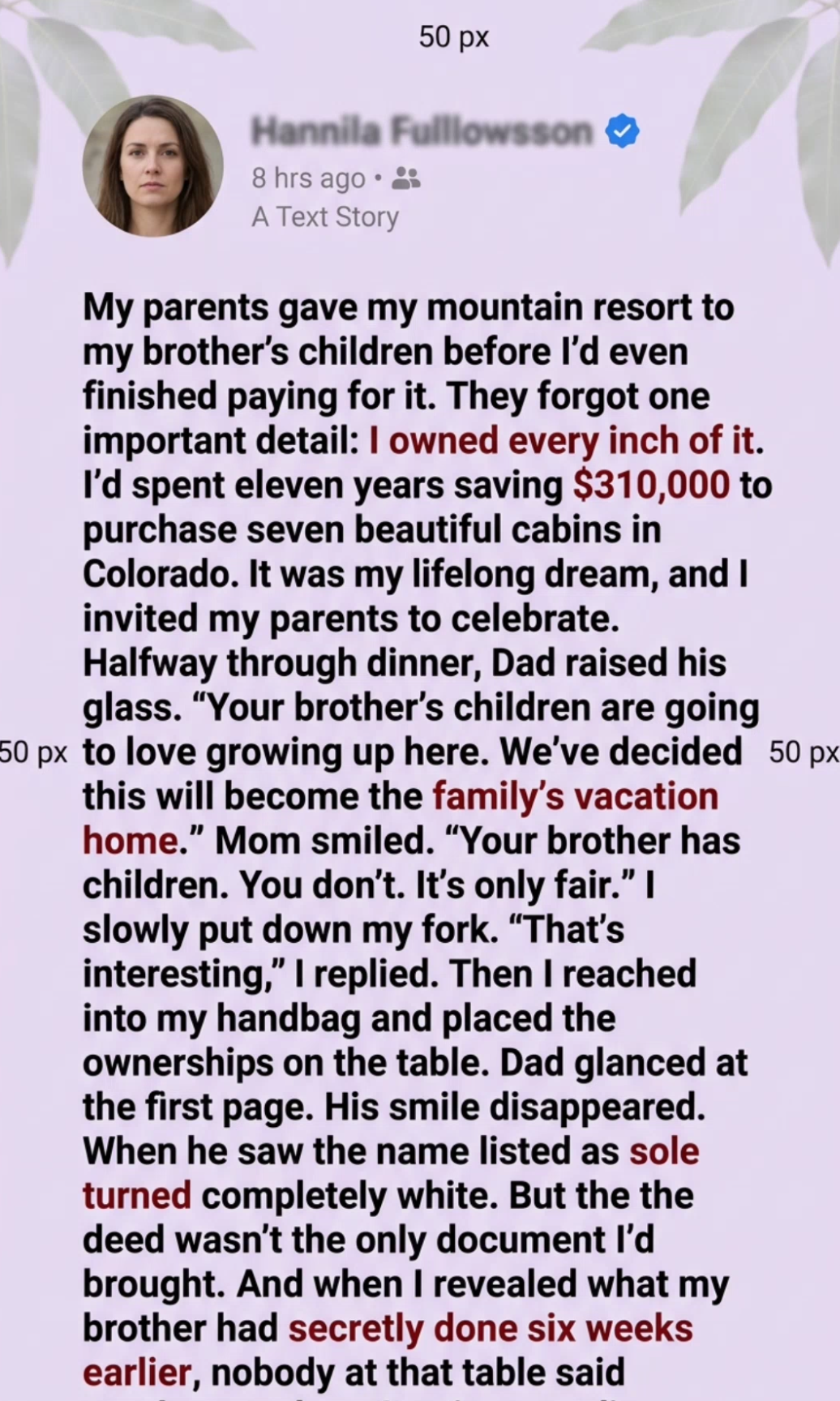
I never imagined my father raising a glass and announcing that my property would become my brother’s children’s inheritance.
That was how the evening began to fall apart.
My name is Lauren Mitchell. I was forty-one, unmarried, and the owner of a small mountain lodging business outside a Colorado town called Silver Creek.
Eleven years earlier, I had started saving money for the property.
At first, I had no intention of buying seven cabins. I wanted one small place in the mountains, somewhere people could escape for a weekend without paying resort prices.
I worked as an operations manager for a hotel group in Denver. I took extra shifts, handled holiday schedules, and spent years accepting promotions that came with more responsibility but little additional recognition.
Whenever friends suggested expensive vacations, I stayed home.
Whenever someone invited me to upgrade my car, I kept driving my old sedan.
I packed lunches, avoided unnecessary debt, and deposited money into a separate savings account every payday.
My goal was $310,000.
It took eleven years to reach it.
The property I eventually found had seven small cabins, a main lodge, a maintenance shed, and several acres of wooded land. It needed work, but the location was beautiful.
A narrow creek ran behind the cabins. In winter, snow covered the pine trees and made the entire place look like a postcard.
I used my savings for the down payment and closing costs, then arranged financing for the remaining purchase price.
I named the business Pine Hollow Mountain Retreat.
The first year was difficult.
One cabin had plumbing problems. Another needed a new roof. The heating system in the main lodge failed during a cold spell, and I spent three nights arranging emergency repairs while guests waited for updates.
There were months when I wondered whether I had made a terrible mistake.
But slowly, the business improved.
I hired two local employees, built relationships with nearby restaurants and tour operators, and learned how to manage seasonal bookings.
By the third year, Pine Hollow was operating steadily.
I didn’t become wealthy.
I became independent.
And that was worth more to me than anything my parents had ever promised.
My family had never understood why I wanted the property.
My father, Robert, believed real estate was only worthwhile if it could be passed down through generations.
My mother, Diane, believed family property should be shared according to need rather than ownership.
My brother Nathan was their favorite example of someone who needed help.
He had two children, Mason and Lily, and a wife named Vanessa. They lived in a comfortable suburban house, but Nathan was constantly struggling with expenses.
He had tried several businesses.
A landscaping partnership.
An online furniture store.
A short-lived construction company.
None lasted very long.
Whenever one failed, my parents helped him recover.
They paid a few bills, covered a vehicle payment, or offered money for the children.
I rarely objected.
It was their money.
But I did notice that their definition of fairness changed depending on who was asking.
When Nathan needed help, family came first.
When I needed help, I was reminded that I had chosen an independent life.
The subject of my resort became particularly uncomfortable after Mason and Lily started asking about it.
They loved the cabins.
They enjoyed the creek, the outdoor firepit, and the small hill where guests sometimes went sledding in winter.
I was happy to let them visit.
I gave them their own room in the main lodge, showed them how to roast marshmallows, and even helped Mason build a small wooden birdhouse during one summer weekend.
I never charged my family for occasional visits.
But I never said the property belonged to all of us.
I never promised it would become a family vacation home.
And I certainly never promised it to Nathan’s children.
Six weeks before the dinner, Nathan called me.
He sounded unusually friendly.
“Hey, Lauren. How’s Pine Hollow?”
“Busy. We’re getting ready for the summer bookings.”
“Good. Listen, I wanted to ask you something.”
He said he was considering setting up a long-term family vacation arrangement.
He thought it would be wonderful if Mason and Lily could spend more time at the resort.
I told him they were welcome to visit when we had availability.
“That’s great,” he said. “Maybe we should put something in writing so everyone knows what the arrangement is.”
I was surprised.
“What kind of arrangement?”
“Nothing complicated. Just a family-use agreement. So Mom and Dad can bring the kids whenever they want.”
I explained that the cabins were a commercial business. Guests booked them months ahead, and I couldn’t promise unlimited family access.
Nathan laughed.
“You’re making it sound like a corporate contract. We’re family.”
I told him I would consider a reasonable arrangement for occasional visits, but I wouldn’t sign anything that interfered with bookings or business operations.
He said he understood.
A few days later, an email arrived with an attachment titled Pine Hollow Family Use Agreement.
I opened it.
The document was much longer than I expected.
It included provisions about recurring family access, holiday reservations, storage of personal belongings, and the right for certain family members to use designated cabins.
One paragraph caught my attention.
It described the arrangement as a continuing family occupancy right, transferable to Nathan’s children.
I called him.
“Why does this say the agreement can be transferred to Mason and Lily?”
“It’s just legal language,” he replied.
“Then why does it say they can occupy the cabins during designated periods without payment?”
“Because they’re family.”
“That’s not what we discussed.”
Nathan sighed.
“Lauren, it’s a draft. We can change it.”
I told him I would not sign it.
He became irritated.
“You always have to make everything difficult.”
“I bought a business. I can’t give away its rooms whenever somebody wants.”
He ended the call.
I thought that was the end of it.
I was wrong.
A month later, my mother called and asked whether I could host a family dinner at Pine Hollow.
She said my father wanted to celebrate the success of the business.
I was touched.
I arranged dinner at the main lodge, hired a local caterer, and reserved the largest dining room.
My employees helped prepare the property.
The fireplace was cleaned. The tables were decorated with simple pine branches and candles. I ordered a meal that included roast chicken, vegetables, fresh bread, and a chocolate cake from the bakery in town.
Nathan arrived with Vanessa and the children.
My parents came shortly afterward.
Everyone seemed happy.
My mother hugged me.
“Look at this place,” she said. “You really did it.”
For a moment, I felt that perhaps this was the evening I had imagined.
Then my father stood and raised his glass.
“I want to say something.”
Everyone turned toward him.
He smiled at Nathan’s children.
“Your grandfather has been thinking about the future. This property is going to be a wonderful place for Mason and Lily to grow up visiting.”
I stopped eating.
He continued.
“Your brother has children. They deserve a place where they can make memories. We’ve decided this will become the family’s vacation home.”
My mother nodded.
“Lauren, you don’t have children. It’s only fair that the next generation gets to enjoy it.”
I looked from one parent to the other.
Nathan was smiling.
Vanessa was quiet.
Mason and Lily looked confused.
I put down my fork.
“That’s interesting.”
My father nodded as though I had agreed.
“It makes sense, doesn’t it?”
I reached into my handbag and removed a folder.
“Before we discuss the future of Pine Hollow, I think everyone should see something.”
I placed the folder on the table.
The first document was the recorded deed.
It showed the property’s legal description and ownership information.
My name appeared as the sole owner.
My father glanced at the first page.
His smile disappeared.
He turned to the next page.
Then he looked at me.
“Why are you showing us this?”
“Because you just announced that you’ve decided what happens to a property you don’t own.”
My mother frowned.
“We’re not saying you don’t own it.”
“Then what exactly have you decided?”
She looked toward Nathan.
“We thought you would understand.”
I took out another document.
This one was a copy of the agreement Nathan had sent me six weeks earlier.
“I also want to discuss something else.”
Nathan’s expression changed.
“Lauren, not tonight.”
I looked directly at him.
“Actually, tonight is a good time.”
The second document was a title-company inquiry.
Six weeks earlier, after receiving Nathan’s proposed family-use agreement, I had asked my attorney to review it.
She had immediately noticed that the document was not simply an informal family arrangement.
Several clauses attempted to establish long-term occupancy rights over portions of the property.
The document had no effect because I had never signed it.
But there was something else.
My attorney had discovered that a week after I rejected the agreement, someone had contacted a local title company requesting information about transferring a portion of Pine Hollow to a family trust.
The inquiry had included a draft property description and a proposed list of beneficiaries.
The listed beneficiaries were Mason and Lily.
The person making the inquiry had identified himself as someone authorized to discuss the property on my behalf.
His name was Nathan Mitchell.
I placed the title-company correspondence on the table.
My father read it.
His eyes moved slowly across the page.
“What’s this?”
I answered calmly.
“Nathan contacted a title company and asked about transferring part of my property into a trust for his children.”
My mother turned toward him.
“Nathan?”
He shifted in his chair.
“I was only asking questions.”
“Did you tell them you were authorized to act for me?” I asked.
“I was trying to understand the options.”
“That’s not what I asked.”
He looked at the documents.
“I never transferred anything.”
“Correct. Because you don’t own it, and you don’t have authority to transfer it.”
My father pushed the papers away.
“Why would you do something like that, Nathan?”
Nathan became defensive.
“I was trying to plan for the kids. Lauren has no children. This place is going to stay in the family anyway.”
I looked at him.
“It’s already in the family. I’m your sister.”
He ignored that.
“You know what I mean.”
“Yes. You mean you want to decide what happens to something I spent eleven years buying.”
He shook his head.
“You have more than you need.”
I stared at him.
“More than I need?”
He gestured toward the windows.
“Seven cabins. A lodge. All this land. You don’t even have a family.”
I felt my stomach tighten.
“My employees depend on this business. My guests pay for these rooms. My mortgage is tied to this property. This isn’t an empty holiday house.”
My mother interrupted.
“But the children love it here.”
“They can love it without owning it.”
She looked wounded.
“We’re only thinking about the grandchildren.”
I took another document from the folder.
“Then you should know what happened when Nathan contacted the title company.”
The title company had contacted my attorney because the inquiry included a draft authorization bearing my name.
The signature looked convincing at first glance.
But it wasn’t mine.
The date on the authorization was six weeks earlier.
I had been at Pine Hollow that day, dealing with a broken water pump. My maintenance manager had helped me arrange the repair, and I had records showing where I was.
The title company had not accepted the document as proof of authority.
Instead, it had asked for confirmation directly from me.
My attorney had immediately advised me to place a written notice with the title company that no transfer or encumbrance could be processed without my verified instructions.
I had also filed a report about the suspected misuse of my signature.
I wasn’t accusing Nathan of successfully transferring anything.
He hadn’t.
But he had attempted to make a transaction appear authorized when it wasn’t.
I turned the document toward him.
“Did you sign my name?”
Nathan’s face reddened.
“I didn’t forge anything.”
“Then who submitted this?”
He glanced at my father.
My father looked stunned.
“Answer her.”
Nathan leaned back.
“It was a draft. I thought we could work it out.”
“Who signed it?”
He said nothing.
My mother began crying.
“Please, not in front of the children.”
I looked at her.
“They’re not the problem. The adults are.”
Vanessa finally spoke.
“I didn’t know about the title company.”
Everyone turned toward her.
She looked at Nathan.
“You told me you were discussing a possible family trust. You said Lauren was going to approve it.”
Nathan shook his head.
“I said we were working on it.”
“You told me the paperwork was almost finished.”
“I was trying to make something happen.”
Vanessa stared at him.
“Without asking her?”
He didn’t answer.
Mason and Lily sat quietly beside their mother.
I felt sorry for them.
They had come to dinner expecting a celebration.
Instead, they were listening to adults argue about a property they had been told would belong to them.
I stood and walked around the table.
“Kids, why don’t you go outside with Vanessa for a few minutes? There’s cake waiting in the kitchen, too.”
Vanessa nodded and led them away.
When the door closed, I returned to my seat.
My father looked older than he had when he arrived.
“Lauren, I didn’t know Nathan had done that.”
I believed him.
He had made an assumption about my property, but I didn’t think he had known about the title-company inquiry.
My mother wiped her eyes.
“We just wanted the children to have something special.”
I took a slow breath.
“I understand wanting to help your grandchildren. But you don’t get to help them by taking something from me.”
My father stared at the deed.
“We thought you might leave it to them eventually.”
“Maybe I will. Maybe I won’t. That’s my decision.”
Nathan gave a bitter laugh.
“So everything is yours, and nobody else gets a say.”
“Yes,” I replied. “That’s what ownership means.”
He looked at me as though he had never expected me to say it so plainly.
I continued.
“I didn’t inherit Pine Hollow. I didn’t receive it as a gift. I didn’t ask anyone to buy it for me. I saved for eleven years, paid the down payment, accepted the debt, and worked through every problem that came with owning it.”
Nathan looked down.
“You make it sound like we never supported you.”
“You didn’t pay for it.”
“We’re family.”
“That doesn’t make you an owner.”
My father rubbed his forehead.
“What happens now?”
I opened the folder one final time.
“I’ve already taken steps to protect the business. My attorney has documented the title-company inquiry, and the property records are being monitored. Any attempt to use my name or authorization without permission will be addressed through the appropriate legal channels.”
Nathan shook his head.
“You’re going to involve lawyers over a family misunderstanding?”
“Someone used my name on a property authorization. That’s not a misunderstanding.”
He looked furious.
“You’d really report your own brother?”
“I’ve already reported the suspected misuse of my signature. I didn’t do it because you’re my brother. I did it because someone tried to act on a property they don’t own.”
My mother began crying harder.
I felt no satisfaction.
This wasn’t a victory.
It was a family dinner that had become a legal problem.
The following weeks were uncomfortable.
Nathan initially refused to cooperate with my attorney’s requests.
He claimed he had only been exploring options and that the authorization had been prepared by someone else.
The title company provided its records.
The person who submitted the draft had used Nathan’s email address and phone number.
My attorney sent a formal demand that he stop representing himself as authorized to act for me.
The matter was reviewed by the appropriate authorities, and the title company retained the disputed documents.
No property was transferred.
No trust was created.
No one acquired ownership of any cabin.
After consulting his own attorney, Nathan agreed to provide a written statement acknowledging that he had no ownership interest in Pine Hollow and no authority to negotiate or arrange transactions involving the property.
He also agreed not to contact the title company or any lender about it again.
I did not pursue a civil claim for financial damages because the attempted transaction had not gone through and my immediate goal was to protect the business.
But I kept the records.
I wasn’t going to pretend nothing had happened.
My parents were less cooperative.
For several weeks, my mother called repeatedly.
She said I was destroying the family over a misunderstanding.
My father sent a message saying that I had embarrassed him in front of everyone.
I replied that I hadn’t announced anything about their property at dinner.
Eventually, I agreed to meet them at a café.
My mother arrived first.
She looked tired.
“Your father thinks you hate us.”
“I don’t hate you.”
“Then why are you doing this?”
I stirred my tea.
“Because I need you to understand that my property is not a family resource simply because I own it.”
She looked down.
“We never meant to hurt you.”
“I know you wanted Mason and Lily to have something. But you made a decision about my life without asking me.”
She nodded slowly.
“Your father thought you would be willing.”
“Why?”
“Because you don’t have children.”
I looked at her.
“Mom, being unmarried doesn’t mean I have no future. Not having children doesn’t mean my work belongs to someone else’s children.”
She said nothing.
I continued.
“I love Mason and Lily. I want them to enjoy the cabins. But I will never promise them ownership just because other people think my life is less important without children.”
My mother wiped her eyes.
“I hadn’t thought about it that way.”
“That’s the problem.”
She reached across the table.
I didn’t take her hand immediately.
But after a moment, I placed mine over hers.
I wasn’t ready to forget.
I was willing to talk.
That summer, Mason and Lily visited Pine Hollow again.
This time, Nathan asked before making any plans.
He sent a message explaining that the children wanted to spend a weekend at the resort.
I checked the booking schedule.
One cabin was available.
I told him they could reserve it at the family rate, subject to the same rules as other guests.
He replied:
Nathan: Understood. Thank you.
When they arrived, I met them near the main lodge.
Mason ran toward me.
“Aunt Lauren! Can we go to the creek?”
“After you put your bags away.”
Lily hugged me.
“Are we allowed to roast marshmallows?”
“Of course. We just have to wait until the firepit is ready.”
They were happy.
They didn’t ask about ownership.
They didn’t ask about the trust.
They were children who wanted to play in the mountains.
I spent part of the afternoon helping them make a small wooden sign for the birdhouse Mason had built the previous summer.
Nathan stayed near the lodge.
He didn’t approach me until the children were busy.
“I owe you an apology,” he said.
I waited.
“I shouldn’t have contacted the title company. I shouldn’t have used your name on anything.”
“No, you shouldn’t have.”
He looked toward the creek.
“I thought you would eventually give the place to the kids.”
“Why would you think that?”
He shrugged.
“Because Dad said you probably wouldn’t need it forever.”
I looked at him.
“That’s not a plan I ever agreed to.”
He nodded.
“I know that now.”
I didn’t tell him everything was forgiven.
I simply said, “I hope you do.”
The following winter, Pine Hollow had its best holiday season yet.
The cabins were full, the staff had settled into a good routine, and I had finally saved enough to replace the old heating system in the main lodge.
I also created a small scholarship for local students interested in hospitality, maintenance, or outdoor recreation.
It wasn’t a grand foundation.
It was a modest program that helped two students each year pay for vocational training or college expenses.
When my father heard about it, he called.
“That’s a good thing you’re doing,” he said.
“Thank you.”
There was a pause.
Then he asked, “Have you thought about what will happen to the property when you’re older?”
I smiled slightly.
“Yes.”
“And?”
“I have an estate plan. The business has a succession structure. My employees and the people who helped build it are protected.”
“Will the children get anything?”
“That’s something I’ll decide when I update the plan. But I won’t promise anything because someone assumes I’m supposed to.”
He was quiet.
Then he said, “Fair enough.”
It was the first time he had acknowledged that the decision belonged to me.
I still think about that dinner.
Not because I enjoyed watching my father’s face change when he saw the deed.
Not because I wanted Nathan to feel embarrassed.
I think about it because I finally understood something I had struggled with for years.
My family had treated my independence as though it meant I had fewer needs, fewer feelings, and fewer rights to protect what I had built.
Because I didn’t have children, they assumed my sacrifices were temporary.
Because I had a successful business, they assumed I could afford to share whatever they wanted.
Because I was the unmarried daughter, they thought I should be grateful that my brother’s children would eventually benefit from my work.
But Pine Hollow wasn’t a consolation prize.
It wasn’t an inheritance waiting for someone else.
It was the result of eleven years of choices, missed holidays, difficult repairs, financial risks, and mornings when I wondered whether I could keep the business alive.
I didn’t buy seven cabins so my family could decide who deserved them.
I bought them because I wanted to build something that belonged to me.
And now, when I walk along the wooden path between the cabins, I no longer feel the need to imagine my parents finally being proud.
I am proud.
The deed has my name on it.
The business has my name on it.
And the future belongs to the person who earned the right to decide it.
THE END.