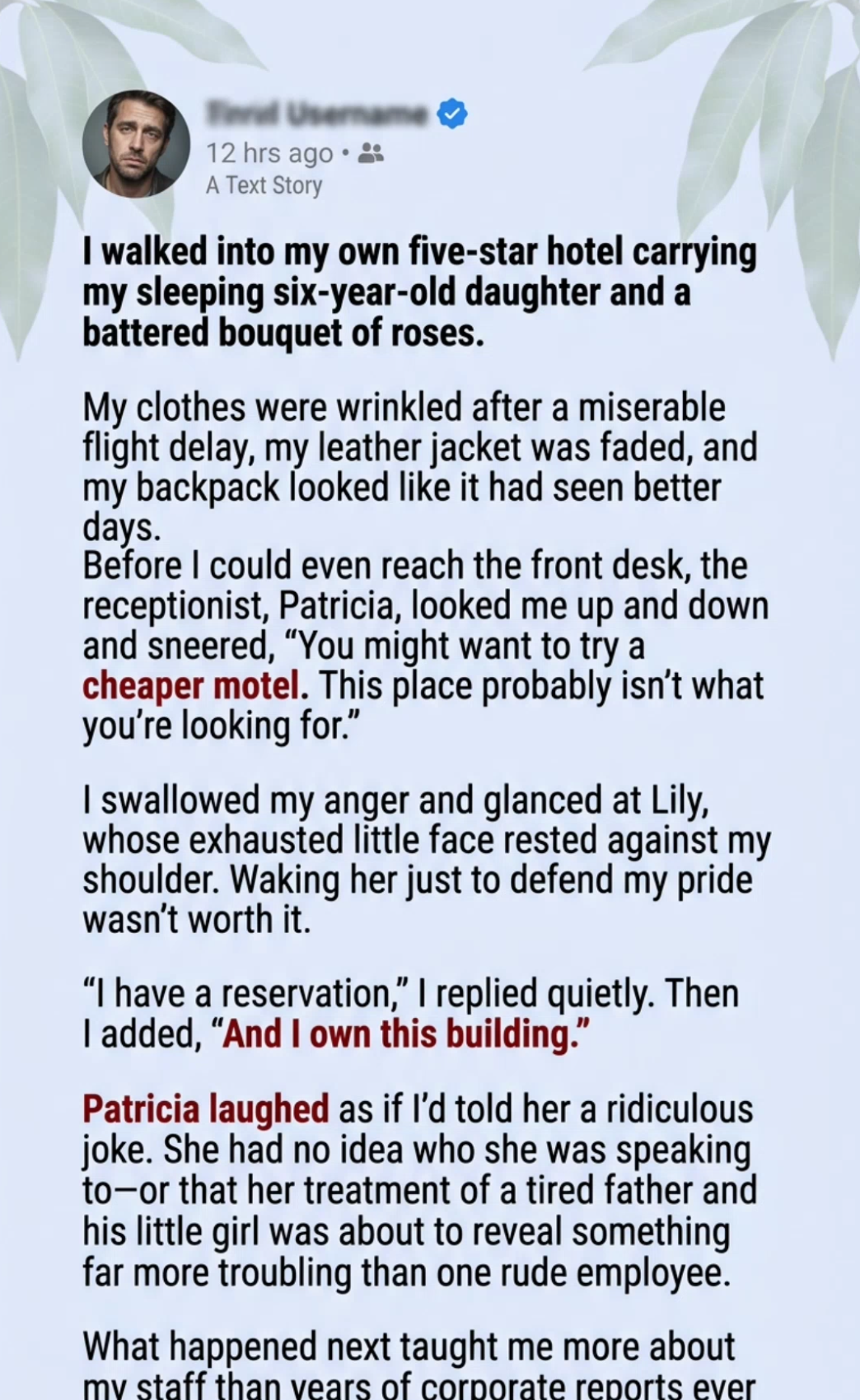
The first thing Patricia noticed about me was my jacket.
The second was my backpack.
The third, apparently, was that I didn’t look like someone who belonged in a five-star hotel.
She didn’t notice the little girl sleeping against my shoulder.
Or perhaps she noticed and simply didn’t care.
I was standing in the lobby of the Grand Meridian Hotel at 10:47 on a rainy Thursday night. My six-year-old daughter, Lily, had one arm wrapped around my neck. Her pink sneakers dangled against my side, and her cheek rested on my shoulder.
In my other hand, I held a battered bouquet of roses wrapped in brown paper.
They had been sitting in my backpack for almost eight hours.
I had bought them that morning for Lily’s mother, my late wife, Claire.
It would have been our ninth wedding anniversary.
Claire had died eighteen months earlier after a short, aggressive illness. Since then, Lily and I had been learning how to live with the empty spaces she left behind.
That morning, Lily had asked whether we could visit the place where her mother and I had celebrated our first anniversary.
“The hotel with the fountain?” she had asked.
“That’s the one.”
“Can we stay there tonight?”
I had promised her we would.
Unfortunately, our flight had been delayed twice because of bad weather. Lily had fallen asleep in the airport, woken up during boarding, and cried because she thought we had missed the trip entirely.
By the time we reached the hotel, I was exhausted.
I hadn’t shaved. My shirt was wrinkled, my leather jacket was faded, and my backpack had a broken zipper held together with a small metal clip.
I probably looked like a man who had spent the last two days sleeping in airports.
But I had a reservation.
And I owned the building.
“Good evening,” I said quietly.
Patricia looked at me without smiling.
“Can I help you?”
“I have a reservation under Daniel Mercer.”
She glanced at the computer.
“One moment.”
She typed something, then looked at me again.
“Are you sure this is the correct hotel?”
I thought she was asking because the reservation might be under a different name.
“Yes. The Grand Meridian.”
She glanced at my jacket.
“This is a five-star property.”
“I know.”
“Perhaps you meant the Meridian Budget Inn. It’s about three blocks away.”
I stared at her.
“No. I booked a room here.”
She sighed as though I had inconvenienced her.
“Sir, I don’t think you understand the kind of hotel this is.”
Lily shifted in her sleep.
I adjusted my arm beneath her knees.
“Could you please check the reservation?”
Patricia leaned closer to the computer.
Then she gave a small laugh.
“You might want to try a cheaper motel. This place probably isn’t what you’re looking for.”
I felt my jaw tighten.
I had heard people make assumptions about me before. It wasn’t new.
But I had never expected to hear that sentence from someone standing behind the reception desk of my own hotel.
I took a slow breath.
“I have a reservation,” I repeated. “And I own this building.”
Patricia laughed.
Not a polite laugh.
A dismissive one.
“Of course you do.”
The security guard near the entrance looked over.
I glanced at Lily.
Her little face was pressed against my shoulder. She was finally sleeping peacefully.
I could have told Patricia my full name, shown her my identification, and demanded that she call the general manager.
Instead, I asked one question.
“Would you please check whether my reservation has been confirmed?”
She tapped the keyboard again.
Then she frowned.
“There’s a problem with your booking.”
“What problem?”
“It appears the room hasn’t been paid for.”
I blinked.
“That’s impossible. It was charged to my company account three days ago.”
“Well, it isn’t showing as paid.”
“Could you check the transaction?”
“Sir, I don’t have time to investigate every booking that comes through this desk.”
I looked at her name badge.
Patricia.
Then I looked at the security guard.
“Could you please ask the night manager to come down?”
Patricia folded her arms.
“The night manager is busy.”
“Then I’ll wait.”
She leaned toward the guard.
“Can you help this gentleman find the exit?”
That was when I decided the problem was no longer about my room.
It was about what happened when someone who didn’t look wealthy walked into a place that claimed to welcome everyone.
My name is Daniel Mercer.
I was forty-two years old, and I had spent the previous eleven years building a hospitality company from a small collection of independently managed properties.
The Grand Meridian was our flagship hotel.
It had 214 rooms, a rooftop restaurant, a spa, two event halls, and a lobby with a marble fountain that Claire had once described as “unnecessarily dramatic.”
She loved it.
When we first visited, we were newly married and had very little money. We couldn’t afford to stay there, so we spent an afternoon in the public garden outside the building and shared a coffee from a nearby café.
Years later, after the hotel became available for acquisition, I bought the property through Mercer Hospitality Group.
I remembered Claire’s reaction when I told her.
“You bought the fountain hotel?”
“I bought the whole building.”
She had laughed.
“Then promise me something.”
“What?”
“Never let people forget that a hotel is supposed to make someone feel welcome.”
I had promised.
I also remembered the roses.
Claire had loved pale pink roses, but the flower shop had been nearly empty that morning. I had bought the closest thing I could find: a dozen cream-colored roses with slightly bruised petals.
Lily had helped me choose them.
She had insisted that her mother wouldn’t mind if they weren’t perfect.
“Mom liked the ones that smelled nice,” she had said.
Now I stood in the lobby with those roses in my hand while an employee tried to send me away.
I felt something heavy settle in my chest.
Not anger alone.
Disappointment.
The security guard approached.
“Sir, perhaps you could step outside while we sort this out.”
I looked at him.
“What’s your name?”
“Martin.”
“Martin, have I threatened anyone?”
He hesitated.
“No, sir.”
“Have I raised my voice?”
“No.”
“Then why are you asking me to leave?”
He glanced at Patricia.
She gave him a small nod.
Martin looked uncomfortable.
“I’m just following instructions.”
I understood that.
He was probably earning an hourly wage, working a late shift, and trying to avoid trouble.
I didn’t blame him for not wanting to challenge the receptionist.
“That’s all right,” I said. “Please ask the night manager to come down.”
Before he could answer, a woman came out of the office behind the desk.
She was wearing a dark navy blazer and had a tablet tucked beneath her arm.
“What’s happening?”
Patricia immediately changed her expression.
“This guest is refusing to understand that his booking hasn’t been paid. He’s also making claims about owning the property.”
The woman looked at me.
Then at Lily.
Her expression softened.
“Good evening. I’m Evelyn Shaw, the night operations manager. How can I help you?”
I explained the situation calmly.
Evelyn listened without interrupting.
When I finished, she asked for my name.
“Daniel Mercer.”
Her eyes widened slightly.
“Mr. Mercer?”
I nodded.
She looked toward Patricia.
Then back at me.
“May I see your identification, please?”
I handed it over.
She checked the card, then opened something on her tablet.
After a few seconds, she said, “Your reservation is confirmed. It’s prepaid through the corporate office. You’re booked into the Garden Suite.”
Patricia frowned.
“That’s not possible.”
Evelyn turned the tablet toward her.
“It’s right here.”
Patricia stared at the screen.
I noticed something else.
The payment record showed a manual adjustment made earlier that evening.
The original payment had been marked as reversed.
I leaned closer.
“Why was the payment reversed?”
Evelyn’s expression changed.
“That’s something I need to investigate.”
Patricia spoke quickly.
“It must be a system error.”
“Maybe,” I said. “But I would like to know who made the adjustment.”
Evelyn checked the transaction details.
Then she looked up.
“Patricia’s user ID.”
The lobby became very quiet.
Patricia’s face reddened.
“I was trying to correct a duplicate transaction.”
Evelyn looked at her.
“Then why did you tell the guest he hadn’t paid?”
Patricia didn’t answer.
I looked at the receptionist.
“Did you know who I was when you told me to find a cheaper motel?”
She crossed her arms.
“No.”
“Would you have treated me differently if you had?”
She looked away.
That answer told me more than anything she could have said.
Evelyn immediately offered to take us upstairs.
I thanked her but asked if we could first get Lily settled somewhere quiet.
She arranged for a porter to bring our bags and had the kitchen prepare a small plate of fruit and warm milk.
I also asked her to make sure Patricia didn’t have to stand at the desk dealing with an angry crowd.
“I don’t want a scene,” I said. “I want the records preserved and the situation reviewed.”
Evelyn nodded.
“Understood.”
As we walked toward the elevator, Martin approached me.
“Sir?”
I turned.
He looked embarrassed.
“I apologize for asking you to leave.”
“You were following instructions.”
“Still, I should have asked what was happening.”
I shook his hand.
“Thank you for saying that.”
Lily stirred as the elevator doors closed.
“Are we at the hotel, Daddy?”
“Yes, sweetheart.”
“Is the fountain downstairs?”
“It is.”
She smiled sleepily.
“Can we see it tomorrow?”
“Absolutely.”
She closed her eyes again.
I looked at the reflection of myself in the elevator doors.
For years, I had believed that owning a hotel meant understanding hospitality.
That night, I realized I might have understood the business better than I understood what was happening inside it.
The next morning, Lily woke up at eight.
She sat on the enormous bed, looking around the suite.
“Is this where Mom stayed?”
“Not this exact room.”
“But the same hotel?”
“Yes.”
She climbed out of bed and ran toward the window.
“There’s the fountain!”
I joined her.
Below us, the courtyard was bright with morning sunlight. The marble fountain Claire had loved was running, its water falling into a shallow circular pool.
Lily pressed her hands against the glass.
“Mom would like this.”
“I think so too.”
We went downstairs for breakfast.
I deliberately chose the main restaurant rather than ordering room service.
I wanted to observe the hotel during normal operations.
The breakfast manager greeted us warmly. A server helped Lily choose pancakes, and another employee brought a small bowl of strawberries without being asked.
Everything appeared normal.
But I noticed that several employees seemed unusually nervous when they saw me.
One supervisor whispered to another.
A housekeeper turned away quickly.
It was subtle, but it happened repeatedly.
I wondered whether Patricia had told everyone about the incident.
After breakfast, I asked Evelyn to meet me in the small conference room.
She arrived carrying a folder.
“I’ve reviewed the payment issue,” she said.
“And?”
“The reservation was paid in full. The payment was manually reversed at 8:16 p.m.”
“Why?”
“Patricia said she believed it was a duplicate charge. But the original transaction was valid.”
“Did she contact accounting?”
“No.”
“Did she contact the guest?”
“No.”
“Then why was it reversed?”
Evelyn hesitated.
“She said she wanted to move the booking to a different room category.”
I frowned.
“Why?”
“She claimed the Garden Suite had been reserved for a VIP arrival.”
I looked at her.
“Who?”
“She couldn’t provide a name.”
“Was the suite actually occupied?”
“No. It remained vacant overnight.”
I leaned back.
“That doesn’t make sense.”
Evelyn opened the folder.
“There is something else.”
She showed me a report from the previous three months.
It contained several guest complaints.
A couple had been told their prepaid reservation could not be found.
A family with two children had been asked to provide an additional deposit even though their booking confirmation showed no deposit requirement.
A business traveler had complained that he was treated rudely after arriving in casual clothes.
A woman traveling alone had been asked whether she was certain she could afford the restaurant before being seated.
The complaints had all been closed.
The explanations were almost identical.
Guest misunderstanding.
System issue.
Communication problem.
I read through the pages.
“Who reviewed these?”
“The front office supervisor.”
“Who reports to?”
“Patricia.”
I looked up.
“So the complaints about Patricia were being reviewed by Patricia’s own supervisor?”
Evelyn nodded.
“That’s what the reporting structure shows.”
I stared at the documents.
The problem was bigger than one rude receptionist.
It was a system that allowed complaints to disappear before anyone senior saw them.
“How many complaints were there?”
“Twenty-three in six months.”
I closed the folder.
“Let’s find out what happened to every one of them.”
The investigation took two weeks.
I didn’t want to make decisions based on one incident, even one that had happened to me.
I asked our regional operations director, Marcus Bell, to lead an independent review.
He brought in someone from human resources and an external hospitality consultant.
They examined booking records, guest complaints, staff schedules, internal messages, and payment adjustments.
What they discovered was deeply troubling.
Patricia had not been responsible for every complaint.
But she had repeatedly made decisions that favored guests she believed were wealthy, influential, or connected to senior management.
She offered complimentary upgrades to guests who mentioned corporate connections.
She delayed check-in for guests who arrived in worn clothing or asked too many questions.
She sometimes moved prepaid reservations into lower room categories without clearly explaining the change.
In several cases, guests had been asked to pay additional charges that weren’t supported by their bookings.
The money had not disappeared into Patricia’s personal account.
The investigation found no evidence of theft.
But her behavior had created financial confusion, damaged guest trust, and exposed the hotel to serious complaints.
More concerning was the way the complaints had been handled.
The front office supervisor had been changing complaint classifications to make them appear resolved.
The supervisor said she had been under pressure to keep the hotel’s satisfaction scores high.
She also admitted that Patricia had been considered difficult to challenge because she had worked at the hotel for almost nine years and had a close relationship with a former general manager.
There had been no formal protection for employees who reported concerns.
Two junior receptionists had tried to raise issues.
Both had been told to stop creating problems.
One had eventually resigned.
The other had requested a transfer.
I read the interview summaries late one evening.
Then I called Marcus.
“Did anyone ever investigate the complaints before now?”
“Not properly.”
“Why?”
“Because the hotel was meeting its financial targets. The guest satisfaction numbers looked acceptable, and the complaints were being closed.”
I rubbed my forehead.
“So we were measuring the wrong things.”
Marcus didn’t disagree.
Patricia was placed on administrative leave while the review continued.
The front office supervisor was also removed from her position.
I didn’t fire either employee immediately.
I wanted the process to be fair, documented, and consistent with company policy.
Patricia was invited to a formal meeting with human resources.
She arrived looking confident.
When Marcus presented the findings, she became defensive.
“Guests exaggerate,” she said. “People come here expecting special treatment because they saw the photographs online.”
Marcus placed the report on the table.
“There are twenty-three complaints.”
“That doesn’t mean they’re all true.”
“No one is saying every complaint is accurate. But the booking records confirm several of the incidents.”
She crossed her arms.
“Some people simply don’t look like they belong in this hotel.”
I felt my stomach tighten.
Marcus looked at her.
“What does that mean?”
“You know what I mean. People arrive in dirty clothes, carrying old bags, and expect the same treatment as guests who have paid thousands for a suite.”
I spoke for the first time.
“Do you believe a guest’s appearance determines whether they deserve respectful treatment?”
Patricia looked at me.
“Mr. Mercer, I didn’t know who you were that night.”
“That’s the point.”
She frowned.
“I was trying to protect the hotel’s standards.”
“From what?”
“People who don’t fit the environment.”
I leaned forward.
“Did you check whether I had paid?”
She didn’t answer.
“Did you ask whether my daughter needed assistance?”
“No.”
“Did you offer to help with our bags?”
“No.”
“Did you check the reservation before suggesting I go to a cheaper motel?”
She looked down.
I continued.
“You were not protecting the hotel’s standards. You were making a judgment about a father and his sleeping child based on the clothes they were wearing.”
Patricia’s eyes filled with tears.
“I didn’t mean to upset anyone.”
I believed she might be telling the truth.
But intention did not erase the consequences.
The review found repeated violations of the hotel’s guest-service standards and payment procedures.
After considering her record and the evidence, the company terminated her employment.
The front office supervisor received a final written warning and was transferred out of the reporting role, with additional training and monitoring.
The decisions were not made because Patricia had insulted the owner.
They were made because the same conduct had affected multiple guests and because the records showed that the hotel had failed to address it.
I made that distinction clear to everyone involved.
A week later, Marcus asked whether I wanted to attend a staff meeting.
I agreed.
The meeting was held in the hotel ballroom.
About seventy employees were present.
Some looked nervous.
Others seemed curious.
I stood at the front without a prepared speech.
“My name is Daniel Mercer,” I began. “Most of you know that I own the building and that my company operates this hotel. But I want to talk about something more important than ownership.”
I looked around the room.
“Two weeks ago, I walked into this lobby carrying my six-year-old daughter. We had been traveling all day. She was asleep on my shoulder. I had a reservation, and the room was paid for.”
Nobody moved.
“The receptionist looked at my clothes and decided I didn’t belong here. She suggested I find a cheaper motel.”
A few employees lowered their eyes.
“I could have shown her my identification. I could have told her I owned the building. But I didn’t. I wanted to know whether someone who appeared to have no influence would receive the same treatment as someone who did.”
I paused.
“The answer was no.”
I let the silence settle.
“That is not the hotel we are supposed to operate.”
I explained the investigation without naming employees or discussing confidential personnel matters.
I told them that guest complaints had been mishandled, that some staff members had been afraid to speak up, and that management had focused too heavily on satisfaction scores rather than the actual experiences behind them.
Then I said something I had written down the night before.
“A guest doesn’t need to be wealthy to deserve dignity. A guest doesn’t need to wear expensive clothes to deserve help. A guest doesn’t need to know the owner to be treated with kindness.”
I looked toward the back of the room.
“And an employee doesn’t need to be popular with management to be heard.”
Several people nodded.
I announced three changes.
First, every guest complaint would be logged in a system that could not be edited or closed without an independent review.
Second, payment adjustments and reservation changes would require a second authorized approval.
Third, employees would have a confidential channel to report misconduct, with clear protection against retaliation.
I also announced a training program focused on practical hospitality, conflict resolution, and respectful communication.
But I didn’t want the meeting to become a list of new rules.
So I asked a question.
“How many of you have ever watched a guest being treated unfairly and stayed quiet because you thought speaking up might cost you your job?”
Several hands rose.
More than I expected.
One young receptionist near the front looked as though she wanted to say something but was afraid.
I invited her to speak.
“My name is Hannah,” she said. “I worked the evening shift with Patricia. I saw her turn away people who looked poor. I told my supervisor once, but she said I was being naive.”
Her voice shook.
“I wanted to help, but I didn’t know what would happen if I did.”
I nodded.
“Thank you for telling us.”
She sat down.
I looked at the room.
“That is a management failure. Not just an employee failure.”
The following month, we began a program called The Welcome Standard.
It wasn’t a marketing campaign.
There were no television advertisements or glossy posters.
It was a practical set of expectations built around three simple questions:
Did we listen?
Did we verify?
Did we help?
Every employee, from the front desk to the housekeeping team, was trained to approach guests without assumptions.
We also introduced a small arrival-assistance team during busy hours so that families, elderly guests, and people traveling with young children could receive help without having to ask repeatedly.
The finance department reviewed every disputed guest charge from the previous year.
Some guests received refunds.
Others received explanations and corrected invoices.
We contacted people who had filed complaints and asked whether they were willing to speak with an independent representative.
Not everyone wanted to talk.
Some had already moved on.
One woman told us she had never expected anyone to follow up.
She said she had stayed at the hotel for a conference and had been made to feel embarrassed because she arrived in a simple dress after a long train journey.
“I didn’t complain because I thought perhaps I was being sensitive,” she said.
I apologized.
She accepted.
That conversation stayed with me.
A hotel can spend millions on marble floors, expensive furniture, and impressive restaurants.
But one dismissive sentence can make a guest feel unwelcome before they even reach the elevator.
Lily didn’t know any of this.
To her, the most important part of the trip was still the fountain.
On the morning after our arrival, I took her downstairs.
She stood beside the water and watched the sunlight move across the surface.
“Can I throw a coin in?” she asked.
“Sure.”
I gave her one.
She closed her eyes before dropping it.
“What did you wish for?” I asked.
“That’s a secret.”
I smiled.
We sat on a bench nearby.
After a while, she looked at the roses.
I had placed them in a small vase in our suite.
“Are those for Mom?”
“Yes.”
“Can we leave one for her?”
I considered that.
“How about we put one in the garden?”
She nodded.
We found a gardener who helped us place a single rose in a small vase beside the courtyard fountain.
Lily stood quietly.
“Happy anniversary, Mom,” she whispered.
I looked away for a moment.
Grief has a way of arriving when you least expect it.
It doesn’t always come with tears.
Sometimes it comes with a child’s voice saying something simple that makes the world feel both smaller and more precious.
Three months later, I returned to the hotel without announcing my arrival.
This time, I wore a plain gray sweater and jeans.
I carried no briefcase, no expensive watch, and no company documents.
I walked through the front doors alone.
A young receptionist looked up.
“Good afternoon. Welcome to the Grand Meridian. How may I help you?”
I smiled.
“Could you tell me where the garden courtyard is?”
“Of course. It’s just beyond the restaurant. Would you like me to show you?”
“Thank you.”
She came around the desk and pointed me in the right direction.
Before returning, she asked, “Is there anything else I can help you with?”
“No, that’s perfect.”
I walked toward the courtyard.
It was a small interaction.
Nothing extraordinary.
But it was exactly what I wanted to see.
A guest had asked a simple question.
An employee had answered with courtesy.
No assumptions.
No judgment.
No need to know who was standing in front of her.
A few days later, I received a letter from Patricia.
She wrote that she had found another job at a smaller property outside the city.
She said she had spent years believing that luxury hospitality required keeping certain kinds of people away from certain areas.
She admitted that she had judged guests by their appearance and had sometimes confused confidence with professionalism.
She also said she understood that her actions had contributed to a culture where people were afraid to challenge her.
The final paragraph read:
I am not asking you to change the decision. I only want you to know that I understand why it happened. I hope I can become a better employee somewhere else.
I read the letter twice.
Then I placed it in the personnel file.
I didn’t reply.
Not every apology requires a conversation, and not every mistake can be repaired through forgiveness.
But I hoped she meant what she wrote.
One year after that rainy Thursday, Lily and I returned to the Grand Meridian.
She was seven now.
Her backpack was new, and she carried a small drawing she had made at school.
It showed a hotel with a fountain, a father holding a little girl’s hand, and a large yellow sun above the roof.
At the bottom, she had written:
Mom’s favorite hotel.
We gave the drawing to the front desk team.
The receptionist thanked her and asked whether she would like it displayed on the children’s welcome board.
Lily nodded proudly.
Then she looked up at me.
“Daddy, do you remember the lady who was mean to us?”
I paused.
“Yes.”
“Why was she mean?”
I thought carefully before answering.
“Sometimes people decide what someone is like before they know anything about them.”
“Because of their clothes?”
“Sometimes.”
“That’s silly.”
I smiled.
“You’re right. It is.”
She looked toward the fountain.
“Are all the people here nice now?”
I glanced around the lobby.
A porter was helping an elderly couple with their luggage. A receptionist was explaining a reservation to a family. A housekeeper stopped to help a little boy retrieve a toy that had rolled beneath a chair.
I couldn’t promise that every employee would always behave perfectly.
No company could.
But I could tell her what we were trying to do.
“We’re working hard to make sure everyone feels welcome.”
She nodded.
“Good.”
Then she took my hand.
We walked toward the fountain together.
I thought about Claire and the promise I had made to her.
Never let people forget that a hotel is supposed to make someone feel welcome.
For years, I had believed that promise was about the quality of the rooms, the food, the service, and the building itself.
But that night had taught me something more important.
A hotel’s true character isn’t revealed when a wealthy guest arrives with a private driver.
It’s revealed when an exhausted father walks through the door carrying his sleeping child, wearing an old jacket, holding a tired bouquet of roses, and asking for the room he has already paid for.
The people behind the desk may never know who he is.
They may never know how much money he has, what company he owns, or what influence he carries.
And they shouldn’t need to know.
Because dignity isn’t a reward for looking important.
Respect isn’t a privilege reserved for the wealthy.
And hospitality isn’t something we offer only to people we believe can benefit us.
As Lily and I stood beside the fountain, she slipped her hand into mine.
“Daddy?”
“Yes?”
“Next time, can we come when Mom’s roses are fresh?”
I smiled.
“Next time, we’ll bring the freshest ones we can find.”
She leaned against my side.
And I realized that the most important thing I had taken from that night wasn’t a management lesson or a new company policy.
It was a reminder of why I had bought the hotel in the first place.
Not to own a beautiful building.
But to create a place where people could walk through the doors, exactly as they were, and feel that they belonged.
THE END.