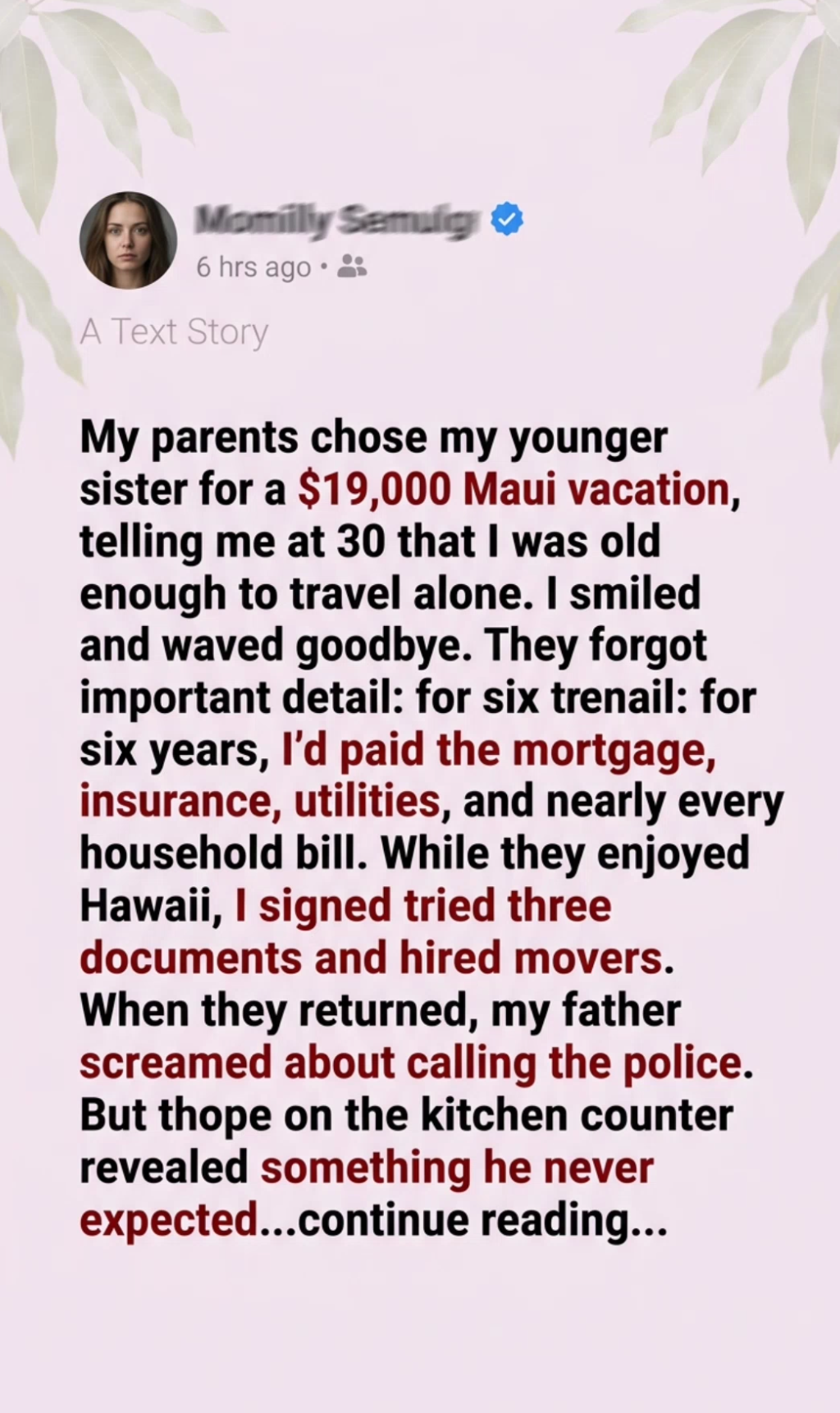
My name is Emily Carter, and I was thirty years old when I finally stopped being the daughter my parents could depend on but never appreciate.
For six years, I had been quietly supporting my family.
I paid the mortgage, property insurance, electricity, water, internet, groceries, and nearly every unexpected household expense. I never complained because I believed that was what family did for one another.
I wasn’t rich, but I had a stable job as a financial analyst, and I earned enough to help my parents maintain the comfortable lifestyle they had grown accustomed to.
My father, Richard, was sixty-two. He had retired early after selling his small construction business, although his retirement savings weren’t nearly as substantial as he had expected.
My mother, Linda, was sixty. She had worked part-time for years but had never been particularly careful with money.
My younger sister, Jessica, was twenty-four.
She was beautiful, outgoing, and always seemed to get whatever she wanted.
Growing up, Jessica was the favorite.
She was the daughter my parents proudly showed off at family gatherings. She was the one whose achievements were celebrated, whose mistakes were forgiven, and whose wishes somehow became everyone’s responsibility.
I was different.
I was dependable.
If a bill was overdue, I handled it.
If Dad’s car needed repairs, I paid.
If Mom needed help with an unexpected expense, she called me.
If Jessica wanted something expensive, my parents somehow found a way to make it happen.
I used to believe that being dependable was something to be proud of.
Eventually, I realized it had become my assigned role.
Six years earlier, my parents had been struggling financially.
Their mortgage payments had increased, Dad’s business had been experiencing difficulties, and they were worried about losing the family home.
One evening, my father called me into the living room.
“Emily, we need to talk.”
I sat down.
“What’s wrong?”
He explained that they were behind on several payments and needed help.
My mother began crying.
“We don’t know what we’re going to do.”
I looked at the house around me.
It was the same home where I had grown up. My childhood bedroom was still upstairs. The backyard still had the old wooden swing my father had built when I was twelve.
I couldn’t imagine them losing it.
“How much do you need?” I asked.
My father told me.
I agreed to help.
At first, I thought it would be temporary.
I began paying the mortgage directly through the lender’s payment system. I covered the insurance, utilities, and several other recurring expenses.
I also paid for groceries whenever my parents needed them.
Six months passed.
Then another year.
Eventually, my financial support became permanent.
Nobody asked when I planned to stop.
Nobody suggested that my parents should reconsider their spending.
And nobody seemed to remember that I had my own future to build.
I continued working, saving, and trying to maintain some independence.
I rented a small apartment near my office, but I spent so much time at my parents’ house helping them that it sometimes felt like I had two homes and no real life of my own.
Jessica, meanwhile, seemed to live without financial worries.
She had recently started working in marketing, but she frequently changed jobs.
My parents paid for her car insurance, helped with her rent, and covered several of her credit card payments.
Whenever I questioned the difference, my mother gave me the same answer.
“Emily, you’re older. You understand responsibility. Your sister is still figuring things out.”
I was thirty.
Jessica was twenty-four.
Apparently, six years was enough to make me responsible for everyone.
I didn’t argue.
I simply kept paying.
Then came the Maui vacation.
It started with a family dinner in early spring.
My mother announced that she and Dad were planning a special trip.
“We’ve been talking about going to Hawaii for years,” she said.
Jessica immediately became excited.
“Oh my goodness! Maui would be amazing!”
My father smiled.
“We found a beautiful resort. Oceanfront rooms, private excursions, and everything.”
I looked at them.
“That sounds wonderful. When are you going?”
My mother answered.
“Late June.”
I smiled.
“That’s exciting.”
Then Jessica added:
“And I’m coming too!”
I looked at her.
“You’re going with them?”
She laughed.
“Obviously! It’s a family vacation.”
I waited.
I assumed they would eventually mention my name.
They didn’t.
Instead, my father began discussing the hotel, flights, restaurants, and activities.
I finally asked:
“Have you booked everything?”
My mother nodded.
“Almost. It’s going to cost around $19,000, but your father deserves a proper vacation.”
I was surprised.
Nineteen thousand dollars was a significant amount of money.
Especially considering that I had paid their mortgage the previous month.
But I didn’t say anything.
I simply asked:
“Should I look at flights for myself?”
My mother exchanged a glance with my father.
Then she smiled awkwardly.
“Oh, Emily, we thought you might prefer doing something on your own.”
I blinked.
“What do you mean?”
My father put down his fork.
“You’re thirty years old. You’re independent. You can travel alone whenever you want.”
Jessica laughed.
“Yeah, Emily. You don’t need Mommy and Daddy to take you everywhere.”
I looked at her.
I wasn’t asking them to take me anywhere.
I was asking why I was being excluded from a family vacation.
My mother continued.
“Your sister is younger. She still enjoys spending time with us.”
I stared at her.
“She’s twenty-four, Mom. She’s an adult too.”
My father became irritated.
“Don’t turn this into an argument. We just want a nice vacation.”
I nodded slowly.
“Of course.”
The conversation moved on.
They discussed snorkeling, sunset dinners, and a helicopter tour.
I sat there listening to them plan a $19,000 vacation while I was still paying for the roof over their heads.
Something about the entire situation felt different.
For years, I had accepted being treated as the responsible one.
I had convinced myself that my parents appreciated what I did, even if they didn’t say it.
But now they were openly treating me as though I didn’t belong.
And the money I provided apparently didn’t make me family enough to be invited.
The next morning, my mother sent me a message.
“Please don’t be upset about Hawaii. We just thought you would enjoy having some time to yourself.”
I replied:
“That’s fine. Have a wonderful trip.”
She sent a heart emoji.
I put my phone down.
Then I opened my banking application.
I looked at the recurring payments.
Mortgage.
Property insurance.
Electricity.
Water.
Internet.
Gas.
Home maintenance.
Groceries.
I calculated what I had paid over the previous six years.
The total was staggering.
More than $146,000.
That didn’t include the countless smaller expenses, emergency repairs, furniture, appliances, and money I had given my sister.
I sat quietly at my desk.
I wasn’t angry about spending money on my parents.
I was angry that they had allowed me to believe my contributions were a family responsibility while treating me like an optional guest.
A few days later, I made a decision.
I called an attorney.
Her name was Rebecca Miller.
I explained the situation and asked her to review the financial and property arrangements.
There was something important about the house that my parents had apparently never considered.
Although I had paid the mortgage for six years, the property was still legally owned by my parents.
I had never been added to the deed.
My payments had been made as family assistance, not as part of a formal ownership agreement.
Rebecca explained that paying household expenses did not automatically make me an owner.
She also explained that I needed to separate my financial responsibilities from my parents’ property.
“Emily, you need to understand that you cannot simply claim the house because you’ve paid the bills,” she said.
“I understand.”
“Do you have any formal agreement requiring you to continue paying these expenses?”
“No.”
“Then you are generally free to stop voluntarily providing financial support, subject to any specific contractual obligations you may have. We’ll review everything carefully.”
I nodded.
For the first time, someone was reminding me that I had choices.
Rebecca helped me prepare three documents.
The first was a formal notice ending my voluntary financial support for my parents’ household.
The second was a written accounting of the contributions I had made over the years, supported by bank statements and payment records.
The third was a separate agreement concerning the furniture, personal belongings, and other property I owned in the house.
I had purchased several expensive appliances, a bedroom set, a television, and other household items.
I had receipts for almost everything.
Rebecca advised me to handle the removal of my belongings carefully and to obtain any necessary written permission rather than risk a dispute.
I agreed.
I wasn’t interested in taking anything that didn’t belong to me.
I only wanted my own possessions and my financial independence.
Then I hired a moving company.
I scheduled the move for the week my parents would be in Maui.
I had already arranged a new apartment closer to my workplace.
It was smaller than my parents’ house, but it was mine to manage.
I didn’t tell my parents.
I didn’t announce my decision.
I simply began preparing.
The weeks passed.
My parents became increasingly excited about Hawaii.
My mother sent pictures of swimsuits.
My father talked about the restaurants they planned to visit.
Jessica posted photographs of new luggage and expensive sunglasses.
One evening, she called me.
“Emily, can you do me a favor?”
“What?”
“Mom says you haven’t paid the electricity bill yet.”
I looked at the calendar.
The payment was due in three days.
“I’ll take care of the existing bill.”
“Thanks! You’re the best.”
She ended the call.
I stared at my phone.
Even now, she expected me to keep paying.
I opened my banking application and scheduled the final payment for the current billing period.
Then I canceled the recurring arrangement.
The same day, I contacted the insurance company and informed them that I was not the policyholder and would no longer be responsible for paying the premium.
I made sure my parents received the necessary notices so they could arrange their own coverage without a lapse.
I also contacted the utility providers and removed my payment methods wherever possible.
I wasn’t going to leave anyone without essential services unexpectedly.
I was simply ending the arrangement that had allowed my parents to rely on my money indefinitely.
Finally, the departure day arrived.
My parents and Jessica were leaving early in the morning.
I went to their house the previous evening to say goodbye.
My mother was packing.
Jessica was sitting on the sofa, scrolling through her phone.
My father was checking the airline itinerary.
“Have a safe flight,” I said.
My mother hugged me.
“Thank you, sweetheart.”
Jessica smiled.
“Don’t forget to water my plants while we’re gone.”
I looked at her.
“You’re taking your plants?”
She laughed.
“No, silly. They’re staying here.”
I smiled.
“Enjoy Hawaii.”
My father picked up his suitcase.
“You should use this time to think about taking a trip yourself. You work too much.”
I nodded.
“Maybe I will.”
They left early the following morning.
I watched their car disappear down the street.
Then I went inside.
I looked around the house one last time.
My childhood photographs were still on the wall.
The dining table where we had celebrated birthdays was still in the center of the room.
For a moment, I felt sad.
Then I remembered the conversation about being too old to travel with my family.
I called the moving company.
They arrived at nine.
I showed them the inventory list and the receipts Rebecca had helped organize.
We removed my bedroom furniture, television, desk, personal belongings, and the appliances I had purchased.
Everything was handled according to the written arrangements.
I didn’t touch my parents’ furniture.
I didn’t remove their possessions.
I didn’t damage anything.
By late afternoon, my belongings were in my new apartment.
It was quiet.
There were boxes everywhere.
But I felt something I hadn’t felt in years.
Freedom.
That evening, I sat on the floor eating takeout because I hadn’t unpacked my dishes.
I looked around my new home and smiled.
For once, I wasn’t responsible for paying someone else’s bills.
I wasn’t waiting for my sister to ask for money.
I wasn’t worrying about whether my parents had enough to cover the mortgage.
I was thirty years old.
And I was finally beginning my own life.
The following morning, I mailed the documents Rebecca had prepared.
One copy went to my parents’ home.
Another was delivered electronically to their email addresses.
I also sent them a short message.
“Mom and Dad, I’ve moved my personal belongings into my new apartment. I’ve enclosed documentation regarding the financial support I’ve provided and formal notice that I will no longer be paying household expenses. Please arrange your own mortgage, insurance, utilities, and other payments going forward. I wish you all the best.”
Then I turned off my phone.
For the next several days, I enjoyed the silence.
I went to work.
I unpacked.
I bought groceries.
I ordered a comfortable sofa.
I started planning a vacation of my own.
I decided I would eventually visit Italy.
Not because I wanted to prove anything to anyone.
But because I had spent years postponing my own dreams.
I wanted to see the world.
I wanted to enjoy my money.
And I wanted to stop feeling guilty every time I spent something on myself.
Meanwhile, my parents were enjoying Maui.
My mother posted photographs of beautiful beaches.
My father shared pictures of expensive dinners.
Jessica uploaded a series of photographs beside the ocean.
The captions were full of happiness.
“Best family vacation ever!”
I looked at the photograph.
Then I closed the application.
I didn’t comment.
I didn’t send a message.
I simply continued living my life.
A week later, my phone began ringing.
It was my father.
I answered.
“Hello, Dad.”
His voice was furious.
“What have you done?”
I leaned back in my chair.
“What are you talking about?”
“We got your letter!”
I remained calm.
“All right.”
“You can’t just stop paying everything!”
“I can stop voluntarily paying your household bills, Dad.”
“That’s our house!”
“Yes. And that’s why you need to arrange your own payments.”
He shouted something I couldn’t understand.
Then my mother took the phone.
“Emily, sweetheart, we don’t understand. The mortgage payment didn’t go through.”
I closed my eyes.
“Mom, I told you I was ending the arrangement.”
“But we’ve been depending on you!”
“I know.”
“How can you do this to us?”
I took a breath.
“How could you take Jessica to Hawaii and tell me I was too old to come while expecting me to keep paying for your house?”
Silence.
Then my father grabbed the phone again.
“Don’t bring Hawaii into this! We paid for that vacation ourselves!”
I stared at the wall.
“Really, Dad?”
He hesitated.
I continued.
“Who paid the mortgage for the previous six years?”
“That’s different!”
“Who paid the insurance?”
“Emily—”
“Who paid the electricity, water, internet, and nearly every household expense?”
He became louder.
“You chose to help us!”
“Yes. I chose to help you. I never agreed to support you forever.”
Then he said something that shocked me.
“If you don’t come back and fix this, I’m calling the police!”
I almost laughed.
“Why?”
“Because you took everything out of the house!”
I sat up.
“I took my own belongings, Dad. I have the receipts, the inventory, and the written arrangements.”
“You stole from us!”
“No. I removed property that belonged to me.”
He continued shouting.
I interrupted him.
“There’s an envelope on the kitchen counter. Please read it before making any more accusations.”
Then I ended the call.
The envelope contained the three documents.
The first explained that my voluntary financial support had ended.
The second listed the contributions I had made over six years, totaling more than $146,000, with supporting records.
The third contained the inventory of the personal belongings I had removed, along with copies of the purchase receipts and the written arrangements concerning their removal.
There was also a short personal letter.
“Mom and Dad,
For six years, I helped you because I loved you. I paid your mortgage, insurance, utilities, and household expenses because I believed we were supporting one another as a family.
I never expected a vacation in return.
I never expected expensive presents.
I never expected you to repay every dollar.
But I did expect to be treated like your daughter.
When you decided to take Jessica to Maui and told me I was old enough to travel alone, you made it clear that you considered me responsible enough to support the family but not important enough to include in it.
I have finally understood that being your dependable daughter does not mean sacrificing my entire future.
I am not abandoning you. I am simply returning responsibility for your household to the people who own it.
I love you both.
But from now on, I will be building a life of my own.
Emily.”
When my parents returned from Hawaii, they found the letter, the payment records, and the empty spaces where my belongings had been.
My father called again.
This time, his voice was different.
“Emily, we need to talk.”
“About what?”
“About the house.”
I waited.
He explained that they had already contacted the mortgage company and discovered how much they needed to pay every month without my assistance.
They had also realized that the insurance and utility payments were no longer being handled automatically.
My mother had begun looking through their retirement accounts.
They were worried.
I understood.
But I couldn’t solve the problem for them anymore.
“Maybe you should speak to a financial adviser,” I suggested.
My father sighed.
“We never thought you’d actually leave.”
I looked around my apartment.
“That’s because you never thought I would choose myself.”
He was quiet.
Then he asked:
“Are you really going to let us struggle?”
I felt tears gathering in my eyes.
“Are you really asking me to keep paying for your lifestyle after excluding me from your family vacation?”
He didn’t answer.
I continued.
“I love you, Dad. But I am not your mortgage payment.”
The conversation ended shortly afterward.
Over the following weeks, my parents began adjusting their finances.
They canceled several subscriptions, reduced unnecessary expenses, and considered downsizing.
My father eventually found part-time consulting work.
My mother started working additional hours at a local shop.
Jessica, who had returned from Maui with a collection of expensive souvenirs, was asked to contribute toward household expenses.
For the first time, everyone had to participate.
I didn’t celebrate their difficulties.
I didn’t want them to lose their home.
I simply refused to keep paying for everything while pretending the arrangement was fair.
A month later, my mother called.
“Emily, can we meet?”
I agreed.
We met at a small café.
She looked tired.
She held my hands across the table.
“I miss you.”
I smiled sadly.
“I miss you too, Mom.”
She began crying.
“Your father says you abandoned us.”
I shook my head.
“I didn’t abandon you. I stopped paying for everything.”
She looked down.
“We never realized how much you were doing.”
I wanted to believe her.
But I needed to say something.
“Mom, you didn’t need to realize it. You knew. You saw the payments. You knew who handled the bills. You knew how often I helped.”
She wiped her eyes.
“I suppose we became too comfortable.”
I nodded.
“Yes. You did.”
Then she asked whether I would consider helping them financially again.
I took a moment.
“I can help you review your budget or find ways to reduce expenses. I can help you understand your options. But I won’t return to the arrangement we had before.”
She nodded slowly.
It wasn’t the answer she wanted.
But she accepted it.
A few days later, Jessica contacted me.
At first, she sounded irritated.
“Emily, you really made things difficult for everyone.”
I sighed.
“Hello to you too, Jessica.”
She continued.
“Mom and Dad are stressed. They can’t afford everything.”
“Then you should help them.”
She laughed.
“Why should I? You’re the one who always handled that stuff.”
I stared at my phone.
“Exactly. That’s the problem.”
She went quiet.
I continued.
“You’re an adult. You went on a $19,000 vacation with them. If you want them to have a comfortable life, you can contribute too.”
She didn’t like that.
She accused me of being jealous of her relationship with our parents.
I told her I wasn’t jealous.
I was simply finished being treated as the family bank.
She ended the call.
Months passed.
My life began to change.
I received a promotion at work.
I increased my retirement contributions.
I traveled to Italy for two weeks and visited Rome, Florence, and Venice.
I took photographs everywhere.
I ate wonderful food.
I sat in small cafés and watched people walking through the streets.
One afternoon, while sitting beside a canal in Venice, I received a message from my father.
“Hope you’re enjoying your trip.”
I smiled.
It was a small message, but it felt different.
I replied.
“Thank you, Dad. I am.”
He sent another message.
“Maybe one day we can all go somewhere together.”
I looked at the water.
Then I wrote:
“Maybe. But next time, everyone can plan and pay their own way.”
He replied with a thumbs-up.
I laughed.
It wasn’t a perfect reconciliation.
But it was honest.
When I returned home, my parents invited me to dinner.
Jessica was there too.
The conversation was awkward at first.
Then my father cleared his throat.
“Emily, I owe you an apology.”
I looked at him.
He continued.
“We became accustomed to your help. We didn’t appreciate how much you were sacrificing.”
My mother nodded.
“We should never have made you feel like you weren’t part of the family.”
Jessica looked down at her plate.
I listened.
Then I answered.
“Thank you. I appreciate that.”
My father asked whether I would consider helping with a few expenses again.
I smiled gently.
“I can help when there’s a genuine emergency, and when I’m able. But I won’t take responsibility for the entire household again.”
He nodded.
“That’s fair.”
For the first time, I believed he understood.
The following Christmas, we had dinner at my new apartment.
It was smaller than the family house, but it was warm and comfortable.
I prepared dinner.
My mother brought dessert.
Jessica helped decorate the table.
My father brought a bottle of wine.
Nobody discussed money.
Nobody expected me to pay for everything.
And nobody told me I was too old to join the family.
As I watched everyone sitting around my table, I thought about the six years I had spent trying to earn appreciation through financial support.
I thought about the $146,000.
I thought about the Maui photographs.
And I thought about the three documents I had signed while my parents were enjoying their vacation.
I had once believed that walking away would make me a bad daughter.
Now I understood that setting boundaries didn’t mean I had stopped loving my family.
It meant I had finally started respecting myself.
My parents had told me I was old enough to travel alone.
They were right.
I was also old enough to make my own decisions, protect my money, and build a future that didn’t depend on being useful to everyone else.
And perhaps the greatest lesson I learned was this:
Being the responsible daughter should never mean becoming the forgotten daughter.
I still love my parents.
I still want my sister to succeed.
I still hope we can share many happy Christmases together.
But I no longer confuse financial support with unconditional access to my life.
My money belongs to me.
My time belongs to me.
And my love is no longer something anyone gets to take for granted.
The End.