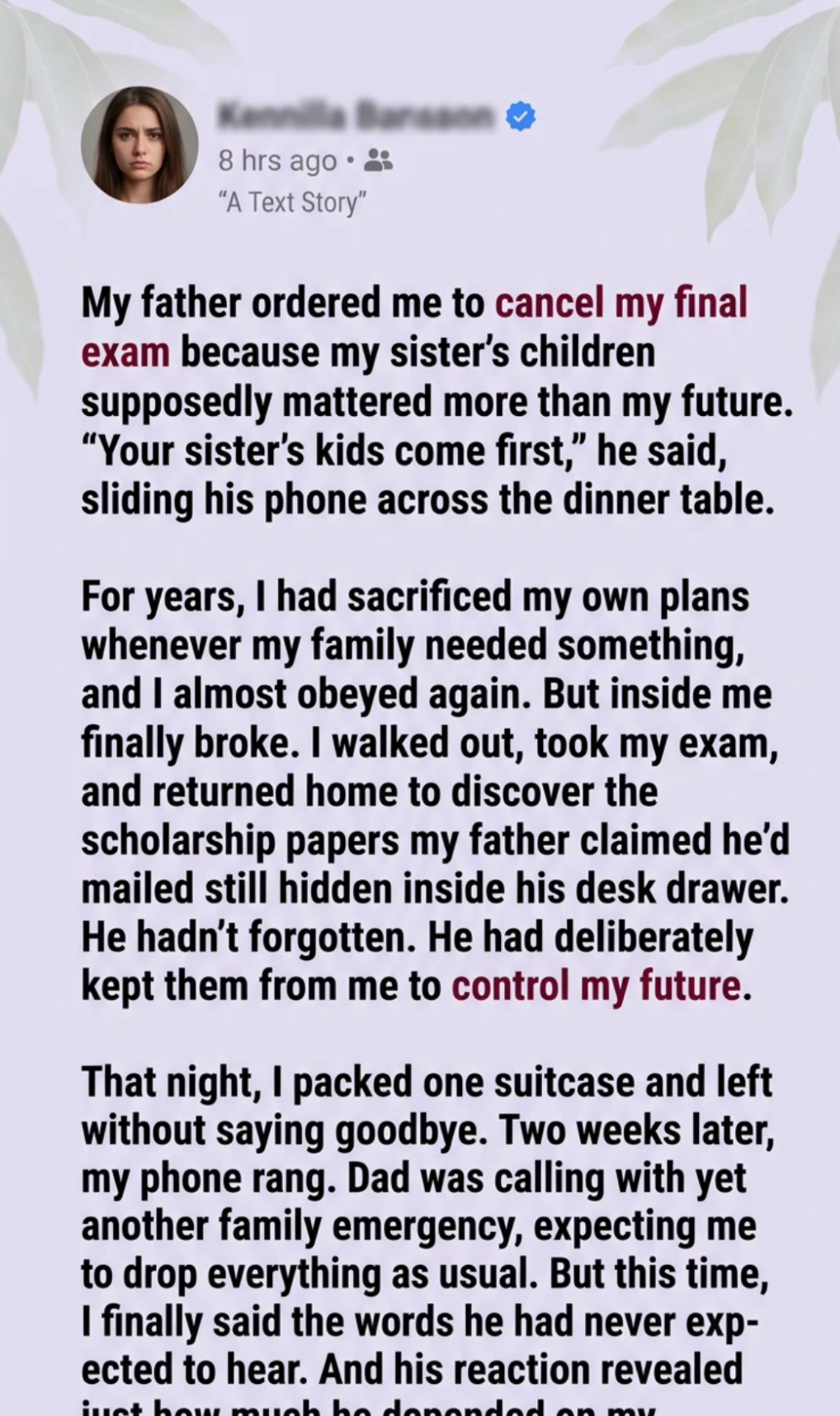
For years, I had been the daughter who always sacrificed her plans, postponed her dreams, and rescued everyone whenever my family needed something. My father believed I would obey him forever. He never imagined that one hidden envelope would finally make me walk away.
My name is Emily Carter, and I was twenty-four years old when I finally understood that my family didn’t see my future as something worth protecting.
I had spent years working toward one goal: finishing my degree in nursing and earning a place in a highly competitive graduate program. I studied late into the night, worked part-time at a medical clinic, and saved almost every dollar I could. I wasn’t the smartest person in my class, but I was determined. Every exam, every assignment, and every exhausting shift brought me closer to the life I had imagined.
Unfortunately, my family had a different plan for me.
I was the oldest of two daughters. My younger sister, Melissa, had married young and had two children, Noah and Sophie. My father, Robert, adored them. He called them his little angels and believed everything in the family should revolve around their needs.
My mother, Diane, rarely disagreed with him.
And I had become the person everyone called when something went wrong.
If Melissa needed someone to watch the children, she called me. If my parents needed help paying a bill, they called me. If someone had an appointment, an emergency, or a problem with work, I was expected to rearrange my schedule.
At first, I didn’t mind helping.
I loved my niece and nephew. I loved my parents. I wanted my sister to succeed.
But gradually, helping became an obligation, and my own life became something I was expected to postpone indefinitely.
The first time I realized how serious the problem had become was when I missed an important university presentation because Melissa had forgotten to arrange childcare.
My father told me I was selfish for refusing to help.
I apologized.
The second time, I canceled a weekend study session because my parents wanted me to drive my mother to a family gathering.
I apologized again.
Then came the final exam that would determine whether I graduated with honors.
I had prepared for months. My professor had warned us that the examination would be difficult, and missing it without an approved reason could delay graduation by an entire semester.
I had one chance to complete it.
The night before the exam, my father invited me to dinner.
I arrived expecting an ordinary family meal. My mother was preparing roast chicken, Melissa was sitting on the sofa scrolling through her phone, and the children were watching television.
My father looked unusually serious.
“Emily, we need to discuss something.”
I put my handbag beside the chair.
“What’s wrong?”
He slid his phone across the dinner table.
“Your sister needs you tomorrow.”
I looked at the screen. It showed a message from Melissa explaining that her childcare arrangements had fallen through.
I frowned.
“Tomorrow? I have my final exam.”
My father barely reacted.
“Your sister has an important appointment. She needs someone to watch Noah and Sophie.”
I stared at him.
“I told everyone about this exam weeks ago.”
He leaned back.
“Things happen. Your sister’s kids come first.”
I thought he was joking.
“Dad, I can’t cancel my final exam. It’s one of the most important exams in my entire degree.”
He shook his head.
“You’re young. You can take another exam later.”
“That’s not how it works. If I miss it, I might have to wait another semester.”
Melissa finally looked up.
“Emily, it’s only one day. I don’t understand why you’re making such a big deal out of it.”
I turned toward her.
“You knew about my exam. You could have arranged childcare earlier.”
She sighed.
“I’ve been busy.”
My father placed his fork on the table.
“Your sister has two children. You don’t have anyone depending on you. You can afford to be flexible.”
I felt something tighten inside my chest.
For years, that had been their argument.
Because I wasn’t married, my time was considered available.
Because I didn’t have children, my responsibilities were considered unimportant.
Because I was still building my career, my dreams could always wait.
I looked at my father.
“Are you actually ordering me to cancel my exam?”
He answered without hesitation.
“Yes. Your sister’s children come first.”
My mother looked down at her plate.
Melissa returned to her phone.
And something inside me finally broke.
I stood up.
“I’m not canceling it.”
My father frowned.
“Sit down. We’re not finished talking.”
“I am.”
He raised his voice.
“Emily, don’t walk away from this family because of an examination!”
I picked up my handbag.
“I’m not walking away because of an examination. I’m walking away because none of you thinks my future matters.”
Then I left.
I barely slept that night.
My phone kept lighting up with messages from my mother and sister. Melissa accused me of abandoning her children. My father sent a message saying I was behaving like an ungrateful stranger.
I didn’t answer.
The next morning, I woke up before sunrise, dressed carefully, reviewed my notes one final time, and drove to the university.
As I entered the examination building, my hands were shaking.
I thought about my father.
I thought about Melissa.
I thought about all the times I had sacrificed something important because someone else had decided their needs mattered more.
Then I took a deep breath.
I turned off my phone and entered the examination room.
For the first time in years, I chose myself without asking anyone’s permission.
The exam lasted three hours.
When I walked out, I felt exhausted but strangely peaceful.
I had done it.
I had protected something that belonged to me.
I drove home that afternoon expecting another argument. Instead, the house was quiet. My father was at work, my mother was grocery shopping, and Melissa had taken the children home.
I went into my father’s study to look for a document I needed for my university records.
His desk was usually locked, but the drawer was slightly open.
Inside were several envelopes, bank statements, and a stack of paperwork.
I wasn’t looking for anything personal.
Then I saw my name.
The envelope was addressed to me and had the university’s logo printed in the corner.
My heart began beating faster.
I pulled it out.
It was the scholarship approval package I had been waiting for.
For months, I had been told that the university had never sent the final documents. My father had claimed he mailed the requested paperwork weeks earlier, but that something must have gone wrong.
I had called the scholarship office several times.
They told me my application was incomplete because the acceptance documents had never been returned.
I had been devastated.
The scholarship would have covered a significant portion of my remaining tuition and provided a living allowance while I completed my studies.
I had assumed I had lost the opportunity because of an administrative mistake.
But the envelope was right there.
It had never been mailed.
I opened it with trembling fingers.
Inside was the original scholarship award letter, the acceptance form, and a reminder that the deadline had passed several weeks earlier.
There was also a handwritten note attached to the front.
My father’s handwriting.
Emily will need to delay this until Melissa’s situation improves. She can try again next year.
I read the sentence again.
Then again.
My father hadn’t forgotten to mail my scholarship papers.
He had deliberately kept them from me.
I sat down in his chair.
The room seemed to shrink around me.
Suddenly, several things made sense.
Why he had discouraged me from accepting extra shifts at the clinic.
Why he kept telling me that graduate school was unnecessary.
Why he repeatedly suggested that I should work closer to home so I could help Melissa.
Why he always seemed uncomfortable whenever I spoke about moving away.
He hadn’t simply expected me to help the family.
He had been making decisions about my future without my permission.
I photographed every page and carefully returned the original documents to the envelope.
Then I went upstairs and packed one suitcase.
I took my clothes, university records, identification, laptop, and a few personal belongings.
Before leaving, I stood in the hallway and looked at the family photographs.
There was one of me graduating from high school. My father stood beside me, smiling proudly.
I remembered how happy I had been that day.
I wondered when my happiness had become something he believed he could control.
I didn’t leave a long letter.
I didn’t argue.
I simply placed my house key on the kitchen counter and walked out.
I moved into a small furnished apartment near the university. It wasn’t luxurious, but it was quiet. Nobody could demand that I abandon my studies or rearrange my future because someone else had failed to plan.
For the first few days, I barely spoke to my family.
My mother called repeatedly.
Melissa sent messages accusing me of being dramatic.
My father left a voicemail saying that I was embarrassing everyone.
I saved the messages but didn’t respond.
Instead, I contacted the scholarship office.
I explained that I had only recently discovered the original documents and asked whether there was any possibility of an appeal or late reconsideration.
The administrator was sympathetic but explained that the award had already been reassigned.
I was disappointed, but I refused to give up.
I asked whether there were alternative funding opportunities.
She sent me information about another scholarship, a university hardship fund, and a graduate assistant position.
I applied for all three.
I also contacted my academic adviser and explained my situation without going into unnecessary family details.
She helped me arrange a financial plan that allowed me to continue studying.
For the first time, I began building a future based on my own decisions.
Two weeks after I left, my phone rang.
It was my father.
I watched his name appear on the screen for several seconds before answering.
“Emily, where are you?”
“Safe.”
“That’s not an answer. Your mother is worried sick.”
“Then tell her I’m safe.”
He sighed impatiently.
“We have a problem.”
I almost laughed.
Of course they did.
Melissa had apparently been called into work unexpectedly, and her regular childcare arrangements had fallen through. My father wanted me to return home immediately and watch the children.
I looked at the calendar.
I had an important meeting with my university adviser that afternoon.
“I can’t.”
He became irritated.
“What do you mean, you can’t?”
“I have plans.”
“Emily, this is a family emergency.”
I closed my eyes.
There it was again.
The familiar phrase that had controlled my life for years.
A family emergency.
A family obligation.
A family sacrifice.
I had heard those words so often that I had almost forgotten I was allowed to say no.
My father continued.
“Your sister needs you. Your mother can’t manage both children. You need to come home.”
I took a breath.
Then I said the words he had never expected to hear.
“No, Dad. Your emergency is no longer my responsibility.”
Silence.
He seemed unable to process what I had said.
“What did you just say?”
“I said no. I have my own life, and I am not canceling it every time someone else needs something.”
His voice became sharp.
“After everything we’ve done for you?”
I looked around my small apartment.
At the books on my desk.
At my university schedule.
At the suitcase I still hadn’t completely unpacked.
“What have you done for me, Dad?”
He began speaking louder.
“We raised you. We gave you a home. We supported your education.”
I felt tears gathering in my eyes.
“And you kept my scholarship papers hidden in your desk.”
He went completely silent.
For several seconds, I could hear only his breathing.
Then he said quietly, “You went through my things?”
“I found an envelope with my name on it. The scholarship documents you told me you had mailed.”
He didn’t answer.
“Why did you do it?” I asked.
He finally spoke.
“Melissa needed help. She has children. You don’t understand how difficult her situation is.”
I stared at the wall.
“So you decided my future could wait.”
“It wasn’t like that.”
“You deliberately kept an opportunity from me because you wanted me available for your family.”
He became defensive.
“I was trying to keep everyone together.”
“No, Dad. You were trying to keep me under your control.”
He raised his voice.
“Don’t talk to me like that! I’m your father!”
I answered calmly.
“Being my father doesn’t give you ownership of my life.”
Then he said something that revealed just how much he depended on my obedience.
“If you stop helping Melissa, what are we supposed to do? Who is going to watch the children? Who is going to help your mother? Who is going to take care of things when something goes wrong?”
I felt a strange sadness.
He wasn’t asking how I was doing.
He wasn’t asking whether I had enough money for rent.
He wasn’t asking whether I had recovered from discovering what he had done.
He was asking who would replace me.
For years, I had believed that my family needed me because they loved me.
Now I understood that they also needed my obedience because it made their lives easier.
I took a breath.
“You’re going to have to make arrangements like everyone else. I’m your daughter, not the family emergency service.”
He began shouting.
“You’re abandoning your sister!”
“No. I’m refusing to abandon myself.”
Then I ended the call.
I sat quietly for several minutes.
I expected to feel guilty.
Instead, I felt as if I had finally put down something heavy that I had been carrying for years.
The following morning, my mother came to my apartment.
I hadn’t told her the address, but Melissa must have given it to her.
She stood outside holding a grocery bag.
“Can we talk?”
I opened the door but didn’t invite her inside immediately.
She looked exhausted.
“Your father is furious.”
“I imagine he is.”
“Melissa is struggling. The children need help.”
I looked at her.
“And what about me?”
She lowered her eyes.
“I know you’re upset.”
“Mom, Dad hid my scholarship documents.”
She became still.
I watched her face carefully.
“You knew?”
She didn’t answer.
I felt my heart sink.
“Mom?”
She finally whispered, “Your father said he would explain it later.”
I stepped back.
“So you knew he had the papers?”
She nodded slightly.
I couldn’t believe it.
Both of my parents had known that I was waiting for an opportunity that was sitting inside their house.
My mother began crying.
“He thought you would be happier staying close to us. Melissa has the children, and we thought you could help her while she got settled.”
I shook my head.
“You thought I should give up my future because my sister had children?”
“That’s not what we meant.”
“Then what did you mean?”
She had no answer.
I opened the door wider and let her come inside.
We sat at the small kitchen table.
For the first time, I told her exactly how I had felt over the years.
I explained the missed opportunities, the canceled plans, the guilt, and the constant expectation that I would always be available.
I told her how painful it had been to discover that my own father had deliberately prevented me from receiving financial support for my education.
My mother cried throughout the conversation.
Finally, she said, “I never wanted you to feel less important.”
I looked at her.
“But that’s exactly how you treated me.”
She reached for my hand.
I didn’t pull away, but I didn’t hold hers either.
“I need time,” I told her.
She nodded.
Before leaving, she placed the grocery bag on the counter.
Inside were fresh vegetables, bread, and a small container of homemade soup.
It was a quiet gesture, but it didn’t repair what had happened.
A few weeks later, I received an email from the university.
My application for the graduate assistant position had been successful.
The position included a tuition reduction, a monthly stipend, and the opportunity to work alongside a senior nursing lecturer.
I read the email three times before believing it.
Then I called my academic adviser.
She congratulated me and said she had been impressed by how quickly I had reorganized my plans after losing the original scholarship.
I thanked her.
When I ended the call, I sat on the floor and cried.
Not because I was sad.
Because I had finally achieved something without sacrificing myself for someone else’s convenience.
The next few months were difficult but rewarding.
I worked, studied, and gradually became more confident.
My father continued sending messages, although they became less frequent.
At first, they were angry.
Then they became practical.
He wanted me to help with a bill.
Melissa needed childcare.
My mother needed a ride.
I refused whenever the request interfered with my responsibilities.
Sometimes I offered help when I genuinely could.
But I stopped treating every request as an order.
Eventually, Melissa called.
She sounded different.
“Emily, can we talk?”
I agreed.
She admitted that she had become accustomed to depending on me. She said Dad had always told her that I didn’t mind helping because I had no children and no husband.
“I never thought about how much you were giving up,” she said.
I listened.
Then I told her something I had wanted to say for years.
“My life doesn’t become less important because it looks different from yours.”
She began crying.
“I’m sorry.”
I accepted her apology, but I made it clear that I would no longer be her automatic childcare arrangement.
She agreed.
It wasn’t an instant transformation, but it was a start.
My relationship with my father remained the hardest.
He struggled to understand why I couldn’t simply forgive him and return to the old arrangement.
He said he had made the decision for the family.
I told him that a decision made for the family should never require one person to sacrifice their entire future without being asked.
He eventually admitted that he had been afraid I would move away, become independent, and stop helping everyone.
That admission hurt.
He had not hidden my scholarship because he believed I couldn’t succeed.
He had hidden it because he was afraid I would.
By the time I completed my degree, I had built a life that no longer revolved around my family’s emergencies.
I accepted a position at a respected hospital and continued working toward my professional goals.
At my graduation ceremony, my mother attended.
Melissa came with the children.
My father arrived late and sat quietly near the back.
When my name was announced, I walked across the stage and accepted my certificate.
I looked toward the audience.
My mother was crying.
Melissa was clapping.
My father stood with his hands together, his expression difficult to read.
After the ceremony, he approached me.
“Emily.”
I turned.
He looked older than I remembered.
“I’m proud of you.”
I waited.
He swallowed.
“I should never have hidden those papers.”
For the first time, he didn’t offer an excuse.
He didn’t mention Melissa’s children.
He didn’t talk about family obligations.
He simply admitted that he had been wrong.
I nodded.
“Thank you for saying that.”
He looked at my certificate.
“You did it anyway.”
I smiled slightly.
“Yes. I did.”
He reached for a hug, and I allowed it.
But I understood that forgiveness and returning to the old relationship were two different things.
I could forgive him without surrendering my independence.
I could love my family without being available every time they needed something.
And I could be a loving sister and daughter without giving up the future I had worked so hard to build.
That evening, I returned to my apartment and placed my graduation certificate on the shelf beside my university photographs.
I thought about the envelope hidden in my father’s desk.
For a long time, I had believed it represented an opportunity someone had taken away from me.
But eventually, it became something else.
It became the moment I realized that my future was not something my family could hand out, postpone, or cancel.
It belonged to me.
My father had spent years believing that I would always obey him because I loved him.
He had mistaken my kindness for weakness and my loyalty for permission.
The day he told me his grandchildren came before my future, he expected me to surrender another piece of my life.
Instead, I took my exam.
I found the truth.
I packed my suitcase.
And when he called two weeks later with another emergency, I finally told him no.
It wasn’t the easiest word I had ever spoken.
But it was the first word that truly changed my life.
The End.