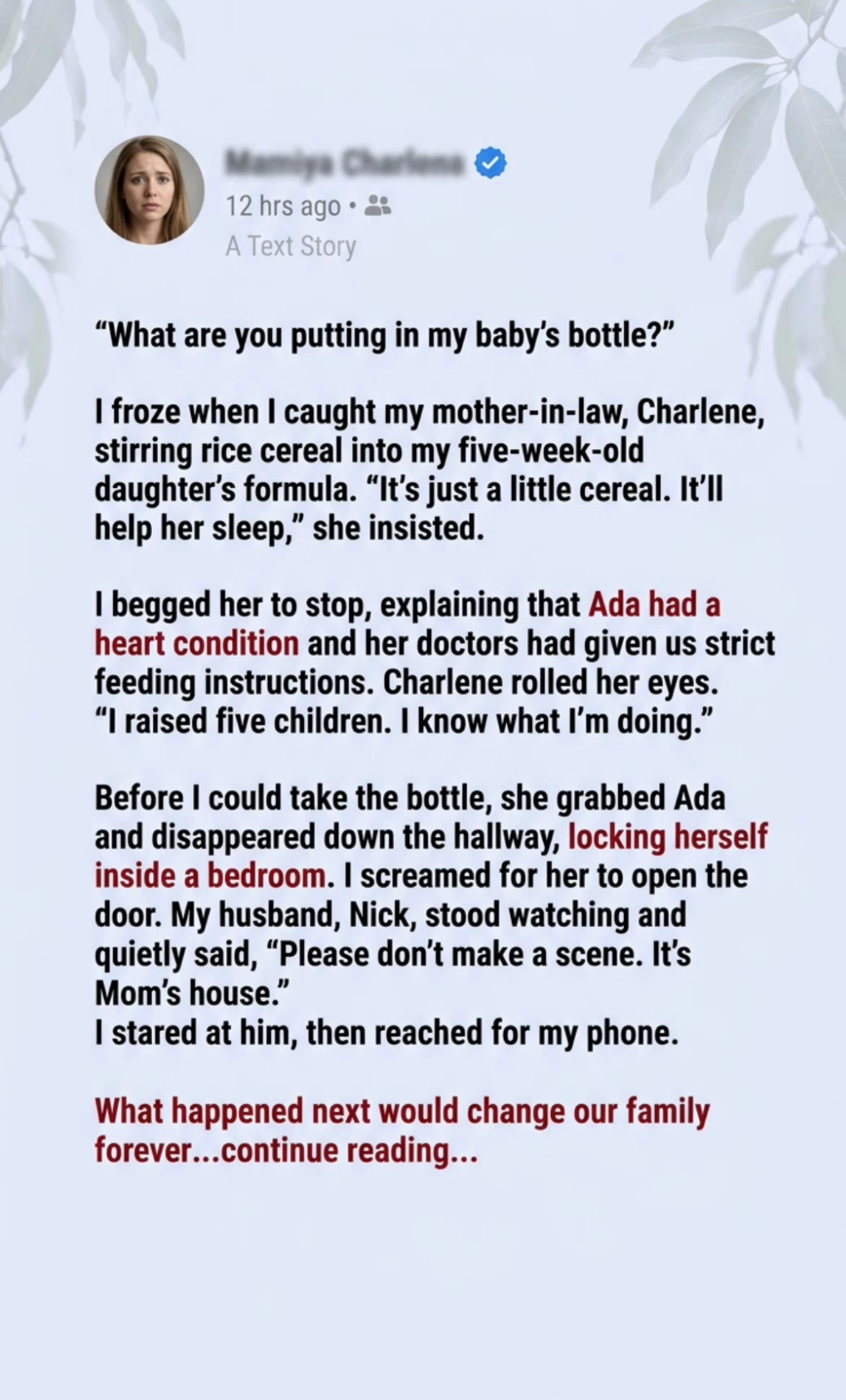
I thought the most frightening part of becoming a new mother would be learning how to care for a fragile newborn. I never imagined I would have to fight someone in my own family to protect my daughter from a dangerous decision. When I discovered what my mother-in-law had secretly mixed into Ada’s formula, I begged her to stop. She dismissed the doctors, locked herself in a bedroom with my baby, and left my husband standing beside me, asking me to stay quiet. That was the moment I realized this wasn’t simply a disagreement about parenting. It was a matter of Ada’s safety—and I was the only person in that house willing to put it first.
My name is Emily Carter, and my daughter, Ada, was five weeks old when I learned that the people who were supposed to help protect my child could become the greatest threat to her safety.
Ada was born with a congenital heart condition. The doctors had discovered it during pregnancy, and although they reassured us that she could grow and develop with careful medical management, her first weeks of life required close attention.
We had spent days in the hospital learning how to feed her, monitor her breathing, recognize signs of distress, and follow her specialist’s instructions.
Her feeding schedule was precise.
Her formula had to be prepared exactly as directed. We were not permitted to add cereal, thickeners, or anything else unless her medical team specifically approved it. Even a seemingly harmless change could affect how much she consumed, how easily she swallowed, and how her body handled feeding.
I had written the instructions on a sheet of paper and placed it on the refrigerator.
I had also explained everything to my husband, Nick.
He had been present during the hospital appointments. He had heard the cardiologist explain Ada’s condition. He had watched me carefully measure every bottle.
At least, I believed he had understood.
When Ada was discharged, Nick suggested that we stay temporarily at his mother’s house.
His mother, Charlene, lived in a large two-story home with an extra bedroom and plenty of space. Nick said she could help us while I recovered from childbirth and adjusted to caring for a newborn.
“Mom has raised five children,” he told me. “She knows what she’s doing. It will make things easier.”
I wasn’t convinced.
Charlene and I had never been particularly close. She was outspoken, confident, and accustomed to having the final word. She often described modern parenting as unnecessarily complicated and believed doctors sometimes frightened new parents with too many rules.
But Nick promised that she would respect our decisions.
So I agreed.
For the first few days, everything seemed manageable.
Charlene cooked meals, washed a few baby clothes, and occasionally held Ada while I showered. I thanked her because I knew she was trying to help.
But little comments began appearing.
“You’re feeding her again already?”
“She doesn’t need to be held every time she cries.”
“You’re making yourself nervous by checking everything.”
I tried to ignore them.
Ada was still very small, and I was learning how to recognize her different cries. Sometimes she needed feeding. Sometimes she needed comfort. Sometimes she simply wanted to be held.
I didn’t consider that a problem.
Charlene did.
One afternoon, I came downstairs after folding a basket of laundry. Ada had just finished a feeding, and I expected to find her sleeping in her bassinet.
Instead, I saw Charlene standing near the kitchen counter with a bottle in her hand.
She was stirring something into it.
At first, I couldn’t understand what I was seeing.
A small container of rice cereal was open beside her.
She scooped another spoonful into the formula and stirred.
My stomach dropped.
“What are you putting in my baby’s bottle?”
Charlene turned around as though I had interrupted an ordinary household chore.
“Rice cereal,” she answered. “It’ll help her sleep.”
I hurried toward her.
“Stop. Ada can’t have that.”
Charlene sighed.
“It’s just a little.”
“Her doctors specifically told us not to add anything to her formula.”
She rolled her eyes.
“Oh, Emily. Not everything needs to become a medical emergency.”
I reached for the bottle.
“Please give it to me.”
She moved it away.
“I raised five children. I know what I’m doing.”
I stared at her.
“That doesn’t change Ada’s medical condition.”
Charlene’s expression hardened.
“You’re acting as if I’m trying to hurt her.”
“I’m asking you not to put something in her bottle that her doctors told us not to give her.”
She placed the bottle on the counter, then reached for Ada, who was resting in her portable bassinet nearby.
“Give her to me,” I said.
Charlene lifted my daughter.
“She needs to eat.”
“I’ll prepare her formula.”
“You’re too anxious. That’s your problem.”
I stepped closer.
“Charlene, I’m serious. Please give me my baby.”
Instead of answering, she turned and walked toward the hallway.
I followed her.
“Charlene!”
She entered the guest bedroom and shut the door.
Then I heard the lock turn.
For a moment, I couldn’t believe it.
She had taken my five-week-old daughter into a bedroom and locked me out.
I grabbed the handle.
“Open the door!”
Nothing.
“Charlene, give me Ada!”
I knocked again, harder.
I could hear movement inside, followed by her voice.
“You’re not going to tell me how to care for a baby in my own house!”
I turned toward Nick.
He had been standing near the living room entrance.
He had watched the entire exchange.
I expected him to walk over, demand that his mother open the door, and take our daughter.
Instead, he looked uncomfortable and lowered his voice.
“Please don’t make a scene. It’s Mom’s house.”
I stared at him.
For a second, I thought I had misunderstood.
“Nick, she’s locked in a room with our five-week-old baby.”
“She’s trying to help.”
“She put cereal in Ada’s formula!”
“She said it was only a little.”
I felt my hands begin to shake.
“Your daughter has a heart condition. You were at the hospital. You heard the doctors.”
Nick rubbed his forehead.
“Can you just calm down?”
That was when something inside me changed.
I had spent weeks trying to keep everyone comfortable. I had avoided arguments with Charlene. I had tolerated comments about my parenting. I had tried to make Nick’s family feel included during a frightening period of our lives.
But my daughter’s safety was not something I could negotiate to preserve someone’s pride.
I reached for my phone.
Nick frowned.
“What are you doing?”
“Calling for help.”
“Emily, don’t.”
I looked at him.
“Then you open that door and bring me my daughter.”
He didn’t move.
I dialed emergency services and explained that my five-week-old daughter had a diagnosed heart condition, that a family member had prepared a bottle containing an unapproved thickening ingredient, and that she had locked herself in a bedroom with the baby despite my repeated demands to return her.
I gave the dispatcher our address.
Nick’s face changed.
“You’re actually calling the police?”
“I’m calling for help because you won’t protect your daughter.”
The dispatcher asked whether Ada was breathing normally and whether she had already consumed any of the bottle.
I couldn’t answer the second question.
I hadn’t seen what happened after Charlene entered the bedroom.
That uncertainty frightened me more than anything else.
I stayed outside the locked door, speaking loudly enough for Charlene to hear.
“Please put Ada down and open the door. I’m not trying to hurt you. I just need to know she’s okay.”
Charlene shouted back.
“You’re embarrassing this family!”
I closed my eyes.
“Open the door.”
A few minutes later, emergency responders arrived.
One of the officers spoke to Nick while another approached me.
I explained the situation again, including Ada’s heart condition and the instructions from her medical team.
The officer asked whether we had the hospital discharge paperwork.
I retrieved the folder from my bag.
The paramedic read the feeding instructions and immediately understood why I was concerned.
They asked Charlene to unlock the bedroom.
At first, she refused.
Then the officer explained that the situation involved the safety of a newborn and that she needed to cooperate.
The lock finally turned.
Charlene opened the door with Ada in her arms.
My daughter was crying.
I stepped forward immediately.
“Give her to me.”
This time, Charlene handed her over.
I held Ada against my chest, checking her face and watching her breathing.
She was warm and upset, but I couldn’t tell whether she had swallowed any of the altered formula.
The paramedic asked Charlene about the bottle.
“It’s nothing,” she said. “Just a little rice cereal.”
“Did the baby drink from it?” the paramedic asked.
Charlene hesitated.
“Only a little.”
My heart sank.
The paramedic asked how much Ada had consumed and when.
Charlene gave an unclear answer.
I showed them the bottle.
The contents looked thicker than ordinary formula.
The paramedic advised that Ada needed prompt medical assessment, particularly given her medical history and the uncertainty surrounding the feeding.
They recommended that we go to the hospital.
I didn’t hesitate.
I gathered Ada’s medical folder and diaper bag.
Nick stood near the doorway.
“Emily, maybe we should just talk about this first.”
I turned toward him.
“We can talk after our daughter has been checked.”
He followed us outside.
Charlene remained in the hallway, insisting that everyone was overreacting.
As the ambulance doors closed, I looked down at Ada.
Her tiny fingers curled around mine.
“Mommy’s here,” I whispered. “You’re safe.”
At the hospital, the medical team examined her and contacted the appropriate specialists.
I explained exactly what had happened and showed them the bottle preparation instructions.
The doctors assessed her condition, monitored her, and determined what observation or testing was necessary based on her symptoms and medical history.
Thankfully, Ada did not show signs of an immediate life-threatening complication.
But the doctors were not pleased that an unapproved ingredient had been added to her formula.
One of them spoke to me privately.
“With a baby this young, especially one with an underlying heart condition, feeding changes should never be made without the medical team approving them.”
I nodded.
“I know. I tried to stop her.”
The doctor looked at me carefully.
“Who prepared the bottle?”
“My mother-in-law.”
“Does she understand the feeding instructions?”
“She has been told. They’re written down in the house. My husband was also present when we discussed them with the specialists.”
The doctor paused.
“Then she needs to understand that this is not a matter of different parenting preferences. These instructions exist because of your daughter’s medical needs.”
I felt tears gathering in my eyes.
“Thank you.”
I wasn’t looking for someone to tell me I was right.
I needed someone to understand that I had not invented the danger to control my mother-in-law.
I had been following the instructions given to me by the people responsible for my daughter’s care.
Nick arrived at the hospital about forty minutes later.
He approached the bed where Ada was being monitored.
“How is she?”
“She’s being checked.”
He looked at the medical equipment and then at me.
“Mom is really upset.”
I stared at him.
“Your daughter is in a hospital bed, Nick.”
“I know.”
“Then why are you talking about your mother’s feelings?”
He lowered his voice.
“She didn’t mean to hurt Ada.”
“Intent doesn’t erase what happened.”
He looked away.
“She says you made her feel like she was dangerous.”
I almost laughed, but there was nothing funny about it.
“She took our baby into a locked room after I told her the bottle wasn’t safe. What was I supposed to call that?”
Nick didn’t answer.
I sat beside Ada and held her tiny hand.
For the rest of the afternoon, the medical team continued evaluating her. Once they were satisfied with her condition and provided instructions for what to watch for, they discussed the feeding plan with us again.
Before we left, I asked for a written copy of the instructions.
I wanted every detail clearly documented.
The doctor agreed.
That evening, I told Nick we were not returning to his mother’s house.
He looked surprised.
“Where are we supposed to go?”
“My sister’s house.”
“Emily, that’s a big reaction.”
I turned toward him.
“No. A big reaction would have been allowing this to happen again.”
He sighed.
“Mom apologized.”
“She hasn’t apologized to me.”
“She says she was only trying to help.”
“Then she can help by respecting the instructions and staying away from Ada’s feeding until we decide otherwise.”
He shook his head.
“You’re making me choose between you and my mother.”
I looked at him for a long moment.
“No, Nick. I’m asking you to choose your daughter’s safety. Your mother is an adult. She can handle being told no.”
He had no response.
My sister, Rachel, picked us up from the hospital.
She had prepared the guest room and placed fresh sheets on the bed. She also brought a small bassinet into the room so Ada could sleep safely beside me.
When I walked through the front door, I nearly cried from relief.
Nobody questioned the doctor’s instructions.
Nobody told me I was too anxious.
Nobody tried to take Ada out of my arms.
Rachel simply said, “You can rest. I’ll make you something to eat.”
For the first time in days, I felt supported.
The next morning, Nick called.
“Mom wants to talk to you.”
“Not today.”
“She’s really hurt.”
I closed my eyes.
“Nick, I spent last night in the hospital because she ignored our daughter’s medical instructions. I’m not ready to comfort her.”
“She says she feels like you think she can’t be trusted.”
I took a breath.
“She locked herself in a bedroom with our newborn. Trust is exactly what she needs to rebuild.”
He was quiet.
Then he said, “I don’t think you understand how difficult this is for me.”
I looked at Ada sleeping in her bassinet.
“I understand that you don’t want conflict with your mother. But you need to understand something, too. I will never put your mother’s comfort above our daughter’s safety.”
He ended the call shortly afterward.
For several days, I received messages from Charlene.
The first said I had humiliated her.
The second said she had raised five healthy children without doctors telling her what to do.
The third said I was trying to turn Nick against his family.
I didn’t respond.
Then came a message that made me put my phone down.
“One day you’ll understand that I was only trying to help. You can’t keep Ada away from her grandmother forever.”
I showed it to Rachel.
She read it and shook her head.
“She’s still making this about herself.”
“That’s what worries me,” I said. “She hasn’t acknowledged what happened.”
A few days later, I contacted Ada’s medical team and asked whether we should establish a written caregiver protocol for anyone who might eventually look after her.
They agreed that clear written instructions were sensible.
We discussed the feeding plan, safe preparation, signs that required medical attention, and who was permitted to make changes.
I also arranged for Nick to attend the next appointment.
I wanted him to hear everything again.
He arrived reluctantly.
The specialist explained Ada’s condition and answered our questions. He also emphasized that no caregiver should add cereal or any other ingredient to her formula unless the medical team specifically recommended it.
Nick nodded.
Afterward, I asked him to stay in the parking lot for a few minutes.
“Do you understand now?” I asked.
He looked tired.
“Yes.”
“Do you understand why I called for help?”
He hesitated.
Then he said, “I should have opened the door.”
I felt my throat tighten.
“Yes, you should have.”
“I thought Mom would calm down.”
“She had our baby behind a locked door. I didn’t have the luxury of waiting to see what she would do.”
He stared at the ground.
“I’m sorry.”
I wanted to believe him.
But I had learned that an apology was only the beginning.
Over the next several weeks, Nick began visiting us at Rachel’s house.
At first, he still defended his mother whenever the incident came up.
Then, slowly, he stopped.
He arranged to attend Ada’s appointments and learned how to prepare her bottles according to the medical instructions. He also began taking responsibility for the night feedings that were appropriate under her care plan.
One evening, he sat beside me while Ada slept.
“I’ve been thinking about what happened,” he said.
I continued folding a blanket.
“What about it?”
“I keep remembering you standing outside that bedroom door.”
I stopped folding.
He looked down.
“I heard you asking Mom to open it. And I just stood there.”
I didn’t speak.
“I was worried about upsetting her. I didn’t think clearly.”
“Nick, I needed you to be Ada’s father in that moment.”
“I know.”
“You weren’t being asked to fight your mother. You were being asked to get your daughter out of a locked room.”
His eyes became wet.
“I know,” he repeated.
For the first time, I believed he understood the difference.
But the question of Charlene remained.
About a month after the incident, she asked to meet with us.
I agreed to a meeting in a public place, with Rachel accompanying me for support.
Charlene arrived carrying a small gift bag.
She looked uncomfortable.
“I brought something for Ada,” she said.
I thanked her but didn’t open it immediately.
She sat down.
“I think this whole situation has gone too far.”
I waited.
“I was trying to help. I didn’t know you would react like that.”
I looked at her.
“Charlene, you were told not to change Ada’s formula. You knew about her heart condition. I asked you to stop, and you locked yourself in a room with her.”
Her expression tightened.
“I didn’t want you grabbing things out of my hands.”
“She is my daughter.”
“And I’m her grandmother.”
“Being her grandmother doesn’t give you permission to ignore her medical instructions.”
Charlene looked toward Nick.
He didn’t rescue her.
Instead, he said, “Mom, you should have given Ada back when Emily asked.”
Charlene seemed stunned.
“You’re taking her side?”
“I’m taking Ada’s side.”
For several seconds, nobody spoke.
Then Charlene looked down at her hands.
“I didn’t think the cereal would hurt her.”
I answered quietly.
“That doesn’t make it safe.”
She swallowed.
“I suppose I should have listened.”
It wasn’t the apology I had hoped for, but it was the first time she had acknowledged that she should have followed the instructions.
I made my boundaries clear.
Charlene could have a relationship with Ada, but she would not be permitted to prepare her feeds or make medical decisions. Any visit would need to be agreed upon in advance, and she would have to follow the instructions we provided without argument.
If she ignored those boundaries again, the visit would end.
Charlene didn’t like it.
But Nick supported me.
That mattered.
Months passed.
Ada grew stronger under the care of her medical team. Her appointments continued, and we followed the feeding plan exactly as prescribed.
I never forgot that afternoon in the kitchen.
I never forgot the sound of the bedroom lock turning.
And I never forgot how alone I had felt when Nick told me not to make a scene.
But I also watched my husband change.
He stopped treating every disagreement with his mother as something I needed to resolve for him. He began setting limits himself. When Charlene questioned Ada’s feeding instructions during a visit, Nick immediately reminded her that the doctors’ guidance was not optional.
The first time he did that without looking at me for approval, I realized he was finally becoming the partner and father I had needed.
One afternoon, several months after the incident, I was holding Ada near the window when Charlene arrived for a planned visit.
She approached slowly.
“May I hold her?”
I looked at Ada, then at Charlene.
“Yes, if you wash your hands first.”
She nodded and went to the bathroom.
When she returned, I placed Ada carefully in her arms.
Charlene looked down at her granddaughter.
“She’s getting so big.”
“She is.”
For a moment, there was no argument, no lecture, and no attempt to prove who knew more.
Just a grandmother holding a baby.
I hoped we could build something better from there.
But I also knew that trust would take time.
That night, after everyone had gone, I sat beside Ada’s crib and watched her sleep.
Her tiny chest rose and fell gently.
I thought about the day I had called for help and wondered how different things might have been if I had stayed silent.
Perhaps Charlene would have continued making changes without telling me. Perhaps Nick would have continued dismissing my concerns. Perhaps I would have spent every visit worrying about what someone might put into my daughter’s bottle.
I would never know.
But I knew one thing.
I had made the right decision.
Some people would say I should have handled the situation privately. Others would say I should have been more respectful because Charlene was older and had raised five children.
But respect does not mean surrendering your child’s safety.
Love does not mean allowing someone to ignore medical instructions.
And keeping the peace is never more important than protecting a newborn who cannot speak for herself.
I didn’t call for help because I wanted to punish my mother-in-law.
I called because my daughter needed someone to act.
And when the person standing beside me refused to do it, I did it myself.
The End.