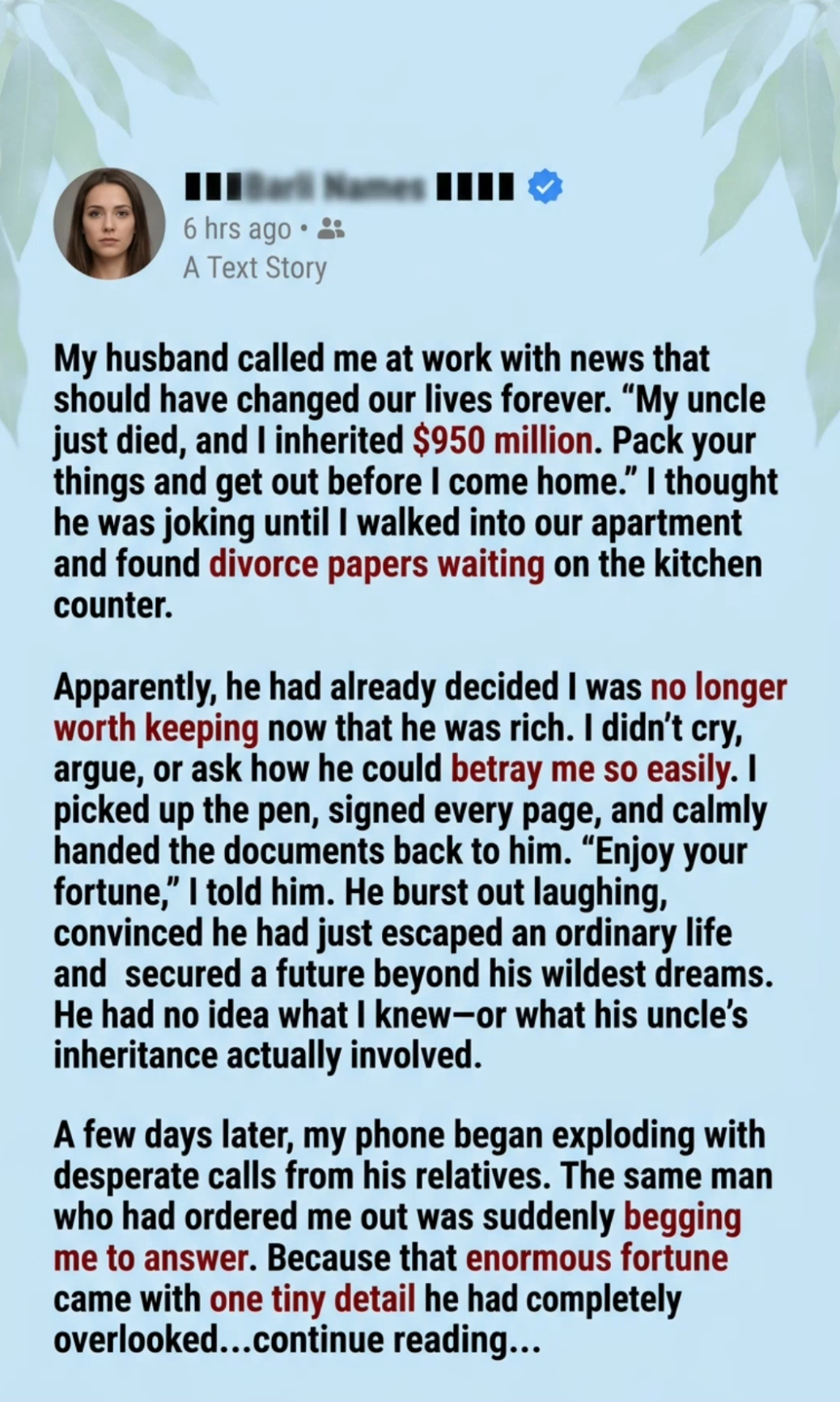
The call came on an ordinary Tuesday afternoon. My husband announced that his uncle had died and left him an inheritance worth $950 million. Then, before I could even congratulate him, he told me to pack my belongings and leave our apartment. He had already prepared divorce papers. He believed his newfound wealth made him powerful enough to replace me without consequences. I didn’t argue. I signed every page and wished him luck. What he didn’t know was that I had once worked closely with his uncle, and I knew something about the inheritance that he had never bothered to learn. The fortune was real, but it wasn’t what he imagined. Three days later, his relatives began calling me in desperation, and the man who had ordered me out of our home was suddenly begging me to help him.
My name is Eleanor Hayes. I was thirty-nine years old when my husband, Christopher, called me at work and told me he had become one of the richest men in the country.
We had been married for twelve years.
We lived in a comfortable apartment in Chicago, Illinois. It wasn’t enormous or particularly luxurious, but it was ours—or at least, I had always believed it was.
Christopher worked in commercial property development. He was ambitious, charming when he wanted to be, and obsessed with the idea of becoming wealthy.
I worked as a financial compliance consultant. My job involved reviewing complex financial arrangements, examining corporate records, and helping clients understand the obligations attached to major transactions.
I earned a good living, and we had built a comfortable life together.
Christopher, however, never thought it was enough.
He talked constantly about reaching the level of wealth enjoyed by the people he admired. He followed billionaire business owners, collected expensive watches, and spent hours discussing investments he believed would make him rich.
Whenever I suggested that we should enjoy what we already had, he accused me of lacking ambition.
“You think too small, Eleanor.”
I usually smiled and changed the subject.
His uncle, Richard Whitmore, was a different kind of man.
Richard had built a vast business empire over several decades. He owned interests in commercial real estate, logistics, manufacturing, and private investment companies. He rarely appeared in public and disliked discussing his wealth.
Christopher had always complained that his uncle was too cautious.
“He could help the whole family,” Christopher once told me. “But he acts like every dollar needs a committee meeting.”
I had met Richard several times during family gatherings. He was intelligent, reserved, and surprisingly observant.
Unlike Christopher, he asked about my work.
During one dinner, he had spent nearly an hour discussing financial compliance, corporate governance, and the importance of independent oversight.
“You understand something many people don’t,” he told me. “Money isn’t just what you own. It’s also what you are responsible for.”
I remembered that sentence.
At the time, I didn’t realize how important it would become.
Christopher and I had been experiencing problems for almost a year. He had become increasingly distant and often spoke about our marriage as though it were an arrangement that had stopped benefiting him.
He spent more time with wealthy business associates and less time at home.
He also began making comments about women who married successful men.
“Some people know how to position themselves,” he said one evening.
“What does that mean?”
“It means they understand that relationships are about more than feelings.”
I looked at him.
“Are you talking about us?”
He laughed.
“Don’t make everything personal.”
I should have paid more attention.
Then came the phone call.
It was 2:40 on a Tuesday afternoon. I was reviewing a client’s financial report when my phone began vibrating.
Christopher.
I answered.
“Hello?”
His voice was unusually loud.
“Eleanor, you won’t believe what happened.”
“What?”
“My uncle Richard is dead.”
I sat back.
“Oh, Christopher. I’m so sorry.”
He ignored my sympathy.
“Do you understand what this means?”
I was quiet.
“He left me everything.”
“What do you mean?”
“Everything! His estate. His investments. The companies. The whole thing.”
I frowned.
“Are you sure?”
“Nine hundred and fifty million dollars, Eleanor. That’s the estimated value. Nine hundred and fifty million!”
I stared at my computer screen.
It was an extraordinary amount of money.
“Christopher, that’s a lot to process. When did you find out?”
“This morning. His attorney called.”
I took a breath.
“I’m sorry about your uncle. I know you had a complicated relationship, but—”
“Pack your things.”
I stopped.
“What?”
“You heard me. Pack your things and get out before I come home.”
For a moment, I thought the call had dropped.
“Christopher, what are you talking about?”
“I’m not going to spend the rest of my life sharing my money with someone who never understood my ambitions.”
I felt my stomach tighten.
“Are you saying you want a divorce?”
“I’m saying I have a different future now.”
He spoke as though he were announcing a promotion.
“I’ve already had the documents prepared. They’ll be on the kitchen counter. Sign them, take your personal belongings, and leave.”
I couldn’t speak.
Then he added, “Don’t make this difficult. You should be grateful I’m handling it cleanly.”
The call ended.
I sat at my desk for several minutes.
My colleagues were talking in the background. A printer was running. Someone laughed near the conference room.
Ordinary life continued while mine seemed to have split into two completely different realities.
I finally closed my laptop.
I called my supervisor, explained that I needed to leave, and drove home.
When I entered the apartment, I saw the documents immediately.
A thick folder sat in the middle of the kitchen counter.
Beside it was a black pen.
I opened the folder.
The first page was a divorce petition. The proposed settlement was heavily favorable to Christopher. It suggested that he would retain certain assets and that I would leave the apartment without pursuing additional claims.
There were also statements about our finances that I knew were incomplete.
I turned another page.
Then another.
Christopher had already signed his portion.
He had prepared everything before calling me.
I sat down.
For twelve years, I had believed we were building a life together.
Now he was treating me like an inconvenience that needed to be removed before the money arrived.
I thought about the difficult years when his business had struggled. I remembered paying several household expenses while he tried to establish himself. I remembered staying awake with him when he worried about losing a major client.
I remembered the promises.
And I remembered Richard.
A few months earlier, his uncle had contacted me privately.
He had asked for a meeting to discuss a matter involving his estate and a financial oversight arrangement. He explained that he wanted his succession plans handled carefully and that he was concerned about how certain family members might react to sudden wealth.
I had not been asked to make any decisions on his behalf. I had simply provided general professional observations and directed him toward independent legal and financial advisers.
But during that meeting, Richard had said something that stayed with me.
“Christopher thinks inheritance is the same as ownership. One day, he may learn the difference.”
At the time, I had thought he was speaking philosophically.
Now I understood that he had been warning me about something specific.
I looked down at the divorce papers.
Then I picked up the pen.
I signed where the documents requested my signature, but I did not sign any separate release, financial waiver, or additional agreement that had not been properly reviewed. I photographed the entire packet and sent it to my attorney, Laura Bennett, for immediate review.
When Christopher arrived that evening, he found me sitting at the kitchen table.
The folder was closed.
He looked pleased.
“You’re finished?”
I pushed the documents toward him.
“Here.”
He opened the folder and checked the signatures.
Then he laughed.
“That was easier than I expected.”
I looked at him.
“Enjoy your fortune, Christopher.”
He laughed again.
“Oh, I intend to.”
He took the folder and placed it inside his briefcase.
“You’re making the right decision. You’ll be much happier without having to keep up with my life.”
I stood.
“I hope you get everything you want.”
He smiled.
“I will.”
I packed two suitcases that night and stayed with a close friend.
I did not beg him to reconsider.
I did not demand an explanation.
And I did not tell him what I knew about his uncle’s estate.
The next morning, I met with Laura.
She reviewed the documents carefully.
“Eleanor, I need to make something clear. Signing a divorce petition or proposed settlement does not necessarily mean every financial issue is resolved. We need to determine whether the documents are enforceable, whether the disclosures are complete, and whether any marital property rights are being waived.”
“I understand.”
“Also, the inheritance issue is separate. We need to know what the actual estate documents say.”
I nodded.
“I think I know something about that.”
I told her about Richard’s private meeting and his comments regarding succession planning.
Laura listened carefully.
“Do you have any documents?”
“Only my meeting notes and the correspondence arranging the appointment.”
“Good. Preserve everything. Don’t contact Christopher about the estate. If there is a legal issue, we want the estate’s independent representatives to handle it.”
I agreed.
That afternoon, I received an email from Richard’s estate attorney, Jonathan Pierce.
He asked whether I would be available for a formal meeting regarding an administrative matter connected to the estate.
I replied that all communication should be coordinated through Laura.
Two days later, the meeting took place.
Jonathan arrived with another attorney and a financial administrator.
He explained that Richard’s estate had been structured through several separate legal entities, including trusts, holding companies, and operating businesses.
The $950 million figure Christopher had heard was an estimated total value of the assets connected to the estate.
It was not a personal bank balance.
It was not a pile of money waiting to be transferred.
And it was not automatically available to Christopher.
I listened carefully.
Jonathan opened a document.
“Your husband’s uncle left him a substantial beneficial interest, but the estate plan includes conditions and administrative requirements.”
I looked at him.
“What kind of conditions?”
He explained that Richard had established a family trust years earlier. The trust held controlling interests in several companies and investment entities. Its purpose was to preserve the businesses, protect employees, and prevent the estate from being dismantled through sudden distributions.
Christopher had been named as a potential beneficiary and successor participant in the family structure.
But the trust did not give him unrestricted ownership of the entire estate.
Instead, it required a period of independent review, financial disclosure, and approval by the trustees before certain distributions or management appointments could occur.
There were also restrictions on transferring or selling major assets.
“Why?” I asked.
Jonathan looked at me.
“Your uncle-in-law was concerned that a sudden inheritance might lead to irresponsible decisions.”
I thought about Richard’s warning.
Christopher thinks inheritance is the same as ownership.
Jonathan continued.
“There’s another important matter. Richard’s estate plan includes a provision for an independent governance review if a beneficiary attempts to pressure another person into signing documents connected to the estate or uses misleading statements about ownership.”
I frowned.
“Does that mean the divorce papers?”
“Not necessarily. We are not making that determination. But the estate’s trustees are aware of the circumstances surrounding your husband’s announcement, and they will review any relevant evidence.”
I looked at Laura.
She remained calm.
The truth was becoming clearer.
Christopher had celebrated an inheritance he did not fully understand.
He had also rushed to divorce me because he believed the money would make him untouchable.
But the inheritance was not an unrestricted fortune.
It was a complicated legal structure with obligations.
And the people responsible for administering it were not going to hand over control simply because he had received a phone call.
The following day, Christopher called me.
I almost didn’t answer.
“Hello?”
“Eleanor, where are you?”
“Why?”
“We need to talk.”
“About what?”
“The estate.”
I remained silent.
He continued.
“The attorney is making things complicated. He says I can’t access the money yet.”
I leaned back.
“That sounds frustrating.”
“Don’t be sarcastic. They want documents, financial disclosures, and meetings. They’re talking about trustees and restrictions.”
I said nothing.
“Did you know about this?”
I looked out the window.
“Your uncle was careful about his estate.”
“That’s not an answer.”
“I don’t know what you want me to say.”
He lowered his voice.
“Did Richard tell you something?”
I paused.
“Christopher, I met with your uncle once to discuss general governance questions. You know that.”
“Did he tell you about the trust?”
“I didn’t receive confidential estate documents.”
That was true.
He began speaking more quickly.
“I need you to tell me everything he said.”
“Why?”
“Because I think he set this up to control me.”
I closed my eyes.
“Maybe he wanted to protect what he built.”
Christopher became angry.
“You always take other people’s side.”
I looked at the phone.
“Goodbye, Christopher.”
I ended the call.
Over the next few days, his calls became more frequent.
At first, he was irritated.
Then he sounded worried.
Then desperate.
He told me that the estate’s trustees were refusing to approve certain requests. He complained that the family businesses were not releasing money to him and that his relatives were questioning his plans.
I did not intervene.
I had my own legal matters to resolve.
Laura was reviewing the divorce documents, and we had begun preparing a complete financial disclosure. Some of the proposed terms Christopher had given me were not acceptable, and several issues required formal negotiation.
Then, on the fourth day after I signed the initial papers, my phone began ringing repeatedly.
Christopher.
His mother, Margaret.
His sister, Olivia.
His cousin, Andrew.
Even a number I recognized as belonging to the estate’s financial administrator.
I answered the administrator first.
“Ms. Hayes, this is Daniel Foster from the Whitmore estate office. I apologize for contacting you unexpectedly.”
“Is something wrong?”
“There has been a development concerning Mr. Christopher Whitmore’s request for an early distribution.”
I sat down.
“What development?”
“His request has been placed on hold pending review of certain statements and documents. The trustees would like to confirm whether you have any information about the circumstances surrounding the proposed divorce agreement.”
I looked toward Laura’s office door.
“I’ll have my attorney contact you.”
“Of course.”
I ended the call.
Then Christopher called again.
I answered.
“Eleanor!”
His voice was shaking.
“What’s happening?”
“What do you mean?”
“They’re saying I can’t receive the money. They say I don’t have full control. My mother is furious. My cousins are saying Uncle Richard never intended me to manage the businesses.”
I stayed quiet.
“Please, Eleanor. You have to help me.”
“How?”
“You knew him. You spoke to him. Tell them he wanted me to have everything.”
I took a breath.
“Christopher, I can’t tell them something that isn’t true.”
He became louder.
“You’re doing this because I divorced you!”
“No. I signed the documents you put in front of me because you told me you wanted to end our marriage. The estate is a separate matter.”
“They’re asking about the divorce.”
“Then you should answer honestly.”
He went silent.
Finally, he said, “They found your email.”
I frowned.
“What email?”
“The one you sent your attorney. They say there was a meeting with Uncle Richard and that you know something about his plans.”
I felt a chill.
I had not shared confidential information. But my correspondence and meeting notes were relevant to the questions being asked.
“Christopher, I didn’t create your uncle’s estate plan.”
“You could explain that he wanted me to inherit everything.”
“I cannot say that because I don’t know that it is true.”
He began breathing heavily.
“Please. My relatives are turning against me. The trustees won’t approve anything. I need you to tell them I’m supposed to have control.”
I looked at the clock.
It was nearly midnight.
“Christopher, I think you need to speak to your own attorney.”
He whispered:
“They said the entire inheritance could be affected.”
I felt a strange mixture of sadness and disbelief.
“Then you should have understood the responsibilities before celebrating the money.”
He didn’t answer.
I ended the call.
The following morning, Laura contacted the estate’s attorney.
She explained that I had no authority over the trust and had never claimed otherwise. She also provided the limited records relevant to the meeting, making clear that I would cooperate with lawful requests but would not speculate about Richard’s intentions.
The trustees continued their review.
What they discovered was more complicated than Christopher had expected.
Richard’s estate plan had been designed to protect the businesses from being broken apart. The estimated $950 million represented the combined value of the companies, properties, investments, and other holdings.
Christopher had been named as a beneficiary, but his access to distributions depended on the trust’s terms.
He could not simply sell the companies, withdraw the assets, or demand the entire amount.
The trust also required professional management and independent oversight.
If he wanted to participate in major decisions, he needed to demonstrate that he understood the responsibilities involved.
The trustees were particularly concerned about statements Christopher had made to relatives and potential business partners suggesting that he already had unrestricted control over the estate.
They also wanted clarification about why he had rushed to divorce me immediately after learning of the inheritance.
The estate did not have authority to decide our divorce or punish him for ending the marriage. But the trustees could consider whether his conduct raised concerns under the governance provisions of the trust.
That distinction mattered.
I wasn’t trying to take his inheritance away.
I wasn’t trying to punish him.
I simply refused to lie for him.
A week later, Christopher appeared outside Laura’s office.
He looked nothing like the confident man who had laughed while I signed the divorce papers.
His shirt was wrinkled, and he had dark circles beneath his eyes.
Laura allowed him to sit in the conference room after confirming that the conversation would be limited to matters appropriate for discussion.
He looked at me.
“Eleanor, please.”
I waited.
“I made a mistake.”
I didn’t answer.
He continued.
“I thought everything would be different once the inheritance came through. I thought I would finally have the freedom to live the way I wanted.”
“You already had freedom.”
He shook his head.
“I wanted more.”
I looked at him.
“And you thought I was something you could discard.”
He lowered his eyes.
“I was angry. I was overwhelmed.”
“You called me at work and told me to leave before you got home.”
“I know.”
“You put divorce papers on the kitchen counter.”
“I know.”
“You laughed when I signed them.”
His eyes filled with tears.
“I know.”
I looked at him for a long time.
Then I asked, “What do you want from me?”
He swallowed.
“I want you to talk to the trustees. Tell them I wasn’t trying to manipulate anything. Tell them I deserve the inheritance.”
I almost laughed.
“You don’t need me to tell them what you deserve. You need to show them who you are.”
He looked at me.
“Please. I thought you would understand.”
“I understood perfectly. You believed money made you better than me.”
He shook his head.
“That’s not what I meant.”
“Then what did you mean?”
He had no answer.
Laura gently reminded him that any legal questions about the divorce should be addressed through counsel.
Christopher stood.
Before leaving, he turned toward me.
“Can we start over?”
I looked at him.
“No.”
He nodded slowly.
For the first time, he seemed to understand that the decision was final.
The divorce process continued, and the original papers were reviewed in light of the full financial circumstances. I did not rely on the fact that I had signed the initial documents as proof that every issue was resolved. My attorney made sure the final agreement properly addressed our rights and obligations.
Eventually, the divorce was finalized through a negotiated settlement.
Christopher retained the inheritance rights he was legally entitled to under Richard’s estate plan, subject to the trust’s conditions. He did not receive unrestricted control of the $950 million.
The estate’s trustees appointed professional managers to oversee the operating companies, and Christopher was required to complete the governance process before taking part in certain major decisions.
Some relatives were angry.
Others were relieved.
Richard’s plan had been designed to prevent the family from fighting over the businesses, and the trustees were determined to follow it.
Christopher eventually accepted a limited role within the family investment structure. He received distributions according to the trust’s terms, but he did not become the sole owner of the entire fortune.
As for me, I returned to my work.
I moved into a smaller apartment overlooking a quiet park and began traveling again. I spent more time with friends, read books I had postponed for years, and focused on projects that genuinely interested me.
A few months later, I received a letter from the estate’s attorney.
It was a personal note Richard had written before his death.
The letter had been included among the documents he wanted released after the initial estate review.
It read:
Eleanor,
If you are reading this, I imagine Christopher has already discovered that inheriting wealth is not the same as understanding responsibility.
I have watched you during family gatherings. You ask questions before making decisions. You listen before judging. You understand that money creates obligations as well as opportunities.
I hope you never allow anyone to make you feel that your worth depends on what another person owns.
I cannot decide what will happen between you and Christopher. That is your decision, and yours alone.
But I hope you remember this: the person who stands beside you when there is nothing to gain is worth more than the person who appears when there is a fortune to inherit.
Richard.
I read the letter twice.
Then I placed it in a drawer.
I didn’t cry.
I simply sat by the window and thought about the man who had understood something his nephew never had.
Christopher had believed that $950 million would make him powerful.
But the inheritance had come with responsibilities, restrictions, and obligations that he had never considered.
He had mistaken an estimated estate value for money he could spend.
He had mistaken a potential inheritance for unrestricted ownership.
And he had mistaken my quiet nature for weakness.
The fortune had not magically made him a better person.
It had simply revealed the person he already was.
As for me, I had not become rich overnight, and I had not needed to take anything from him.
I had my career, my savings, my independence, and the freedom to decide what kind of life I wanted.
One evening, several months after the divorce, Christopher sent me a final message.
I hope you’re happy. I never thought things would end this way.
I looked at it for a moment.
Then I replied:
I hope you learn to value people before you calculate what they are worth.
I didn’t receive another message.
Sometimes I think about the day he called me at work.
I remember the excitement in his voice when he announced the $950 million inheritance.
I remember how quickly that excitement turned into cruelty.
And I remember the kitchen counter, the divorce papers, and the black pen.
He believed I had signed away my future.
In reality, I had simply stopped trying to hold on to a man who had already decided to leave.
The inheritance was never mine.
The companies were never mine.
The $950 million was never something I needed to fight for.
What mattered was the lesson Richard had left behind: wealth is not measured only by what someone receives. It is also measured by the responsibility they are willing to carry and the people they refuse to abandon when money enters the room.
Christopher inherited a fortune.
But I inherited something he could never take away.
The freedom to build a life without someone who only valued me when he thought I had something to offer.
And that, I finally understood, was worth more than all the money in his uncle’s estate.
The End.