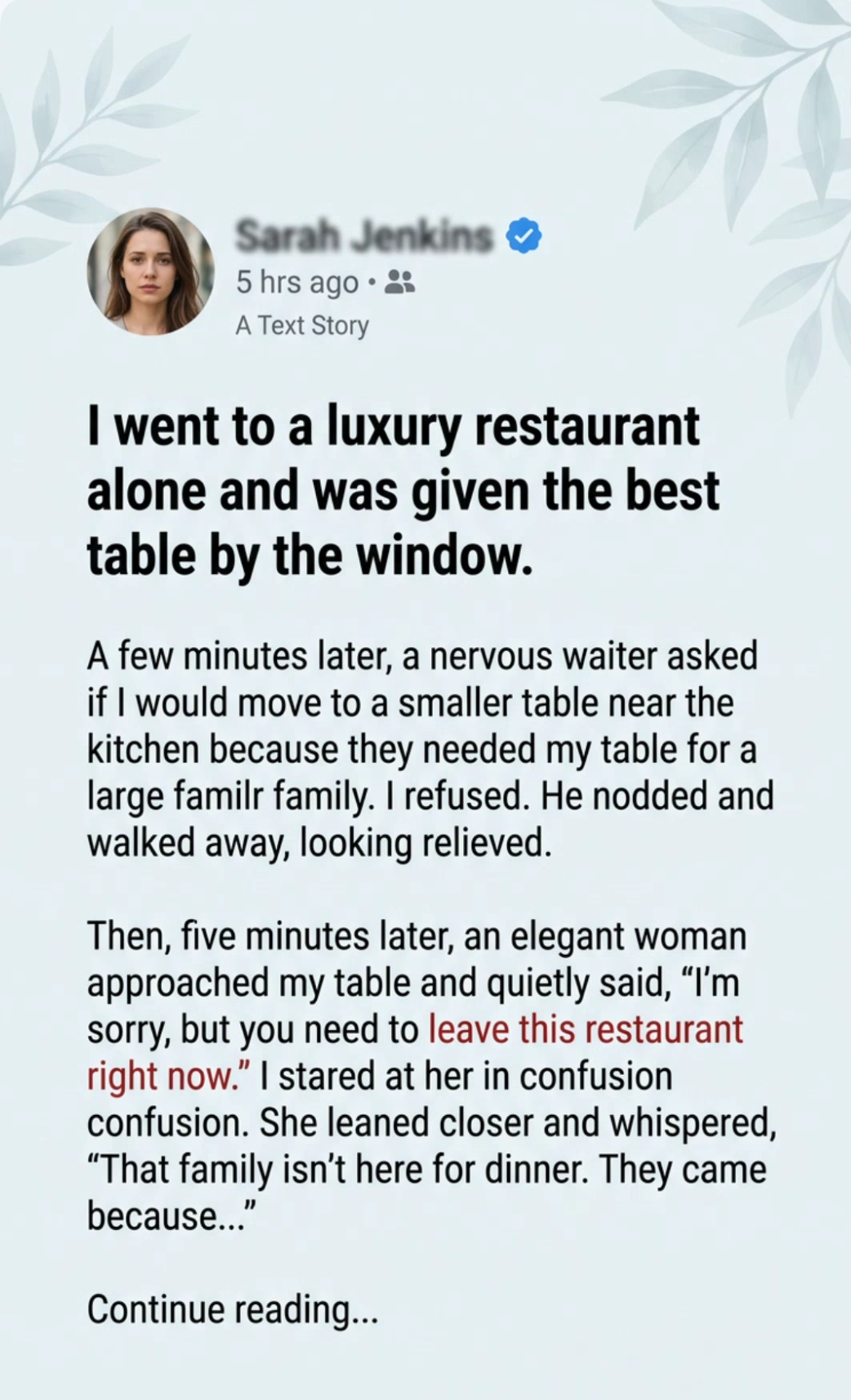
I had booked the table for a quiet evening, expecting nothing more than a good meal and a little time to myself. But when a nervous waiter tried to move me to a smaller table near the kitchen, I refused. Five minutes later, a woman in an elegant black dress approached me with an expression I would never forget. She leaned close and whispered that I was in danger. What I learned about the family arriving for dinner changed everything I thought I knew about the restaurant—and the man who owned it.
I had chosen the restaurant because I wanted one evening that belonged entirely to me.
It was called The Beaumont, an expensive establishment in the center of the city known for its French-inspired menu, polished silverware, and enormous windows overlooking the river. Reservations were difficult to obtain, and the restaurant had a reputation for treating its wealthiest customers like royalty.
I wasn’t particularly wealthy, but I had saved for the evening.
My name is Margaret Ellis. I was sixty-three years old, recently retired from a career in banking, and still learning how to enjoy the freedom that came after decades of working according to someone else’s schedule.
My husband, Peter, had died three years earlier. Since then, I had become accustomed to doing many things alone.
At first, dining alone had felt uncomfortable. I imagined people watching me, wondering why a woman my age had no one to accompany her.
Eventually, I stopped caring.
That evening, I wore a navy-blue dress, a pearl necklace Peter had given me for our thirtieth anniversary, and a pair of comfortable black shoes. I arrived ten minutes before my reservation and was greeted by a young hostess named Chloe.
“Good evening, Mrs. Ellis. Welcome to The Beaumont.”
She checked her tablet.
“We have your reservation. Please follow me.”
She led me through the dining room toward a beautiful table beside the window.
It was easily the best seat in the restaurant.
From there, I could see the river, the lights of the buildings across the water, and the occasional boat moving slowly beneath the bridge.
“Is this all right?” Chloe asked.
“It’s lovely. Thank you.”
She placed the menu in front of me and adjusted the candle.
A waiter named Daniel soon approached.
“Good evening, madam. My name is Daniel, and I’ll be looking after you tonight.”
He was probably in his early twenties. His uniform was immaculate, but his hands trembled slightly as he poured the water.
“Would you like to begin with something to drink?”
“Sparkling water, please.”
“Certainly.”
He returned a few minutes later with the bottle.
I was reading the menu when he approached again.
“Excuse me, madam.”
I looked up.
“Yes?”
Daniel glanced toward the entrance, then back at me.
“I was wondering if you might be willing to move to another table.”
I lowered the menu.
“Is there a problem with this one?”
“Not exactly. We have a large family arriving shortly, and they requested a table by the window.”
I looked around.
There were several empty tables in the dining room, including two near the windows.
“Are those tables unavailable?”
Daniel hesitated.
“They’ve been reserved for other guests.”
“And this one was assigned to me when I made my reservation.”
“Yes, madam. I understand.”
I studied his face.
He looked uncomfortable, almost frightened.
“Where would you like me to move?”
He pointed toward a small table near the kitchen entrance.
It was squeezed between a service station and a narrow passage where waiters carried trays.
I shook my head.
“No, thank you. I would prefer to remain here.”
Daniel nodded immediately.
“Of course, madam.”
His expression changed.
Instead of looking disappointed, he looked relieved.
He collected the empty water bottle and walked away.
I returned to my menu, although I found myself wondering why a waiter would be relieved that a customer had refused to move.
Five minutes later, an elegant woman approached my table.
She was perhaps in her late forties, wearing a black tailored dress and a simple diamond bracelet. Her dark hair was pulled back neatly, and she carried herself with the quiet authority of someone accustomed to being listened to.
“Mrs. Ellis?”
I looked up.
“Yes?”
“My name is Victoria Hale. I need to speak with you privately.”
“Is something wrong?”
She glanced toward the entrance.
Then she leaned closer.
“I’m sorry, but you need to leave this restaurant right now.”
I stared at her.
“Excuse me?”
“Please don’t raise your voice. And don’t look toward the entrance.”
I felt my stomach tighten.
“Why?”
Her voice dropped.
“That family isn’t here for dinner.”
I slowly put down my menu.
“What does that mean?”
Victoria pulled out the empty chair opposite me but didn’t sit.
“They’re coming here to meet someone. Someone they believe is sitting at this table.”
I looked at her in confusion.
“But I’m just having dinner.”
“I know. That’s why I’m trying to get you out before they arrive.”
I glanced toward the dining room.
“Who are they?”
Victoria swallowed.
“They’re connected to a man named Charles Whitmore.”
The name meant nothing to me.
“Should I know him?”
Victoria looked at me carefully.
“Your late husband was Peter Ellis, wasn’t he?”
My heart gave a sudden, painful beat.
“Yes.”
“Did Peter ever work with a man named Charles Whitmore?”
I searched my memory.
Peter had worked in commercial banking for nearly thirty-five years. He had dealt with hundreds of business owners, investors, and company directors.
“I don’t remember that name.”
Victoria closed her eyes briefly.
“Then perhaps he never told you what happened.”
I stood up.
“I’m sorry, but I think you owe me an explanation.”
Before she could answer, the restaurant doors opened.
A family of six entered.
A tall man in his early sixties walked at the front. He wore an expensive charcoal suit and carried himself with the confidence of someone who expected every person in the room to recognize him.
Behind him were a younger man, two women, and an elderly couple.
The manager hurried forward to greet them.
“Mr. Whitmore. Welcome back.”
The tall man barely acknowledged him.
“Is the window table ready?”
The manager glanced toward me.
“There’s a small issue, sir.”
Charles Whitmore followed his gaze.
His expression changed when he saw me.
He stopped walking.
For several seconds, neither of us moved.
Then he approached.
“Margaret?”
I felt cold.
I knew him.
Not personally, but I had seen his face in an old photograph.
He was the man Peter had once mentioned during a particularly difficult period near the end of his banking career.
Charles Whitmore had been the owner of a property development company that collapsed after a series of financial disputes. Peter had been involved in reviewing the company’s accounts.
I remembered the name now.
“Mr. Whitmore,” I said.
He looked at Victoria.
“What is she doing here?”
Victoria stepped between us.
“She’s a paying guest, Charles. She has every right to be here.”
He ignored her.
“Margaret, I need to speak with you.”
“I don’t think we have anything to discuss.”
His jaw tightened.
“Your husband left something that belongs to my family.”
I stared at him.
“My husband died three years ago.”
“I know.”
“Then whatever you’re looking for, you should discuss it with his former employer or his estate attorney.”
Charles leaned closer.
“I’m not interested in his employer. I’m interested in the original documents he took.”
I felt a chill move down my back.
“Peter never took anything from you.”
One of the younger men stepped forward.
“Dad, maybe we should do this somewhere private.”
Charles turned sharply.
“Stay out of it, Andrew.”
The young man stopped.
Victoria looked at me.
“Margaret, please come with me. There’s something you need to see.”
I hesitated.
I didn’t know whether I could trust her, but I knew I didn’t want to remain alone with Charles and his family.
I picked up my handbag.
“Where are we going?”
“To my office. It’s upstairs.”
Charles immediately objected.
“No. She stays here.”
Victoria turned toward him.
“You don’t own this restaurant, Charles.”
His expression darkened.
“I have a financial interest in it.”
“And you have no authority to intimidate a guest.”
That was when I noticed something unusual.
The manager, who had been standing a few feet away, was no longer smiling.
He was holding his phone.
Daniel, the waiter, had returned and was standing near the service station. His face was pale, but when our eyes met, he gave me a small nod.
I understood then why he had looked relieved when I refused to move.
He had wanted me to remain visible.
He had wanted someone to see what was happening.
Victoria guided me toward a private staircase.
We entered a small office overlooking the dining room. It was furnished with a desk, two leather chairs, and a cabinet filled with restaurant records.
Victoria closed the door.
“Are you all right?”
“I’d like to know what is happening.”
She sat down.
“I own this restaurant. My father established it thirty years ago. Charles is one of our investors, but he has been trying to force a sale of the business.”
I looked at her.
“Why would that involve my husband?”
Victoria opened a drawer and removed a thick folder.
“Because Peter was the independent financial examiner who reviewed the original investment agreement.”
She placed a document on the desk.
I recognized Peter’s signature immediately.
It was dated nearly nine years earlier.
I leaned forward.
“What is this?”
“An investment review. Your husband discovered that Charles and two other investors had concealed significant liabilities while attempting to purchase a controlling interest in several local businesses.”
I looked through the pages.
There were financial statements, correspondence, and a report signed by Peter.
Victoria continued.
“Peter identified irregular transactions involving money that had been promised to our company. He also found evidence that the same investors had attempted to use misleading financial information to obtain additional loans.”
I remembered Peter coming home late during that period.
He had been quieter than usual. He had complained about pressure from a group of businessmen who wanted him to approve documents he considered incomplete.
I had asked him whether everything was all right.
He had simply said, “Some people believe money gives them permission to bend the truth.”
I had never asked for more details.
“Why are you showing me this now?” I asked.
Victoria took a breath.
“Because Charles believes Peter kept a copy of the original evidence. He thinks you may know where it is.”
“I don’t.”
“Are you certain?”
“Yes. Peter never discussed confidential banking records with me, and I never had access to his professional files.”
Victoria nodded.
“I believe you.”
She opened another section of the folder.
“Before he died, Peter contacted my father. He warned him that certain original documents might disappear if Charles gained control of the company.”
“Your father?”
“Arthur Hale. He founded The Beaumont and several other businesses. He was one of the people Peter helped.”
Victoria showed me a letter.
It was written in Peter’s handwriting.
I recognized the slanted letters and the way he crossed his capital T’s.
The letter was addressed to Arthur Hale.
Mr. Hale,
I have completed my review of the documents you provided. There are discrepancies that should not be ignored. I have retained a copy of my professional findings in accordance with the firm’s record-retention requirements. I recommend that you preserve all original agreements and correspondence and consult independent counsel before proceeding.
I cannot disclose confidential information outside the proper legal channels, but I believe you should understand that the proposed transaction carries risks beyond those currently reflected in the financial statements.
Peter Ellis.
I read it twice.
“Did Peter give you this?”
“No. My father received it directly. He kept it because he trusted Peter.”
I looked at Victoria.
“Then why does Charles think I have something?”
“Because a few weeks ago, one of his attorneys sent a request to Peter’s former firm asking about the original review. They were told that certain archived records had been transferred to the firm’s legal custodian. Charles believes your husband’s personal estate may contain additional material.”
I shook my head.
“Peter’s belongings were handled after his death. His professional files were returned to his employer. I never kept anything that belonged to the bank.”
Victoria leaned back.
“Then Charles has no legitimate reason to approach you.”
“He seems to disagree.”
Victoria looked toward the window.
“That’s why I asked you to leave. I knew he was coming, and I knew he intended to pressure whoever was sitting at that table.”
I stared at her.
“Why didn’t you call the police before he arrived?”
“I did.”
She showed me the phone on her desk.
“The officers are already on their way. The restaurant’s security team has also saved the entrance and dining-room footage.”
I felt my hands begin to shake.
“What was he planning to do?”
Victoria answered carefully.
“I don’t know exactly. But one of his employees contacted our manager earlier today and asked whether a woman named Margaret Ellis had reserved a table. They also requested that the window table be kept available.”
I remembered Daniel’s nervous expression.
“They knew I was coming?”
“They knew your name and reservation time. I believe they expected you to be alone.”
I sat down.
For the first time that evening, I understood the seriousness of what had happened.
The table had not been requested because the family wanted a better view.
It had been reserved because they wanted access to me.
A few minutes later, two police officers arrived.
Victoria explained what had happened, and I provided my account. The officers spoke with Daniel and the manager, then reviewed the security footage.
Daniel admitted that Charles’s assistant had approached him earlier that afternoon.
The assistant had instructed him to move me to a smaller table and said that the family needed privacy.
Daniel had felt uncomfortable because he had recognized my name from the manager’s warning.
When I refused to move, he had been relieved because the restaurant’s security cameras had a clear view of my table.
The footage also showed Charles entering, approaching me, and following us toward the staircase.
One officer asked whether Charles had threatened me directly.
“Not physically,” I answered. “But he demanded documents from my late husband and made it clear that he expected me to cooperate.”
The officers documented the incident.
They did not arrest anyone that night, and they made no conclusions about the underlying financial dispute. They explained that any criminal allegations would require further investigation and supporting evidence.
I appreciated that.
I wasn’t interested in revenge.
I wanted the truth established properly.
The following week, I met with Peter’s former employer and the firm’s legal custodian.
They confirmed that the professional records had been preserved under the firm’s retention procedures. I was not entitled to remove or disclose confidential client material simply because I had been Peter’s wife.
However, the firm agreed to cooperate with lawful requests from the appropriate authorities and legal representatives.
Margaret Ellis, my own attorney, helped me document the restaurant incident and respond to further communications from Charles’s representatives.
Then something unexpected happened.
A few weeks later, Victoria called.
“Margaret, there’s been a development.”
“What happened?”
“Charles’s own son has contacted the company’s auditors.”
I waited.
“Andrew?”
“Yes. Apparently, he has been reviewing the family’s investment records. He believes his father concealed information about several transactions.”
I was surprised.
“Does he have evidence?”
“He has provided documents to the auditors. They are reviewing them independently.”
Victoria explained that Andrew had become increasingly uncomfortable with the way his father had handled the proposed restaurant acquisition.
He had initially believed the investment was legitimate. But after the restaurant incident, he began examining the paperwork more carefully.
He found discrepancies between the investment summaries presented to family members and the underlying company records.
Some payments had been described as capital contributions, while the records appeared to classify them differently. Several liabilities had also been omitted from documents used to justify the proposed purchase.
The auditors began a formal review.
I didn’t follow every detail, but I understood enough to know that Peter’s old concerns were finally receiving attention.
Three months later, the company announced that the proposed sale of The Beaumont had been suspended pending the results of the independent review.
Charles resigned from his position on the restaurant’s investment committee.
His representatives denied wrongdoing and said he intended to cooperate with the auditors.
The matter was eventually referred to the appropriate authorities for further examination. Any legal responsibility would have to be established through the proper process.
I never learned every detail of what happened afterward.
And, honestly, I didn’t need to.
What mattered was that the documents had been preserved, the allegations were being examined independently, and I was no longer being pressured to produce something I had never possessed.
One Saturday afternoon, Victoria invited me back to The Beaumont.
“I’d like you to have dinner with me,” she said. “No business. No uncomfortable surprises.”
I laughed.
“Are you certain you want me back at that table?”
“Especially that table.”
When I arrived, Daniel greeted me at the entrance.
“Good evening, Mrs. Ellis.”
He smiled.
“I’ve saved your favorite seat.”
The table beside the window was waiting.
The river looked beautiful beneath the evening lights.
Victoria joined me a few minutes later.
She ordered two glasses of sparkling water and smiled.
“I owe you an apology.”
“For what?”
“For the way your evening began. You came here to enjoy dinner, and instead you became part of something frightening.”
“You didn’t cause it.”
“I know. But I still wish I could have prevented it.”
I looked around the restaurant.
The staff were moving calmly between tables. Families were laughing. A couple near the fireplace were sharing dessert.
Everything felt ordinary again.
“Daniel did the right thing,” I said.
“He did. He was worried about losing his job, but he still chose to help.”
“I’m glad he did.”
Victoria nodded.
“I’m glad you refused to move.”
I smiled.
“So am I.”
When dinner arrived, I ordered the same meal I had planned to order on the night everything happened.
For the first time in years, I didn’t feel the need to rush home.
I sat by the window, enjoyed my food, and watched the boats move along the river.
As I left, Daniel opened the door for me.
“Have a wonderful evening, Mrs. Ellis.”
“Thank you, Daniel. You too.”
I stepped outside into the cool night air.
I thought about Peter, about the quiet way he had handled difficult situations, and about the principle he had once shared with me.
“People who have nothing to hide rarely need to frighten others into silence.”
I finally understood what he had meant.
Charles Whitmore had believed his money and influence could make a restaurant move a guest, make a waiter obey an uncomfortable instruction, and make a widow surrender information she did not possess.
But he had underestimated the people around him.
A young waiter had chosen courage over convenience. A restaurant owner had refused to let an investor intimidate her guest. And a son had decided to examine his family’s records rather than blindly defend his father.
I had gone to The Beaumont expecting a quiet dinner alone.
I left with something much more valuable: the certainty that I did not have to surrender my dignity simply because someone powerful demanded it.
And the next time I reserved a table by a window, I knew exactly where I would sit.
The End.