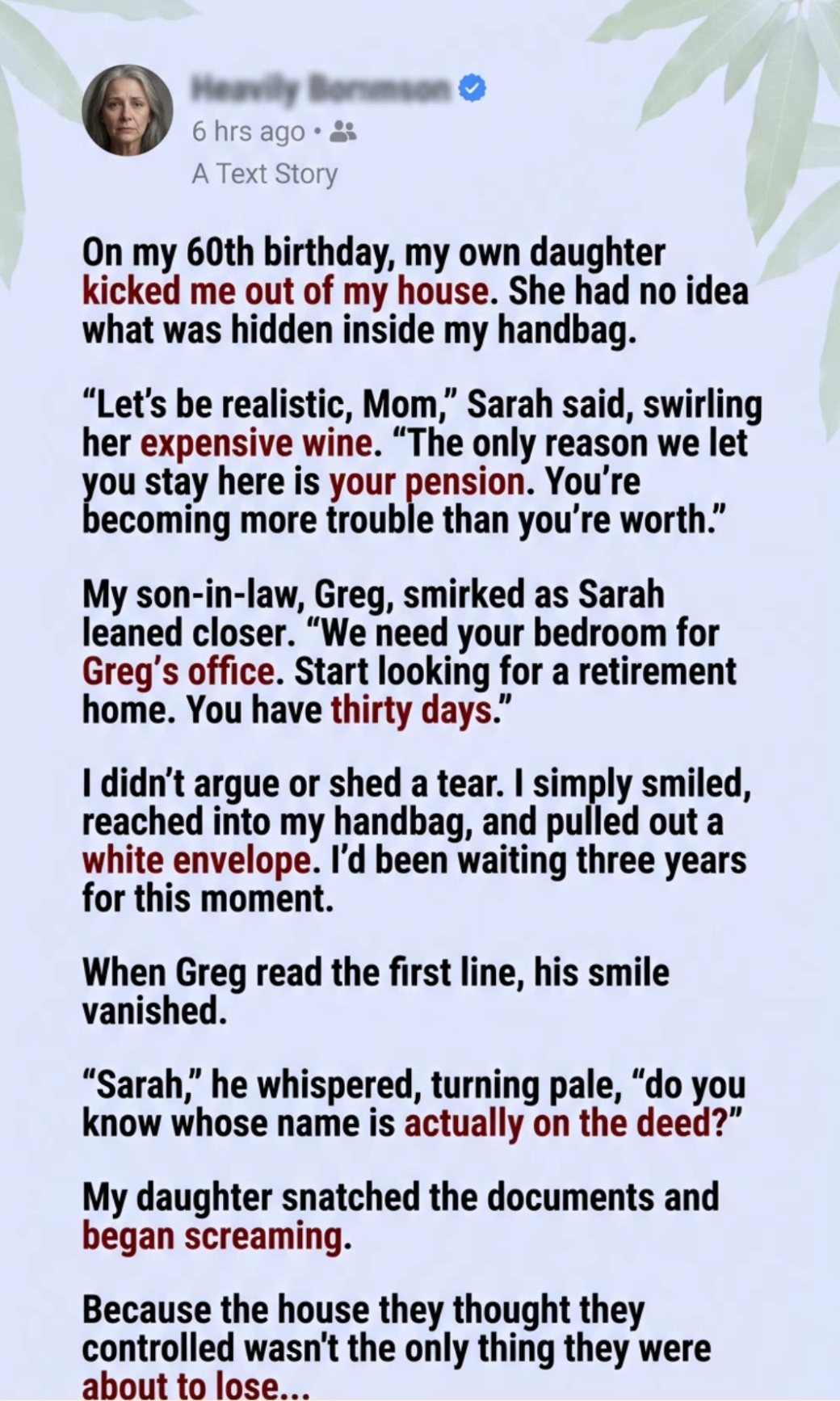
They thought my pension was the only reason I was allowed to live under their roof. My daughter wanted my bedroom for her husband’s office, and her husband had already decided I was an inconvenience they could simply remove. They gave me thirty days to leave. I didn’t argue. I didn’t cry. I opened my handbag and placed a white envelope on the table. Inside was a document that would expose a secret they had never bothered to investigate—and reveal that their plans for my home were built on a lie.
My sixtieth birthday began with a beautiful cake, expensive wine, and a sentence I never imagined hearing from my own daughter.
“Mom, we need to talk about your living arrangements.”
Sarah said it while swirling a glass of red wine at the dining table.
She was thirty-four, beautifully dressed, and wearing the diamond bracelet her husband, Greg, had bought her for Christmas. Greg sat beside her, scrolling through his phone with the relaxed expression of a man who believed every decision had already been made.
I looked at the birthday cake in front of me.
There were three candles arranged in the shape of a six and a zero.
I had baked the cake myself that morning.
“Is something wrong?” I asked.
Sarah sighed.
“Let’s be realistic, Mom. The only reason we let you stay here is your pension. You’re becoming more trouble than you’re worth.”
For a moment, I thought she was making a cruel joke.
I looked at Greg.
He didn’t even raise his eyes from his phone.
Sarah continued.
“We need your bedroom for Greg’s office. He’s working from home more often, and the spare room isn’t big enough.”
I slowly placed my fork on the table.
“My bedroom?”
“Yes. We’ve discussed it, and we think it’s time you started looking for a retirement home.”
Greg finally looked up.
“We’re giving you thirty days. That’s more than enough time to find somewhere suitable.”
I stared at him.
“Thirty days?”
Sarah nodded.
“Don’t make this emotional. You’re sixty now, Mom. You need to start thinking about what’s practical.”
I looked around the house.
The dining table had been purchased by my late husband, Michael. The curtains were ones I had sewn myself. The photographs on the mantel showed Sarah as a little girl, standing between her father and me in the garden.
And the house itself?
That was the part they had never bothered to understand.
I had moved into this property fourteen years earlier, after Michael died. It was a modest but comfortable house with three bedrooms, a small garden, and a driveway wide enough for two cars.
Sarah and Greg had moved in temporarily five years earlier when they were struggling with rent and credit-card debt.
At the time, Sarah had been crying on the phone.
“Mom, we just need a little help. Six months, maybe less. We’ll save enough for a deposit and find our own place.”
I had opened my home because she was my daughter.
Six months became a year.
Then two.
Eventually, they began referring to the house as though it belonged to all three of us.
They changed the living-room furniture without asking. They replaced the garden shed with a storage unit. Greg installed a large television in the bedroom and began treating the dining room as his personal workspace.
I tried to remain patient.
I contributed to the groceries, paid for household repairs, and occasionally helped with their bills. My pension was modest, but I managed my money carefully.
They never seemed to notice that I was helping them far more than they were helping me.
Now, on my sixtieth birthday, they were telling me I had thirty days to disappear.
Sarah lifted her wineglass.
“Honestly, Mom, this is better for everyone.”
I looked at her.
“Better for everyone?”
“Yes. You can find a place with people your own age. You’ll have activities and support. We need space to build our future.”
Greg smirked.
“It’s not personal. We just have to make sensible decisions.”
I nodded slowly.
Then I smiled.
“Of course.”
Sarah looked surprised.
“Good. I’m glad you’re being reasonable.”
I reached for my handbag, which was hanging on the back of my chair.
Inside was a white envelope.
I had carried it for three years.
I removed it and placed it on the table between the wineglasses.
“Before we discuss where I’m going,” I said, “I think you should read this.”
Greg looked irritated.
“What is it?”
“Something I should have shown you a long time ago.”
He opened the envelope.
The first page was a certified copy of the property’s registered title.
His eyes moved down the page.
Then stopped.
He read the first line again.
His face changed.
“Sarah,” he whispered.
She rolled her eyes.
“What?”
He turned the document toward her.
“Do you know whose name is actually on the deed?”
Sarah snatched the paper.
She scanned it quickly.
Then she looked at me.
“This can’t be right.”
“It is.”
She flipped to the second page.
The registered owner was Margaret Ellis.
Me.
Not Sarah.
Not Greg.
Not a family trust they had been promised.
Me.
The house had never belonged to them.
Greg stood up.
“Wait. I thought Michael left this house to Sarah.”
I looked at him.
“Why would you think that?”
“Because Sarah said—”
He stopped.
I turned toward my daughter.
“Sarah?”
Her face had become pale.
“Mom, I didn’t say that.”
I didn’t raise my voice.
“You told Greg that your father had left the property for you and that I was only staying here until you decided what to do with it.”
Sarah looked down.
The silence answered for her.
I opened the envelope again and removed another document.
“This is the original transfer record from when I purchased the property. I bought it after your father died, using the proceeds from selling our old family home and my savings. The title has been in my name ever since.”
Greg sat down slowly.
“But we renovated the kitchen.”
“You contributed to some of the work,” I replied. “And I paid for the rest. I have the invoices.”
Sarah’s voice rose.
“So what? We’re family. You can’t just throw us out.”
I looked at her.
“I haven’t asked you to leave.”
“You’re making it sound like we’re strangers!”
“No, Sarah. I’m making it clear that being family doesn’t make you the owner of my house.”
Greg reached for the documents again.
“What is this other paper?”
I removed a final page.
It was a letter from my solicitor, dated three years earlier.
At the time, Sarah had asked me to sign a document that Greg described as a simple household arrangement. He had said it would help them organize their finances and demonstrate stability to a lender.
I had taken the paperwork to my solicitor instead.
After reviewing it, she discovered that the proposed document could have given Sarah and Greg significant control over certain property decisions if I signed it as written.
I had refused.
My solicitor then prepared a written occupancy agreement clarifying that Sarah and Greg were permitted to live in the house with my consent, but that the arrangement did not transfer ownership or create an automatic right to remain indefinitely.
They had never asked to read it.
They had simply continued living there.
I placed the agreement beside the title.
“This explains the arrangement under which you moved in.”
Greg stared at it.
“Why didn’t you tell us?”
“I did. Your solicitor received a copy when you asked about using the address for your business registration. You chose not to discuss it.”
Sarah pushed the papers away.
“This is ridiculous. You can’t suddenly change everything because we had one argument.”
I looked at the birthday cake.
“One argument?”
I took a breath.
“Sarah, this isn’t about one argument. It’s about five years of you treating my home as yours, making decisions without asking me, and expecting me to be grateful that you allow me to live here.”
She opened her mouth.
I continued.
“And tonight, you told me that the only reason I was allowed to stay was my pension.”
Sarah’s expression changed.
For the first time, she seemed to hear how cruel her words had been.
Greg tried to recover his composure.
“Look, Margaret. We don’t need to make this complicated. We can discuss a fair arrangement. We need the bedroom for work, but maybe you could use the smaller room.”
I looked at him.
“You want me to move out of my own bedroom so you can have an office?”
“It’s a practical solution.”
“Then you can find a practical office somewhere else.”
He frowned.
“You’re being unreasonable.”
I almost laughed.
I had spent five years being reasonable.
I had been reasonable when they delayed moving out. I had been reasonable when they stopped contributing to repairs. I had been reasonable when Greg began inviting business associates over without asking me.
But there was a difference between being kind and allowing people to take advantage of kindness.
I folded the documents and returned them to the envelope.
“I’m going to make a decision about how this house is used. But I won’t make it under pressure.”
Sarah stood up.
“Are you threatening us?”
“No. I’m telling you the truth.”
I picked up my handbag.
“I’m going to Olivia’s tonight. I don’t want to spend my birthday arguing.”
Olivia was my younger sister. She lived twenty minutes away and had already invited me to stay for the weekend.
As I reached the hallway, Sarah called after me.
“Mom, don’t walk away from this!”
I turned.
“It’s my birthday, Sarah. I think I’ve heard enough for one evening.”
Then I left.
The following morning, I met with my solicitor, Helen Brooks.
Helen had handled the property title years earlier and had advised me when Sarah and Greg first moved in.
I explained the birthday conversation and showed her the documents.
She listened without interrupting.
“Margaret, the title is clear. You’re the registered owner. Their occupancy arrangement does not make them owners.”
“What can I do?”
“That depends on what outcome you want. If you want them to leave, we need to follow the correct legal procedure. You shouldn’t change the locks, remove their belongings, or cut off utilities without understanding the applicable rules.”
I nodded.
“I don’t want to punish them. I just don’t want to be treated like a guest in my own home.”
“Then we can begin with a formal meeting and written notice of the terms you are prepared to accept. If they refuse to cooperate, we’ll follow the lawful process.”
Helen reviewed the occupancy agreement and confirmed that it had not transferred any ownership interest.
She also examined the renovation invoices.
Some expenses had been paid by Sarah and Greg, but many had been covered by me. The records showed that their contributions were not evidence of ownership.
Then she noticed something else.
A recent application had been made to a lender using my property address and describing Sarah and Greg as the owners.
I stared at the document.
“What is this?”
Helen looked at me.
“Did you authorize them to represent themselves as owners?”
“No.”
“Did you sign a mortgage application or guarantee?”
“Absolutely not.”
She reviewed the paperwork more carefully.
The application had not resulted in a registered mortgage against my property, but it raised serious concerns about how the information had been presented.
The lender had requested additional documentation, including proof of ownership.
When Sarah and Greg couldn’t provide it, the application had been placed on hold.
Helen advised me not to contact the lender impulsively. She would prepare a formal response clarifying ownership and ask for the records to be preserved.
I felt sick.
The birthday conversation had been humiliating enough.
Now I was discovering that they might have been using my home in financial dealings without my permission.
“Could they have borrowed money against the house?” I asked.
“Not legally without the required authority and documentation. But we need to establish exactly what they submitted and whether any signatures or statements were falsified.”
I nodded.
“Please investigate it properly.”
Helen sent a formal letter requesting that Sarah and Greg stop representing themselves as owners or offering the property as security for any financial arrangement.
She also proposed a meeting to discuss their departure or a new written occupancy agreement.
I did not want to make accusations before the evidence was reviewed.
But I was no longer willing to ignore warning signs.
Three days after my birthday, Sarah called.
“Mom, we need to talk.”
“About what?”
“About the house.”
I waited.
“Greg is upset about the letter from your solicitor.”
“I expected he might be.”
“You’re making this sound like we’re doing something illegal.”
“I haven’t accused anyone of a crime. Helen has asked for clarification about a financial application using my property.”
Sarah became defensive.
“Greg was only trying to arrange a business loan.”
“Then why was the house described as belonging to you?”
“I don’t know. That’s how the broker filled it out.”
“Did you correct the information?”
She was silent.
“Sarah?”
“I thought it was just paperwork.”
I closed my eyes.
“It’s my home. You cannot use it as security or claim ownership without my permission.”
“Dad would never have treated me like this.”
The words struck harder than I expected.
“Your father is dead, Sarah. And he would never have wanted you to lie about owning something that belongs to someone else.”
She hung up.
That evening, Greg sent a message.
We need to settle this. We have nowhere else to go, and you can’t expect us to move out immediately.
I read it twice.
Then I replied:
I understand that moving takes planning. Helen has proposed a reasonable process and time to discuss arrangements. Please communicate with her about the property and the financial application.
I put my phone down.
For the first time, I wasn’t trying to solve every problem myself.
The formal meeting took place the following week.
Sarah and Greg arrived at Helen’s office together.
Sarah looked exhausted. Greg carried a folder filled with paperwork.
Helen began by explaining the legal position.
The property belonged to me. Their occupancy agreement did not give them ownership. Any financial application using the house as collateral required accurate disclosure and proper authorization.
Greg insisted he had never intended to deceive anyone.
“I was trying to get a business loan,” he said. “The broker told us the property would strengthen the application.”
Helen looked at him.
“Did you tell the broker that Margaret was the registered owner?”
Greg hesitated.
“I may have misunderstood what was required.”
Sarah looked at him sharply.
“You told me the paperwork was fine.”
He ignored her.
Helen placed the lender’s documents on the table.
“The application describes Sarah and Greg as owners. It also includes a statement suggesting that the property could be used as security.”
Greg rubbed his forehead.
“I didn’t think it would go this far.”
I looked at him.
“You were willing to risk my home because you needed money for your business?”
He finally met my eyes.
“I thought we would sort it out.”
“Without asking me?”
He said nothing.
Sarah began to cry.
“Mom, we were under pressure. Greg’s business has been struggling. We have credit-card payments and other debts. We didn’t know what else to do.”
I felt sorry for her.
I truly did.
But sympathy could not make the problem disappear.
“You could have told me the truth,” I said. “You could have asked for help. You could have discussed a temporary arrangement. Instead, you told me I was worth less than my pension and demanded my bedroom.”
Sarah wiped her face.
“I didn’t mean it that way.”
“But you said it.”
She looked down.
Helen explained that the lender would be notified of the ownership issue and that any suspected false information would be reviewed through the appropriate channels. No conclusion would be drawn until the documents and communications had been examined.
Greg agreed to withdraw the application and cooperate with the lender’s review.
We then discussed the living arrangement.
I offered Sarah and Greg sixty days to find alternative accommodation, subject to the formal notice and legal requirements Helen would prepare.
They would continue contributing to household expenses during that period.
They would not use the property address for new loans, guarantees, or business applications without my written permission.
They would also stop making changes to the house without discussing them with me.
Sarah looked at me.
“Sixty days?”
“Yes.”
“That’s not much time.”
“It’s more time than you gave me on my birthday.”
She looked away.
Greg began to object, but Helen calmly reminded him that we were negotiating a voluntary arrangement and that the final terms needed to be clear and documented.
Eventually, they agreed.
The next two months were uncomfortable.
Greg became quieter around me. Sarah sometimes avoided the kitchen when I was there.
I stayed at my sister’s house for several nights because I wanted some distance, but I continued visiting my home and managing its affairs.
I had no intention of abandoning the property.
I also made several changes.
I arranged for the locks to be inspected and updated through a locksmith, with Helen confirming the appropriate timing and notice. I reviewed the insurance policy and made sure the ownership records were current.
I also began sorting through the rooms.
For the first time in years, I looked at the house as a place where I could choose how I wanted to live.
Not as a place where I had to accommodate everyone else’s plans.
One afternoon, I found a photograph of Sarah at age seven.
She was standing in the garden beside her father, holding a small yellow watering can. Michael had one arm around her shoulders.
I sat on the edge of the bed and studied the picture.
I remembered the little girl who used to run into my room when she had a nightmare.
I remembered the teenager who had cried after her first heartbreak.
I remembered the young woman who had called me from her first apartment, asking how to make her father’s favorite soup.
I didn’t know when our relationship had changed so much.
Perhaps it had happened gradually.
Perhaps I had mistaken dependence for closeness and silence for peace.
Whatever the reason, I missed my daughter.
But I couldn’t let missing her become another reason to surrender my boundaries.
Forty-eight days after my birthday, Sarah knocked on my bedroom door.
“Can I come in?”
I looked up from the book I was reading.
“Of course.”
She sat on the chair near the window.
“Greg found an apartment.”
“That’s good.”
“It’s smaller than we wanted, but we can afford it.”
I nodded.
She looked around the room.
“Are you really going to stay here alone?”
“Yes.”
“Wouldn’t you be happier somewhere with more people? Somewhere with activities?”
I closed my book.
“Sarah, I enjoy my own company. I have friends, a sister, and a life outside this house. I don’t need to move into a retirement home because you want a bigger office.”
She gave a weak smile.
“I know.”
For a while, neither of us spoke.
Then she said something I hadn’t expected.
“I’m sorry about your birthday.”
I looked at her.
She continued.
“I was angry because Greg was under pressure. His business was struggling, and I felt like everything was falling apart. I thought if we could get the loan, things would improve.”
“Why did you tell me I was only worth my pension?”
Her eyes filled with tears.
“I don’t know. I was trying to make you agree.”
“That doesn’t make it better.”
“I know.”
She looked at her hands.
“I also shouldn’t have told Greg the house belonged to me. I knew it was yours. I think I convinced myself that because we lived here, it was somehow ours.”
I let her words settle.
“Living somewhere doesn’t make you the owner, Sarah. And being someone’s child doesn’t mean you can treat them however you want.”
She nodded.
“I understand that now.”
I wanted to hug her, but I didn’t immediately move.
An apology mattered.
But it didn’t erase what had happened.
“I’m glad you understand,” I said. “I hope we can rebuild our relationship. But it will take time.”
She wiped her cheeks.
“Can we still have Sunday lunch sometimes?”
I smiled faintly.
“If we both want to, yes.”
She stood and hugged me.
This time, I hugged her back.
On the sixtieth day, Sarah and Greg moved out.
They loaded their furniture into a rented van, packed their belongings, and made several trips between the house and their new apartment.
Greg barely spoke to me.
Before leaving, however, he stopped near the front door.
“Margaret, I owe you an apology.”
I looked at him.
“For what?”
“For the way I spoke to you. And for the loan application. I shouldn’t have allowed the paperwork to describe the house as ours.”
I nodded.
“Thank you for saying that.”
He looked uncomfortable.
“I hope things can be normal again.”
“Normal will depend on how we treat each other from now on.”
He accepted that answer and walked outside.
Sarah was the last to leave.
She stood in the doorway holding her handbag.
“Mom?”
“Yes?”
“I love you.”
I looked at her for a moment.
“I love you too.”
She stepped forward and hugged me.
Then she left.
I closed the door gently.
The house was quiet.
For the first time in five years, I could hear the clock ticking in the hallway.
I walked into the kitchen and made myself a cup of tea.
Then I went to the dining table and looked at the place where my birthday cake had stood.
I remembered Sarah’s expensive wine, Greg’s smirk, and the thirty-day deadline they had given me.
I also remembered the white envelope.
It had contained no magical inheritance, no secret fortune, and no dramatic threat.
It contained something much more important: the truth about who owned the house, the legal agreement they had ignored, and the evidence that I had protected my home even when the people living in it assumed I wouldn’t.
Over the following months, the lender confirmed that the proposed loan had not created any interest in my property. The questionable ownership statements were reviewed, and Greg’s application was withdrawn. I continued to keep the records and followed Helen’s advice about any future financial correspondence.
I redecorated the bedroom.
I replaced the heavy curtains with light ones and moved my reading chair beside the window. I planted new flowers in the garden and invited Olivia over for Sunday lunch.
Sarah began visiting occasionally.
At first, she came for short conversations. Later, she stayed for coffee. We were careful with each other, and some subjects remained uncomfortable.
But slowly, we began rebuilding something more honest.
One afternoon, she looked around the living room and said, “It feels different here.”
I smiled.
“It should. It’s finally a home where everyone knows they have to respect the person who lives in it.”
She laughed softly.
Then she helped me water the flowers.
I was sixty years old when my daughter told me I had thirty days to leave my own home.
I had imagined that birthday would mark the beginning of old age.
Instead, it marked the beginning of a different kind of independence.
I learned that being a mother did not mean accepting every insult. Helping family did not mean handing over ownership. And love did not require me to disappear so someone else could feel more comfortable.
The white envelope had reminded my daughter and son-in-law of something they had forgotten.
The house was never theirs to give away.
And neither was my life.
The End.