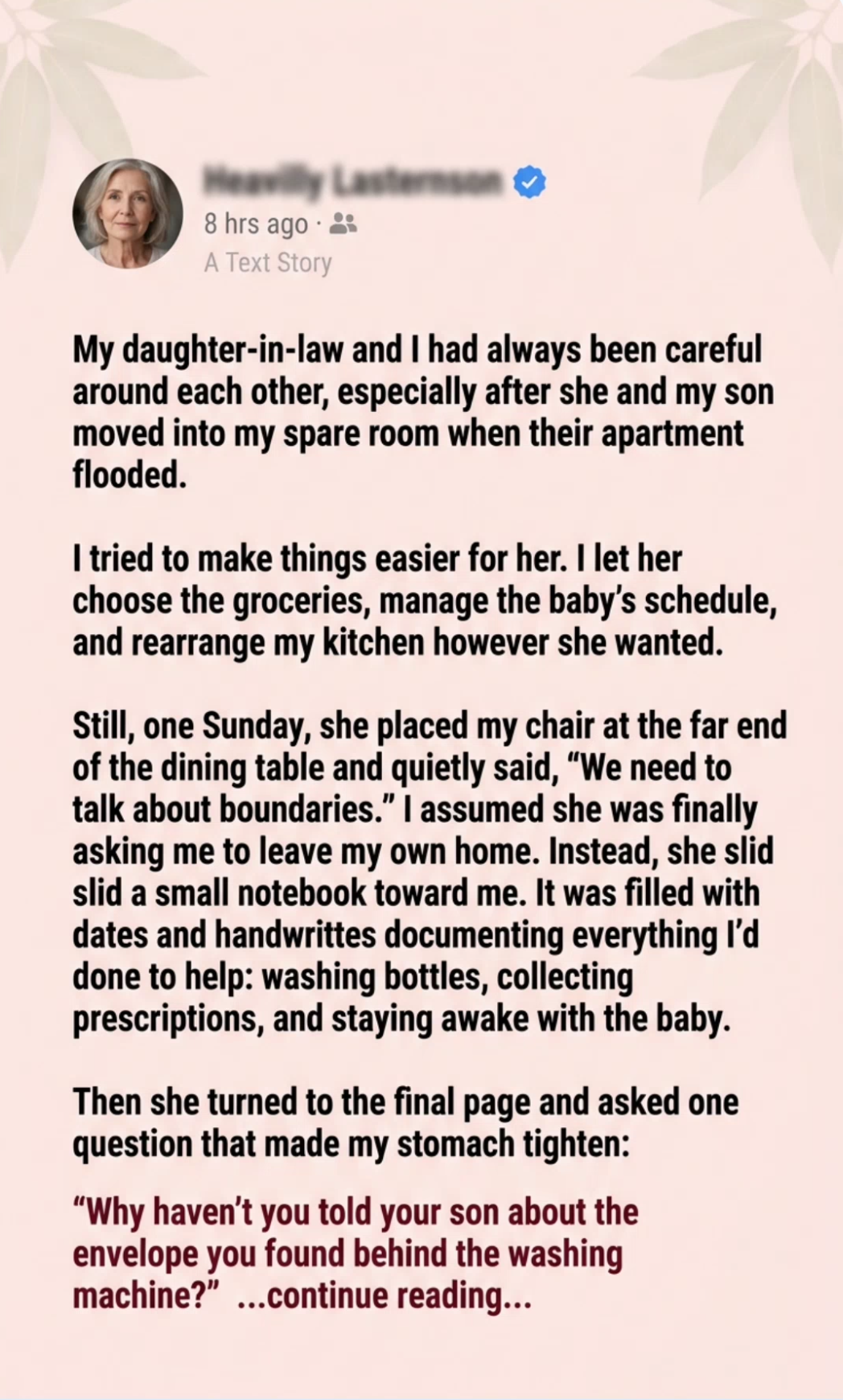
The Sunday afternoon my daughter-in-law placed that notebook in front of me, I thought she was finally going to tell me that I had overstayed my welcome in my own home.
Instead, she asked me a question that made my hands go cold.
“Why haven’t you told your son about the envelope you found behind the washing machine?”
I stared at her.
For several seconds, I couldn’t find my voice.
I hadn’t told anyone about the envelope.
Not my son. Not my sister. Not even my closest friend.
Yet somehow, my daughter-in-law knew.
And when I eventually discovered what was inside that envelope, I understood that the problem in our family had never really been about boundaries, household chores, or who sat where at the dinner table.
It was about a secret someone had gone to extraordinary lengths to keep hidden.
My name is Eleanor Whitmore. I was sixty-eight years old, a widow, and the owner of a modest three-bedroom house in a quiet neighborhood.
My husband, Robert, and I had lived there for almost thirty-five years. We raised our only son, Matthew, in that house. We celebrated birthdays there, endured family arguments there, and eventually watched our son leave to build a life of his own.
After Robert passed away, the house became quieter than I had expected.
I kept myself busy with gardening, reading, and volunteering at the local community center. Matthew visited regularly, usually on Sundays, and although I missed having a family under my roof, I was comfortable with my independence.
Then, one rainy evening, Matthew called.
“Mom, we have a problem.”
His wife, Lauren, was on the other end of the line, crying.
Their apartment building had suffered serious water damage after a pipe burst on an upper floor. Their bedroom ceiling had collapsed, and several rooms had become uninhabitable.
They needed somewhere to stay while repairs were completed.
“Can we stay with you for a little while?” Matthew asked.
I didn’t hesitate.
“Of course. Bring everything you need.”
They arrived two days later with suitcases, boxes, baby furniture, and their seven-month-old daughter, Sophie.
I was delighted to have them.
I moved some of my belongings into the smaller bedroom and gave them the master bedroom because it was more convenient for the baby.
Lauren looked uncomfortable.
“Are you sure, Eleanor?”
“Absolutely. You’re recovering from everything that happened, and Sophie needs space.”
I meant every word.
I wanted them to feel welcome.
What I didn’t realize was that our temporary arrangement would uncover things about my family that I had never imagined.
The Small Sacrifices Nobody Noticed
During the first few weeks, I did everything I could to make life easier.
Lauren preferred organic groceries, so I changed my shopping routine.
She liked the kitchen organized according to her system, so I rearranged the cupboards.
She had a specific schedule for Sophie’s feeding and sleeping, so I followed it whenever I helped with the baby.
If she wanted the living room quiet during nap time, I kept the television off.
If she needed to rest, I watched Sophie.
I washed bottles, sterilized feeding equipment, collected prescriptions, and occasionally prepared dinner.
Sometimes I stayed awake past midnight when Sophie was unsettled.
I never complained.
I understood that having a baby and suddenly losing the comfort of your own home could be stressful.
But gradually, I began noticing that Lauren was becoming increasingly uncomfortable around me.
If I entered the kitchen while she was preparing food, she would stop talking.
If I picked up Sophie without asking, even for a moment, her expression changed.
Once, I bought a little knitted sweater for the baby.
Lauren thanked me but immediately placed it inside a drawer.
“She’s got plenty of clothes,” she said.
I nodded.
“Of course.”
Matthew noticed some of the tension but seemed determined to avoid conflict.
“Mom, just give Lauren some space,” he told me one evening.
“I am giving her space.”
“I know. But she’s under pressure.”
I didn’t argue.
I didn’t want him caught between his wife and his mother.
I simply tried harder.
One Sunday, I prepared a roast dinner.
I had invited them to sit together because it reminded me of the meals Robert and I used to have when Matthew was growing up.
When everyone came to the table, I noticed something unusual.
My chair had been moved.
It was no longer beside Matthew.
Instead, it was positioned at the far end of the table, near the kitchen doorway.
Lauren looked at me.
“I thought this arrangement would be more comfortable.”
I pulled out the chair.
“That’s fine.”
We ate quietly for several minutes.
Then Lauren put down her fork.
“Eleanor, we need to talk about boundaries.”
I looked at her.
“All right.”
Matthew immediately became uncomfortable.
“Can we not do this during dinner?”
Lauren shook her head.
“No. I think we need to talk now.”
She reached beneath the table and pulled out a small notebook.
She placed it in front of me.
I assumed it contained a list of household rules.
Instead, I saw dates.
Lots of dates.
Each entry contained a description of something I had done.
June 4 — Eleanor washed Sophie’s bottles.
June 6 — Eleanor collected the baby’s prescription.
June 8 — Eleanor stayed awake until 1:20 a.m. because Sophie was crying.
June 10 — Eleanor rearranged the kitchen after Lauren requested it.
June 12 — Eleanor purchased groceries.
June 14 — Eleanor watched Sophie while Lauren rested.
I turned several pages.
Every small favor had been recorded.
Every act of kindness had a date and a description.
I looked up.
“Why have you been writing all this down?”
Lauren folded her hands.
“Because I wanted to understand something.”
“Understand what?”
She turned to the final page.
There was only one sentence.
Why haven’t you told Matthew about the envelope you found behind the washing machine?
My stomach tightened.
I looked at her.
“How do you know about that?”
Matthew turned toward me.
“What envelope?”
I couldn’t answer immediately.
Because the envelope had been hidden for a reason.
And because I had begun to suspect that what I found inside it might change everything.
The Envelope Behind the Washing Machine
I found the envelope eleven days earlier.
The washing machine had started making an unusual noise, so I pulled it slightly away from the wall to inspect the water connection.
Something white was wedged between the machine and the wall.
At first, I thought it was an old receipt.
But when I pulled it free, I realized it was a sealed envelope.
It was old, slightly yellowed, and addressed to my husband.
The handwriting was Robert’s.
My heart stopped.
Robert had been dead for almost six years.
I stood there holding the envelope for several minutes.
I hadn’t seen his handwriting in a long time.
I turned it over.
There was no return address.
Only a date written in the upper corner.
March 17.
Six years earlier.
Three months before Robert died.
I recognized the date immediately.
It was around the time he had become increasingly withdrawn and had begun spending long afternoons in his workshop.
I had always assumed he was struggling with his declining health.
I opened the envelope.
Inside were several documents and a handwritten letter.
The first document was a bank statement.
The second was a property record.
The third was a copy of a financial agreement involving a substantial sum of money.
But the letter was what frightened me.
It began:
My dearest Eleanor,
If you are reading this, I have probably run out of time to explain everything properly.
I sat down on the laundry room floor.
Robert had written several pages.
He explained that he had discovered an irregularity involving money he had set aside for Matthew.
The money was supposed to be used to purchase a small property that would eventually become Matthew’s first home.
Robert had placed the funds in a separate investment account.
But someone had withdrawn a significant portion of the money without his knowledge.
He had begun investigating.
And he had discovered that the transaction involved someone he trusted.
The letter ended with a sentence that I read over and over.
Eleanor, if I cannot resolve this before I am gone, please don’t allow our son to inherit a problem he doesn’t understand. Find out who signed the final authorization.
I had no idea what to do.
I placed everything back inside the envelope.
Then I hid it in a drawer.
For several days, I couldn’t bring myself to tell Matthew.
I didn’t want to accuse anyone without evidence.
I didn’t want to damage my son’s marriage.
And most of all, I didn’t want to believe that someone in our family might have betrayed Robert.
But now Lauren was sitting across from me, asking why I had kept it secret.
I looked at her.
“How did you find out about the envelope?”
She didn’t answer.
Matthew leaned forward.
“Mom, what envelope?”
I slowly explained everything.
When I finished, he looked stunned.
“Why didn’t you tell me?”
“Because I didn’t know what it meant.”
Lauren lowered her eyes.
Then she said something unexpected.
“Because I put it there.”
The room went silent.
The Confession Nobody Expected
I stared at her.
“What?”
Lauren’s eyes filled with tears.
“I found it in the laundry room when I was looking for a place to store some cleaning supplies. I recognized your husband’s handwriting because Matthew showed me an old birthday card.”
I felt a chill move through my body.
“You opened it?”
She nodded.
“I shouldn’t have.”
“Then why did you?”
She looked toward Matthew.
“Because I recognized the name on one of the documents.”
Matthew frowned.
“What name?”
Lauren took a breath.
“Your uncle David.”
I stared at her.
David was Robert’s younger brother.
He had died four years earlier after a long illness.
He and Robert had been close for most of their lives, although their relationship had become strained toward the end.
I remembered several arguments between them, but Robert had never explained what they were about.
Lauren continued.
“The financial agreement listed David as the recipient of the money.”
Matthew stood.
“That doesn’t make sense. Uncle David was already retired.”
“I know.”
“How much money?”
Lauren looked at me.
“Approximately $185,000.”
I felt the room tilt.
Robert had never mentioned losing that amount of money.
He had told me that his investments were secure.
He had told me that Matthew’s future was protected.
I looked at Lauren.
“Why didn’t you tell us?”
She wiped her eyes.
“Because I didn’t know what to do. I thought perhaps your husband had given David the money voluntarily.”
“Then why did you put it behind the washing machine?”
She looked ashamed.
“Because I was frightened.”
“Of what?”
“Because the last page contained a photocopy of a signature. It looked like yours.”
I froze.
Matthew turned toward me.
“Mom?”
I shook my head.
“I never signed anything.”
Lauren nodded.
“That’s what I thought.”
She explained that she had initially planned to tell Matthew.
But before she could, she found another document in the envelope.
It was a handwritten note from Robert.
It mentioned a second person.
A person who had helped David arrange the transfer.
Lauren recognized the name.
It was her father.
The Name That Connected Two Families
I felt as though the floor had disappeared beneath me.
“Your father?” I whispered.
Lauren nodded.
“My father worked in banking for many years. He knew Uncle David through a business association.”
Matthew looked at her.
“You knew this before we moved in?”
“No. I found out after we arrived.”
“Then why didn’t you tell me?”
“Because I needed to understand what my father had done.”
Her voice was shaking.
She explained that her father, Richard, had worked as a financial adviser before retiring.
Years earlier, he had helped Robert and David arrange several investment transactions.
She had recognized his name on the document because it was written beside a reference number.
At first, she thought it might be a routine administrative record.
But when she searched through the remaining papers, she found something that changed her understanding.
There was a copy of a letter from Robert to Richard.
It was dated two months before Robert died.
The letter stated that Robert believed the withdrawal had been made using an authorization he had never approved.
He asked Richard to provide copies of the original transaction records.
There was no reply in the envelope.
I looked at Lauren.
“Did your father ever tell you about this?”
She shook her head.
“Not until last month.”
My heart began beating faster.
“What did he say?”
Lauren reached into her handbag and removed a folded piece of paper.
“My father called me after I found the envelope. I asked him about the transaction.”
She placed the paper on the table.
It was a letter.
Richard had written that he had indeed helped arrange the transfer, but he claimed he had believed Robert had authorized it.
He said David had told him that Robert wanted the money moved temporarily to protect it from a business dispute.
However, Richard admitted that he had never personally verified Robert’s consent.
He had relied on David’s instructions.
I read the letter twice.
“Did your father know the signature was false?”
Lauren shook her head.
“He says he didn’t. But he also says he should have checked.”
Matthew sat down.
“Why didn’t anyone tell us?”
Lauren looked at him.
“Because my father was ashamed. And because he believed the money had eventually been returned.”
I looked at the document again.
“Was it?”
Lauren hesitated.
“Not all of it.”
The Notebook Was Never What I Thought
I looked at the notebook on the table.
“Then why did you write down everything I did?”
Lauren took a deep breath.
“Because I was trying to decide whether I could trust you.”
I felt hurt.
“Trust me?”
She nodded.
“I know how that sounds. But when I found the envelope, I thought you might already know what happened. I thought perhaps you were keeping it secret because you wanted to protect someone.”
I stared at her.
“And the notebook?”
“It was a way of documenting what happened in the house while I tried to understand the situation.”
I looked down at the pages.
Every bottle washed.
Every prescription collected.
Every night I had stayed awake.
Every grocery purchase.
It suddenly seemed ridiculous.
“Why record my kindness?”
Lauren’s eyes filled again.
“Because I was afraid that if I confronted you, you would deny everything. I wanted to have a clear record of our interactions.”
I shook my head.
“Lauren, I have never asked you to prove that I helped you.”
“I know.”
“Then why didn’t you simply ask me?”
She looked at Matthew.
“Because I was afraid of what he might do if he learned that my father was connected to the missing money.”
Matthew looked deeply hurt.
“You thought I would blame you?”
“I didn’t know.”
He shook his head.
“You’re my wife.”
“I know.”
“And you thought I would turn against you because of something your father might have done years ago?”
Lauren began crying.
I watched them.
For the first time, I understood that the notebook wasn’t necessarily a list of accusations.
It was a record of fear.
A very misguided attempt to create certainty in a situation where nobody trusted anyone enough to speak openly.
But that didn’t excuse the way she had treated me.
I closed the notebook.
“Lauren, I understand that you were frightened. But I need you to understand something, too.”
She looked up.
“I opened my home to you because you needed somewhere safe. I changed my routines because I wanted you to feel comfortable. I helped with Sophie because I love her.”
I paused.
“None of that was an agreement to become a person you could secretly investigate.”
She nodded through her tears.
“I’m sorry.”
The Second Letter
The next morning, I called Andrew, a solicitor who had handled Robert’s estate.
I explained what we had found.
He advised me not to make assumptions until the documents had been independently examined.
He also suggested contacting the bank that had held Robert’s investment account.
I gathered everything from the envelope.
The original letter.
The bank statement.
The property record.
The authorization.
And Richard’s letter.
Andrew arranged for a financial investigator to review the documents.
Several days later, he called me.
“Eleanor, I think we’ve found something important.”
“What?”
“The transfer was not recorded as a gift.”
I sat down.
“What does that mean?”
“It was recorded as a temporary secured advance. The money was supposed to be returned within eighteen months.”
“Was it?”
“Approximately $120,000 was repaid through several transactions. The remaining amount appears to have been transferred into another account.”
“Whose account?”
There was a pause.
“Your son Matthew’s.”
I nearly dropped the phone.
“That’s impossible.”
“Let me explain. The account was opened in Matthew’s name when he was a teenager. Robert was listed as the trustee. It appears that a portion of the funds was transferred there after David’s death.”
I stared at the wall.
“Then Matthew received the money?”
“Not necessarily. We need to examine the account history.”
The investigator discovered that the account had been dormant for several years.
But one transaction stood out.
Shortly before Robert died, he had deposited a substantial amount into it.
The account balance was far larger than anyone in the family had realized.
And there was a note attached to the transaction.
For Matthew’s future home. Do not release without my wife’s written approval.
I felt tears filling my eyes.
Robert had not lost everything.
He had been trying to protect what remained.
But the most important question was still unanswered.
Who had attempted to access the account after his death?
The Signature That Wasn’t Mine
The bank provided copies of the original documents.
One authorization bore my name.
It supposedly gave permission to release the account funds to an investment company.
I had never seen it before.
The signature looked convincing at first glance.
But the investigator noticed that the handwriting contained several unusual features.
The letters were too carefully formed.
The spacing was inconsistent with my usual signature.
And the date on the authorization was especially troubling.
It was dated two weeks after Robert’s funeral.
I remembered exactly where I had been that day.
I had been at home with Matthew, organizing his father’s personal belongings.
I had not visited a bank.
I had not signed any financial documents.
Andrew requested a formal handwriting examination.
The report later concluded that the signature was inconsistent with my known handwriting and showed indications of reproduction rather than natural writing.
That still did not establish who had created it.
But the bank’s records revealed that the authorization had been submitted by an individual who claimed to be acting with family consent.
The contact details belonged to David’s former business associate.
Richard.
Lauren’s father.
When Lauren learned this, she became visibly distressed.
She called her father immediately.
I didn’t hear the entire conversation, but I heard her ask one question repeatedly.
“Dad, did you use Eleanor’s name?”
There was a long silence.
Then she began crying.
She ended the call and sat on the kitchen floor.
Matthew approached her.
“What did he say?”
She looked up.
“He admitted he submitted the document.”
Matthew stepped backward.
“What?”
“He said he believed the money belonged to the family and that the account was going to be closed anyway.”
“Did he forge Mom’s signature?”
Lauren covered her face.
“He says David gave him the authorization before he died.”
I stared at her.
“Then why was it dated after Robert’s funeral?”
She had no answer.
The Truth About David
The investigation eventually uncovered the complete sequence of events.
Robert had discovered that David was struggling financially several years before his death.
Rather than allowing his younger brother to lose his business, Robert agreed to lend him money.
The arrangement was supposed to be temporary.
David would repay the amount after selling a commercial property.
Richard helped organize the transaction.
But the property sale fell through.
David began using the money to cover other debts.
When Robert discovered what was happening, he demanded repayment.
Their relationship deteriorated.
Robert then learned that a document containing a signature attributed to him had been used to support another financial transfer.
He suspected that David had acted without his permission.
Before Robert could resolve the matter, his health declined.
He wrote the letter to me because he feared he might not have enough time.
After David died, Richard attempted to settle the remaining financial matters.
But instead of contacting me or Matthew, he submitted an authorization claiming that I had approved the release of the funds.
He said he intended to move the money into a different investment account and eventually return it.
But the transaction was never completed properly.
The funds were divided among several accounts, and the records became increasingly complicated.
Richard had not simply made an innocent administrative mistake.
He had knowingly submitted a document that he could not verify as authentic.
The investigators referred the suspected forgery and financial irregularities for formal review.
Richard eventually acknowledged that he had submitted the authorization without obtaining my consent.
He agreed to cooperate with the investigation and provide the remaining financial records.
The matter was settled through the appropriate legal and financial processes.
A substantial portion of the disputed funds was recovered, and the remaining amount became the subject of a separate civil claim.
Most importantly, Matthew’s account was protected, and the money Robert had intended for his son’s future was no longer at risk.
The Conversation Between Two Women
Several weeks later, Lauren asked if we could speak privately.
We sat in the kitchen after Sophie had gone to sleep.
She looked exhausted.
“I want to apologize properly,” she said.
I waited.
“I treated you like someone I needed to watch instead of someone who had helped me.”
I looked at her.
“Why?”
She took a breath.
“Because I grew up in a family where people kept secrets. My father always told me that financial problems should stay private. When I discovered his connection to the envelope, I became frightened that everything I believed about my family was wrong.”
She looked down.
“I started looking for signs that you knew more than you were saying.”
“And the notebook?”
“I thought if I recorded everything, I could understand whether you were hiding something.”
I shook my head gently.
“You cannot discover the truth by turning kindness into evidence.”
She nodded.
“I know that now.”
I looked toward the hallway.
“Lauren, I don’t expect you to become my closest friend. We have different personalities, and we may never agree on everything. But I do expect honesty.”
“I understand.”
“And if something worries you, ask me. Don’t make assumptions and write them down in a notebook.”
She began crying again.
“I’m sorry, Eleanor.”
This time, I believed she meant it.
I reached across the table and took her hand.
“I don’t want this family to become another place where people are afraid to speak.”
She squeezed my fingers.
“Neither do I.”
The Chair at the End of the Table
The following Sunday, I prepared dinner again.
This time, I didn’t make a complicated meal.
I cooked chicken, roasted vegetables, and a simple apple pie.
Matthew helped set the table.
Lauren brought Sophie downstairs.
I noticed that my chair had been moved.
It was beside Matthew again.
I smiled.
Lauren saw me looking at it.
“I thought you’d prefer to sit here.”
“Thank you.”
We began eating.
For the first time in months, nobody seemed to be measuring every word.
Sophie threw a piece of bread onto the floor.
Matthew laughed.
Lauren apologized.
I waved my hand.
“She’s a baby. Bread has survived worse.”
Everyone laughed.
Then Lauren reached into her handbag and pulled out the little notebook.
She placed it on the table.
I looked at her.
“What is that for?”
She opened it to the final page.
Underneath the question she had written several weeks earlier, she had added another sentence.
The truth is not something we should hide from the people we love.
She closed the notebook.
“I don’t think we need to keep this anymore.”
I smiled.
“Then perhaps we should start a different one.”
Matthew looked curious.
“What kind?”
I picked up a clean notebook from the kitchen counter.
“One with things we want to remember.”
Lauren smiled.
“What would you write first?”
I thought for a moment.
Then I wrote:
The day we finally stopped keeping score.
What My Husband Left Behind
Three months later, the repairs to Matthew and Lauren’s apartment were completed.
They began preparing to move back.
I was happy for them.
The house had become lively again, but I knew we all needed our own space.
On their final evening, Lauren came into the kitchen while I was washing dishes.
She handed me a small envelope.
“What is this?”
“Something I found in the baby’s room.”
I opened it.
Inside was a photograph of Robert holding Matthew when he was about two years old.
On the back, Robert had written:
The best thing we can leave our children is not money, but the truth about who we are.
I stared at the words.
“Where did you find this?”
“It was inside the notebook. I had put it there after I found the envelope.”
I smiled sadly.
Robert had always believed that honesty was the foundation of a family.
He had also believed that money could help his children build a secure future, but only if it was handled with care.
I placed the photograph on the shelf beside his wedding picture.
That evening, after Matthew and Lauren had gone to bed, I sat alone in the living room.
I thought about everything that had happened.
The flooded apartment.
The spare bedroom.
The bottles I had washed.
The prescriptions I had collected.
The nights I had stayed awake with Sophie.
The chair at the far end of the table.
The notebook.
The envelope.
And the secret that had traveled through two generations before finally reaching the people who needed to know it.
I realized that I had almost misunderstood the entire situation.
I had thought Lauren was documenting my favors because she believed I was interfering.
But she was frightened by something she didn’t understand.
That didn’t make every decision she made right.
It didn’t erase the hurt.
But it reminded me that families sometimes become divided not because people stop loving one another, but because fear becomes louder than honesty.
A few weeks after they moved out, Lauren called me.
“Can I ask you something?”
“Of course.”
“Would you mind keeping Sophie next Saturday?”
I smiled.
“Not at all.”
Then she added quietly:
“And Eleanor?”
“Yes?”
“Thank you for not giving up on me.”
I looked at Robert’s photograph.
“I didn’t stay because everything was easy, Lauren. I stayed because I wanted us to find a better way.”
She was silent for a moment.
Then she said, “I hope I can do that for Sophie one day.”
I smiled.
“You already can. Just remember to tell her the truth, even when it’s uncomfortable.”
After we hung up, I opened the new notebook.
On the first page, I had written one sentence:
A family should never have to keep a record of how much love it has given.
I added another line beneath it.
And sometimes, the most important thing hidden behind a washing machine isn’t an old envelope. It’s the truth that everyone was too afraid to discuss.
I closed the notebook and placed it beside Robert’s photograph.
For the first time in six years, I felt that his unfinished story had finally reached its ending.
Not because every mistake had been erased.
Not because every relationship had become perfect.
But because the truth was finally out in the open, and nobody had to carry it alone anymore.
The End