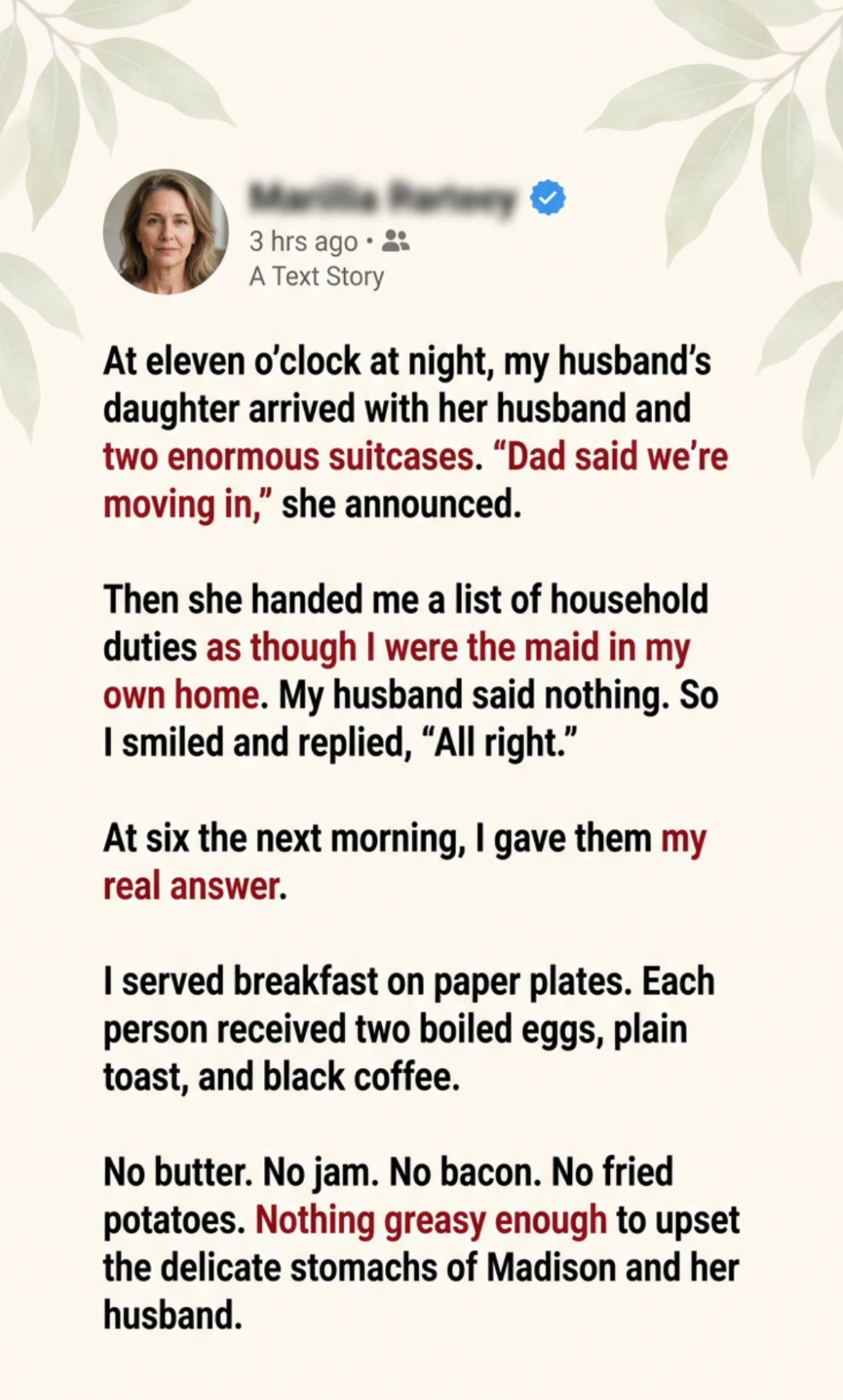
At eleven o’clock on a Thursday night, my husband’s daughter arrived at my front door with her husband, two enormous suitcases, and an attitude that suggested she already owned the house.
I had been sitting in the living room reading when the doorbell rang.
My husband, Richard, was upstairs getting ready for bed.
When I opened the door, Madison stood there wearing an expensive-looking coat, holding her phone in one hand and pointing toward the driveway with the other.
Her husband, Tyler, was standing beside two enormous suitcases.
“Hi,” she said casually. “Dad said we’re moving in.”
I blinked.
“Moving in?”
She stepped past me without waiting for an invitation.
“Yes. Our apartment situation has become impossible, and Dad said we could stay here until we find something better.”
I looked toward Tyler.
He smiled awkwardly.
“Just for a little while.”
I had been married to Richard for six years.
He had one daughter from his first marriage, Madison, who was thirty-one. She had always been somewhat demanding, but I had tried to maintain a good relationship with her.
I attended her wedding.
I remembered her birthdays.
I had helped her choose furniture when she moved into her first apartment.
But she had never behaved as though she considered me part of her family.
And now, without a phone call or a conversation, she was standing in my hallway announcing that she was moving into my home.
I looked at the suitcases.
Then I looked at her.
“Did your father discuss this with me?”
Madison rolled her eyes.
“He’s upstairs. You can ask him if you want.”
Before I could respond, she pulled a folded piece of paper from her handbag.
“I also made a list so things will be easier.”
She handed it to me.
I unfolded it.
At the top, in large handwriting, were the words:
HOUSEHOLD ARRANGEMENTS.
Underneath was a list of instructions.
-
Breakfast prepared by 7:00 a.m.
-
Fresh coffee available every morning.
-
Laundry washed and folded separately.
-
Bedroom cleaned twice a week.
-
No strong cooking smells.
-
Bathroom products kept stocked.
-
Grocery shopping according to our preferences.
-
Dinner prepared by 6:30 p.m.
-
No unnecessary visitors.
-
Madison and Tyler’s privacy must be respected.
At the bottom was another sentence.
Please make sure the house is comfortable for us. We have had a difficult few weeks.
I read the list twice.
Then I heard Richard coming downstairs.
He appeared at the bottom of the staircase wearing his pajamas.
“Oh, good. They’re here.”
He walked over and kissed Madison on the forehead.
“Everything all right?”
Madison smiled.
“Yes. I gave her the list.”
Richard glanced at me.
“That’s helpful, isn’t it, sweetheart?”
I looked at him.
He knew I had just discovered that two adults were moving into our house.
He knew his daughter had handed me a list of domestic responsibilities.
And he seemed to think it was perfectly normal.
I could have argued.
I could have demanded an explanation.
Instead, I smiled.
“All right.”
Madison looked satisfied.
“Wonderful. We’re exhausted. Tyler, bring the bags upstairs.”
They walked toward the guest bedroom.
Richard followed them, carrying one of the suitcases.
I remained in the hallway holding the list.
Then I folded it carefully and placed it on the kitchen counter.
At six the following morning, I gave them my real answer.
And I did it without raising my voice.
The House I Had Spent Twenty Years Building
My name is Margaret Collins.
I was sixty-two years old when this happened.
I had been married once before, to a wonderful man named James, who died after a long illness.
We never had children.
After his death, I spent several years rebuilding my life.
I worked as an accountant for a regional property management company, saved carefully, and eventually purchased a comfortable four-bedroom house in a quiet neighborhood.
I paid for the property with my savings, the proceeds from selling my previous home, and a life insurance settlement from my first husband.
The house was mine before I met Richard.
I had spent twenty years making it comfortable.
I chose every piece of furniture.
I planted the roses along the front walkway.
I renovated the kitchen.
I paid for the new roof and the heating system.
Every room held something I had selected or worked for.
When I married Richard six years earlier, I allowed him to move in.
We agreed that the property would remain in my name because it was my separate premarital asset.
Richard had his own retirement savings and a small investment account.
We divided household expenses fairly.
I never expected him to pay for everything.
And I certainly never expected him to give away rooms in my house without discussing it with me.
Madison had visited occasionally during the first few years of our marriage.
She was polite enough when Richard was around, but she often made comments about my age, my cooking, and the way I organized things.
Once, she suggested that I should replace my living room furniture because it looked old-fashioned.
Another time, she told Richard that I was too protective of the house.
I ignored most of it.
I believed that maintaining peace was worth overlooking a few unpleasant remarks.
But that night, I understood something.
Madison didn’t consider herself a guest.
She considered herself someone who had arrived to take control.
And Richard had allowed it.
The List on the Kitchen Counter
I didn’t sleep much that night.
At 2:30 a.m., I went downstairs and read the list again.
Breakfast at seven.
Laundry separately.
Bedrooms cleaned.
Groceries according to their preferences.
Dinner at 6:30.
No visitors.
I looked around my kitchen.
The kitchen where I had cooked for myself for years.
The kitchen where James and I used to make Sunday breakfast.
The kitchen where Richard and I had celebrated our anniversaries.
Now, apparently, I was expected to become a full-time household employee.
I thought about confronting Richard immediately.
But I decided against it.
I wanted to hear his explanation first.
At 6:00 a.m., I began preparing breakfast.
I boiled eight eggs.
I toasted several slices of plain bread.
I brewed a pot of black coffee.
Then I placed four paper plates on the dining table.
Each person received two boiled eggs, two slices of plain toast, and a cup of black coffee.
No butter.
No jam.
No bacon.
No fried potatoes.
Nothing greasy enough to upset the delicate stomachs of Madison and Tyler.
I also placed a printed copy of the household list beside every plate.
At exactly 6:45, Madison came downstairs.
She was wearing a silk robe and carrying her phone.
She looked at the table.
Then she stopped.
“What is this?”
“Breakfast,” I replied.
She stared at the paper plates.
“Why are we eating off paper?”
“Because you asked for a simple household arrangement, and I thought we should start simply.”
She looked at the food.
“Where’s the bacon?”
I smiled.
“You didn’t mention bacon on your list.”
“Where’s the butter?”
“Also not on your list.”
She looked at me as though I had deliberately insulted her.
“Are you serious?”
“Completely.”
Tyler appeared behind her.
He looked at the plates and then at Madison.
“Is there anything else?”
“There’s coffee,” I said.
“Black?”
“Yes.”
Madison pulled out a chair.
“Where’s Dad?”
“Upstairs.”
She raised her voice.
“Dad!”
Richard came down a few minutes later.
He looked at the table.
Then at me.
“What’s going on?”
I placed a paper plate in front of him.
“Breakfast.”
He looked confused.
“Why paper plates?”
I smiled.
“Your daughter gave me a list of household duties last night. I thought we should establish exactly what everyone expects.”
Madison crossed her arms.
“This is ridiculous.”
I sat down.
“Then perhaps we should discuss the list.”
The Conversation Richard Didn’t Want to Have
Richard pulled out a chair.
“Margaret, we don’t need to make this difficult.”
I looked at him.
“Then explain why you invited two people to move into my house without asking me.”
He sighed.
“They needed help.”
“I understand that. But why didn’t you discuss it with me?”
“Because I knew you’d say yes.”
I stared at him.
That answer was more revealing than he realized.
“You assumed I would agree to something that affects my home because you didn’t want to have an uncomfortable conversation?”
He rubbed his forehead.
“Madison and Tyler are going through a difficult time.”
“So am I.”
He looked surprised.
“What?”
“I am going through the difficult experience of discovering that my husband has made a major decision about my home without consulting me.”
Madison interrupted.
“You’re acting as though we’ve asked you to give us the house.”
I turned toward her.
“You arrived at eleven o’clock at night with two suitcases, announced you were moving in, and handed me a list of domestic responsibilities.”
She shrugged.
“Dad said it was fine.”
“Your father does not own this property.”
The room became quiet.
Richard shifted in his chair.
“Margaret, please.”
I looked directly at him.
“Did you tell Madison she could move in permanently?”
He hesitated.
“Not permanently.”
“Then how long?”
“A few months, perhaps.”
“How many?”
“I don’t know.”
“Three? Six? A year?”
He became irritated.
“Why does everything need to be a negotiation?”
I put down my coffee.
“Because this is my home.”
Madison laughed.
“Well, Dad lives here, too.”
“Yes. And I respect that. But being married to someone does not give either person permission to make unilateral decisions about a property they do not own.”
She rolled her eyes.
“Here we go. The house lecture.”
I stood.
“No. Here’s the arrangement.”
I pointed toward the paper.
“You can stay for a short, agreed period if your father and I both consent. You can contribute to household expenses. You can manage your own laundry, cooking, and cleaning. You can respect the people who live here.”
Madison stared at me.
“And if we don’t?”
I smiled.
“Then you can find somewhere else to live.”
Richard looked at me.
“Margaret, you can’t throw my daughter out.”
I nodded.
“I am not throwing anyone out. I am refusing to become their unpaid housekeeper.”
What Madison Hadn’t Told Her Father
The argument might have ended there.
But something happened that I hadn’t expected.
Tyler quietly asked:
“Margaret, can I ask you something?”
I turned toward him.
“Of course.”
He looked uncomfortable.
“Did Richard tell you that we’re having financial problems?”
I glanced at my husband.
Richard immediately said:
“Tyler, this isn’t necessary.”
But Tyler continued.
“Our landlord is selling the apartment. We have until the end of the month to leave.”
I nodded.
“That explains why you need somewhere to stay. It doesn’t explain the list.”
Tyler looked at Madison.
She seemed annoyed.
Then he said something that changed the conversation.
“We thought we could stay here until we bought a house.”
I looked at him.
“Bought a house?”
He nodded.
“Madison said her father would help us with the down payment.”
I turned toward Richard.
He looked away.
“Is that true?”
He cleared his throat.
“I was considering helping them.”
“With what money?”
“My savings.”
I sat down slowly.
Richard had never mentioned giving Madison a down payment.
He had always been careful with money.
We had agreed that retirement savings should be protected and that large financial gifts to relatives would be discussed together if they affected our household finances.
“How much were you planning to give them?”
He hesitated.
“About $45,000.”
I stared at him.
“Forty-five thousand dollars?”
“It’s my money.”
I took a breath.
“Yes, and I am not telling you that you cannot help your daughter. But we need to discuss how that decision affects our shared retirement plans.”
Madison interrupted.
“Dad promised.”
I turned toward her.
“Your father can make promises about his own money. He cannot promise you my house, my time, or my labor.”
She looked furious.
Then she said something that revealed more than she intended.
“Well, if Dad is going to help us buy a house, it makes sense that we should live here until everything is arranged.”
I looked at her.
“Everything?”
She exchanged a glance with Tyler.
Richard noticed it, too.
“What does that mean?”
Madison hesitated.
“Nothing.”
But Tyler looked increasingly uncomfortable.
Finally, he spoke.
“Madison told me that this house might eventually be sold.”
I stared at him.
Richard looked up sharply.
“What?”
Tyler continued.
“She said you two were planning to downsize and that we might be able to buy the house at a reduced price.”
I felt as though the room had suddenly become much smaller.
I looked at my husband.
“Richard?”
He didn’t answer.
And that was when I realized the suitcase and the list were not the beginning of this problem.
They were simply the first part I had been allowed to see.
The House Sale Nobody Had Discussed With Me
I waited until Madison and Tyler had gone upstairs.
Then I turned toward Richard.
“Have you been discussing selling my house?”
He looked exhausted.
“Not seriously.”
“What does that mean?”
“Madison asked whether we would ever consider downsizing.”
“And what did you tell her?”
“I said perhaps one day.”
“Did you tell her she could buy this house?”
“No.”
“Did you tell her I had agreed?”
He hesitated.
“I might have said it could be an option.”
I stared at him.
“Richard, this property is mine. You know that.”
“I know.”
“Then why are you discussing it as though it’s something we can give away?”
He stood up.
“Because Madison is my daughter. She needs help.”
“And I am your wife. I deserve to be consulted.”
He sighed.
“You make it sound as though I’m trying to take something from you.”
I looked around the kitchen.
“Your daughter arrived here with a list telling me how to serve her. Your husband gave her permission to move into your house. And now I discover that she’s been told she might eventually own it.”
He didn’t respond.
I continued.
“Have you been giving her money?”
He looked down.
That was answer enough.
“How much?”
“Not much.”
“Richard.”
He finally admitted that he had transferred approximately $18,000 to Madison over the previous eight months.
The money had come from his personal savings.
Some had gone toward rent.
Some had paid off credit card balances.
Some had covered Tyler’s business expenses.
I wasn’t angry that he had helped his daughter.
I was angry that he had concealed the extent of it while allowing her to believe she could make demands in my home.
“Why didn’t you tell me?”
“Because I knew you’d be concerned.”
“Concerned? Richard, you have been giving away money without discussing our financial plans.”
“It’s my savings.”
“Then we need to review our finances and understand exactly what is separate and what is shared. But don’t tell me everything is fine while hiding decisions that affect our future.”
He sat down.
For the first time that morning, he looked genuinely ashamed.
The Second List
Later that afternoon, I went into the guest bedroom to collect some fresh towels.
Madison was on the phone.
She didn’t notice me standing in the doorway.
“Yes, Mom,” she said quietly. “We’re here now.”
I stopped.
I hadn’t realized she was speaking to her mother.
Richard’s first wife had died several years earlier, so Madison was speaking about someone else.
I heard her continue.
“Yes, the house is beautiful. Margaret is being difficult, but Dad will handle her.”
I felt my stomach tighten.
“She thinks she can control everything because her name is on the deed.”
A pause.
Then Madison laughed.
“Once Dad gets her to agree to downsize, we’ll be fine.”
I stepped backward before she noticed me.
I returned to my bedroom and sat on the edge of the bed.
It was no longer simply a disagreement about guests.
Madison believed that her father would eventually persuade me to leave.
She believed the house was part of her future.
And she had apparently been discussing it with someone else.
That evening, I called my attorney, a woman named Susan Miller who had helped me prepare my estate documents several years earlier.
I explained the situation.
She advised me to review the property records, my will, and the financial arrangements connected to the marriage.
She also recommended that I document any agreements concerning the temporary stay.
Most importantly, she reminded me that the house was my separate property and that I should not sign anything or agree to a transfer without independent legal advice.
I thanked her.
Then I opened my filing cabinet.
I found the original deed.
The purchase documents.
The mortgage payoff statement.
And the agreement Richard and I had signed before our marriage.
Everything was exactly where it should have been.
I placed the documents in a folder.
I wasn’t planning to use them as a weapon.
I simply wanted to make sure nobody could pretend they didn’t exist.
The Breakfast That Became a Family Meeting
The next morning, Madison came downstairs at 7:15.
She looked at the dining table.
This time, there were no paper plates.
I had prepared a proper breakfast for myself.
Oatmeal, fresh fruit, yogurt, and tea.
I was reading the newspaper.
Madison opened the refrigerator.
“Where’s the orange juice?”
“On the middle shelf.”
She looked inside.
“There’s barely any.”
“Then you can add it to the grocery list.”
She turned toward me.
“Are you seriously expecting me to buy groceries?”
I folded the newspaper.
“Yes. If you’re staying here, you should contribute.”
She laughed.
“Dad said we wouldn’t have to pay anything.”
Richard entered the kitchen.
“Madison, please.”
She turned toward him.
“What? You told us it was fine.”
Richard looked at me.
I placed the household list on the table.
“Perhaps we should review the arrangements together.”
Madison sighed dramatically.
“Again?”
“Yes.”
I opened a notebook.
“First, the house is mine. Second, nobody is moving in permanently. Third, any temporary stay must have a clear end date and reasonable household contributions.”
Madison folded her arms.
“And what exactly are we supposed to contribute?”
I explained that if they stayed, they would pay an agreed amount toward utilities and groceries.
They would handle their own laundry and cleaning.
They would respect the shared spaces.
And they would not treat me as a personal cook or housekeeper.
I also explained that any financial assistance Richard wanted to give them needed to be discussed separately from the use of my property.
Madison looked at her father.
“Are you really going to let her talk to us like this?”
Richard didn’t answer immediately.
Then he said:
“Margaret is right about the house.”
Madison stared at him.
“What?”
He continued.
“I should have discussed this with her before inviting you. That was my mistake.”
For the first time since arriving, Madison seemed genuinely surprised.
She sat down.
Tyler quietly poured himself some coffee.
Richard looked at his daughter.
“You can stay temporarily, but there need to be boundaries.”
Madison shook her head.
“I can’t believe this.”
I smiled.
“Neither could I yesterday.”
The Decision I Made About My Own Home
That afternoon, I asked Madison and Tyler to sit down with us.
I had spoken with Susan again and prepared a written temporary occupancy agreement.
It was straightforward.
They could remain in the guest bedroom for thirty days.
They would contribute toward utilities and groceries.
They would maintain their own room and personal belongings.
They would respect household routines.
There would be no expectation that I would provide daily meals, laundry, or cleaning.
At the end of thirty days, they would need to leave unless we all agreed in writing to a different arrangement.
I placed the document on the table.
Madison read it.
Then she looked at me.
“You want us to sign this?”
“Yes.”
She turned toward her father.
“You’re allowing this?”
Richard nodded.
“It’s reasonable.”
She pushed the paper away.
“This is humiliating.”
I remained calm.
“What’s humiliating about agreeing to basic responsibilities when staying in someone else’s home?”
She stood.
“We don’t need this.”
Tyler looked uncomfortable.
“Madison, perhaps we should discuss it.”
She turned toward him.
“Don’t start.”
He took a breath.
“I think we should sign it.”
She stared at him.
“What?”
“We need somewhere to stay. Margaret is offering us a place. I don’t see why we can’t contribute.”
Madison looked as though she wanted to argue.
But eventually, she sat down.
They signed.
For the next several days, things were uncomfortable.
Madison complained about the grocery budget.
Tyler began helping with dinner.
They kept their bedroom tidy.
I did not wash their clothes.
I did not prepare special breakfasts.
And I certainly did not rearrange my schedule to accommodate their every preference.
It was the first time I had established boundaries without apologizing for them.
The Money Richard Had Been Hiding
A week later, Richard approached me with a folder.
“I think you should see this.”
I looked at him.
“What is it?”
“My savings account statements.”
He sat beside me.
He had reviewed his finances after our conversation and realized that he had given Madison more money than he had admitted.
The total was approximately $31,500.
He had also made a personal loan of $12,000 to Tyler to help with a business project.
Some of the money had been repaid.
Most had not.
I studied the statements.
“Why did you hide this?”
He looked embarrassed.
“Because I knew you’d ask questions.”
“I would have asked reasonable questions.”
“I know.”
He explained that Madison had repeatedly told him she was struggling.
She had also suggested that Tyler’s business was about to become successful and that the money would be repaid quickly.
Richard had wanted to help.
But he had never established a repayment schedule.
He had simply transferred the money whenever she asked.
I closed the folder.
“Richard, you are allowed to help your daughter. But you need to decide how much you can afford without putting your own retirement at risk.”
He nodded.
“I understand.”
“From now on, no large financial transfers without reviewing the numbers.”
He agreed.
Then he said something I hadn’t expected.
“Madison has always made me feel guilty when I say no.”
I looked at him.
“She’s your daughter. But being her father doesn’t mean you have to finance every decision she makes.”
He nodded slowly.
I realized then that Richard’s problem was not that he loved his daughter too much.
It was that he had confused helping her with preventing her from experiencing the consequences of her own choices.
And I had been expected to absorb those consequences inside my own home.
The Day Tyler Finally Spoke
Two weeks after they moved in, Tyler asked if he could speak with me privately.
We sat on the back porch.
He looked nervous.
“Margaret, I want to apologize.”
I looked at him.
“For what?”
“For the way we arrived. For the list. For making you feel like you had to serve us.”
I nodded.
“Thank you.”
He continued.
“To be honest, I didn’t know Madison had written that list until she handed it to you.”
I raised an eyebrow.
“You didn’t?”
“No. She told me her father had arranged everything, but I thought we were just staying in the guest room temporarily.”
He explained that their apartment lease had ended unexpectedly because the property owner had decided to sell.
They had been struggling financially after Tyler’s small contracting business lost two major clients.
Madison had become increasingly anxious.
She had started believing that her father would eventually provide them with a financial solution.
Tyler had disagreed.
He wanted to rent a smaller apartment and rebuild their finances.
Madison wanted to maintain the lifestyle she was accustomed to.
I listened quietly.
Then I asked:
“Do you think the two of you can afford the kind of life you’re trying to maintain?”
He looked down.
“Not right now.”
“Then perhaps it’s time to make some changes.”
He nodded.
I didn’t offer to solve their financial problems.
I didn’t promise to give them money.
But I offered to help Tyler review his business expenses and prepare a realistic budget.
He accepted.
Over the next few days, we worked through his accounts.
He discovered that several expenses could be reduced.
He also realized that he needed to stop taking on projects that required him to borrow money before receiving payment.
For the first time, I saw him taking responsibility for his situation.
And I respected him for it.
Madison’s Unexpected Reaction
When Madison discovered that Tyler had been working with me on a budget, she became furious.
She confronted me in the kitchen.
“Why are you discussing our finances with my husband?”
I put down the knife I was using to cut vegetables.
“Tyler asked for help.”
“You had no right.”
I looked at her.
“He is an adult. He asked me a question, and I answered it.”
She crossed her arms.
“You think you’re better than me because you own this house.”
I shook my head.
“No. I think we should all be responsible for our own decisions.”
She laughed.
“You’ve always wanted to control Dad.”
I stared at her.
“Madison, your father is a grown man. I don’t control him.”
“Then why does he suddenly agree with everything you say?”
“Perhaps because he has started listening.”
She looked shocked.
I continued.
“You don’t have to like my rules. You don’t have to like my cooking. You don’t even have to like me. But while you are staying in my home, you will treat me with respect.”
She turned and walked away.
That evening, Richard spoke with her.
I didn’t hear the entire conversation.
But I heard him say:
“Your stepmother is not your servant, Madison.”
It was the first time he had said those words directly.
And it mattered more than he knew.
Thirty Days Later
On the thirtieth day, Madison and Tyler moved out.
They had found a smaller apartment within their budget.
Tyler had secured two new contracts, and Madison had agreed to return to work full-time.
They packed their belongings into the same two enormous suitcases they had brought that first night.
Madison came downstairs before leaving.
She stood near the front door.
For a moment, I thought she might apologize.
Instead, she said:
“I suppose things could have gone differently.”
I nodded.
“Yes. They could have.”
She looked uncomfortable.
“Thank you for letting us stay.”
“You’re welcome.”
Tyler approached and shook my hand.
“Thank you for everything, Margaret.”
I smiled.
“Take care of each other.”
They left.
I watched their car disappear down the street.
Then I closed the door.
Richard stood behind me.
“Are you all right?”
I looked around the hallway.
The house was quiet again.
“Yes.”
He put his arms around me.
“I’m sorry.”
I turned toward him.
“I need you to understand something. I don’t expect you to choose between me and your daughter.”
He nodded.
“But I do expect you to respect our marriage. If something affects our home, our finances, or our future, we discuss it together.”
“I understand.”
“And I will never again agree to something simply because you have already promised it to someone else.”
He smiled sadly.
“Fair enough.”
The Second Chance Richard Had to Earn
The following months were not perfect.
Richard and I attended several marriage counseling sessions.
We discussed the financial secrecy, his relationship with Madison, and the way he had avoided difficult conversations.
He admitted that he often agreed to his daughter’s demands because he was afraid she would stop speaking to him.
He also admitted that he had expected me to accommodate her because I was the more financially secure person.
I told him that my independence did not make me responsible for everyone else’s choices.
We worked through our disagreements slowly.
Richard began discussing financial decisions with me openly.
He stopped making promises on behalf of the household.
And he started setting reasonable boundaries with Madison.
Their relationship remained close, but it became healthier.
Madison eventually found a stable job.
Tyler’s business improved.
They rented a comfortable apartment and began saving toward a house of their own.
Several months later, Madison called me.
She asked whether she could visit.
I agreed.
She arrived on a Sunday afternoon carrying a small box.
Inside was a beautiful ceramic serving dish.
“I saw this and thought of your kitchen,” she said.
I smiled.
“Thank you. That’s very thoughtful.”
She sat down.
Then she looked at me.
“I owe you an apology.”
I waited.
“I was under a lot of pressure, and I thought Dad would fix everything. I shouldn’t have handed you that list.”
I nodded.
“No, you shouldn’t have.”
She looked down.
“I thought you would just do whatever Dad asked.”
I considered her words.
“That was part of the problem. Your father should never have made a promise that required me to give up my comfort or independence.”
She nodded.
“I understand that now.”
I didn’t hug her dramatically.
I didn’t tell her everything was forgotten.
I simply accepted the apology.
Trust is rebuilt through behavior, not a single conversation.
The Paper Plates I Kept
A year later, Richard and I celebrated our seventh wedding anniversary.
We had dinner at home.
I prepared roast chicken, potatoes, and a chocolate cake.
Richard brought flowers.
After dinner, he helped me wash the dishes.
As I opened the kitchen cupboard, I noticed a stack of paper plates at the back.
I laughed.
Richard looked over.
“What?”
I held one up.
“Remember these?”
He smiled.
“Unfortunately.”
I laughed harder.
“Your daughter nearly declared war over two boiled eggs.”
He shook his head.
“I deserved that morning.”
I placed the paper plates back in the cupboard.
I didn’t keep them because I was angry.
I kept them because they reminded me of the moment I stopped confusing kindness with obligation.
For years, I had believed that being a good wife meant making everyone comfortable.
I had believed that being a good stepmother meant never saying no.
I had believed that keeping peace meant swallowing my own feelings.
But I learned something important.
A home is not a hotel.
A marriage is not permission to make unilateral decisions.
And being generous does not mean allowing people to treat you as though your time, labor, and property belong to them.
Richard and I are still married.
Madison and Tyler visit occasionally.
Sometimes they stay for dinner.
Sometimes Madison helps me prepare vegetables.
Tyler has become quite good at grilling.
And when they leave, they thank me.
Not because I demand it.
Because respect has finally become part of our family routine.
One Sunday, Madison arrived with a small box of pastries.
She placed them on the kitchen counter.
“These are for breakfast tomorrow,” she said.
I smiled.
“That’s lovely.”
Then she added:
“And don’t worry. I brought enough for everyone.”
I laughed.
“That’s the spirit.”
We sat together, drank coffee, and talked about ordinary things.
For the first time, I didn’t feel like someone was measuring what I could do for them.
I felt like a member of the family.
That evening, after everyone had gone, I walked through my house.
I looked at the living room furniture, the kitchen, the dining table, and the hallway.
Everything was exactly where I wanted it.
I thought about that first night when Madison had arrived at eleven o’clock with two suitcases and a list.
She had expected me to become her housekeeper.
Richard had expected me to accept his decision.
And I had nearly agreed simply because I didn’t want an argument.
But at six the next morning, I discovered that the most important thing I could serve my family wasn’t breakfast.
It was an honest answer.
I could love Richard without surrendering my independence.
I could welcome Madison without accepting disrespect.
And I could help people without becoming responsible for their entire lives.
The morning I served breakfast on paper plates wasn’t the morning I stopped loving my husband’s daughter. It was the morning I finally reminded everyone, including myself, that kindness is a gift—not a job description.