Chapter One: The Wedding I Refused to Attend
When my daughter announced she was marrying a divorced man with two children, I told her she was making the biggest mistake of her life.
Her name was Celia Monroe, and she was twenty-nine years old at the time. She had graduated near the top of her class, earned her doctorate in dental medicine, and built a promising career as a pediatric dentist. I had raised her alone after her father died when she was twelve, and I believed I had sacrificed too much to watch her throw away her future.
Then she introduced me to Daniel.
He was thirty-six, divorced, and already had two children: a seven-year-old boy named Noah and a five-year-old girl named Lily. His marriage had ended several years earlier, and he shared custody of the children with his former wife.
He was polite, hardworking, and clearly devoted to his children.
But I couldn’t see any of that.
All I saw was baggage.
“Celia, you have your entire future ahead of you,” I told her during our first dinner together. “Why would you choose a man who already comes with two children and an ex-wife?”
She put down her fork.
“Because I love him, Mom.”
“You could marry someone without complications.”
“Every person has complications.”
“Not like this.”
Daniel tried to remain respectful.
“Mrs. Monroe, I understand your concerns. I know this isn’t the family situation you imagined for Celia. But I love her, and I intend to treat her well.”
I looked at him.
“Intentions don’t pay for school supplies, medical bills, or college tuition.”
He nodded.
“You’re right. They don’t. That’s why I work hard to provide for my children.”
His calmness irritated me more than an argument would have.
After dinner, I pulled Celia aside.
“You’re a professional woman. You have a future. Don’t spend it raising somebody else’s children.”
She looked at me as if I had slapped her.
“They aren’t somebody else’s children to me. If I marry Daniel, they’ll be my family.”
I shook my head.
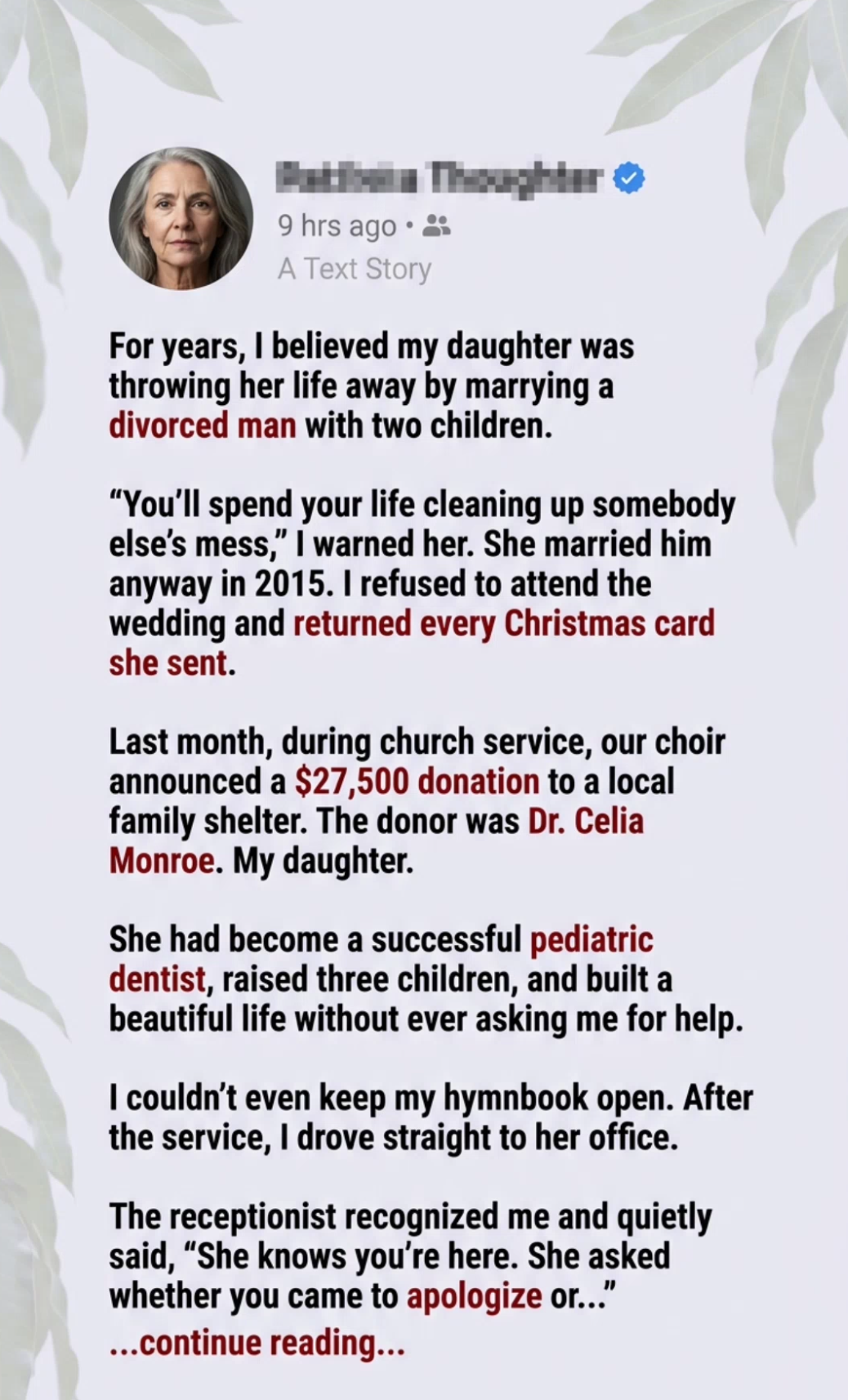
“You’ll spend your life cleaning up somebody else’s mess.”
She didn’t cry.
She simply said, “I wish you could be happy for me.”
I answered with the sentence that would haunt me for years.
“I can’t be happy about a decision that will ruin your life.”
She married Daniel in 2015.
I refused to attend.
I didn’t send a gift. I didn’t call her on the morning of the wedding. I didn’t even ask whether the ceremony had gone well.
When the wedding photographs appeared online, I looked at them once.
Celia wore a simple ivory dress. Daniel stood beside her, smiling. Noah and Lily stood in front of them, holding a small bouquet and a ring pillow.
They looked like a family.
I closed the photographs and told myself that one day my daughter would understand I had been right.
I was wrong.
But it would take me nearly eleven years to admit it.
Chapter Two: The Christmas Cards I Returned
The first Christmas after the wedding, Celia sent me a card.
It showed four people standing beneath a Christmas tree: Celia, Daniel, Noah, and Lily.
Inside, she had written:
Dear Mom, I hope you’re well. We miss you. The children ask about you, and I’d love for you to meet them properly someday. I know things have been difficult, but there’s always a place for you with us. Merry Christmas. Love, Celia.
I read it twice.
Then I placed it back in the envelope, wrote “Return to Sender” across the front, and put it in the mailbox.
I told myself I was protecting my daughter from a life she didn’t understand.
The following year, another card arrived.
This one included a photograph of the children standing beside a birthday cake. Noah had grown taller, and Lily had lost her two front teeth.
Celia wrote that Noah had started playing baseball and Lily had begun taking piano lessons.
I returned that card too.
By the third year, I stopped opening them.
I recognized her handwriting and immediately placed the envelopes in a drawer until I could take them to the post office.
Sometimes she called.
I usually let the phone ring.
When I did answer, our conversations were painfully brief.
“How are you, Mom?”
“Fine.”
“Have you been eating properly?”
“Yes.”
“Would you like to come over for dinner sometime?”
“No, Celia.”
She would pause.
Then she would say, “All right. I love you.”
I never said it back.
Not because I didn’t love her, but because I believed affection would make my position weaker.
I wanted her to realize she had made a mistake.
I wanted her to come home and admit that I had been right.
Instead, she built a life without me.
Years passed.
I heard occasional updates through distant relatives.
Celia had opened her own pediatric dental practice.
Daniel had been promoted at his company.
Noah was doing well in school.
Lily had become an excellent student.
Then I heard that Celia and Daniel had welcomed another child, a little boy named Ethan.
Three children.
The exact situation I had predicted would overwhelm her.
I imagined a house full of noise, endless expenses, school problems, and responsibilities.
I told anyone who asked that I worried about her.
But the truth was that I knew almost nothing about her life.
I had chosen not to know.
Chapter Three: The Woman Who Built a Family
One afternoon, my neighbor Margaret mentioned seeing Celia at a community event.
“Your daughter was there with her husband,” she said. “She looked wonderful.”
I pretended to be uninterested.
“I’m glad she’s doing well.”
Margaret smiled.
“She seems very happy. The children are lovely.”
I continued watering my plants.
“That’s nice.”
Then Margaret added something that bothered me.
“Daniel seems like a good father. He was helping one of the little ones with a science project while Celia spoke to some people.”
I didn’t answer.
Margaret looked at me.
“You know, you could visit them.”
“I don’t think that’s necessary.”
She shook her head.
“Sometimes pride makes people miss the things they would give anything to have later.”
I disliked that comment.
I disliked it because it sounded too close to the truth.
Still, I refused to call Celia.
My life continued quietly.
I attended church on Sundays, volunteered at the local food pantry twice a month, and visited my sister whenever she needed help.
I had friends, a comfortable house, and enough money to live without worrying.
But Christmas became increasingly difficult.
Every year, I wondered whether Celia would send another card.
Eventually, she stopped.
The absence hurt more than I expected.
I told myself I was relieved.
But some nights, I opened the drawer where I had kept the returned envelopes.
I would look at her handwriting and wonder what the children looked like now.
Had Noah grown taller than Daniel?
Did Lily still play piano?
Did Ethan know he had a grandmother?
I never asked.
I never reached out.
I simply closed the drawer.
Chapter Four: The Donation Announced at Church
Last month, something happened that changed everything.
It was a Sunday morning.
Our church was holding its annual community service, and several volunteers were preparing a report about local charitable work.
I was sitting in the third row, holding my hymnbook, when the pastor stepped toward the microphone.
“Before we begin today’s final hymn, I want to recognize a generous contribution made to the Riverside Family Shelter.”
People began looking toward the front.
“The shelter recently received a donation of twenty-seven thousand five hundred dollars to support emergency housing, children’s supplies, and family counseling services.”
There was a warm murmur of appreciation.
The pastor continued.
“This contribution will help families who are experiencing homelessness, domestic difficulties, and unexpected financial hardship. It will provide temporary housing and practical support for parents trying to rebuild their lives.”
Then he announced the donor.
“The gift was made by Dr. Celia Monroe, a local pediatric dentist and founder of Monroe Children’s Dental Care.”
My fingers tightened around the hymnbook.
For a moment, I thought I had misheard.
Celia.
My Celia.
The pastor continued speaking about her work with children, her commitment to underserved families, and her willingness to support parents who couldn’t afford dental treatment for their children.
He mentioned that she had also organized free dental screening days for children at the shelter.
I couldn’t keep my hymnbook open.
My hands began trembling.
A woman sitting beside me leaned over.
“Isn’t that your daughter?”
I nodded.
I couldn’t speak.
The pastor smiled.
“We are grateful for people who remember that a family is not defined by its circumstances, but by the love and care its members give one another.”
I lowered my head.
Those words felt as though they had been spoken directly to me.
For years, I had believed Celia was sacrificing her future by marrying Daniel.
Now I was hearing that she had used her success to help families who were struggling.
She had built a thriving practice.
She had raised three children.
She had created a home.
And she had done all of it without asking me for a single thing.
The donation wasn’t what made me ashamed.
It was what the donation revealed.
My daughter had become the kind of person I had always hoped she would become.
Only she had done it in a life I had spent years refusing to accept.
Chapter Five: The Drive to Her Office
After the service, I barely spoke to anyone.
I sat in my car for nearly twenty minutes, staring at the steering wheel.
Then I started the engine and drove toward Celia’s dental office.
I had never visited it.
I knew the address because Margaret had mentioned it once, and I had secretly looked it up online.
The building was modern but modest, with a bright sign above the entrance.
MONROE CHILDREN’S DENTAL CARE.
There were colorful illustrations of animals on the windows.
Inside, children laughed as they waited for their appointments. A little girl sat beside her father, holding a stuffed rabbit. A boy in a blue sweater was examining a toy dinosaur.
The receptionist looked up.
“Good afternoon. Welcome to Monroe Children’s Dental Care. Do you have an appointment?”
I swallowed.
“I’m looking for Dr. Celia Monroe.”
“Do you have an appointment with her?”
“No. I’m her mother.”
The receptionist’s expression changed slightly.
She glanced at the computer, then looked back at me.
“May I have your name?”
I gave it.
She typed something, then picked up the phone.
I heard her speak quietly.
“Yes, she’s here.”
A pause.
Then she said, “Understood.”
She placed the phone down and looked at me.
“Dr. Monroe knows you’re here.”
My heart began beating faster.
“Will she see me?”
The receptionist hesitated.
Then she quietly asked:
“She wanted me to ask whether you came to apologize or…”
She stopped.
I looked at her.
“Or what?”
The receptionist lowered her voice.
“Or to ask her for something.”
The question hit me harder than anything the pastor had said.
I had spent eleven years teaching my daughter that my love came with conditions.
Now she had every reason to wonder whether I had come because I needed something.
I looked down at my hands.
“I came to apologize,” I whispered.
The receptionist nodded.
“Please have a seat. I’ll let her know.”
I sat in the waiting room.
A little boy nearby was laughing because the dental assistant had given him a sticker.
His mother kissed the top of his head.
I watched them and thought about Noah, Lily, and Ethan.
I wondered whether they had ever wanted to meet me.
I wondered whether Celia had told them about the grandmother who returned their Christmas cards.
I wondered whether she had protected them from the pain I had caused her.
A door opened.
“Mom?”
I stood.
Celia was standing in the hallway.
She looked older, of course. Her hair was shorter, and there were faint lines around her eyes. She wore a white dental coat with her name embroidered above the pocket.
But her eyes were the same.
For a moment, neither of us moved.
Then she said, “Come into my office.”
Chapter Six: The Conversation Eleven Years Too Late
Her office was neat and bright.
There were photographs on the shelves.
One showed Celia and Daniel standing beside a Christmas tree.
Another showed Noah in a graduation gown.
Another showed Lily holding a certificate.
The final photograph showed a little boy sitting on Daniel’s shoulders.
Ethan.
I stared at the pictures.
“You have a beautiful family,” I said.
Celia closed the door.
“Thank you.”
She sat behind her desk.
I remained standing.
“Please sit down, Mom.”
I sat carefully.
For several seconds, we said nothing.
Then Celia folded her hands.
“Why are you here?”
I had prepared a speech during the drive.
I had planned to explain how shocked I was by the donation, how proud I felt, and how I had finally realized that Daniel wasn’t the terrible choice I had imagined.
But now that I was sitting across from her, those words sounded inadequate.
“I heard about the donation at church.”
She nodded.
“Yes. The shelter is doing important work.”
“Twenty-seven thousand five hundred dollars is a lot of money.”
“It was something I had been planning for a while. The shelter needed help expanding its family rooms.”
I looked at her.
“Why did you do it?”
She seemed surprised by the question.
“Because children shouldn’t have to suffer when adults go through difficult times.”
I lowered my eyes.
“That sounds like something a good mother would say.”
Celia was quiet.
Then she asked, “Is that why you came?”
I shook my head.
“No.”
I took a breath.
“I came because I was wrong.”
Her expression changed, but she didn’t speak.
“I was wrong about Daniel. I was wrong about the children. I was wrong about your marriage. I was wrong about everything.”
Celia looked toward the window.
I continued.
“I thought I was protecting you. I thought you were making a foolish decision, and I believed that if I refused to accept it, you would eventually come to your senses.”
She turned back toward me.
“And when I didn’t?”
I felt tears gathering.
“I punished you.”
She nodded slowly.
“Yes, you did.”
“I returned your Christmas cards.”
“I remember.”
“I ignored your calls.”
“I remember those too.”
“I didn’t attend your wedding.”
Celia’s eyes filled.
“I looked for you before the ceremony.”
My throat tightened.
“What?”
“I kept thinking you might change your mind. I kept looking toward the entrance, even after the music started.”
I covered my mouth.
“I didn’t know.”
“You didn’t want to know.”
There was no anger in her voice.
That made it worse.
She wasn’t trying to hurt me.
She was simply telling me the truth.
Chapter Seven: The Children I Never Met
Celia stood and walked to a small cabinet.
She opened a drawer and removed a folder.
Inside were several photographs.
She placed them on the desk.
“This is Noah.”
I picked up the first photograph.
He was a handsome young man with dark hair and a wide smile.
“How old is he now?”
“Eighteen.”
I stared at the picture.
“Eighteen?”
“He starts college next year.”
I felt my chest tighten.
I had missed his childhood.
Celia showed me another photograph.
“This is Lily. She’s sixteen.”
Lily had long brown hair and wore a school uniform. She was smiling beside a piano.
“She still plays?” I asked.
“Every day. She wants to study music.”
I smiled through my tears.
“And Ethan?”
Celia handed me the final photograph.
He was eight years old, missing a front tooth and holding a baseball bat.
“He looks happy,” I whispered.
“He is.”
I studied the photograph.
“Do they know about me?”
Celia took a long breath.
“They know I have a mother. They know we haven’t been close. I never wanted them to hate you.”
I looked up.
“Why not?”
“Because they are children. They shouldn’t have to carry the anger from a disagreement between adults.”
I lowered my eyes.
She continued.
“Noah asked about you when he was little. He wanted to know why his friends had grandparents who came to school events but he didn’t see you.”
I felt tears run down my face.
“What did you tell him?”
“I told him you weren’t ready to be part of our family.”
I closed my eyes.
That was kinder than I deserved.
“Did he believe you?”
“He didn’t have a reason not to.”
I placed the photograph carefully on the desk.
“I missed everything.”
Celia nodded.
“Yes.”
“First days of school. Birthdays. Christmas mornings.”
“Yes.”
“Your pregnancy with Ethan?”
She looked down.
“Yes.”
I covered my face.
For years, I had thought I was punishing my daughter for making a bad decision.
But I had also punished three children who had done nothing wrong.
They had never asked me to approve their family.
They had only wanted to be loved.
Chapter Eight: The Question I Was Afraid to Ask
After a long silence, I looked at Celia.
“Do you hate me?”
She leaned back in her chair.
“No.”
The answer surprised me.
“After everything?”
“I was angry for a long time. I was hurt. There were years when I wished you would call and tell me you were ready to accept my family.”
She paused.
“But I stopped waiting.”
I felt the weight of those words.
“Why?”
“Because I couldn’t keep raising my children while hoping my mother would someday approve of the life I had chosen.”
I nodded.
She continued.
“Daniel never asked me to choose between him and you. In fact, he encouraged me to keep reaching out. He said he didn’t want our marriage to cost me my relationship with my mother.”
I stared at her.
“He did?”
“Yes. He even suggested inviting you to our anniversary dinner once.”
I looked down.
“I would have refused.”
“I know.”
The truth was becoming unbearable.
I had blamed Daniel for separating me from my daughter.
Yet he had apparently spent years trying to bring us together.
“Does he still dislike me?”
Celia shook her head.
“He doesn’t dislike you. But he doesn’t trust you around the children until he knows you can respect them.”
I nodded.
“That is fair.”
Then I asked the question I had been afraid to ask since entering the office.
“Could I meet them?”
Celia didn’t answer immediately.
She looked at me carefully.
“Why?”
I swallowed.
“Because they’re my grandchildren. Because I want to know them. Because I want to stop being a stranger in your life.”
She looked down at her hands.
“Mom, I need you to understand something. You can’t walk into their lives today and expect them to feel close to you tomorrow.”
“I understand.”
“And I don’t want you making comments about their family. Daniel is their father. They love him. You don’t get to question that.”
“I won’t.”
“You also don’t get to tell Noah or Lily that they’re not really your grandchildren.”
My eyes filled again.
“I would never say that.”
Celia looked at me.
“You said something very similar when you called them somebody else’s mess.”
I felt as though the room had become smaller.
“You’re right,” I whispered. “I did.”
She nodded.
“If you want to be part of our lives, you need to accept all of us. Not just me.”
I took her hand.
“I do.”
For the first time in eleven years, she didn’t pull away.
Chapter Nine: Meeting Daniel Again
Celia called Daniel that evening.
She told him I had visited and asked whether he would be willing to meet me.
He agreed.
We arranged to have dinner at their house the following Sunday.
I spent the entire week worrying about it.
I bought a gift for each grandchild.
For Noah, I chose a watch.
For Lily, I bought a beautiful music notebook and a gift card for a music store.
For Ethan, I bought a baseball glove.
I also purchased flowers for Celia.
I nearly bought something for Daniel, but I didn’t know what would be appropriate.
In the end, I brought a simple box of chocolates.
When I arrived, Daniel opened the door.
He looked almost exactly as he had eleven years earlier, except for a little gray in his hair.
“Good evening, Mrs. Monroe.”
I looked at him.
“Please call me by my first name.”
He hesitated.
“Come in.”
The house smelled of roasted chicken and fresh bread.
From somewhere upstairs, I heard laughter.
Daniel led me into the dining room.
Celia was setting the table.
She smiled when she saw me.
“Hi, Mom.”
I smiled back.
“Hello, sweetheart.”
Then three children appeared in the doorway.
Noah stood first.
He was taller than I expected.
Lily stood beside him, holding a phone.
Ethan peeked around her shoulder.
Celia introduced us.
“This is your grandmother.”
The word made my eyes sting.
Noah gave me a polite smile.
“Hello.”
Lily nodded.
“Hi.”
Ethan looked at my gift bags.
“Did you bring presents?”
I laughed softly.
“Yes. But I brought them because I wanted to, not because you have to like me.”
He considered that.
Then he smiled.
“Okay.”
It was a small beginning.
But it was a beginning.
During dinner, Daniel served everyone and made sure Ethan had his favorite vegetables.
Noah talked about college applications.
Lily explained that she had been selected to perform at a school concert.
Ethan told me about baseball.
I listened.
I asked questions.
I tried not to dominate the conversation.
At one point, Noah mentioned that Daniel had helped him prepare for an important mathematics examination.
Daniel smiled.
“You did the hard work. I just helped you understand the problems.”
I watched them.
There was no bitterness in Daniel’s voice.
No attempt to prove that he was a better father than anyone else.
He was simply proud of his son.
And I finally saw what I had refused to see eleven years earlier.
Daniel hadn’t brought two children into Celia’s life as a burden.
He had brought her into a family that needed love.
And together, they had created something beautiful.
Chapter Ten: The Apology I Owed Him
After dinner, the children went upstairs.
Celia began clearing the plates, but Daniel asked her to leave them.
“I’ll take care of it,” he said.
Then he looked at me.
“Would you like some coffee?”
I nodded.
We sat in the living room.
For several minutes, I watched him prepare the coffee.
Finally, I spoke.
“Daniel, I owe you an apology.”
He looked surprised.
“You don’t have to do that.”
“Yes, I do.”
I folded my hands.
“I judged you before I knew you. I treated your children as if they were obstacles rather than people. I told Celia that marrying you would ruin her life.”
Daniel sat quietly.
“I also refused to attend your wedding. I returned her cards. I made it impossible for her to have both her husband and her mother.”
He lowered his eyes.
“I was hurt by what you said. But I understood that you were worried about your daughter.”
“That doesn’t excuse what I did.”
“No,” he agreed gently. “It doesn’t.”
I looked at him.
“Did you ever tell Celia to stop contacting me?”
“Never.”
“Why?”
He looked toward the staircase.
“Because I knew how much she loved you. I didn’t want her to lose her mother because she married me.”
I felt tears gathering.
“I made you the enemy because I couldn’t accept that my daughter had chosen a life I hadn’t planned for her.”
Daniel nodded.
“I think sometimes parents forget that children grow up and become responsible for their own choices.”
I smiled sadly.
“You sound wiser than I was.”
He shook his head.
“I’m not sure about that. I’ve made plenty of mistakes myself.”
He looked toward the kitchen.
“But Celia taught me that family isn’t something you inherit perfectly. It’s something you build, every day.”
I wiped my eyes.
“Thank you for loving her.”
Daniel looked at me.
“I’ve loved her since the day I met her.”
I believed him.
And that was perhaps the most painful realization of all.
The man I had spent eleven years criticizing had been treating my daughter with the love and patience I should have trusted him to give.
Chapter Eleven: A Place at the Table
Over the following months, I began visiting once or twice a month.
At first, the children were polite but reserved.
I didn’t blame them.
I was a stranger who had suddenly appeared in their lives.
I learned their schedules.
Noah was busy preparing for college.
Lily practiced piano most afternoons.
Ethan loved baseball, science experiments, and anything involving dinosaurs.
I began attending their school events when Celia invited me.
The first time I watched Lily perform at a school concert, I cried before she finished the first song.
She noticed me in the audience afterward.
“Did you like it?”
I stood and hugged her.
“I loved it.”
She smiled.
“Thank you for coming.”
Those four words meant more than she could know.
A few weeks later, Ethan invited me to one of his baseball games.
He handed me a paper schedule and told me exactly where to sit.
“You have to come early,” he instructed. “The good seats get taken.”
“I’ll be early.”
“And bring water.”
I laughed.
“I will.”
Noah took longer to warm up to me.
He was old enough to remember that I hadn’t been there during much of his childhood.
One afternoon, while we were sitting in the garden, he asked me a question.
“Grandma, can I ask you something?”
“Of course.”
“Why didn’t you come to the wedding?”
I looked at him.
I could have offered an excuse.
I could have blamed misunderstandings, fear, or circumstances.
But he deserved the truth.
“Because I was wrong,” I said. “I thought your father was not the right person for my daughter, and I was so determined to prove that I refused to see the good things he brought into her life.”
Noah listened quietly.
“Did you think we were bad?”
My heart broke.
“No, sweetheart. You were never bad. I was wrong to make you feel as if you didn’t belong.”
He looked down at the grass.
“Mom said you didn’t know us.”
“I didn’t. And that was my choice.”
He nodded.
Then, after a moment, he said, “I’m glad you’re coming now.”
I reached for his hand.
“So am I.”
Chapter Twelve: The Gift That Meant More Than Money
Nearly a year after the church announcement, Celia invited me to attend a small celebration at the Riverside Family Shelter.
The shelter had completed renovations to several family rooms using donations from local supporters.
My daughter had been asked to speak.
I sat in the second row while she stood at the front.
She spoke about children who needed stability, parents who were struggling to rebuild their lives, and the importance of giving families a chance to begin again.
She didn’t mention our family.
She didn’t need to.
After the speeches, a woman approached Celia with two small children.
“Dr. Monroe,” she said, “I don’t know how to thank you. My daughter was terrified of going to the dentist, but your team treated her so kindly. And the shelter helped us find a safe apartment.”
Celia knelt to speak with the little girl.
“I’m glad you’re feeling better.”
The girl smiled.
“Can I show you my new tooth?”
Celia laughed.
“Of course.”
I watched my daughter interact with that family.
I saw the patience in her face, the gentleness in her voice, and the genuine happiness she found in helping children.
Then I understood why she had chosen pediatric dentistry.
She had always wanted to make children feel safe.
Even when she was young, she had been the child who comforted others when they were frightened.
She had become exactly the woman she had always been.
I had simply failed to recognize her because she hadn’t followed my plan.
After the event, Celia came over and hugged me.
“I’m glad you came.”
I smiled.
“Thank you for inviting me.”
She looked at the shelter entrance.
“I hope we can keep supporting families like these.”
I nodded.
“You’ve already done so much.”
She shrugged.
“There’s always more to do.”
I looked at her.
“I’m proud of you.”
She smiled.
“Thank you, Mom.”
Then I said something I had never said before.
“And I’m proud of the family you and Daniel built.”
Her eyes became moist.
She hugged me again.
This time, I held on a little longer.
Chapter Thirteen: The Christmas Card I Finally Kept
That December, a Christmas card arrived at my house.
The envelope had Celia’s handwriting.
For a moment, I simply stared at it.
Then I opened it.
Inside was a family photograph.
Daniel stood behind Celia, with one arm around her shoulders.
Noah stood on one side, looking taller than ever.
Lily stood beside him, smiling brightly.
Ethan sat in front, holding a small wooden reindeer.
There was also a space near the center of the photograph where another person could have stood.
Celia had written:
Mom, this year has meant more to us than you know. We are grateful that we’re finding our way back to each other. We don’t need everything to be perfect. We just want you to keep showing up. Merry Christmas. Love, Celia, Daniel, Noah, Lily, and Ethan.
I read the card twice.
Then I placed it carefully on the mantel.
I didn’t write “Return to Sender.”
I didn’t put it in a drawer.
I kept it.
On Christmas morning, I arrived at their house carrying a pie.
Ethan opened the door.
“Grandma! You’re here!”
He ran to hug me.
Lily called from the kitchen.
“Grandma, come see the tree!”
Noah was setting plates on the table.
Daniel was preparing breakfast.
Celia came downstairs wearing a sweater and smiling.
“Good morning, Mom.”
I looked around the room.
The children were laughing.
The kitchen was warm.
Daniel was arguing playfully with Ethan about how much syrup belonged on a pancake.
Celia was arranging flowers on the dining table.
It was an ordinary family morning.
And it was more beautiful than any celebration I had imagined.
I placed the pie on the counter.
Then I walked toward my daughter.
“Can I help?”
She smiled.
“Of course.”
She handed me a stack of plates.
I carried them to the table.
No one made a speech.
No one asked me to explain the past.
No one pretended that eleven years of distance could disappear in a single Christmas.
But there was a place for me.
A real place.
Not because I had earned it through money, gifts, or grand gestures.
Because my daughter had decided to leave a door open, and I had finally found the humility to walk through it.
Epilogue: The Family I Almost Lost
A few weeks later, I returned to church.
The pastor mentioned the shelter’s progress and thanked everyone who had contributed.
I sat in my usual seat, but this time my hymnbook remained open.
When the final hymn began, I sang.
I thought about the woman I had been in 2015.
I had believed that a divorced man with two children would ruin my daughter’s future.
I had believed that a mother’s love gave her the right to control her daughter’s choices.
I had believed that refusing to accept Celia’s marriage would somehow protect her.
Instead, I had spent eleven years outside the life she was building.
I had missed birthdays, school concerts, family dinners, and countless ordinary moments that could never be recovered.
But I had learned something.
A child does not stop needing a parent’s love simply because that child becomes an adult.
And a parent does not stop being responsible for the way that love is expressed.
I had been so afraid that Celia would choose the wrong family that I nearly lost the family she had chosen.
The $27,500 donation had brought her name back into my life that Sunday morning.
But the real gift was not the money.
It was the opportunity to see my daughter clearly.
She had married a man who loved her.
She had welcomed two children who needed a mother.
She had raised a third child with the same devotion.
She had built a successful career and used her blessings to help families who had nowhere else to turn.
And she had done all of it while carrying the hurt of a mother who refused to stand beside her.
I couldn’t change the years I had wasted.
I couldn’t attend the wedding eleven years late.
I couldn’t go back and open the Christmas cards I had returned.
But I could do something now.
I could answer when she called.
I could show up for the children.
I could respect Daniel.
I could stop treating love as a reward for obedience.
Most importantly, I could keep choosing my daughter—not by demanding that she live the life I wanted, but by loving the life she had built.
That evening, I called Celia.
“Hi, Mom,” she answered.
“Hello, sweetheart. I was wondering whether the children would like to come over next Sunday. I’d love to cook dinner for everyone.”
She laughed softly.
“I’ll ask them. I’m sure they’ll be happy.”
I paused.
“And Celia?”
“Yes?”
“Thank you for not closing the door completely.”
There was a long silence.
Then she said, “I never wanted you to be outside, Mom. I just needed you to accept the people standing beside me.”
I closed my eyes.
“I understand now.”
And this time, I truly did.
The End