The Fall Nobody Wanted to Acknowledge
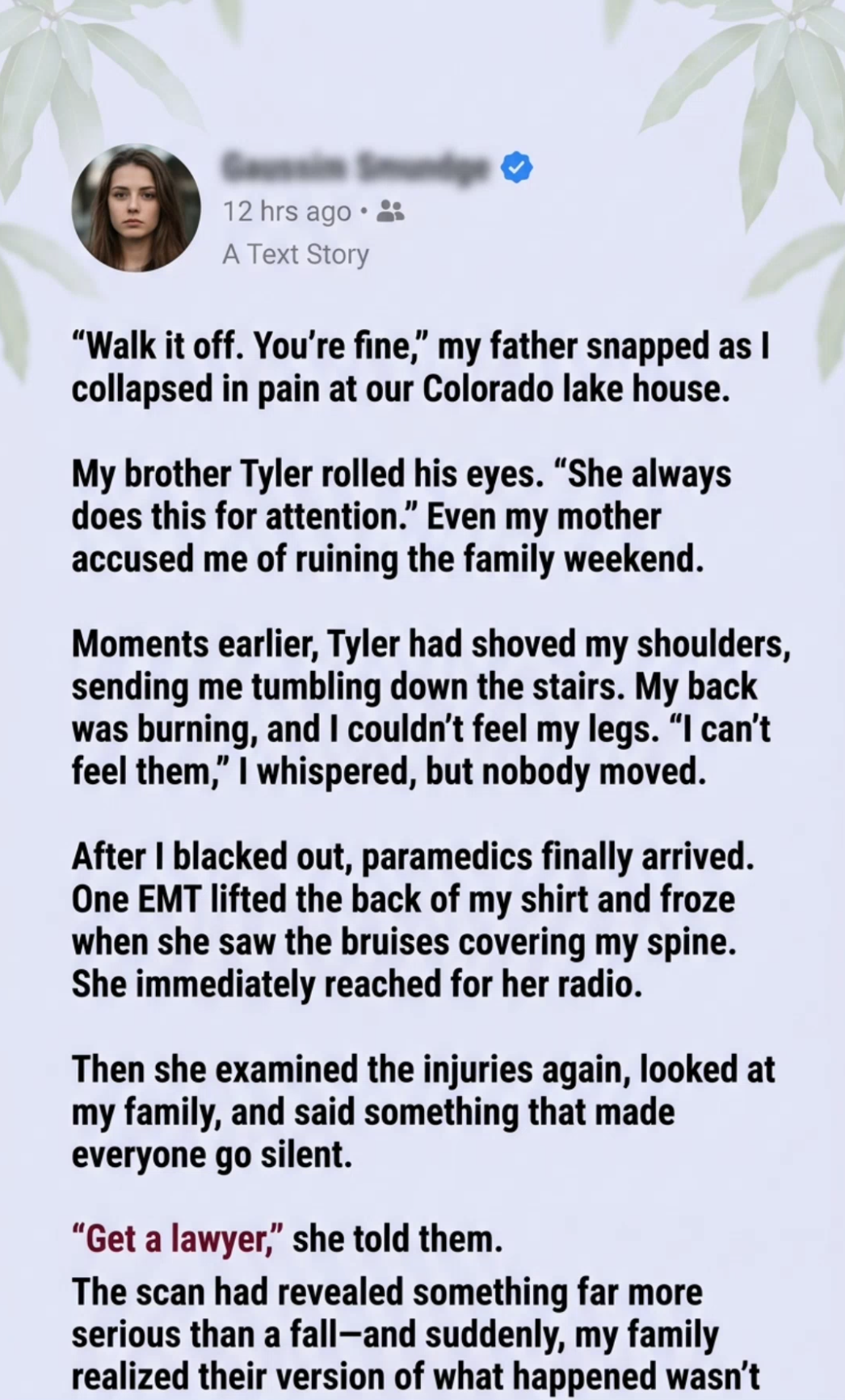
“Walk it off. You’re fine.”
My father’s words were the last thing I expected to hear while lying helplessly on the hardwood floor of our Colorado lake house.
My back was burning.
My legs felt strangely distant, almost as if they belonged to someone else.
I tried to move my right foot, but nothing happened.
“Dad,” I whispered. “I can’t feel my legs.”
He stood above me with his arms crossed.
My younger brother, Tyler, leaned against the staircase railing and rolled his eyes.
“She always does this for attention.”
My mother sighed.
“Emily, please don’t ruin the weekend. Everyone came here to relax.”
I stared at her, struggling to understand what I was hearing.
A few moments earlier, Tyler had shoved both my shoulders during an argument at the top of the stairs.
I had stumbled backward, lost my balance, and fallen down the entire flight.
My head had struck the floor.
My back had twisted painfully beneath me.
And now I couldn’t move.
“Please call an ambulance,” I begged.
My father shook his head.
“You’re being dramatic. Sit up.”
“I can’t.”
Tyler laughed.
“You probably just bruised something.”
I tried to breathe through the pain.
Then everything went dark.
When I regained consciousness, I heard a woman speaking urgently.
“Ma’am, can you hear me?”
I opened my eyes.
A paramedic was kneeling beside me.
Another was preparing medical equipment near the front door.
The first paramedic carefully examined my back. When she lifted the back of my shirt, she suddenly stopped.
Her expression changed.
There were extensive bruises across my lower spine and several darker marks along my shoulders.
She looked toward my family.
“Who witnessed the fall?”
My father immediately answered.
“She slipped. She’s always clumsy.”
The paramedic didn’t respond.
She examined my injuries again, then reached for her radio.
“Requesting additional medical support. Possible spinal trauma. We also need law enforcement notified.”
My mother’s face went pale.
“Why would you need the police? This was an accident!”
The paramedic looked directly at her.
“I’m not making that determination. I’m documenting what I’m seeing and making sure this patient receives appropriate care.”
She turned toward the second EMT.
“Let’s move. We need imaging as soon as possible.”
Then she looked at my father.
“Sir, I strongly recommend you speak with an attorney before making any further statements.”
Nobody spoke.
My father suddenly looked frightened.
Tyler stopped smiling.
And my mother began asking questions nobody seemed willing to answer.
What my family didn’t know was that the medical examination would reveal injuries far more serious than they had imagined.
And the evidence would make their version of the story increasingly difficult to defend.
The Daughter Who Was Always Blamed
My name is Emily Carter.
I was thirty-one years old, and I had spent most of my life trying to earn my family’s approval.
We lived in Colorado, where my father, Richard, had built a successful construction business.
My mother, Diane, managed the household and helped with some of the company’s administrative work.
My older sister, Lauren, lived in Denver with her husband and two children.
And then there was Tyler, my younger brother.
Tyler had always been my father’s favorite.
He was charming when he wanted something, confident around other people, and skilled at making himself look innocent whenever something went wrong.
When we were children, he could break something and somehow convince our parents that I had done it.
If he borrowed my belongings without permission, I was accused of being selfish when I complained.
If he insulted me, my father told me boys sometimes behaved that way.
If I defended myself, I was told I was too sensitive.
My parents called it sibling rivalry.
I called it growing up in a house where one person could do almost anything without consequences.
As adults, things didn’t improve.
Tyler joined my father’s construction business after college.
He received a company vehicle, a generous salary, and opportunities to manage projects.
I had taken a different path.
I worked as a financial analyst for a regional investment company and had built a comfortable life independently.
I rarely asked my parents for anything.
Yet somehow, whenever the family needed help, I was expected to provide it.
I paid for repairs to my parents’ rental property.
I helped my mother with medical appointments.
I even covered several business expenses when Tyler mismanaged a project.
But none of that earned me respect.
My father still described Tyler as the responsible son who would eventually take over the family business.
And I was still the difficult daughter who complained too much.
The Weekend at the Lake House
The lake house had been in our family for nearly fifteen years.
It was a beautiful property overlooking a quiet Colorado lake, surrounded by pine trees and mountains.
My father loved inviting relatives there during the summer.
He enjoyed showing off the property, organizing barbecues, and reminding everyone how successful his business had become.
I hadn’t visited in several months.
This particular weekend was supposed to celebrate my father’s birthday.
My mother had invited everyone.
Lauren and her children were coming.
Tyler had invited a few friends.
I had initially planned to stay home because I had an important work project.
But my mother called repeatedly.
“Your father wants everyone together,” she said.
“Please don’t make excuses.”
So I agreed.
I arrived Friday afternoon with a small overnight bag and a birthday present for my father.
Everything seemed normal at first.
Tyler was already drinking with some friends.
My mother was preparing dinner.
My father was outside checking the barbecue.
I greeted everyone and helped carry groceries into the kitchen.
Then Tyler began making comments.
“Look who’s finally decided to show up.”
I ignored him.
He continued.
“Still working that boring office job?”
I smiled politely.
“Still working.”
He laughed.
“Dad says you should come help with the business. You’d probably be more useful there than sitting behind a computer.”
I didn’t respond.
I knew better than to encourage him.
Later that evening, he asked whether I could transfer money to cover a personal expense.
I refused.
He immediately became irritated.
“What’s the problem? You have plenty of money.”
“I’m not lending you any more money, Tyler.”
He stared at me.
“You think you’re better than everyone?”
“No. I just want you to manage your own finances.”
He walked away.
I thought the argument was over.
I was wrong.
The Argument at the Top of the Stairs
The following afternoon, I was carrying a small box of decorations upstairs when Tyler approached me.
He had been drinking.
“Why did you embarrass me in front of Dad last night?”
I stopped.
“I didn’t embarrass you.”
“You made me look irresponsible.”
“I said I wasn’t lending you money. That’s all.”
He moved closer.
“You always think you’re better than me.”
I stepped toward the wall to give him room.
“Tyler, I don’t want to argue.”
He laughed.
“That’s your problem. You always walk away when someone challenges you.”
I tried to continue upstairs.
Then he grabbed my shoulder.
I turned around.
“Don’t touch me.”
He shoved me.
Both hands struck my shoulders.
I lost my balance.
The box slipped from my arms.
For a split second, I saw the staircase moving toward me.
Then I fell.
I remember striking the steps.
I remember trying to grab the railing.
I remember the terrible pain that spread through my back.
And then I remember the floor.
I couldn’t move properly.
I tried to call out.
Tyler stood at the top of the stairs.
He looked down at me.
For a moment, he seemed surprised.
Then he said:
“Get up. You’re fine.”
I tried.
My legs wouldn’t respond.
“Tyler,” I whispered. “Please call someone.”
He looked toward the kitchen.
“Mom! Emily fell!”
My mother appeared.
She looked at me, then at Tyler.
“What happened?”
“She slipped,” he answered immediately.
I tried to speak.
“He pushed me.”
My mother frowned.
“Emily, don’t start.”
Then my father arrived.
He looked at the broken decorations scattered across the steps.
He looked at me.
And he said those words.
“Walk it off. You’re fine.”
I tried to explain that I couldn’t feel my legs.
Nobody listened.
Until I lost consciousness.
The Hospital Discovery
The ambulance took me to a regional trauma center.
The medical team immediately began assessing my condition.
They ordered imaging of my spine and performed a detailed neurological examination.
I remember fragments of the experience.
Bright lights.
Questions about my name.
A nurse asking whether I could feel her touching my feet.
A doctor telling me not to move.
Then I heard someone say:
“We need to evaluate the spinal injury urgently.”
Later, I learned the imaging had revealed a serious compression injury involving my lower thoracic and upper lumbar spine, along with a fracture that required specialist evaluation.
There were also extensive soft-tissue injuries.
The doctors were concerned about the neurological symptoms I had described.
I needed emergency treatment and close monitoring.
When I finally became fully alert, a woman in a hospital uniform introduced herself.
“My name is Sarah. I’m a trauma social worker.”
She sat beside my bed.
“I need to ask you a few questions about what happened.”
I told her everything.
Tyler’s argument.
The shove.
The fall.
My father’s reaction.
My mother’s refusal to call for help.
Sarah listened carefully.
Then she asked:
“Has anything like this happened before?”
I hesitated.
I thought about the bruises I had hidden.
The arguments.
The times Tyler had grabbed my arm or shoved me during family disagreements.
The times my parents had told me to stop exaggerating.
I looked at her.
“Yes.”
She nodded.
“Would you feel safe returning to the lake house?”
I didn’t answer.
I already knew the answer.
“No.”
Sarah explained that the hospital could help connect me with appropriate support services and discuss reporting options.
She also told me that the medical team would document my injuries and statements carefully.
For the first time that weekend, someone was listening.
The Police Interview
The next morning, a police officer arrived.
He introduced himself as Detective Harris.
He explained that the authorities had been notified because of the circumstances surrounding the injury and the information provided by medical personnel.
He asked whether I was comfortable speaking.
I agreed.
He recorded my account.
I described the argument, Tyler’s physical actions, and the fall.
Then he asked about my parents.
I told him what my father had said.
I explained that I had repeatedly asked for an ambulance and that my family had initially refused to take my condition seriously.
He listened carefully.
“Did anyone else witness the shove?”
I shook my head.
“Not directly. My family came afterward.”
“Do you believe your brother intended to hurt you?”
I thought about it.
“I believe he intentionally shoved me. I don’t know what he intended to happen after that.”
Detective Harris nodded.
“That’s an important distinction. We’ll investigate the circumstances and speak with the other witnesses.”
Before leaving, he asked whether there were any previous incidents.
I told him about the earlier physical confrontations.
He wrote everything down.
Then he explained that investigators would review the available evidence, including statements, medical records obtained through the proper process, and any relevant photographs or communications.
I was exhausted.
But I felt something I hadn’t felt in years.
I felt believed.
My Father’s First Visit
Three days later, my father arrived at the hospital.
He entered my room carrying flowers.
“Emily, how are you feeling?”
I looked at him.
“I’m in pain.”
He placed the flowers on the table.
“Your mother is worried.”
I waited.
He sat down.
“Look, this situation has gotten out of control.”
I stared at him.
“What situation?”
“Tyler didn’t mean to hurt you.”
I said nothing.
“He was upset. You know how he gets.”
I looked at my father.
“He shoved me down the stairs.”
He rubbed his forehead.
“It was an accident.”
“Did you see him push me?”
“No, but—”
“Then why are you telling everyone it was an accident?”
He became irritated.
“Because I know my son.”
I felt my chest tighten.
“And what about knowing your daughter?”
He didn’t answer.
Then he leaned forward.
“We need to make sure this doesn’t destroy Tyler’s future.”
I stared at him.
My back was still injured.
I was receiving treatment.
I didn’t know when I would walk normally again.
And my father was worried about Tyler’s future.
“What about mine?” I asked.
He sighed.
“Don’t make this harder than it needs to be.”
I turned toward the window.
“Please leave.”
He stood up.
“Emily—”
“Please leave.”
He picked up his coat and walked out.
I cried after he left.
Not because I missed him.
Because I finally understood that he was still more concerned about protecting Tyler than protecting me.
The Message That Changed the Investigation
A week after the incident, Detective Harris contacted me.
He said investigators had obtained additional information.
He couldn’t discuss every detail, but he wanted to ask about a message Tyler had sent to one of his friends shortly after the fall.
The message had been voluntarily provided during the investigation.
It read:
She wouldn’t stop arguing. I just pushed her away. Didn’t think she’d fall that hard.
I closed my eyes.
That message confirmed what I had been saying.
Tyler had pushed me.
He knew he had done it.
And he had told someone about it.
Detective Harris explained that the message would be reviewed alongside the other evidence.
He also asked whether I had received any pressure from my family.
I told him about my father’s hospital visit.
Then I mentioned that my mother had sent several messages asking me to tell investigators I had slipped.
He requested that I preserve those messages.
I agreed.
That evening, I saved every communication and sent copies to my attorney.
I had contacted a lawyer specializing in personal injury and related civil matters.
Her name was Jennifer Miller.
She explained that we needed to keep the medical and legal issues separate.
The criminal investigation would determine whether any criminal charges were appropriate.
The civil case could address the injuries, expenses, and other losses if the evidence supported a claim.
She also advised me not to discuss the incident publicly or respond to family pressure.
For the first time, I stopped trying to explain myself to my parents.
I let the evidence speak.
The Family Meeting I Never Wanted
Two weeks later, my mother asked to visit.
She arrived with Lauren.
My sister looked uncomfortable.
My mother sat beside my bed.
“We need to resolve this as a family.”
I looked at her.
“What does that mean?”
She sighed.
“Your father and I think everyone should calm down. Tyler is extremely upset.”
I almost laughed.
“What about me?”
“Of course we’re worried about you.”
“Then why are you asking me to change my statement?”
She looked away.
“We just don’t want this to become something permanent.”
I shook my head.
“Mom, I didn’t create this situation.”
Lauren finally spoke.
“Emily, I know Tyler can be difficult, but maybe you could consider how this affects everyone.”
I turned toward her.
“How has it affected you?”
She hesitated.
“It’s upsetting.”
I nodded.
“Imagine how upsetting it is to be lying in a hospital bed because your brother shoved you down a staircase, while everyone asks you to protect him.”
My mother started crying.
“That’s not fair.”
I looked at her.
“Neither was what happened to me.”
Lauren lowered her eyes.
For several moments, nobody spoke.
Then I said:
“I will cooperate with the investigation. I will not lie about what happened. And I will not accept pressure to protect someone who hurt me.”
My mother stood up.
“Fine. If that’s what you want.”
She left.
Lauren stayed for a moment.
Then she quietly said:
“I’m sorry.”
It wasn’t much.
But it was the first apology I had received from anyone in my family.
The Medical Battle
Recovery was not easy.
My injuries required ongoing treatment, specialist appointments, and physical rehabilitation.
Some days were better than others.
There were mornings when getting out of bed felt like climbing a mountain.
My back remained painful.
My legs were weak, and I struggled with movements I had previously taken for granted.
The doctors were cautious about making predictions.
They explained that recovery from spinal injuries varies greatly and that my progress would depend on several factors.
I followed my treatment plan carefully.
My employer arranged medical leave and helped coordinate a gradual return to work.
My friend Rachel visited regularly.
She brought groceries, helped with transportation, and sat with me during difficult evenings.
One afternoon, while I was struggling through a rehabilitation session, I became frustrated.
“I used to be able to do everything myself,” I told the therapist.
She smiled gently.
“You don’t have to do everything today. You just have to keep moving forward at the pace your body allows.”
I held onto those words.
I wasn’t going to measure my recovery against anyone else’s expectations.
I was going to focus on getting stronger.
The Evidence My Family Couldn’t Explain Away
Several weeks later, the investigation reached an important stage.
Detectives had collected statements, reviewed the relevant messages, and obtained medical documentation through the appropriate procedures.
They had also examined the layout of the staircase and documented the physical circumstances of the incident.
The evidence did not support my family’s simple explanation that I had merely lost my balance without anyone being involved.
Tyler’s own message was particularly important.
My attorney explained that the investigation was continuing and that I should not assume a particular outcome until the authorities made their decision.
Then she showed me another piece of evidence.
It was a photograph taken by a family friend shortly after the fall.
The photograph showed the staircase.
A broken decoration lay near the bottom.
There was also a visible mark on the wall where I had apparently struck it.
The photograph helped establish the physical scene.
My father had repeatedly claimed I had simply tripped.
But the evidence raised serious questions about that account.
My mother eventually called.
Her voice was trembling.
“Emily, the police are asking Tyler more questions.”
I remained silent.
She continued.
“Your father says this could ruin his life.”
I looked at the rehabilitation exercises on my coffee table.
“What about mine, Mom?”
She began crying.
I didn’t comfort her.
For once, I allowed her to sit with the consequences of what had happened.
The Day Tyler Finally Faced the Truth
Months later, I received an update from Detective Harris.
The investigation had progressed, and prosecutors were reviewing the available evidence to determine the appropriate next steps.
Tyler had obtained legal representation.
My father had also stopped calling.
I was no longer interested in hearing explanations from people who had spent weeks trying to make me doubt what I remembered.
Eventually, Tyler sent me a message.
It was short.
I never thought you’d actually get the police involved.
I read it several times.
Then I replied:
I never thought my own brother would push me down a staircase.
He didn’t respond.
A few days later, he sent another message.
I was angry. I didn’t mean for you to get hurt.
I stared at the screen.
I believed he might genuinely regret the consequences.
But regret was not the same as taking responsibility.
I wrote:
You knew you pushed me. You knew I couldn’t move. And you watched everyone blame me.
Then I stopped responding.
I wasn’t going to spend my recovery trying to convince him that my pain mattered.
The Father Who Finally Had Nothing to Say
Six months after the fall, my father contacted my attorney.
He wanted to discuss a possible resolution of the civil claims.
My attorney reviewed the proposal and explained the options.
There were medical expenses, lost income, rehabilitation costs, and other damages that needed to be properly evaluated.
We did not rush into an agreement.
The legal process continued, and the criminal matter proceeded separately according to the evidence and applicable law.
Eventually, Tyler acknowledged through the legal process that he had intentionally shoved me during the argument.
The case resulted in legal consequences determined by the court, while the civil matter was addressed separately.
I won’t pretend that a legal outcome erased what happened.
It didn’t.
But it established something my family had refused to acknowledge.
I hadn’t invented the incident.
I hadn’t fallen simply because I was clumsy.
And I hadn’t deserved what happened.
My father eventually asked to meet me.
I agreed, but only in a neutral location.
We met at a small café.
He looked tired.
He sat across from me and stared at his coffee.
Then he said:
“I should have called an ambulance immediately.”
I nodded.
“Yes.”
“I shouldn’t have dismissed you.”
“No.”
He looked up.
“I thought you were exaggerating.”
I felt tears gathering.
“Dad, I told you I couldn’t feel my legs.”
He lowered his eyes.
“I know.”
For a moment, I wanted him to say something that would make everything better.
But there was no sentence capable of doing that.
Finally, he whispered:
“I’m sorry.”
I took a breath.
“I hope you understand that being my father doesn’t give you permission to decide whether my pain is real.”
He nodded.
“I understand.”
I didn’t hug him.
I wasn’t ready.
But I accepted the apology for what it was.
A beginning, perhaps.
Not a restoration of trust.
The Life I Built After the Fall
One year after the accident, I was still attending rehabilitation appointments.
I had made meaningful progress, although I continued to experience some limitations and occasional pain.
My doctors remained realistic about my long-term recovery.
I had returned to work on a modified schedule and gradually resumed many of my normal activities.
I moved into a smaller apartment closer to my workplace.
I also stopped attending family gatherings where I felt pressured to pretend everything was fine.
My sister Lauren and I slowly rebuilt our relationship.
She admitted that she had spent years ignoring Tyler’s behavior because confronting him created problems for everyone.
She apologized.
I appreciated it.
But I made it clear that things would have to change.
My mother occasionally sent messages.
Some were kind.
Others still contained subtle requests for me to forgive Tyler and move on.
I learned to respond only when I wanted to.
I also began volunteering with an organization that helped people understand their options after family violence and serious injuries.
I never shared my story for sympathy.
I shared it because I wanted others to understand something important.
Being related to someone does not make their behavior acceptable.
And being a victim of an accident or assault does not mean you should remain silent to protect the people involved.
The Last Conversation at the Lake House
Two summers after the incident, I returned to the lake house.
Not for a family weekend.
I had arranged to collect some personal belongings that were still stored there.
My father met me outside.
The mountains looked beautiful.
The lake was calm.
The staircase was visible through the front window.
For a moment, I remembered everything.
The argument.
The shove.
The fall.
The pain.
My father’s voice.
My mother’s accusation.
I felt my stomach tighten.
My father noticed.
“Are you okay?”
I nodded.
“I’m managing.”
He looked toward the house.
“I’ve thought about that day a lot.”
I didn’t answer.
He continued.
“I should have protected you.”
I looked at him.
“Yes. You should have.”
He nodded.
“I know Tyler’s behavior was wrong.”
I picked up my belongings.
“Then I hope you never make another person feel the way you made me feel.”
He looked down.
I walked toward my car.
Before I opened the door, he called my name.
“Emily.”
I turned.
“Will you ever forgive me?”
I considered the question.
“I don’t know, Dad. Maybe. But forgiveness doesn’t mean pretending it didn’t happen.”
He nodded slowly.
I got into my car and drove away.
I didn’t look back.
What My Family Finally Learned
For most of my life, I believed that keeping a family together meant accepting things I shouldn’t have accepted.
I thought being a good daughter meant staying quiet.
I thought being a good sister meant making excuses.
And I thought being strong meant tolerating pain without asking anyone for help.
But the day I fell down those stairs taught me something I will never forget.
When I was lying on that floor, unable to feel my legs, the people who were supposed to protect me chose to dismiss me.
A stranger had to recognize the seriousness of my condition.
A paramedic had to insist on proper medical attention.
A medical team had to document injuries that my family wanted to call an accident.
And investigators had to examine evidence that my parents had tried to explain away.
I used to believe my family’s approval was something I needed to survive.
Now I understand that I can survive without it.
My recovery has not been perfect.
Some days still hurt.
Some memories still return unexpectedly.
But I am no longer the woman who apologizes whenever someone else behaves badly.
I no longer accept blame for telling the truth.
And I no longer confuse family loyalty with silence.
My father once told me to walk it off.
He thought I was exaggerating.
My brother thought I was seeking attention.
My mother thought I was ruining a weekend.
But that paramedic saw what they refused to see.
She saw an injured woman who needed help.
She treated me like my life mattered.
And that was the beginning of everything changing.
Today, I still hope my family learns from what happened.
But I don’t need them to admit the truth for me to know it.
I survived.
I received treatment.
I rebuilt my life.
And I finally learned that I never have to sacrifice my safety just to keep other people comfortable.
My family thought the worst thing that happened that weekend was a ruined vacation.
They were wrong.
The worst thing was discovering that the people I trusted most were willing to watch me suffer rather than hold my brother accountable.
And the greatest thing was discovering that I could finally stand up for myself, even when my own family refused to stand beside me.