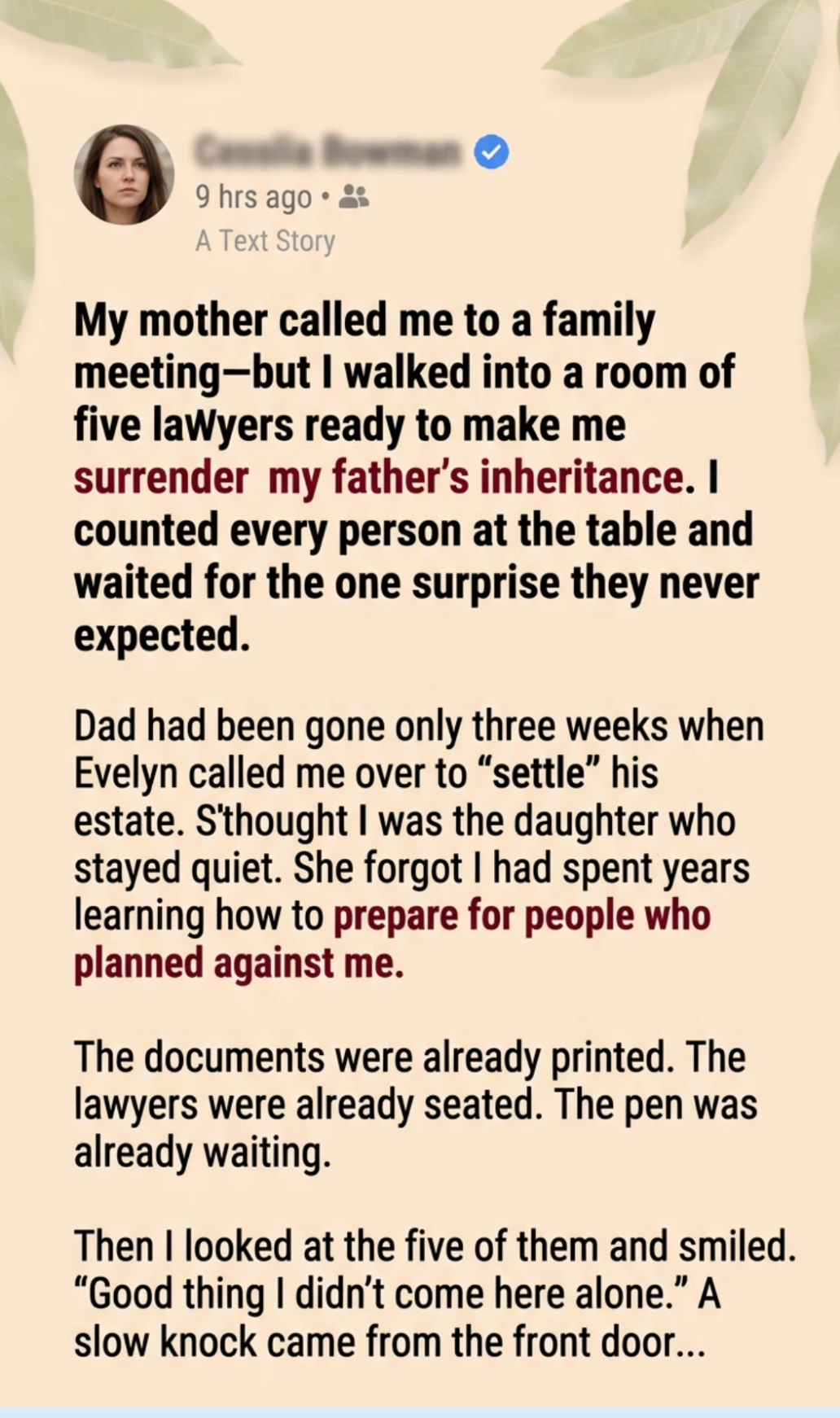
My father had been dead for exactly twenty-three days when my mother called me and said we needed to have a family meeting.
Her voice sounded unusually gentle.
“Sweetheart, we need to settle your father’s estate. There are some important things we need to discuss, and I want everyone together.”
I knew something was wrong.
My mother, Evelyn Carter, had never been particularly interested in family meetings unless she had already decided what everyone was supposed to do.
Still, I agreed to come.
My name is Olivia Carter. I was thirty-four years old, and my father, Robert Carter, had been the one person in my family who never made me feel like I had to earn my place.
He had built a successful commercial construction business from almost nothing. Over thirty years, he had turned it into a company worth millions, accumulated several investment properties, and established a substantial portfolio for retirement.
He wasn’t a perfect man, but he was careful.
Especially with money.
And he had always told me something I never forgot.
“Olivia, when someone suddenly becomes interested in what you own, pay attention to what they want you to sign.”
I had laughed when he first said it.
I wasn’t laughing anymore.
When I arrived at my mother’s house that afternoon, I immediately noticed five unfamiliar cars parked outside.
Inside, five attorneys were seated around the dining room table.
My mother sat at the head.
My older brother, Michael, sat beside her, wearing an expensive suit.
My younger sister, Jessica, was scrolling through her phone.
There were folders arranged neatly in front of every person.
A thick stack of documents sat directly in front of the empty chair reserved for me.
And beside the documents was a black fountain pen.
My mother stood.
“Olivia, darling. We’re glad you came.”
I looked around the room.
“What’s going on?”
She gestured toward the chair.
“Sit down. We have some things to finalize.”
I didn’t sit immediately.
Instead, I counted everyone at the table.
Five lawyers.
My mother.
My brother.
My sister.
Eight people waiting for me to arrive.
Eight people who apparently believed they had already won.
I finally pulled out the chair.
One of the attorneys introduced himself as the estate representative.
He began explaining that my father’s estate required immediate restructuring and that certain beneficiaries had agreed to a proposed distribution.
I glanced at the documents.
Then I noticed my name.
Beside it was a figure that made my stomach tighten.
My proposed inheritance was almost nothing compared with the estate’s estimated value.
I looked at my mother.
“Is this what you called me here to discuss?”
She smiled.
“Your father wanted things handled peacefully. We believe this arrangement is fair.”
My brother leaned forward.
“Honestly, Olivia, you should just sign. Mom has been dealing with everything while we’ve all been grieving.”
Jessica finally put down her phone.
“It’s not like you need the money as much as we do.”
I looked at her.
Then I looked at the lawyers.
Finally, I looked at the signature line.
My mother pushed the pen toward me.
“Just sign here, sweetheart. It will save everyone a lot of trouble.”
I smiled.
Not because I was amused.
Because I finally understood why she had insisted that I come alone.
She thought I was the daughter who stayed quiet.
She thought grief had made me careless.
She forgot that I had spent years learning how to prepare for people who planned against me.
I placed my handbag on the floor and folded my hands.
“Good thing I didn’t come here alone.”
My mother’s smile disappeared.
“What does that mean?”
I looked toward the front door.
A slow knock echoed through the house.
Nobody moved.
Then another knock came.
My mother turned toward the hallway.
“Who is that?”
I stood.
“Someone your lawyers should probably meet.”
And when the door opened, the first person who walked into that room was the last person my family expected to see.
Chapter 1: The Daughter Who Stayed Quiet
I grew up in a family where my brother was considered the natural successor to everything my father built.
Michael was four years older than me.
He was confident, outgoing, and very good at making people believe he understood business.
My mother adored him.
She frequently told relatives that he had inherited my father’s ambition and leadership abilities.
Jessica, my younger sister, was the family favorite in a different way.
She was charming, beautiful, and accustomed to getting whatever she wanted.
I was the practical one.
I studied accounting, earned a degree in business administration, and eventually became a financial compliance consultant.
My work involved reviewing corporate records, identifying irregularities, and helping businesses protect themselves against financial misconduct.
Ironically, my family rarely asked me about my work.
My mother thought accounting was boring.
Michael thought I was overly cautious.
Jessica joked that I was the person who could turn a birthday party into a tax audit.
My father was different.
He listened.
He asked questions.
And occasionally, he asked me to review something important.
When I was twenty-eight, he invited me to his office.
He had been reviewing a potential acquisition and wanted another opinion.
I spent two evenings examining the financial statements.
I discovered that the company had concealed several outstanding obligations.
My father canceled the acquisition.
Later, he told me I had saved him a considerable amount of money.
“Never underestimate the value of someone who reads the entire document,” he said.
That became something of a family joke.
Whenever my father signed anything important, he would sometimes call me and say:
“Come read this before I accidentally give away the house.”
I never thought those words would become so relevant.
Chapter 2: My Father’s Last Conversation
My father became ill during the winter.
At first, the doctors believed it was something treatable.
Then additional tests revealed a more serious condition.
Within several months, his health deteriorated.
I visited him almost every evening.
My brother came when his schedule allowed.
Jessica visited on weekends.
My mother was always present, but their relationship had become complicated over the years.
They had been married for thirty-eight years.
They loved each other, but my father had grown increasingly concerned about my mother’s spending habits and Michael’s financial decisions.
One evening, shortly before his final hospitalization, Dad asked me to stay after everyone else had left.
“Olivia, I need to talk to you about something.”
I pulled a chair beside his bed.
“Of course.”
He looked toward the door.
“Have you kept the documents I gave you?”
I knew exactly what he meant.
Several months earlier, he had asked me to review a collection of estate planning records.
I had retained the copies he specifically authorized me to keep.
“Yes.”
“Good.”
He reached for my hand.
“Your mother is going to want to handle everything quickly when I’m gone.”
I didn’t know what to say.
“Dad, don’t talk like that.”
“Listen to me.”
His voice was weak, but his eyes were serious.
“Michael thinks the company should belong to him. Your mother thinks everything should be divided according to what she wants. Jessica will agree with whoever promises her the most.”
I remained silent.
He continued.
“I’ve made arrangements. Everything is documented. Don’t let anyone pressure you into signing something before you’ve spoken to your own attorney.”
I squeezed his hand.
“Are you worried they’ll try something?”
He looked away.
“I’m worried they won’t respect what I worked for.”
Then he said something that stayed with me long after he was gone.
“You don’t have to fight your family, Olivia. But you do have to protect yourself.”
I promised him I would.
Three days later, he was admitted to the hospital.
He never came home.
Chapter 3: The Funeral and the First Warning
My father’s funeral was attended by hundreds of people.
Business associates, longtime friends, employees, neighbors, and relatives came to pay their respects.
I stood beside my mother throughout the service.
Michael delivered a speech about continuing his father’s legacy.
He spoke about the construction company, the properties, and the importance of keeping the family together.
He didn’t mention my father’s final wishes.
He didn’t mention the years I had spent helping Dad with financial reviews.
He barely mentioned me.
After the service, one of my father’s longtime business partners, Daniel Brooks, approached me.
Daniel had known my father for more than twenty years.
He shook my hand and said quietly:
“Your father was proud of you.”
I thanked him.
Then he added:
“Whatever happens with the estate, don’t sign anything until everything has been reviewed.”
I stared at him.
“Why would you say that?”
He glanced toward my mother.
“Your father asked me to make sure you remembered that.”
Before I could ask another question, someone called his name.
He excused himself.
That evening, my mother gathered everyone in the living room.
“We need to be practical,” she announced.
Michael immediately agreed.
“The company can’t sit without leadership. We need to make decisions.”
I looked at him.
“Dad has an estate plan. We should follow it.”
My mother frowned.
“We’ll deal with the paperwork later.”
“Why later?”
“Because we’re grieving, Olivia.”
I didn’t argue.
But I noticed something.
Michael was already discussing which company vehicles he wanted to keep.
Jessica was asking whether the investment property in Florida would be sold.
And my mother had started referring to the construction company as Michael’s business.
My father had been dead for less than a week.
Yet they were already dividing things.
Chapter 4: The Family Meeting Was Never About Family
Three weeks after the funeral, my mother made the call.
She said the attorneys had prepared everything.
She said it would be easier if we settled the estate together.
She said she wanted to avoid unnecessary conflict.
What she didn’t say was that the documents were designed to make me surrender almost every meaningful claim to my father’s estate.
I learned that when I opened the folder at the dining room table.
The proposed agreement transferred control of the family construction company to Michael.
It gave my mother broad authority over the remaining assets.
Jessica would receive a substantial cash distribution.
My inheritance would be limited to a relatively small payment.
There was also a clause stating that I would waive future claims against the estate and release certain parties from liability.
I read it twice.
Then I looked at the attorney who had placed the documents in front of me.
“Who prepared this agreement?”
He answered carefully.
“Our office was instructed to prepare a proposed family settlement.”
“By whom?”
He looked toward my mother.
“Your mother and your brother.”
I nodded.
“Was the will reviewed before preparing this?”
One of the other lawyers answered.
“We have reviewed the available estate documentation.”
“Available?”
He hesitated.
“That’s correct.”
I looked at the first attorney again.
“Have you verified whether this is consistent with my father’s signed will and trust documents?”
My mother interrupted.
“Olivia, please. We don’t need to turn this into an interrogation.”
I ignored her.
“I’m asking a simple question.”
The attorney cleared his throat.
“The agreement represents a proposed settlement among the family members.”
“That wasn’t my question.”
Michael leaned forward.
“Why are you making this difficult?”
I looked at him.
“Because I’m being asked to sign away my inheritance.”
He sighed.
“Dad wanted us to stay together.”
“No. Dad wanted his wishes respected.”
My mother pushed the pen closer.
“Your father would be disappointed to see you behaving this way.”
That was when I realized they weren’t simply trying to persuade me.
They were trying to use my grief against me.
I put the pen down.
“I won’t sign anything today.”
My mother looked furious.
“Then why did you come?”
I smiled.
“Because I wanted to see exactly what you were planning.”
Chapter 5: The Person at the Front Door
The knock came again.
My mother looked toward the hallway.
Michael stood up.
“Who is it?”
Before anyone answered, the front door opened.
A woman entered carrying a leather briefcase.
Behind her was an older man wearing a dark gray suit.
I recognized both immediately.
The woman was Margaret Lawson, an estate litigation attorney I had hired shortly after my father’s final conversation.
The older man was Daniel Brooks, my father’s longtime business partner.
My mother froze.
“What are they doing here?”
Margaret calmly introduced herself.
“Good afternoon. I’m representing Olivia Carter regarding the administration of her father’s estate.”
One of the five attorneys at the table immediately sat straighter.
“Are you counsel of record?”
Margaret placed her business card on the table.
“I am.”
My mother looked at me.
“You hired your own lawyer?”
“Yes.”
“Without telling us?”
I smiled faintly.
“Why would I need your permission?”
Margaret opened her briefcase.
“I understand you’ve prepared a family settlement agreement for Olivia’s signature.”
The first attorney nodded.
“That’s correct.”
“Then I suggest everyone pause before proceeding.”
She removed several documents.
“Because the proposed agreement appears to conflict with provisions in the estate documents that were executed by Mr. Carter.”
My brother’s expression changed.
“What provisions?”
Margaret placed a certified copy of the relevant trust documents on the table.
“The provisions concerning ownership, beneficiary rights, and the succession of the family business.”
My mother stared at the papers.
“Where did you get those?”
Margaret answered.
“From the estate planning attorney who prepared and maintained the original records.”
My mother looked at me.
“You’ve been planning this?”
I shook my head.
“No. Dad planned for this.”
Chapter 6: The Inheritance Nobody Had Told Them About
Margaret explained that my father had established a revocable living trust several years earlier.
The purpose was to organize his assets, protect the family business, and provide clear instructions for what should happen after his death.
The trust included several important provisions.
The family construction company was not supposed to pass directly to Michael.
Instead, ownership interests were to be transferred according to a carefully structured succession arrangement.
My father had also designated beneficiaries for his investment properties and financial accounts.
The distribution was not what my mother had presented at the meeting.
It was significantly different.
Margaret continued.
“Mr. Carter amended certain provisions approximately eighteen months ago. Those amendments were properly executed and witnessed. The most recent version supersedes the earlier documents.”
My mother shook her head.
“That isn’t possible.”
Margaret placed another document on the table.
“Here is the amendment.”
Michael grabbed the page.
He read it quickly.
Then he read it again.
“What is this?”
Margaret explained that my father had assigned different responsibilities to different people.
Michael was given an opportunity to participate in the company’s future management, but not unrestricted ownership or authority.
My mother retained certain financial benefits and property rights.
Jessica was named as a beneficiary of specific assets.
And I had been appointed successor trustee under the conditions described in the document.
I stared at Margaret.
Although I knew my father had discussed his estate arrangements with me, I hadn’t known the full extent of the changes.
“Dad made me successor trustee?”
Margaret nodded.
“Yes.”
My mother suddenly laughed.
“This is ridiculous. Olivia doesn’t know how to run a construction company.”
Daniel Brooks finally spoke.
“Robert didn’t appoint Olivia to manage construction operations. He appointed her to protect the trust and oversee the financial responsibilities assigned to her.”
Michael turned toward Daniel.
“You knew about this?”
Daniel nodded.
“Your father discussed the succession plan with me.”
“And you didn’t tell us?”
“Your father specifically instructed me to respect his estate planning arrangements.”
My brother pushed the document away.
“This is a setup.”
Margaret remained calm.
“No. This is a legally executed estate planning document.”
Chapter 7: The Five Lawyers Start Asking Questions
Until that moment, my mother had been directing the meeting.
Now the five lawyers were examining the documents Margaret had brought.
One of them asked for the original execution date.
Another requested confirmation from the estate planning attorney.
A third began reviewing the trust’s beneficiary provisions.
The room had completely changed.
My mother leaned toward the attorney beside her.
“Can we still proceed with the agreement?”
He quietly shook his head.
“Not without reviewing these documents.”
Michael looked furious.
“Why are we listening to her lawyer? We already have our own attorneys.”
Margaret answered.
“Because Olivia is entitled to independent legal representation, and no one here can require her to sign a settlement that she hasn’t agreed to.”
I looked at the stack of papers.
A few minutes earlier, those documents had been intended to control my future.
Now they looked like what they really were.
An attempt to make me surrender rights without fully understanding what I was signing.
I turned toward my mother.
“Did you know Dad had changed the estate plan?”
She looked away.
“Your father discussed many things.”
“That isn’t an answer.”
“He was confused toward the end.”
Daniel immediately responded.
“Robert was fully capable of making his estate planning decisions when those amendments were executed. His attorney documented the relevant capacity assessment and execution process.”
My mother went pale.
Jessica finally spoke.
“Mom, did you know about this?”
My mother didn’t answer.
I looked at her.
“You invited me here to sign away something Dad had specifically arranged for me to protect?”
She raised her voice.
“We were trying to avoid a family fight!”
“No. You were trying to make sure I didn’t know what I was giving up.”
Nobody spoke.
Then Margaret opened another folder.
“And there’s one more issue we need to discuss.”
Chapter 8: The Financial Records
Margaret placed several financial statements on the table.
They related to the family construction company.
My father had maintained detailed records of the business.
After his death, certain expenses had been questioned during the preliminary estate review.
Some payments had been made to a company associated with Michael.
Other payments involved personal expenses that appeared to have been recorded as business costs.
Margaret explained that the records required further independent examination.
Michael immediately became defensive.
“Those were legitimate business expenses.”
Daniel looked at him.
“Some may have been. Others need explanation.”
My brother shook his head.
“I was running the company.”
“Your father was still overseeing the business when some of those transactions occurred,” Daniel replied.
My mother looked between them.
“What are you saying?”
Margaret answered carefully.
“I’m saying that the estate’s financial records need a full review before anyone signs a release or settlement.”
I picked up one of the statements.
There were payments I recognized.
A luxury vehicle.
A private vacation.
Several transfers to a business that had no obvious connection to construction.
I looked at Michael.
“Did Dad approve these?”
He snapped.
“You don’t understand how business works.”
I put the statement down.
“I understand financial records perfectly well.”
He looked at the lawyers.
“This is getting out of control.”
Margaret closed the folder.
“Then the appropriate next step is an independent accounting review.”
My mother looked exhausted.
“Can we please stop?”
I finally understood something.
The meeting had never been about making the estate easier to administer.
It had been about getting my signature before I discovered what was inside the estate records.
And that was exactly why I had brought Margaret.
Chapter 9: My Father’s Final Letter
After the meeting was formally suspended, Margaret handed me a sealed envelope.
It had my name written on the front.
I recognized my father’s handwriting immediately.
My hands began shaking.
“What’s this?”
Margaret spoke softly.
“Your father left instructions for this letter to be delivered to you after his death.”
I opened it.
Inside was a handwritten note.
My dear Olivia,
If you’re reading this, I’m no longer there to answer your questions.
I know your mother and Michael may disagree with some of my decisions. I hope they eventually understand that I made them after careful consideration.
You have always been the person who asked questions before accepting an answer. Some people mistake that for stubbornness. I never did.
I chose you because I trust your judgment, not because I expect you to fight with your brother or sister.
Protect what I built, but don’t let it become the most important thing in your life.
Money can be divided. Property can be sold. Businesses can close.
But once trust is destroyed, it is much harder to rebuild.
If anyone asks you to sign something you don’t understand, walk away.
And if they tell you that protecting yourself means you don’t love your family, remember that I taught you better.
I love you, sweetheart.
Dad.
I couldn’t speak.
I held the letter against my chest.
For several minutes, I simply sat there.
Margaret placed a hand on my shoulder.
“He wanted you to have that.”
I nodded.
My father had known there might be conflict.
He had known people might disagree.
And he had made sure I wouldn’t have to face everything alone.
Chapter 10: The Family Turns Against Itself
The following weeks were difficult.
My mother stopped answering my calls.
Michael sent several angry messages accusing me of trying to take control of the company.
Jessica initially avoided the entire situation.
Then she called me one evening.
“Olivia, can we talk?”
I agreed.
She sounded nervous.
“Mom says you’re trying to take everything.”
I sighed.
“Have you read Dad’s estate documents?”
“No.”
“Then how do you know what I’m trying to do?”
She went quiet.
I explained that I wasn’t trying to take anyone’s inheritance.
I wanted the estate administered according to Dad’s documented wishes.
Jessica admitted that she had been told she would receive a larger distribution if I signed the proposed settlement.
That was the first time she understood why my mother had been so eager to arrange the meeting.
“Did you know what was in the agreement?” I asked.
“Not really. Mom said it was just paperwork.”
I closed my eyes.
“Jessica, you were willing to let me sign away my rights without even knowing what the documents said.”
“I didn’t think it was like that.”
“That’s the problem.”
She began crying.
For the first time, I heard uncertainty in her voice.
“I don’t know what to believe anymore.”
I told her to get her own lawyer.
Not my mother’s lawyer.
Not Michael’s lawyer.
Her own.
Then I ended the call.
I wasn’t going to become the person who controlled everyone else’s decisions.
I simply wanted everyone to understand what they were signing.
Chapter 11: The Independent Investigation
Over the next several months, the estate was reviewed by independent professionals.
The trust documents were authenticated.
The property records were examined.
The business accounts were reconciled.
The estate attorney confirmed the validity of the latest amendments, and the relevant beneficiaries were formally notified.
The review also identified several questionable business transactions.
Some expenses were legitimate.
Others required additional documentation.
Michael was asked to provide explanations and supporting records.
He initially refused.
But after his own attorney advised him to cooperate, he began submitting documents.
The review eventually established that certain payments had not been properly documented.
The matter was addressed through the appropriate business and estate procedures.
My father had left enough records to make the review possible.
That was one of his greatest strengths.
He documented everything.
Every major transaction.
Every property purchase.
Every ownership change.
Every significant financial decision.
He had always believed that a good business owner should be able to explain where every dollar came from and where every dollar went.
The estate administration took longer than anyone wanted.
But eventually, the assets were distributed according to the valid estate documents and trust provisions.
The construction company continued operating under a revised management arrangement.
Michael retained a role in the business, subject to the succession terms and oversight requirements.
My mother retained the benefits provided under the estate plan.
Jessica received her designated inheritance.
And I accepted the responsibilities my father had entrusted to me.
It wasn’t the dramatic victory my family had imagined.
It was something much more important.
The truth had been established.
Chapter 12: The Apology I Never Expected
Nearly six months after the family meeting, my mother called.
I almost let it go to voicemail.
But I answered.
“Hello?”
She sounded different.
Not angry.
Not commanding.
Just tired.
“Olivia, could we meet?”
I hesitated.
“Why?”
“I want to talk.”
We arranged to meet at a quiet café.
When she arrived, she looked older than I remembered.
She sat across from me and folded her hands.
“I owe you an apology.”
I didn’t say anything.
She continued.
“I shouldn’t have asked you to sign those documents without making sure you understood everything.”
“That wasn’t the only problem, Mom.”
She nodded.
“I know.”
She looked down at her coffee.
“Your father told me he had changed the estate plan. I knew he had made some changes, but I didn’t understand all the details.”
“Then why did you arrange the meeting?”
She took a long breath.
“Michael convinced me that the company would be in trouble if everything wasn’t transferred quickly. He said you would complicate things.”
I stared at her.
“And you believed him?”
“I wanted to believe him.”
She began crying.
“I was scared. Your father had always handled everything. When he died, I felt like I had lost the person who kept our family together.”
I softened slightly.
“But you tried to make me give up my inheritance.”
“I know.”
“And you used five lawyers to pressure me.”
She wiped her eyes.
“I thought you would sign.”
That sentence told me more than any apology could.
She hadn’t expected me to ask questions.
She hadn’t expected me to bring my own attorney.
She hadn’t expected me to know how to protect myself.
She had expected the quiet daughter to remain quiet.
I finally spoke.
“I don’t want to fight with you, Mom. But I can’t pretend that what happened was harmless.”
She nodded.
“I understand.”
We didn’t hug.
We didn’t suddenly become close again.
But for the first time since my father’s death, we had a conversation without someone trying to control the outcome.
It was a beginning.
Not a complete reconciliation.
But a beginning.
Chapter 13: The Last Thing My Father Left Me
A year after my father died, I visited his grave.
I brought white roses.
I sat quietly for a long time, thinking about the last conversation we had.
I told him the estate had been settled.
The company was operating.
The properties were protected.
Everyone had received what he intended them to receive.
Then I told him something else.
“I didn’t fight them, Dad. I just didn’t let them take what you left behind.”
The wind moved gently through the trees.
I smiled.
For months, I had thought the greatest thing my father had left me was his inheritance.
The company.
The properties.
The investments.
The financial security.
But standing there, I realized I had inherited something much more valuable.
He had taught me to think independently.
He had taught me to read carefully.
He had taught me that being kind didn’t mean being defenseless.
And he had taught me that love should never require someone to surrender their dignity.
I placed the flowers beside his grave.
Then I stood and walked back toward my car.
My phone vibrated.
It was a message from Jessica.
Mom wants us all to have dinner next Sunday. She says she wants to try again.
I looked at the message for a moment.
Then I replied:
I’d like that. But this time, let’s have dinner as a family. No documents, no lawyers, and no one asking anyone to sign anything.
She sent back a heart.
I put my phone away.
As I drove home, I thought about that afternoon in the dining room.
Five lawyers.
A stack of documents.
A black pen.
And a mother who believed she had already decided my future.
She had expected me to sit down, listen quietly, and sign.
Instead, I had brought someone who knew exactly what my father wanted.
And when that door opened, the entire room finally understood something.
I wasn’t the helpless daughter they remembered.
I was the daughter my father had trusted to protect what mattered.
I never needed to shout.
I never needed to threaten anyone.
I simply refused to sign away something that wasn’t theirs to take.
And that was the last lesson my father ever taught me:
You can love your family without surrendering your rights, your voice, or your future.
The inheritance was important.
But protecting my father’s final wishes was even more important.
And the greatest thing he left me wasn’t the money.
It was the courage to stand up when everyone expected me to sit down.
The End