At eleven o’clock at night, the doorbell rang three times in quick succession. I was already in bed, halfway through a book, when I heard my husband, Richard, get up and walk down the hallway. I assumed it was a neighbor or perhaps someone delivering something to the wrong address. But then I heard a woman’s familiar voice.
“Finally! It took you long enough.”
I sat up.
Madison.
Richard’s thirty-two-year-old daughter from his first marriage.
I hadn’t seen her in nearly four months, and the last time she visited, she had spent most of the evening criticizing our furniture, complaining about the food, and asking her father why he had bought a house with such a small guest room.
I put down my book and walked toward the staircase.
By the time I reached the living room, Madison had already dragged two enormous suitcases through the front door. Her husband, Tyler, stood behind her holding a backpack and looking around as if he were inspecting a hotel room.
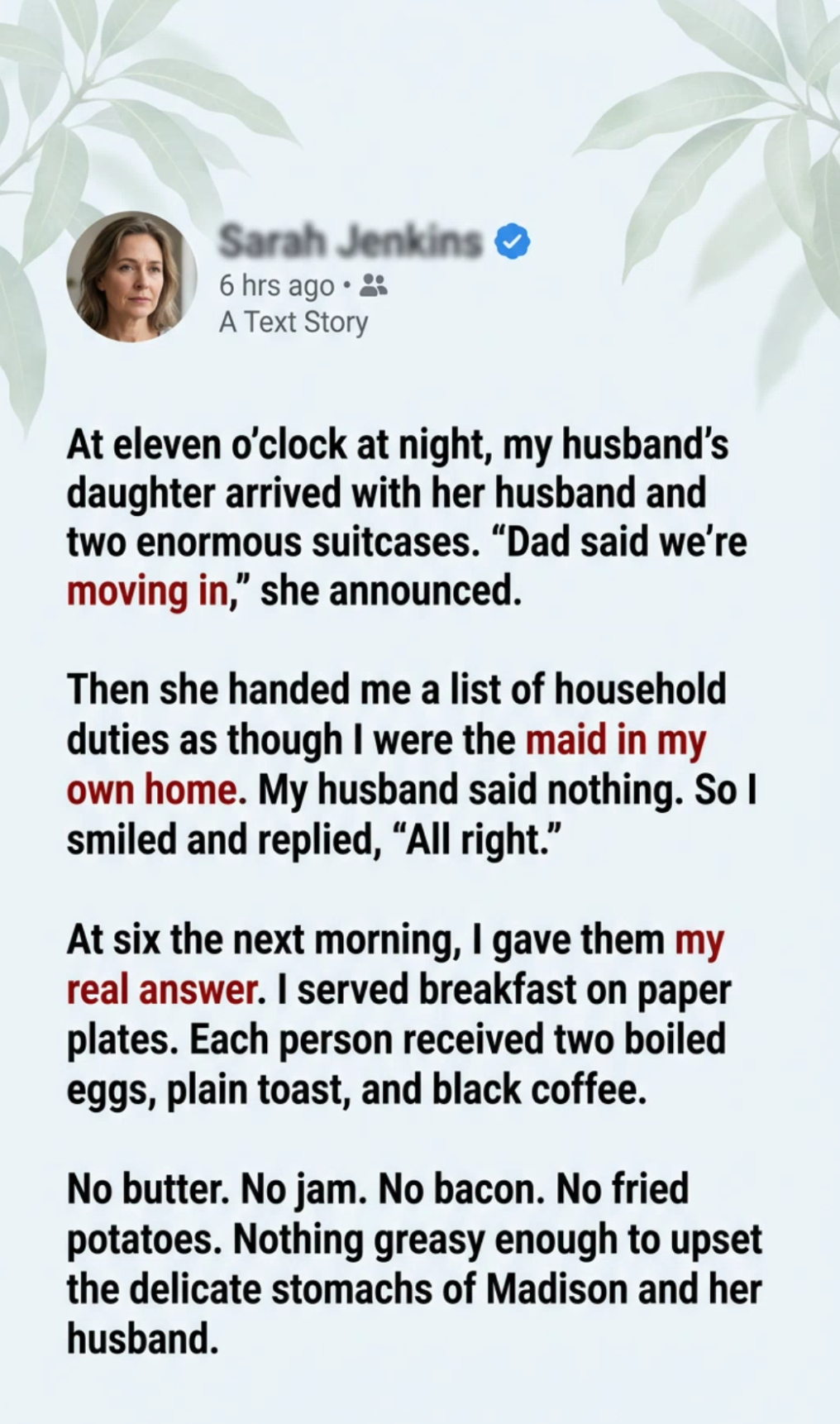
“Dad said we’re moving in,” Madison announced.
She said it casually, as though she were telling me they had decided to order pizza.
I looked at Richard.
He was standing beside the door with his hands in his pockets.
“Richard?”
He avoided my eyes.
“It’s only temporary, sweetheart,” he said. “They’ve had a difficult time with their apartment. Madison and Tyler need somewhere to stay while they figure things out.”
“How long is temporary?”
“A few weeks. Maybe a couple of months.”
Madison laughed.
“Dad, don’t make it sound like we’re asking permission. We’re family.”
Then she reached into her handbag, pulled out a folded sheet of paper, and placed it on the coffee table.
“This is just to make things easier,” she said.
I picked it up.
At the top, in large letters, was written:
HOUSEHOLD RESPONSIBILITIES
Below it was a list.
Prepare breakfast every morning before 7:00.
Wash and iron our clothes.
Keep the guest bedroom clean.
Prepare dinner according to our dietary preferences.
Do not use the washing machine after 8:00 p.m.
Keep the living room quiet when Tyler is working.
Make sure the refrigerator is stocked with our preferred groceries.
Clean the bathroom twice a week.
And finally:
Do not enter our bedroom without permission.
I read the list twice.
Then I looked at Madison.
“Who wrote this?”
“I did,” she answered proudly. “I thought it would prevent misunderstandings.”
Tyler nodded.
“We both work better when the household has structure.”
I almost laughed.
They had arrived at eleven at night with two suitcases and a list of instructions for me.
I had lived in that house for nine years. I had chosen the curtains, painted the walls, planted the garden, paid for most of the renovations, and turned an empty property into a home.
Yet somehow, in less than five minutes, I had become the person responsible for making their lives comfortable.
I turned toward Richard.
“You knew about this?”
He cleared his throat.
“Madison has been under a lot of stress. Just try to be understanding. She’s my daughter.”
“And I’m your wife.”
His expression tightened.
“Please don’t start an argument tonight.”
That sentence told me everything.
He had already decided whose feelings mattered.
I folded the paper carefully, placed it back on the table, and smiled.
“All right.”
Madison looked surprised.
“Really?”
“Of course,” I replied. “If that’s what everyone wants, we’ll make it work.”
Richard visibly relaxed.
Tyler carried their bags upstairs.
Madison followed him, calling over her shoulder, “Oh, and I don’t eat anything too greasy in the morning. It upsets my stomach. Tyler is the same way.”
“Noted,” I said.
When they disappeared upstairs, Richard came over and kissed my forehead.
“I knew you’d understand.”
I didn’t answer.
He went to bed believing the problem had been solved.
I stayed downstairs for another twenty minutes, looking at the list.
Then I took out my phone and opened my calendar.
At six the next morning, I gave them my real answer.
I woke before sunrise, showered, dressed, and went into the kitchen.
I prepared breakfast.
Four paper plates.
Each contained two boiled eggs, two slices of plain toast, and a small portion of nothing else.
I made a pot of black coffee.
No butter.
No jam.
No bacon.
No fried potatoes.
No fruit.
No special tea.
Nothing that required me to spend an hour preparing a meal for people who had arrived the night before and assigned me household duties.
At precisely six-thirty, I carried the plates into the dining room.
Richard came downstairs first.
He looked at the table.
“What’s this?”
“Breakfast.”
He examined his plate.
“Where’s everything else?”
“Everything else?”
“You know, eggs, bacon, potatoes. Maybe some fruit.”
I sat down.
“I remembered Madison said greasy food upset her stomach. So I kept it simple.”
He stared at me.
Before he could answer, Madison appeared at the top of the stairs wearing a silk robe.
“Is breakfast ready?”
“Yes.”
She walked into the dining room, looked at her plate, and stopped.
“Are you serious?”
“Completely.”
“Where’s the butter?”
“I didn’t put any out.”
“The jam?”
“None.”
“Is there anything else?”
“No.”
Tyler entered behind her.
He looked at the coffee.
“Do you have milk?”
“No.”
He turned toward Richard.
“Seriously?”
Richard rubbed his forehead.
“Let’s not make a big deal out of breakfast.”
Madison pulled out a chair but didn’t sit.
“Dad, I thought you told me everything would be taken care of.”
I placed my coffee cup on the table.
“Your father told me you were moving in. He didn’t tell me I had been hired as your personal housekeeper.”
The room went quiet.
Madison’s face changed.
“What?”
I reached into the drawer beside me and took out the folded list.
I placed it in front of her.
“Since we’re organizing household responsibilities, I thought we should discuss the arrangement.”
Richard sighed.
“Please, not this again.”
I looked at him.
“Actually, this is the first time we’re discussing it properly.”
Madison crossed her arms.
“I don’t understand why you’re being so difficult. We’re family.”
“Family members usually ask before moving into someone else’s home.”
“We didn’t have anywhere else to go.”
“That may be true. But needing help doesn’t give you the right to hand me a list of chores.”
Tyler leaned back.
“We weren’t trying to offend you.”
“Then you should have thought about how that list would make me feel.”
Madison shook her head.
“Dad, she’s making this personal.”
I looked directly at her.
“It became personal when you decided I was responsible for your laundry, meals, cleaning, and shopping without asking me.”
Richard finally spoke.
“Enough. They’re going through a difficult period. We can discuss the details later.”
I nodded.
“Good. Then let’s discuss the details now.”
I pulled out another sheet of paper.
It contained four simple points.
First, anyone staying in our home would contribute to groceries and household expenses.
Second, everyone would clean up after themselves and share ordinary household responsibilities.
Third, nobody would be assigned personal service duties unless they had freely agreed to them.
Fourth, the arrangement would have a clear end date.
Madison read the page and laughed.
“An end date? Dad, are you seeing this?”
Richard looked uncomfortable.
“Maybe we should talk privately.”
“No,” I said calmly. “We should talk together. They are the people moving in, after all.”
Madison pushed her plate away.
“I am not paying rent to stay with my own father.”
I looked at her.
“Then perhaps you should stay with your father somewhere else.”
Richard’s head snapped toward me.
“What did you just say?”
I held his gaze.
“I said this is my home too.”
For a moment, nobody moved.
Then Madison stood.
“You know what? This is ridiculous. I thought you were going to welcome us.”
“I would have welcomed you if you had arrived as guests.”
“We’re not guests. We’re family.”
“Then behave like family.”
Her mouth fell open.
Tyler stood beside her.
“Maybe we should go back upstairs.”
Madison followed him, muttering something under her breath.
Richard remained at the table.
He looked at the untouched breakfast and then at me.
“You embarrassed my daughter.”
“No, Richard. I refused to let her embarrass me in my own home.”
He shook his head.
“I promised her she could stay.”
“And you made that promise without discussing it with me.”
“I didn’t think it would be a problem.”
“That is exactly the problem.”
He stared at me for a long moment, then walked away.
I thought that would be the end of it.
I was wrong.
By noon, the situation had become much worse.
Madison came downstairs carrying a laundry basket.
She placed it directly beside the washing machine.
“Can you do these today?” she asked.
I looked inside.
There were towels, clothes, workout leggings, and several pieces of Tyler’s work clothing.
“No.”
She blinked.
“What do you mean, no?”
“I mean you can use the washing machine yourself.”
“But I don’t know how you use it.”
“It’s a washing machine, Madison. You put the clothes in, add detergent, and press the appropriate setting.”
She looked offended.
“I thought you were going to help us settle in.”
“I helped you carry your suitcases upstairs.”
“That isn’t what I mean.”
“I know.”
She picked up the basket and walked into the kitchen.
“Dad!”
Richard appeared a moment later.
“What happened?”
“She refuses to wash our clothes.”
Richard looked at me.
“Could you just do it this once?”
I took a breath.
“Why?”
“Because she’s your guest.”
“Yesterday she was a guest. Today she is telling me what chores to do.”
He looked irritated.
“Do you really want to fight over laundry?”
“No. I want to stop being treated like a servant.”
He lowered his voice.
“Madison has always had trouble adjusting to changes. You know that.”
I stared at him.
“She’s thirty-two years old, Richard.”
He said nothing.
I walked past them and went into my home office.
I closed the door and opened the folder where I kept our household documents.
Richard and I had married nine years earlier.
When we first met, he had been a widower for several years. Madison was twenty-three at the time, and she lived in another city. I had always made an effort to include her in our family.
I remembered buying her a beautiful winter coat when she started her first office job.
I remembered helping her prepare for an interview.
I remembered spending an entire weekend helping her choose furniture for her first apartment.
I had never expected gratitude for those things.
I had simply believed that kindness was part of being a family.
But over the years, Madison had developed a habit of treating my generosity as an obligation.
If I bought her a birthday present, she complained about the color.
If I invited her to dinner, she criticized the food.
If I offered advice, she accused me of interfering.
Richard always had the same explanation.
“She doesn’t mean anything by it.”
“She has a difficult personality.”
“She lost her mother when she was young.”
I had accepted those explanations because I loved my husband.
But I was beginning to understand that his explanations had become excuses.
I opened our property documents.
The house had been purchased before our marriage. I had used money from the sale of my previous apartment for the down payment, and the mortgage was in my name. Richard contributed to household expenses, but he had never been the sole owner of the property.
Our marriage agreement and the documents prepared by our attorney clearly described our separate property arrangements.
I had never used that information to make Richard feel unwelcome.
I had never reminded him that the house was legally mine.
I had considered it our home.
That afternoon, I called my attorney, Helen Brooks.
She had handled the paperwork when Richard and I married.
“I’m not asking you to start a legal dispute,” I explained. “I just want to understand what I should do if my husband invites people to live here without my agreement.”
Helen listened carefully.
Then she asked, “Are you being threatened or prevented from using your own home?”
“Not exactly. But I’m being pressured to provide services, and my husband is refusing to discuss an end date.”
“Then start by keeping a record of what is happening. Don’t sign anything you don’t understand, and don’t make threats you don’t intend to follow through on. You should also review the ownership documents and any agreements that apply to the property.”
I thanked her.
Before ending the call, she added something that stayed with me.
“Being generous does not mean surrendering your right to make decisions about your own home.”
I wrote that sentence in my notebook.
That evening, I prepared dinner for myself and Richard.
Madison and Tyler were invited to eat with us, but they announced they had ordered food.
I didn’t object.
At seven-thirty, Richard came into the kitchen while I was washing a plate.
“We need to talk.”
“I’m listening.”
He leaned against the counter.
“Madison feels unwelcome.”
“I can understand why she might feel disappointed.”
“She’s my daughter.”
“I know.”
“She needs support.”
“Then support her.”
He looked at me as though I had said something unreasonable.
“What do you think I’ve been doing?”
“You promised her a place to stay without asking me. You agreed to a list of responsibilities for me without asking me. And every time I object, you tell me to be understanding.”
He folded his arms.
“I was trying to help my child.”
“And I was trying to protect our marriage from becoming a place where one person makes decisions and the other person is expected to obey.”
He looked away.
“She’s only going to stay a little while.”
“How long?”
“I told you. A few weeks.”
“Then let’s write down the date.”
He became quiet.
“Why does everything have to become so formal?”
“Because your promises keep changing.”
He left the kitchen without answering.
The following morning, I found a new note on the refrigerator.
It said:
MADISON AND TYLER’S SCHEDULE
Breakfast: 7:00 a.m.
Laundry: Tuesday and Friday.
Groceries: Fresh items every Wednesday.
Dinner: 6:30 p.m.
Bathroom cleaning: Monday and Thursday.
I stared at it for several seconds.
Then I removed the note, folded it, and placed it on the dining table.
When Madison came downstairs, she saw it.
“Why did you take that down?”
“Because you don’t make schedules for other people in their own homes.”
She rolled her eyes.
“It’s just organization.”
“Then organize your own responsibilities.”
She laughed.
“You’re acting like I asked you to do something terrible.”
I turned toward her.
“Madison, you have a husband. You have two healthy hands. You are capable of making breakfast, washing clothes, buying groceries, and cleaning a bathroom.”
Her face reddened.
“Dad said you were a caring person.”
“I am.”
“Then why are you treating us like strangers?”
“Because strangers would probably have asked before giving me a list of chores.”
She turned and stormed upstairs.
A few minutes later, Richard came down.
“What did you say to her?”
“The truth.”
He rubbed his temples.
“You have to stop provoking her.”
I put my cup down.
“Richard, I want you to listen carefully. I did not marry you to become responsible for every adult in your family. I married you because I wanted a partnership.”
He looked at me.
“And what does that mean?”
“It means you and I make decisions together. It means your daughter can receive help without being allowed to control me. It means we respect each other.”
He didn’t answer.
I continued.
“If you want Madison and Tyler to stay here, you need to agree with me on the arrangement. I will not be their housekeeper. I will not pay all their expenses. I will not accept instructions from them. And there must be a realistic plan for them to move into their own place.”
Richard sighed.
“I don’t know why this has become such a big issue.”
“Because you keep pretending it isn’t one.”
For the first time, I saw uncertainty in his expression.
He had assumed I would eventually give in.
He was beginning to understand that I wouldn’t.
But Madison had no intention of accepting the situation.
Three days later, I came home from grocery shopping and found her standing in the living room with her phone in her hand.
“Where have you been?”
I set the bags down.
“Shopping.”
“You forgot the almond milk.”
“I didn’t know you needed almond milk.”
“I told Dad.”
“Then he can buy it.”
She looked at me in disbelief.
“You’re seriously refusing to buy one carton of milk?”
“I’m refusing to be responsible for a grocery list I never agreed to.”
She raised her phone.
“I’ve been talking to my friends about this.”
I didn’t respond.
“They think it’s unbelievable. One of them said you sound jealous of me.”
I almost smiled.
“Jealous?”
“Because Dad has always loved me.”
I looked at her carefully.
“Madison, nobody is competing with you for your father’s love.”
“Then why are you making this so difficult?”
“Because loving your father doesn’t mean I have to surrender my dignity.”
She walked closer.
“You knew he had a daughter when you married him.”
“Yes.”
“So you knew I would always be part of his life.”
“I hoped you would be.”
Her expression hardened.
“Well, I am. And I don’t plan to disappear just because you don’t like me.”
I picked up the grocery bags.
“You don’t have to disappear. You just have to respect the people you live with.”
She turned away.
That night, Richard and I had our first serious argument in years.
He stood in the bedroom doorway while I folded laundry.
“You’re forcing me to choose between my wife and my daughter.”
I stopped folding.
“No, Richard. You’re choosing to make it a competition.”
“She has nowhere to go.”
“She has a husband.”
“Tyler lost his job.”
“Then they need help finding work and affordable housing.”
“They’re embarrassed.”
“And I’m supposed to solve that by becoming their maid?”
He looked angry.
“You’re making this about money.”
“I’m making this about respect.”
He shook his head.
“I never thought you would behave this way.”
I put the towel down.
“Neither did I.”
He stood there, waiting for me to apologize.
I didn’t.
The next morning, I received a message from an unknown number.
It was Madison’s friend.
The message read:
I don’t know what happened between you and Madison, but she’s very upset. She says you’re making her life miserable. You should remember that she’s Richard’s daughter.
I read it twice.
Then I deleted it.
I wasn’t going to defend myself to people who knew only one side of the story.
A week after their arrival, I received a phone call from a woman named Patricia.
She introduced herself as the manager of the apartment building where Madison and Tyler had previously lived.
She said she had received a request from Madison to send some belongings to our address.
I was surprised.
“Why is she moving her things out of storage?”
Patricia hesitated.
“I’m sorry. I thought you knew. Madison and Tyler ended their lease several weeks ago. They were supposed to collect the remaining items before the end of the month.”
I felt my stomach tighten.
“Several weeks ago?”
“Yes. They said they were moving in with family.”
I thanked her and ended the call.
For several minutes, I sat quietly at the kitchen table.
Richard had told me their apartment situation was temporary.
He had told me they needed a few weeks to figure things out.
But they had already ended their lease before arriving.
They had not come for a short visit.
They had planned to move in permanently.
And nobody had told me.
When Richard returned from work, I was waiting in the living room.
“Did Madison and Tyler end their lease before they moved here?”
He stopped.
“Who told you that?”
“Patricia from their apartment building.”
He placed his briefcase down.
“They couldn’t afford it anymore.”
“That isn’t what I asked.”
He looked uncomfortable.
“Yes. They ended it.”
“When?”
“About three weeks ago.”
I stared at him.
“So you knew they had no apartment to return to.”
He didn’t answer.
“You told me they needed somewhere to stay temporarily.”
“They’re still figuring things out.”
“Richard, they moved out of their apartment before you told me they were coming here.”
“I didn’t want you to worry.”
I let out a slow breath.
“You didn’t want me to disagree.”
He frowned.
“That’s not fair.”
“Then explain why you didn’t tell me.”
He rubbed the back of his neck.
“Madison was struggling. She was crying. She said she didn’t know what to do. I couldn’t turn my back on her.”
“You could have told me the truth.”
“I knew you’d say no.”
The words landed between us like a door slamming shut.
I looked at him for a long moment.
“So you knew I might not agree, and you decided to make the decision without me.”
He lowered his eyes.
“I thought once they were here, you’d understand.”
I felt something inside me change.
It wasn’t anger anymore.
It was disappointment.
Deep, quiet disappointment.
“You didn’t ask me because you knew I had the right to say no.”
He said nothing.
I stood.
“Richard, I need some time to think.”
He reached for my hand.
“Please don’t do this.”
I gently pulled away.
“I’ve been thinking about this since the night they arrived.”
The next morning, I called Helen again.
I explained what I had learned and asked her to review the property documents with me.
She arranged a meeting for the following week.
I also contacted a financial adviser because I wanted to understand exactly how household expenses were being handled.
I discovered that Richard had already paid several bills for Madison and Tyler using our joint household account.
There was nothing wrong with helping his daughter if we had agreed to it.
But he had spent money from an account we both contributed to without discussing the amounts or the length of the support.
The total was not devastating, but it was significant enough to require a conversation.
I printed the statements.
I didn’t accuse him of stealing.
I simply wanted transparency.
When Richard saw the papers, he became defensive.
“Are you auditing me now?”
“I’m reviewing our household finances.”
“I paid some of Madison’s bills. She’s my daughter.”
“And the money came from an account we both use.”
“I was going to replace it.”
“When?”
He looked away.
I continued.
“I don’t object to you helping her. I object to you making financial commitments on my behalf.”
He pushed the papers aside.
“You’re becoming obsessed with control.”
I shook my head.
“I’m asking for honesty.”
Madison overheard us.
She entered the room and looked at the statements.
“Are you seriously counting every dollar my father spends on me?”
I looked at her.
“No. I’m asking him to be honest about money from our shared account.”
She turned toward Richard.
“Dad, I told you this would happen.”
Richard looked exhausted.
“Madison, please.”
She ignored him.
“You’ve always wanted Dad to yourself.”
That accusation finally made me angry.
I stood up.
“Enough.”
Madison stared at me.
“You don’t get to tell me how much I love my husband, and you don’t get to use his love for you as an excuse to mistreat me.”
She folded her arms.
“I’m not mistreating you.”
“Then stop assigning me chores, demanding groceries, and expecting me to manage your life.”
She looked at Richard.
“Are you going to let her speak to me like that?”
Richard opened his mouth, but no words came out.
For the first time, I didn’t rescue him from the silence.
I walked out of the room.
That afternoon, Tyler approached me while I was watering the plants.
He looked embarrassed.
“Can I talk to you?”
I turned off the hose.
“Of course.”
He stood awkwardly near the garden steps.
“I know Madison has been difficult.”
I waited.
“She doesn’t always realize how she sounds.”
“I’m sure she doesn’t.”
He rubbed his hands together.
“I also know we came here suddenly.”
“You did.”
“Things got bad with the apartment. I lost my job, and Madison was scared. Her father offered to help.”
“I understand that.”
He looked relieved.
“I don’t want you to think we’re trying to take advantage of you.”
I looked at him.
“Then help me understand why you arrived with a list of duties for me.”
He lowered his head.
“That was Madison’s idea. I told her it was too much, but she said it would make things easier.”
“Did you agree with her?”
He hesitated.
“I didn’t want to argue.”
I nodded slowly.
“That’s the same reason your father keeps giving me.”
Tyler looked uncomfortable.
“I suppose it is.”
I turned toward the garden.
“I don’t expect you to take sides. But if you’re going to live here, you need to take responsibility for your part in the situation.”
He nodded.
“I understand.”
For a moment, I thought perhaps things might improve.
But the next evening, Madison invited six friends over without asking.
I returned from an appointment and found them in the living room, laughing loudly, drinking wine, and moving furniture to make space for a large speaker.
One of them had placed a glass on the wooden table I had inherited from my mother.
I stopped in the doorway.
“What is happening?”
Madison turned.
“I’m having a few friends over.”
“I can see that.”
She smiled.
“It’s Friday. We thought we’d relax.”
I looked around.
There were shoes on the sofa, food containers on the floor, and a bottle of wine beside the television.
“Did you ask Richard?”
“Dad said it was fine.”
I looked toward the hallway.
Richard appeared a moment later.
He saw my expression.
“It’s only a few people.”
I walked over to the table and lifted the glass.
A wet ring had already formed on the wood.
I looked at Madison.
“Please move your guests into the dining area.”
She frowned.
“Why?”
“Because this is a shared living room, and I wasn’t told there would be a gathering.”
“It’s not a big party.”
“Then it shouldn’t be difficult to move.”
Her friends exchanged uncomfortable looks.
Madison laughed sharply.
“Unbelievable. You really can’t stand seeing me happy.”
I set the glass down.
“Your happiness is not the problem. Your lack of consideration is.”
She turned to her friends.
“Sorry. Apparently, we’re not allowed to enjoy ourselves.”
One of the women quietly picked up her handbag.
Another began collecting empty glasses.
Within ten minutes, the guests had left.
Madison stormed upstairs.
Richard followed her.
I remained downstairs, looking at the mark on my mother’s table.
I had spent years trying to keep peace in that house.
Now I was beginning to understand that peace without respect was simply silence imposed on the person who complained.
The following Monday, Helen arrived with a folder.
She reviewed the property records with me and explained the options available under the relevant agreements and local law.
She also made it clear that I should not attempt to remove anyone by changing locks, throwing away belongings, or cutting off essential services. If the situation became a formal dispute, the proper legal procedures would have to be followed.
I appreciated her caution.
I wasn’t interested in revenge.
I wanted my home and my marriage to return to a place of mutual respect.
Helen helped me prepare a written household agreement.
It was simple.
Madison and Tyler could remain for thirty days while they searched for a new apartment and employment.
They would purchase their own personal groceries, contribute a reasonable amount toward shared household expenses, and clean up after themselves.
They would not expect me to provide laundry, meals, transportation, or personal services.
Any visitors would need to be discussed with both homeowners.
At the end of thirty days, we would review the arrangement, but there would be no automatic extension.
I showed the agreement to Richard first.
He read it silently.
“Thirty days?”
“Yes.”
“That’s not enough time.”
“Then they should begin looking immediately.”
He put the paper down.
“You’re giving them an ultimatum.”
“No. I’m setting a boundary.”
He stared at the document.
“Madison will never sign this.”
“Then she can discuss another reasonable arrangement with us.”
“And if she refuses?”
I looked at him.
“Then we will have to consider the next appropriate steps.”
He walked away with the agreement still in his hand.
That evening, he showed it to Madison.
I heard her shouting upstairs.
“You’re letting her throw me out!”
Richard tried to calm her.
“She isn’t throwing you out. She’s asking us to agree on some rules.”
“Rules? I’m your daughter!”
“I know.”
“Then why are you letting her treat me like a stranger?”
I heard a door slam.
A few minutes later, Madison came downstairs.
Her eyes were red.
She held the agreement in one hand.
“I can’t believe you would do this.”
I remained seated.
“I know you’re upset.”
“You don’t want me here.”
“I want you to have a stable place to live. But I also want to be respected in my own home.”
“You’re making Dad choose.”
“No, Madison. Your father is allowed to love you and respect his wife at the same time.”
She shook her head.
“You’ve changed him.”
I looked at her sadly.
“No. I think you’re finally seeing a side of him that you’ve never had to consider before.”
She threw the agreement onto the table.
“I’m not signing this.”
“That’s your choice.”
She stared at me as if she expected me to argue.
When I didn’t, she walked upstairs.
For the next several days, the house was cold.
Madison stopped speaking to me.
Tyler avoided the living room.
Richard spent most evenings in his office.
I continued with my ordinary routine.
I cooked for myself, tended the garden, visited friends, and went to work.
I did not wash their clothes.
I did not prepare their meals.
I did not purchase their special groceries.
I did not ask whether they needed anything.
Not because I wanted them to suffer, but because they were adults who had to begin managing their own lives.
On the ninth day, something unexpected happened.
I returned home from the supermarket and found Tyler in the kitchen preparing dinner.
He had bought vegetables, chicken, and rice.
Madison was sitting at the counter, looking at her phone.
“Hi,” Tyler said.
“Hello.”
He glanced at the stove.
“I thought I’d cook tonight.”
“That’s nice.”
Madison didn’t look up.
Tyler served two plates and then hesitated.
“Would you like some?”
I smiled.
“Thank you, but I’ve already eaten.”
He nodded.
I went upstairs.
It was a small moment, but it mattered.
For the first time since their arrival, someone had offered something without demanding something in return.
The next morning, Richard knocked on my office door.
“Can I come in?”
“Of course.”
He sat opposite me.
For a while, he said nothing.
Then he spoke.
“I think I made a mistake.”
I closed my notebook.
“Which part?”
He looked down.
“All of it.”
I waited.
“I should have spoken to you before inviting them. I shouldn’t have agreed to that list. And I shouldn’t have used our money without discussing it.”
I felt my shoulders relax slightly.
“Thank you for saying that.”
He rubbed his hands together.
“I was afraid Madison would think I was abandoning her.”
“And what did you think I would feel?”
He looked at me.
“I didn’t think about it.”
That answer hurt more than an excuse.
He continued.
“Her mother died when she was young. I promised myself I would always be there for her. Sometimes I think I’ve spent so much time trying to make sure she never feels abandoned that I’ve forgotten she is an adult.”
I nodded.
“I understand why you want to protect her.”
“But I shouldn’t have made you responsible for protecting her too.”
“No.”
He looked toward the window.
“She says you hate her.”
“I don’t hate her.”
“She thinks you’re trying to separate us.”
“I have never asked you to stop being her father. I have asked you to stop making me pay for decisions I wasn’t allowed to help make.”
He nodded slowly.
“I understand.”
I wanted to believe him.
But an apology was only the beginning.
I looked at him.
“What happens when she gets angry again?”
He sighed.
“I’ll speak to her.”
“And if she refuses to respect the agreement?”
He took a breath.
“Then I’ll have to accept that she can’t stay here under those conditions.”
For the first time in weeks, I saw him taking responsibility instead of passing it to me.
I reached across the desk and touched his hand.
“That’s all I’ve wanted.”
The next day, Richard sat down with Madison and Tyler.
He told them he had made a mistake by arranging their move without discussing it with me.
He explained that the household agreement was not a punishment.
It was a way for everyone to live together without resentment.
Madison cried.
She said she had nowhere to go.
Richard told her they would help her search for an apartment and that he would contribute a limited amount toward a deposit if they agreed on a budget.
But he also made it clear that she could not continue treating me as a servant.
Madison looked at him.
“So you’re taking her side.”
Richard shook his head.
“I’m taking responsibility for my own marriage and for my own choices.”
She turned away.
Tyler was the first to speak.
“I think we should sign it.”
Madison stared at him.
“Are you serious?”
“Yes. We need a plan. We can’t keep fighting every day.”
She looked at the paper.
Then she looked at Richard.
Finally, she signed.
Tyler signed beneath her.
Richard signed as well.
I signed last.
It wasn’t a warm family moment.
Nobody hugged.
Nobody smiled.
But it was honest.
And honesty was something we desperately needed.
Over the next two weeks, the house slowly became calmer.
Tyler found temporary work through a former colleague.
Madison began applying for administrative positions.
They bought their own groceries and started cleaning their bathroom.
They also stopped leaving laundry baskets outside my bedroom door.
One afternoon, Madison approached me while I was arranging flowers.
“I need to ask you something.”
I put down the scissors.
“What is it?”
She looked uncomfortable.
“Can I borrow the car on Thursday?”
I considered the request.
“Where are you going?”
“An interview.”
“Have you checked whether the insurance covers you driving it?”
She nodded.
“I called the company. They said I need to be added temporarily.”
“Then we can discuss it once that’s arranged.”
She looked disappointed but didn’t argue.
“Okay.”
It was the first time she had asked me for something without acting as though I owed it to her.
I noticed.
A week later, she came home carrying a small paper bag.
She found me in the kitchen.
“I bought something.”
She placed the bag on the counter.
Inside was a jar of strawberry jam and a small packet of butter.
I looked at her.
“What is this?”
She gave an awkward smile.
“I remembered your breakfast.”
I was surprised.
“You don’t have to buy anything for me.”
“I know.”
She looked down.
“I was rude that morning.”
I didn’t answer immediately.
She continued.
“I thought because Dad was paying for everything, I could just settle in. I didn’t think about how it would feel for you.”
I nodded.
“Thank you for acknowledging that.”
She took a breath.
“I also want to apologize for the list.”
I looked at her carefully.
“Madison, I don’t need you to agree with every decision I make. But I do need you to respect me.”
“I know.”
“Good.”
She left the kitchen.
I didn’t suddenly become her closest friend.
And she didn’t suddenly become a different person.
But something had shifted.
The remaining days passed without another major argument.
On the twenty-eighth day, Madison and Tyler found a small apartment not far from Richard’s office.
It wasn’t luxurious.
It had two bedrooms, a modest kitchen, and a narrow balcony.
But it was affordable.
Richard helped them inspect the lease and review the moving costs.
This time, he discussed everything with me before committing any shared money.
Madison also got a job offer.
Tyler’s temporary position had become permanent.
They would be able to manage their rent if they kept their spending under control.
On the morning they moved out, the two enormous suitcases that had arrived at eleven at night stood beside the front door.
Madison carried one downstairs.
Tyler followed with the other.
Richard helped them load everything into the car.
I stood near the entrance.
Madison approached me.
For a moment, neither of us spoke.
Then she said, “Thank you for letting us stay.”
I smiled faintly.
“You’re welcome.”
She looked toward the dining room.
“I was awful when we first arrived.”
“Yes, you were.”
She gave a small, embarrassed laugh.
“I suppose I deserved that answer.”
I smiled.
“Perhaps.”
She hesitated.
“I’m sorry I treated you like you worked for me.”
I looked at her.
“That was the part I found hardest to forget.”
“I know.”
She reached into her handbag and handed me a small envelope.
“What is this?”
“Something for the household expenses. We should have contributed from the beginning.”
I opened it.
Inside was a check for an amount that covered their agreed contribution and several shared expenses.
I looked at her.
“You didn’t have to do this all at once.”
“I wanted to.”
I nodded.
“Thank you.”
She glanced toward the car.
“Dad says we can come for dinner next Sunday.”
“If everyone agrees on the arrangements, you’re welcome.”
She smiled.
“Understood.”
Then she walked outside.
Richard returned a few minutes later.
He stood beside me and looked at the empty hallway.
“It’s quiet again.”
“Yes.”
He turned toward me.
“I’m sorry.”
I looked at him.
“For what?”
“For making you feel like you didn’t have a voice in your own home.”
I took his hand.
“Don’t promise me you’ll never make a mistake again. Just don’t make the same mistake and expect me to stay silent.”
He nodded.
“I won’t.”
The following Sunday, Madison and Tyler came for dinner.
They arrived at six, not eleven.
They brought a dessert and a bottle of sparkling water.
Madison asked whether she could help set the table.
Tyler offered to wash the dishes afterward.
I thanked them both.
Dinner wasn’t perfect.
There were a few awkward moments, and Madison still had a habit of checking her phone during conversations.
But nobody handed me a list.
Nobody demanded special treatment.
Nobody acted as though my home existed for their convenience.
After dinner, Madison helped me clear the table.
She picked up the jar of strawberry jam she had brought the previous week and placed it beside the bread.
“You know,” she said, “I never understood why you were so upset about breakfast.”
I looked at her.
“Do you understand now?”
She nodded.
“I think I do. It wasn’t really about the eggs.”
“No.”
“It was about the way I arrived and acted like everything belonged to me.”
I smiled.
“Exactly.”
She looked toward the living room, where Richard and Tyler were talking.
“I was so used to Dad fixing everything that I forgot other people had feelings too.”
I handed her a plate.
“Remember that the next time someone helps you.”
She nodded.
“I will.”
When everyone had left that night, Richard and I sat together in the living room.
He looked around the house.
“I missed this.”
“What?”
“Being able to sit here without worrying about another argument.”
I leaned back.
“Then let’s protect it.”
He took my hand.
“I will.”
I never again saw that folded list of household duties.
I didn’t need to.
The lesson had already been learned.
Madison and Tyler eventually built a more stable life in their apartment. They still visited, and Richard remained close to his daughter. I never asked him to love her less, and he finally understood that loving her did not mean allowing her to disrespect me.
As for me, I learned something I should have understood much earlier.
Kindness is not an agreement to accept everything.
Helping family does not mean surrendering your independence.
And being a loving wife does not mean becoming invisible in your own home.
Sometimes the most important answer isn’t a furious argument, a slammed door, or a dramatic speech.
Sometimes it is a quiet refusal to keep doing what everyone has come to expect from you.
That morning, I served breakfast on paper plates.
Two boiled eggs.
Plain toast.
Black coffee.
No butter.
No jam.
And no unnecessary effort.
It wasn’t the breakfast that changed our family.
It was the moment I finally stopped pretending that respect was something I had to earn by serving everyone else.
Because a home is not a hotel, marriage is not a dictatorship, and family is not a license to treat someone badly.
I had welcomed them into my home.
But I had finally remembered that I belonged there too.
The End