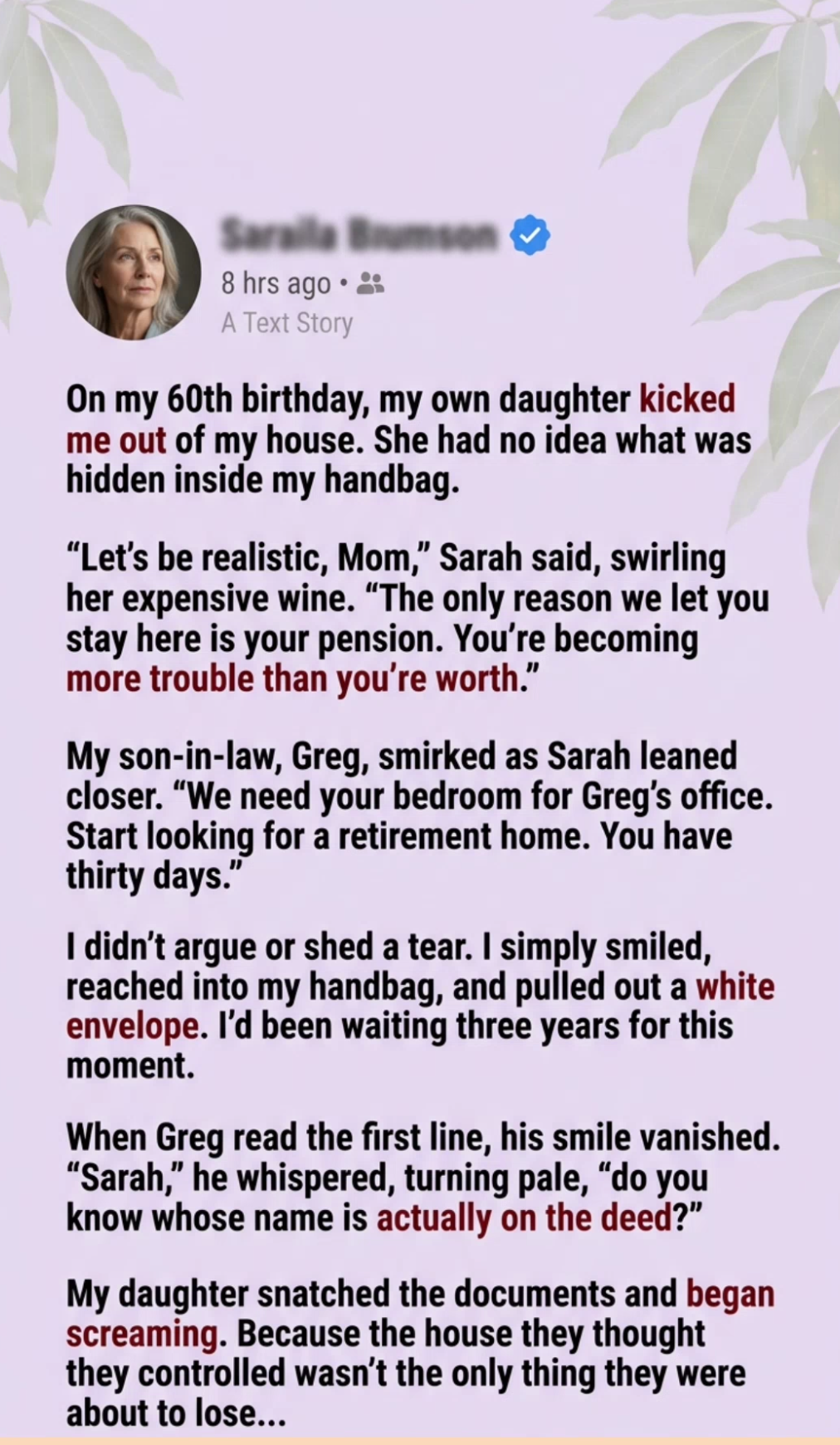
The cake was still on the dining table when my daughter told me I had thirty days to leave.
Sixty candles had been arranged around the frosting, although only six had actually been lit. Sarah had insisted that lighting all sixty would make the dining room too warm. She had also insisted that we celebrate at home instead of going to the restaurant I had chosen.
“It will be more comfortable here, Mom,” she had said.
At the time, I thought she was being considerate.
Now I understood that she had wanted me surrounded by familiar furniture when she delivered the news.
I sat at the head of the dining table, still wearing the blue dress I had bought for my birthday. My silver earrings were a gift from my late husband, Michael. Beside my plate sat a small bouquet of white roses.
Sarah, my only daughter, was swirling an expensive glass of wine.
Greg, her husband, leaned back in his chair with the relaxed expression of a man who believed every decision had already been made.
“Let’s be realistic, Mom,” Sarah said. “The only reason we let you stay here is your pension. You’re becoming more trouble than you’re worth.”
I stared at her.
For a moment, I wondered whether I had heard correctly.
“I’m sorry?”
Sarah sighed as though I were a child who needed something explained twice.
“We need your bedroom for Greg’s office. He’s working from home more often, and this house has enough space. You should start looking for a retirement home.”
Greg smirked.
“We’ve already discussed it. Thirty days should be enough time to find somewhere suitable.”
I looked around the dining room.
The wooden cabinets had been chosen by Michael and me. The curtains were the ones I had sewn shortly after we moved in. The photograph on the fireplace showed my husband standing beside me on the day we received the keys.
I remembered carrying boxes through that front door.
I remembered Michael painting the hallway while I prepared sandwiches on the floor.
I remembered Sarah running through the garden when she was six years old, shouting that the house was the most beautiful place in the world.
And now she was telling me I had thirty days to leave.
I didn’t argue.
I didn’t cry.
I didn’t ask why my own daughter had become so cruel.
Instead, I smiled.
Then I reached into my handbag and pulled out a white envelope.
I had been waiting three years for this moment.
I placed it on the table.
Greg glanced at it.
“What is that?”
“Something you should read before making any more decisions about this house.”
He opened the envelope casually.
The first page contained the official property details, including the registered owner’s name.
His smile disappeared.
He read the line again.
Then he looked at Sarah.
“Sarah,” he whispered, turning pale, “do you know whose name is actually on the deed?”
My daughter snatched the documents from his hands.
She scanned the page.
Her face changed.
“What is this?”
I folded my hands.
“It’s the truth.”
She stared at me.
“Why is your name on this?”
“Because I own the house.”
Greg stood up so quickly that his chair scraped against the floor.
“That can’t be right.”
“It is.”
“No. We live here. We pay for things here.”
“You live here because I allowed you to.”
Sarah’s face turned red.
“You told us this was our family home!”
“It is a family home. That doesn’t mean I transferred ownership to you.”
She looked at the documents again.
Then she began screaming.
But the deed was only the first page of what I had brought.
The other documents inside that envelope were going to reveal something much bigger.
And before the evening ended, my daughter would learn that the woman she had just tried to throw out had been protecting her from the consequences of her own decisions for three years.
My name is Eleanor Bennett.
I turned sixty on a Thursday.
I had spent most of my adult life believing that a mother’s love meant making sacrifices without keeping score.
When Michael and I married, we were young, broke, and hopeful. He worked as an electrician, and I worked as a receptionist at a small medical clinic. We rented a tiny apartment above a bakery, where the smell of fresh bread drifted through the floorboards every morning.
We didn’t have much, but we had plans.
Our daughter, Sarah, was born three years later.
Michael cried when he held her for the first time. He promised he would give her a good life, and he spent the next twenty-seven years trying to keep that promise.
We eventually bought our house.
It wasn’t a mansion, but it had four bedrooms, a comfortable kitchen, a garden, and a wide front porch where Michael liked to sit with his coffee.
We worked hard to pay off the mortgage.
I took extra shifts. Michael accepted weekend jobs. We postponed vacations and bought secondhand furniture.
When the final mortgage payment was made, we celebrated with a bottle of sparkling wine and a homemade dinner.
Michael lifted his glass.
“To our home,” he said.
I smiled.
“To everything we’ve built.”
He kissed my forehead.
“And to Sarah. One day, she’ll understand what it takes to build something.”
He never imagined that she would eventually try to take it from me.
Sarah had always been intelligent and ambitious. She was popular at school, earned good grades, and had a natural ability to persuade people.
As a child, she could convince her father to buy her almost anything.
As a teenager, she learned how to make an ordinary request sound like an emergency.
When she wanted an expensive dress, she explained that everyone else had one.
When she wanted a car, she promised she would use it responsibly.
When she wanted to attend a university in another city, Michael and I adjusted our savings to help her.
We didn’t complain.
We wanted her to have opportunities we had never enjoyed.
After university, Sarah began working in marketing. She met Greg at a business networking event.
He was confident, well-dressed, and always spoke as though he knew something everyone else didn’t.
At first, I liked him.
He brought flowers when he visited and helped Michael repair a loose section of the garden fence.
But as their relationship developed, I began noticing small things.
Greg rarely asked questions about other people.
He spoke about money constantly.
He described people by their salaries, houses, and professional connections.
When Sarah announced they were getting married, Michael and I were happy for her.
We helped pay for the wedding.
We gave them money toward their first apartment.
We bought furniture for their new home.
And when Greg’s business began experiencing financial problems, Michael quietly helped them cover several expenses.
I didn’t object.
I thought we were helping a young couple establish themselves.
Then Michael became ill.
It happened faster than any of us expected.
A routine medical appointment turned into additional tests, then hospital visits, and eventually a diagnosis that changed everything.
Michael had a serious heart condition.
He underwent treatment, but his health continued to decline.
During those difficult months, Sarah visited frequently at first.
Greg usually stayed for a short time.
He always seemed uncomfortable in hospitals.
Michael never complained about him.
He was more concerned about me.
“Don’t spend every minute worrying about me,” he would say. “You need to look after yourself too.”
I would squeeze his hand.
“I’m not going anywhere.”
He smiled.
“I know.”
One evening, while the rain tapped against the hospital window, Michael asked me to promise something.
“What is it?”
“Don’t let anyone make you feel like a burden.”
I laughed softly.
“Why would anyone do that?”
He looked at me for a long moment.
“Because sometimes people become selfish when they think someone is vulnerable.”
I brushed his hair away from his forehead.
“You worry too much.”
He smiled, but his expression remained serious.
“Promise me.”
I held his hand.
“I promise.”
Michael died four months later.
The house became unbearably quiet.
For weeks, I couldn’t bring myself to sit in his favorite chair.
I kept his coffee mug in the kitchen cabinet, even though I knew I would never see him use it again.
Sarah came to stay with me for several nights after the funeral.
She hugged me and said I shouldn’t be alone.
Greg also came, carrying groceries and speaking gently.
For a little while, I felt surrounded by family.
Then Sarah suggested something.
“Mom, why don’t we move in with you?”
I looked at her.
“Move in?”
“Just for a while. Our apartment is expensive, and Greg is thinking about changing jobs. It would help everyone.”
Greg nodded.
“You wouldn’t have to worry about living alone either.”
I hesitated.
The house had four bedrooms, and I had no reason to refuse immediately.
“Are you sure you want to live here?”
Sarah smiled.
“Of course. This is where I grew up.”
I agreed.
At first, it was pleasant.
Sarah cooked dinner occasionally.
Greg helped with a few repairs.
We watched television together and shared stories about Michael.
But gradually, their behavior changed.
Sarah began rearranging the kitchen.
Greg replaced the living-room television without asking.
They moved some of my photographs because they wanted more space for their own decorations.
I tried not to be difficult.
I told myself that families needed to adjust when they lived together.
Then came the requests for money.
At first, Sarah asked whether I could help with the electricity bill.
Then Greg mentioned that their car needed repairs.
A few weeks later, they needed assistance with a credit-card payment.
I had Michael’s life insurance, my pension, and savings accumulated over decades.
I was not wealthy, but I was financially secure.
I helped them.
I paid for the car repairs.
I covered several household expenses.
I contributed to groceries.
I even gave them money toward a business opportunity Greg claimed would produce a reliable income.
I never asked for repayment.
I believed I was helping my daughter.
But I began noticing that their gratitude disappeared almost as quickly as the money.
When I asked whether they could contribute to a particular bill, Sarah would sigh.
“Mom, you know we’re trying to get ahead.”
When I mentioned that I needed to keep some money aside for emergencies, Greg would say:
“There’s no point letting money sit in an account when it could be working for the family.”
I didn’t like the way he said it.
But I said nothing.
Three years passed.
During those three years, I learned that being generous could become dangerous when the people receiving help started believing they were entitled to it.
And I began preparing quietly.
The first warning came from a conversation I wasn’t supposed to hear.
It was a Sunday afternoon.
Sarah and Greg were in the kitchen discussing a home renovation.
I was upstairs folding towels when I heard Greg say:
“We need to get the ownership sorted out before we spend another cent.”
Sarah answered:
“Mom won’t sign anything.”
“Then explain that it’s for convenience. She doesn’t understand all the paperwork anyway.”
I stopped moving.
“What paperwork?” Sarah asked.
Greg lowered his voice.
“The property arrangement. If we’re going to put money into this place, we need something in writing.”
Sarah laughed.
“She trusts me.”
I felt cold.
I stood in the hallway, listening.
Greg continued.
“Trust isn’t enough. We need control. Once the paperwork is done, we can refinance and use the equity to clear our debts.”
I didn’t hear Sarah answer.
A few seconds later, they changed the subject.
I went into my bedroom and closed the door.
I sat on the edge of the bed for a long time.
I wanted to believe I had misunderstood.
But I couldn’t ignore what I had heard.
That afternoon, I called the attorney who had handled Michael’s estate.
Her name was Helen Brooks.
I had known Helen for many years. She was careful, practical, and never rushed me into a decision.
When I explained the conversation, she asked me to bring all the property documents to her office.
I did.
Helen reviewed the records.
Then she looked at me.
“Eleanor, the house is still registered in your name alone.”
“I know.”
“Has anyone asked you to sign a transfer?”
“Not yet.”
“Have you signed any power of attorney or mortgage documents?”
“No.”
She nodded.
“Good. Do not sign anything concerning the property without independent advice.”
I felt embarrassed.
“Do you think they’re trying to take my house?”
Helen didn’t immediately answer.
“I think you have heard something that deserves attention. We should establish the facts before reaching a conclusion.”
She explained the property’s legal status and recommended that I obtain updated official records.
She also helped me organize my financial documents.
I learned that I had been paying far more of the household expenses than I realized.
Helen suggested I separate my personal finances from the joint expenses I had agreed to share.
She also recommended that I keep copies of all payments and communications.
I followed her advice.
I opened a separate bank account.
I reviewed my pension deposits.
I canceled an automatic payment for Greg’s business subscription that I had never intended to support permanently.
And I stopped giving them cash without a clear explanation.
Sarah noticed almost immediately.
“Mom, why did the payment for Greg’s business software stop?”
“I reviewed my expenses.”
“But he needs it.”
“Then he can pay for it.”
She stared at me.
“You’ve never been like this.”
I smiled.
“People are allowed to review their finances.”
She walked away.
I thought the issue would end there.
It didn’t.
Two weeks later, Greg brought home a folder.
He placed it on the dining table.
“Eleanor, we need your signature on something.”
I looked at the papers.
“What is it?”
“Just a document confirming that we’re helping maintain the property.”
I read the first page.
It was not a simple maintenance acknowledgment.
It referred to an agreement involving financial contributions, property improvements, and possible future interests in the house.
I looked up.
“Why does this mention an ownership interest?”
Greg smiled.
“It’s standard language.”
“Then you won’t mind if Helen reviews it.”
His smile tightened.
“Who’s Helen?”
“My attorney.”
Sarah entered the room.
“Mom, why do you need a lawyer for everything?”
“Because this concerns my property.”
Greg took the papers back.
“Forget it. We were only trying to protect our investment.”
I looked at him.
“What investment?”
He didn’t answer.
Sarah became angry.
“You’re making us feel like strangers.”
I folded my hands.
“You are not strangers. But you are not the owners of this house.”
She stormed away.
That night, I sent the document to Helen.
She called me the next morning.
“Eleanor, don’t sign this.”
“Why?”
“Because it could create arguments about financial contributions and potential interests in the property. The exact effect would depend on the full agreement and applicable law, but you should not accept these terms without a proper review.”
I felt sick.
“Are they trying to get the house?”
“I can’t tell you what their intention is. But I can tell you that the document is not something you should sign casually.”
Helen advised me to keep the original copy and make sure my property records remained current.
I did exactly that.
From that moment, I stopped treating the situation as an ordinary family disagreement.
I began treating it as a serious financial matter.
The second warning came six months later.
Greg had started working from home more often.
He began using the spare bedroom as an office.
At first, I didn’t mind.
Then he started telling me which rooms I could use.
He complained when I watched television in the afternoon.
He asked me not to use the front door when he was on video calls.
He even told me that my sewing machine was too noisy.
One morning, I found a note on the refrigerator.
It listed several household rules.
No visitors without prior approval.
No television before 5:00 p.m.
No personal belongings in the downstairs hallway.
No changes to the furniture without discussion.
I stared at the paper.
At the bottom, Greg had written:
These arrangements are necessary for the smooth operation of the household.
I took the note down.
That evening, I asked Sarah about it.
“Did you and Greg write these rules?”
She shrugged.
“We’re just trying to make the house more organized.”
“Why do I need approval to invite a friend?”
“Because we work here.”
“And why can’t I watch television in the afternoon?”
“Because it distracts Greg.”
I looked at her.
“Sarah, I lived here before either of you moved in.”
She sighed.
“Mom, don’t make everything about the past.”
I said nothing.
The next day, I invited my friend Margaret over for coffee.
We sat in the garden and talked for two hours.
When Greg came home, he was furious.
“Why didn’t you tell us someone was coming?”
I looked at him.
“Because I don’t need permission to invite a friend into my own home.”
He laughed.
“That’s exactly the attitude we’re trying to change.”
I stared at him.
“What attitude?”
“The idea that this house revolves around you.”
For a moment, I couldn’t speak.
Then I stood.
“Greg, be very careful about what you say next.”
He raised his eyebrows.
“Or what?”
I walked away.
I didn’t want another argument.
But I made a note of what had happened.
I also began keeping copies of the messages and documents related to the house.
Helen advised me to remain calm and avoid confrontations.
She reminded me that if someone was attempting to create a claim through informal contributions or alleged agreements, accurate records would matter.
I listened.
I didn’t know how far things would go.
But I knew I needed to be prepared.
The third warning came from my bank.
One afternoon, I received a notification about an attempted inquiry involving a loan secured against the property.
I immediately called the bank.
The representative explained that someone had submitted preliminary information about the house, but no loan had been approved.
I asked who had made the inquiry.
The bank couldn’t disclose everything over the phone, but they advised me to visit the branch with proof of ownership and contact the legal department.
I called Helen.
She told me not to panic.
“An inquiry is not the same as a completed loan,” she explained. “But we need to find out what information was submitted and whether your identity or property documents were used without authorization.”
I visited the bank the following morning.
After reviewing the available records, the bank confirmed that an inquiry had been made using information about the property.
The application had not progressed because the required owner authorization was missing.
I asked whether the applicant had claimed to have authority to act for me.
The bank could not provide all the details immediately, but it agreed to investigate.
I returned home with a copy of the relevant correspondence.
Sarah was in the kitchen.
“Mom, why did you go to the bank?”
I looked at her.
“How do you know I went to the bank?”
She hesitated.
“Greg mentioned something.”
I put my handbag down.
“Did Greg submit a loan inquiry using this property?”
Her face changed.
“I don’t know what you’re talking about.”
“Then ask him.”
She picked up her phone.
“Why are you always suspicious?”
I didn’t answer.
That evening, Greg came into my room.
He stood near the doorway.
“Eleanor, I heard you contacted the bank.”
“Yes.”
“You misunderstood the situation.”
“Explain it.”
“I was exploring financing options for a business opportunity.”
“Using my property?”
“We weren’t going to do anything without your approval.”
“Then why was the inquiry submitted?”
He sighed.
“It’s just preliminary.”
I looked at him.
“Did you represent that you had authority to act for me?”
He frowned.
“That’s not how it works.”
“Then explain how it works.”
He became irritated.
“You’re making a big deal out of nothing.”
I looked at him for a long moment.
“Greg, this is my house. My name is on the deed. I have not authorized you to borrow against it.”
He shrugged.
“Fine. Forget it.”
He walked away.
I immediately called Helen and documented the conversation.
She advised me to notify the bank formally that no one else had permission to use the property as security.
She also helped me obtain additional official records and discuss protective measures appropriate to the jurisdiction.
I followed every step.
I did not accuse Greg publicly.
I did not threaten Sarah.
I simply protected my property.
And I waited.
By the time my sixtieth birthday approached, the atmosphere in the house had become unbearable.
Sarah rarely spoke to me unless she needed something.
Greg had begun referring to the downstairs bedroom as “the office space.”
They had even discussed replacing my bedroom furniture.
One afternoon, I overheard Sarah telling a friend that I would soon be moving into a retirement community.
She said it as though it were already arranged.
I didn’t confront her.
Instead, I made a decision.
I would give them one final opportunity to reveal their intentions.
My birthday dinner was the perfect moment.
I invited no outside guests.
I wanted the conversation to happen in front of both of them.
I bought a blue dress.
I arranged white roses.
I baked the lemon cake Michael had always loved.
And I placed a white envelope in my handbag.
Inside were several documents.
The first was the updated official property record showing that I remained the registered owner.
The second was a letter from Helen explaining the legal status of the house and confirming that Sarah and Greg had no documented ownership interest.
The third was a summary of the unauthorized financing inquiry and the bank’s confirmation that no loan had been approved.
The fourth was a financial statement showing the money I had contributed to the household over the previous three years.
And the fifth was a formal notice prepared by Helen, setting out the next steps if Sarah and Greg refused to respect my rights as the homeowner.
I didn’t bring the envelope because I wanted to humiliate them.
I brought it because I was tired of being told that I had no power in my own home.
I had spent three years watching them behave as though my silence meant consent.
That night, I intended to end the misunderstanding.
But I never expected Sarah to make the first move so cruelly.
Now, as my daughter screamed over the property documents, I remained seated.
“You can’t do this!” she shouted.
I looked at her.
“Do what?”
“Kick us out!”
“I haven’t asked you to leave tonight.”
Greg grabbed the first page.
“This is ridiculous. We’ve invested money into this house.”
I nodded.
“Then show me the receipts.”
He frowned.
“What?”
“You said you’ve invested money. Show me the records.”
“We’ve paid bills.”
“So have I.”
“We’ve bought furniture.”
“You bought furniture for rooms you use.”
“We repaired things.”
“Then we can review the receipts and discuss any legitimate claim under the law. But that doesn’t make you the owner.”
Sarah slammed the document onto the table.
“Dad told us this house would eventually be mine!”
I looked at her.
“Your father never transferred this property to you.”
“He promised!”
I took a breath.
“Your father loved you. He wanted you to have a secure future. But he never gave you permission to take something that belongs to me.”
Sarah’s eyes filled with tears.
“You’re being cruel.”
“No, Sarah. I’m being clear.”
Greg stepped forward.
“Eleanor, let’s not make decisions while everyone is emotional.”
I looked at him.
“You told me I had thirty days to leave.”
“That was a misunderstanding.”
I almost laughed.
“Was the list of retirement homes also a misunderstanding?”
He said nothing.
I took another page from the envelope.
“There’s something else you need to see.”
I placed the bank correspondence on the table.
Sarah picked it up.
Her eyes moved across the page.
“What is this?”
“An inquiry involving a loan secured against this house.”
Greg’s face became pale again.
He reached for the document.
“Give me that.”
Sarah pulled it away.
“Greg, what is she talking about?”
He looked at her.
“It’s nothing.”
“Then why is your name mentioned in the correspondence?”
The room became silent.
Sarah looked at him again.
“You told me you were just checking business financing.”
“I was.”
“Using Mom’s house?”
“I said I wasn’t going to do anything without permission.”
I looked at him.
“Then why did the bank receive information suggesting you had authority to discuss financing against the property?”
Greg’s jaw tightened.
“You don’t understand business.”
I nodded.
“Perhaps not. But I understand the difference between my permission and your assumption.”
Sarah turned toward him.
“You said this was all arranged!”
Greg didn’t answer.
For the first time, my daughter looked uncertain about the man she had defended for years.
But I wasn’t finished.
I reached into the envelope and pulled out the financial statement.
“This is what I have contributed since you moved in.”
Sarah glanced at it.
“What does this have to do with anything?”
“Everything. You said the only reason you allowed me to stay was my pension. But I have been paying a large portion of the household expenses. I have also helped with your car, your bills, and Greg’s business.”
Greg laughed nervously.
“Those were family expenses.”
“Exactly. Family expenses. Not rent for the privilege of living in my own home.”
Sarah looked at the figures.
Her face slowly changed.
“You kept records of all this?”
“Yes.”
“Why?”
“Because I began to realize that you were treating my help as something you were entitled to.”
She shook her head.
“I can’t believe you would keep score against your own daughter.”
I looked at her sadly.
“I wasn’t keeping score. I was trying to understand where my money was going.”
She pushed the paper away.
“This is unbelievable.”
I reached for the final document.
“This is the notice Helen prepared. It explains the steps I will take if you continue to use my property or financial information without authorization, or if you refuse to agree to a lawful arrangement for your stay.”
Greg’s expression hardened.
“Are you threatening us with a lawyer?”
“No. I’m explaining that I have one.”
He looked toward Sarah.
“She’s serious.”
I met his eyes.
“I have been serious for three years. You simply didn’t believe me.”
The argument continued for another hour.
Sarah accused me of betraying her.
Greg accused me of being ungrateful.
They said they had helped me after Michael died.
They said they had sacrificed their privacy to live with me.
They said I was selfish for caring so much about a house.
I listened.
Then I asked one question.
“Did either of you ever ask what I wanted?”
Neither answered.
I continued.
“When you moved in, I welcomed you. When you needed money, I helped you. When you changed the furniture, I accepted it. When you took over the spare bedroom, I adjusted. When you made rules about my own home, I tried to avoid arguments.”
I looked at Sarah.
“But when did you last ask whether I was happy?”
She looked down.
“Mom…”
“When did you last ask whether I wanted to live this way?”
She wiped her eyes.
“I thought you were fine.”
“You thought I was quiet.”
Greg stood.
“This conversation is going nowhere.”
I nodded.
“Then we can stop.”
I collected the documents and returned them to the envelope.
Sarah looked at me.
“What happens now?”
I answered calmly.
“First, we will review the household finances. Second, you and Greg will need to discuss your housing arrangements with me. Third, any use of my identity or property without permission will be dealt with through the appropriate legal channels.”
Greg shook his head.
“You can’t just make us leave.”
“I haven’t said that you must leave tonight. I will follow the proper legal process and the agreements that apply. But I will no longer pretend this arrangement is acceptable.”
Sarah looked at me.
“Where are we supposed to go?”
I stared at her.
“You are both adults. You have jobs, skills, and the ability to make decisions. You can find a place to live.”
Greg laughed.
“You don’t understand our financial situation.”
“Then perhaps you should have considered it before telling me I was becoming more trouble than I was worth.”
He went silent.
I stood and carried the birthday cake into the kitchen.
I wasn’t hungry anymore.
But I wasn’t going to let them destroy the entire evening.
I cut myself a small piece, placed it on a plate, and returned to the table.
Sarah stared at me.
“Are you seriously eating cake now?”
I looked at her.
“It’s my birthday.”
For the first time that evening, nobody had anything to say.
The following morning, I called Helen.
I explained what had happened and asked her to review the documents again.
She advised me to avoid emotional confrontations and communicate important decisions in writing.
She also reminded me that because Sarah and Greg had been living in the house for an extended period, their legal status and any notice requirements would need to be assessed under the applicable local law.
I agreed.
I did not change the locks.
I did not remove their belongings.
I did not shut off utilities.
I followed the proper procedures.
Helen prepared a formal written request for Sarah and Greg to stop representing themselves as owners or authorized representatives of the property.
She also requested that they provide records of any expenses they claimed entitled them to reimbursement or an interest in the house.
The bank continued its review of the financing inquiry.
I provided the correspondence and confirmed that I had not authorized any borrowing secured by my property.
A few weeks later, the bank confirmed that the inquiry had not resulted in a loan and that my ownership remained unchanged.
That was a relief.
But the situation inside the house remained difficult.
Sarah barely spoke to me.
Greg began spending more time outside.
One evening, I heard them arguing in their bedroom.
“You told me your mother would eventually sign it,” Greg said.
Sarah replied angrily.
“You said the bank wouldn’t care as long as we had the property information.”
There was a long silence.
Then Greg said something that made my blood run cold.
“We needed that money. I can’t keep covering everything.”
I walked away.
The next morning, I told Helen exactly what I had heard.
She advised me not to secretly record conversations or enter private spaces to collect evidence. Instead, she recommended that I preserve legitimate documents and let the bank’s investigation proceed.
I followed her advice.
Two weeks later, the bank requested additional information from Greg.
He refused to provide it.
The inquiry was closed without financing.
Meanwhile, Helen received a response from Greg’s representative.
Greg claimed that he and Sarah had made substantial improvements to the property and expected compensation.
Helen requested supporting documents.
Some expenses were legitimate household purchases.
Others were ordinary personal costs.
There was no signed agreement transferring ownership.
There was no registered mortgage in their favor.
There was no document establishing that they owned the house.
Any genuine financial claim would need to be considered separately, based on evidence and the applicable law.
That distinction mattered.
I wasn’t going to deny someone a legitimate reimbursement simply because I was angry.
But I wasn’t going to surrender my home because someone had bought a sofa and paid a few bills.
About six weeks after my birthday, Sarah knocked on my bedroom door.
“Mom?”
I looked up from my book.
“Come in.”
She entered slowly.
She looked tired.
Her hair was tied back, and she wore an old sweater I had bought her years earlier.
“Can we talk?”
“Of course.”
She sat on the edge of the chair.
For several moments, she said nothing.
Then she whispered:
“Greg and I are having problems.”
I closed my book.
“What happened?”
She looked down.
“He says I’m the reason everything is falling apart.”
I waited.
“He says I promised him the house would eventually be ours.”
I felt a wave of sadness.
“Did you?”
She nodded.
“I thought you would give it to me one day.”
I looked at her.
“Why?”
“Because I’m your daughter.”
I took a breath.
“Sarah, being my daughter doesn’t mean you automatically own everything I have.”
She began to cry.
“I know.”
“Do you?”
She wiped her face.
“I thought Dad wanted me to have it.”
“Your father wanted you to be secure. He also wanted me to be secure.”
She looked at me.
“Did he ever tell you he wanted me to have the house?”
“Your father and I discussed our estate plans. We wanted to make sure I could live comfortably and make my own decisions. We also discussed how you would eventually be provided for.”
She stared at me.
“What does that mean?”
“It means there are plans for my estate, but those plans are not a transfer of ownership while I’m alive.”
I opened the drawer beside my bed and took out a copy of my estate planning summary.
Helen had helped me update it after Michael died.
The document explained that I retained control of my property and could revise my estate plan in accordance with the law.
It also explained that Sarah could inherit under the terms of my will, but that she had no present ownership rights.
Sarah read the page.
“So you could change everything?”
“Yes. Subject to the law and any applicable obligations.”
She looked up.
“Would you?”
I didn’t answer immediately.
“I don’t want to make decisions about my estate because someone has hurt me. But I also won’t leave my future in the hands of people who treat me as though I’m already gone.”
She lowered her eyes.
“I never thought of it that way.”
“That’s because you never asked.”
She cried quietly.
I reached for a tissue box and placed it beside her.
I didn’t hug her immediately.
Not because I didn’t love her, but because I wanted her to understand that an apology couldn’t erase everything overnight.
After a few minutes, she spoke again.
“I don’t know what happened to me.”
I looked at her.
“You became used to receiving help without considering what it cost the person giving it.”
She nodded.
“I think Greg made me believe we deserved more.”
“And what do you believe now?”
She looked around the room.
“I don’t know.”
I gave her a small smile.
“Then start by deciding what kind of person you want to be.”
She left quietly.
Greg’s reaction was very different.
When he learned that Sarah had spoken to me, he became furious.
He accused her of betraying him.
He said I was manipulating her.
He said the house had been their plan for years and that I was destroying their future.
Sarah finally challenged him.
“You told me Mom would sign the papers.”
Greg looked at her.
“She would have eventually.”
“How do you know?”
“Because she’s your mother.”
Sarah shook her head.
“You used my relationship with her to make business plans.”
Greg became angry.
“Don’t start blaming me. You wanted this too.”
She didn’t deny it.
And that was the first honest thing she had said about the situation.
They argued for several days.
Eventually, Greg moved some of his belongings into a rented storage unit and began staying with a colleague.
Sarah remained in the house temporarily while she considered her options.
I made sure all important arrangements were documented.
I did not force her to leave immediately.
But I did insist that the household agreement be respected and that she begin making independent housing arrangements.
She signed the updated agreement after receiving independent advice.
For the first time, she began paying a fixed contribution toward the household expenses.
She also stopped asking me to cover her personal bills.
It wasn’t easy.
There were awkward dinners, tense conversations, and several occasions when she slipped back into old habits.
But the rules were clear.
And I no longer apologized for having them.
Three months after my birthday, Sarah found a small apartment near her workplace.
It was nothing like the large house she had imagined inheriting.
It had two bedrooms, one bathroom, and a small balcony overlooking a parking area.
But it was hers to manage.
She signed the lease herself.
Greg moved into a separate apartment while they worked through their marital problems.
Their relationship eventually ended.
I did not celebrate that.
I knew Sarah was hurting, even though she had made many mistakes.
She came to me one evening after the separation.
“Mom, I think I need to tell you something.”
I put down my knitting.
“I’m listening.”
She looked at her hands.
“Greg wanted the house because he was in debt.”
I remained silent.
“He had borrowed money for his business. Some of the investments failed. He was trying to find another way to get financing.”
I nodded.
“Did you know about the loan inquiry?”
She nodded.
“Not at first. He told me it was just a way to see how much the property was worth.”
I felt disappointed.
“And the plan to have me move into a retirement home?”
She started crying.
“That was my idea.”
I looked at her.
She continued.
“I thought if you moved somewhere smaller, we could use the house. Greg said it would solve everything.”
I sat very still.
“Sarah, did you ever think about asking me whether I wanted to move?”
“No.”
“Did you ever think about how I would feel?”
She shook her head.
“I thought you had enough money to live somewhere else.”
I looked at her.
“I don’t need an expensive house to be happy. But I do need to be treated like a human being.”
She covered her face.
“I know.”
I let the silence remain.
Then I asked:
“Why did you tell me I was becoming more trouble than I was worth?”
She looked at me through her tears.
“Because Greg kept saying we couldn’t build a future while you were still living here. I started repeating what he said. I convinced myself that you were the problem.”
I felt my eyes sting.
“You were my little girl once.”
She began sobbing.
“I know.”
“I used to sit beside your bed when you were sick. I worked extra shifts to pay for your school trips. Your father and I spent years making sure you never felt you had less than anyone else.”
“I know, Mom.”
“And on my sixtieth birthday, you told me I had thirty days to leave.”
She cried harder.
“I am so sorry.”
I looked away for a moment.
I wanted to forgive her.
But forgiveness is not a switch that can be turned on because someone finally feels guilty.
I took a breath.
“I love you, Sarah. I always will. But I need time to trust you again.”
She nodded.
“I understand.”
For the first time, she didn’t ask me to make her feel better.
She simply sat with the consequences of what she had done.
Over the following year, our relationship changed slowly.
Sarah began attending counseling.
She worked through the resentment she had carried since her father’s death and the unhealthy financial expectations that had developed during her marriage.
She also found a more stable job.
I didn’t pay her rent.
I didn’t cover her bills.
I didn’t give her money whenever she felt overwhelmed.
But I did invite her to dinner occasionally.
Sometimes we talked about ordinary things.
Sometimes we spoke about Michael.
And sometimes we discussed the past.
One afternoon, she came over carrying a framed photograph.
It was an old picture of Michael standing in the garden, holding a little girl on his shoulders.
Sarah was about four years old.
She placed it on the table.
“I found this while unpacking.”
I smiled.
“Your father loved that garden.”
“He always said it was his favorite place.”
“It was.”
She sat beside me.
“Do you think he would be disappointed in me?”
I considered the question.
“I think he would be disappointed by some of your choices.”
She nodded.
“But I also think he would want you to learn from them.”
She looked at the photograph.
“I wish I could talk to him.”
“So do I.”
We sat quietly for a while.
Then she asked:
“Are you still angry?”
I looked at her.
“Sometimes.”
She nodded.
“I understand.”
“But I’m not waiting for you to suffer. I want you to build a good life. I just want you to remember that other people are not tools for building it.”
She took my hand.
“I will try.”
That was enough for that afternoon.
On my sixty-first birthday, Sarah came to the house again.
This time, she arrived at six in the evening with a small cake and a bouquet of white roses.
She didn’t bring Greg.
She didn’t bring a list.
She didn’t announce that she was moving in.
She stood at the front door and waited.
“Happy birthday, Mom.”
I smiled.
“Thank you.”
She handed me the flowers.
“I wasn’t sure whether you still liked white roses.”
“I do.”
She followed me into the kitchen.
“I brought a cake. I know you usually make your own, but I wanted to do something.”
I looked at her.
“That was thoughtful.”
She placed the cake on the table.
Then she noticed the photograph of Michael.
“He looks happy there.”
“He was.”
Sarah smiled sadly.
“I miss him.”
“So do I.”
We sat down for dinner.
It wasn’t an expensive meal.
I had made roast chicken, vegetables, and potatoes.
Sarah helped set the table.
After dinner, she washed the dishes without being asked.
When she finished, she came into the living room.
“Mom, can I ask you something?”
“Of course.”
“Are you planning to leave the house to me?”
I looked at her.
She quickly added:
“You don’t have to answer. I’m not asking because I expect it. I just want to understand.”
I smiled.
“I have an estate plan. It will be reviewed when necessary, and I’ll make decisions based on my circumstances and what I believe is right. But I’m not making promises about my property while I’m alive.”
She nodded.
“That’s fair.”
I looked at her carefully.
“Why did you ask?”
She took a breath.
“Because I used to think inheritance was something I was entitled to. I don’t want to think that way anymore.”
I reached across the table and touched her hand.
“That’s a good place to start.”
She smiled.
And for the first time in a very long time, the smile between us felt genuine.
I still live in the house Michael and I worked so hard to buy.
I still sit on the front porch in the morning.
I still use the kitchen where Sarah once learned to bake cookies.
And I still keep the photograph of Michael in the garden beside the fireplace.
The white envelope from my sixtieth birthday is stored safely with my legal papers.
I don’t keep it because I enjoy remembering that terrible evening.
I keep it because it reminds me of something important.
For three years, I had mistaken silence for patience.
I had mistaken financial support for love.
I had mistaken my daughter’s demands for temporary difficulties.
And I had nearly allowed two people to convince me that growing older meant becoming less entitled to my own life.
But my sixty-first birthday taught me something different.
A woman does not stop being independent because she turns sixty.
A mother does not lose her rights because her child needs help.
And a house does not become someone else’s property simply because they have grown comfortable living inside it.
I still love Sarah.
I hope she continues to grow.
I hope she finds happiness and builds a life she can be proud of.
But I no longer confuse loving someone with allowing them to control me.
Michael once asked me to promise that I would never let anyone make me feel like a burden.
I kept that promise.
And if I could speak to him now, I would tell him that the house we built is still standing.
The garden is still beautiful.
The front porch still catches the morning sunlight.
And the woman he loved finally learned that protecting her peace is not selfish.
It is necessary.
The End