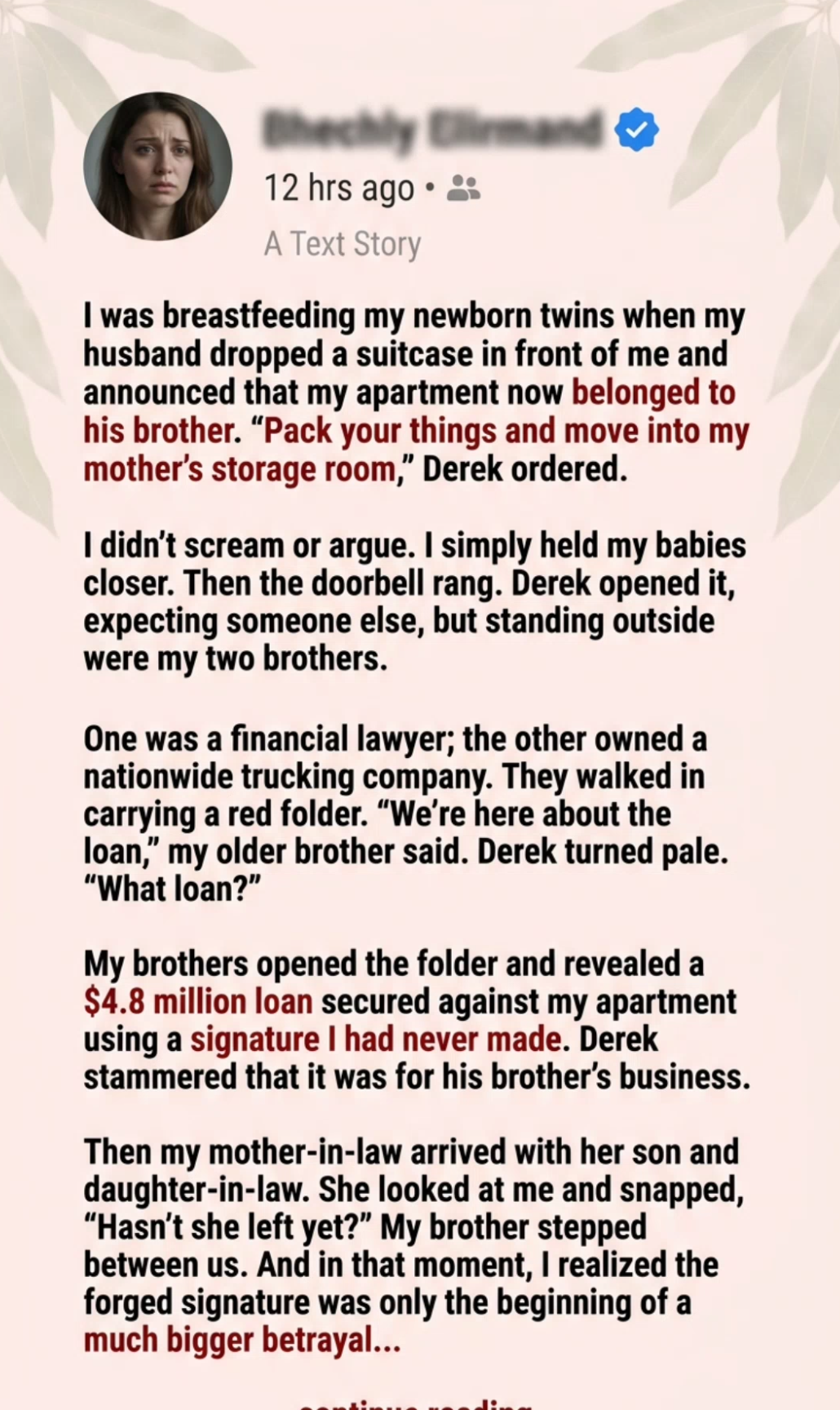
The suitcase landed on the floor with such force that one of my newborn twins startled awake. I was sitting on the sofa, breastfeeding little Emma while her brother, Ethan, slept in a bassinet beside me. I looked up at my husband, Derek, expecting him to explain why he had come home carrying luggage. Instead, he pointed toward the hallway and said something that made the room feel suddenly unfamiliar.
“Pack your things. You’re moving out.”
I stared at him.
“What?”
“This apartment belongs to my brother now. He needs somewhere to live, and my mother has already arranged everything. You can take the babies and stay in her storage room until you figure something out.”
For several seconds, I couldn’t speak. My arms tightened around Emma, and I instinctively glanced toward Ethan’s bassinet.
“You’re telling me to leave my home with two newborns?”
Derek shrugged.
“Don’t make this difficult. My brother has more important problems than you do.”
I looked around the apartment. The cream-colored curtains, the framed wedding photograph, the small dining table where we had celebrated our first anniversary, and the nursery we had spent months preparing were all still there. Everything belonged to the life I thought we had built together.
But there was something Derek had forgotten.
The apartment wasn’t his.
It wasn’t his mother’s.
And it certainly wasn’t his brother’s.
It belonged to me.
My name is Natalie Bennett. I was thirty-four years old, the mother of six-week-old twins, and until that afternoon, I believed my marriage was going through the ordinary exhaustion that comes with raising newborns.
My husband had become distant during my pregnancy. He spent more evenings with his family, answered calls in another room, and became unusually interested in my financial documents. Whenever I asked questions, he said I was worrying too much.
I had accepted those explanations because I wanted our family to work.
My apartment had been purchased four years before I met Derek. I had inherited a substantial amount from my late father, added my own savings, and purchased the property outright. The title was registered solely in my name. Derek moved in after our marriage, but I never transferred ownership or added him to the deed.
He knew that.
His mother, Margaret, knew it too.
Yet Derek was standing in my living room, ordering me to surrender the home where my children had been born.
I didn’t scream.
I didn’t throw anything.
I simply adjusted the blanket around Emma and asked, “Who told you that this apartment belongs to your brother?”
Derek looked irritated.
“Mom handled it.”
“Handled what?”
“The paperwork. Don’t pretend you don’t understand.”
I studied his face.
“Show me the paperwork.”
He laughed.
“You don’t need to see anything. You’re not the person making the decisions anymore.”
Then the doorbell rang.
Derek looked toward the entrance.
“That’ll be the movers,” he said.
He opened the door with an impatient expression.
But the people standing outside weren’t movers.
They were my brothers.
My older brother, Jonathan, was a financial lawyer who specialized in commercial lending, property disputes, and financial misconduct. My younger brother, Michael, owned a nationwide trucking company with operations in several states.
Jonathan carried a thick red folder.
Michael held a leather document case.
Neither man looked pleased.
“Good afternoon, Derek,” Jonathan said calmly.
Derek’s face changed.
“What are you doing here?”
“We’re here about the loan.”
Derek blinked.
“What loan?”
Jonathan stepped inside.
“The $4.8 million loan secured against Natalie’s apartment.”
For the first time since he had entered the room, Derek looked genuinely frightened.
“That’s not your business.”
Jonathan placed the red folder on the dining table.
“It became our business when someone submitted a mortgage application using my sister’s property and a signature she never authorized.”
Derek’s eyes moved from Jonathan to me.
I looked at him.
“What loan?”
He opened his mouth, but no words came out.
Michael closed the door behind him.
“Before anyone starts shouting, we should establish one thing. Natalie never signed a mortgage agreement. She never authorized anyone to use her apartment as collateral. And according to the preliminary records we received, the application was submitted using documents connected to her identity.”
Derek shook his head.
“You don’t understand. It was for my brother’s business.”
Jonathan opened the folder.
“Then your brother’s business can explain why it needed a loan secured against property he doesn’t own.”
At that exact moment, the doorbell rang again.
Derek turned toward it.
When he opened the door, his mother, Margaret, walked in with his younger brother, Ryan, and Ryan’s wife, Chloe.
Margaret was carrying a handbag and wearing the confident expression of someone arriving to collect something she believed was already hers.
She glanced at the suitcase on the floor.
“Hasn’t she left yet?”
Nobody answered.
Margaret looked at Jonathan.
“Who are you people to interfere in our family matters?”
Jonathan closed the red folder.
“I’m Natalie’s brother. And I suggest you sit down before you say anything else.”
Margaret laughed.
“Her brother? This is between Natalie and her husband.”
“No,” Jonathan replied. “This concerns a property registered exclusively to my sister and a multimillion-dollar loan application that appears to have been submitted using her identity.”
Margaret’s expression changed.
Ryan stepped forward.
“Let’s not exaggerate. It’s just business.”
Michael turned toward him.
“Then explain the business.”
Ryan looked at Derek.
Derek looked at his mother.
And for the first time, I understood that the suitcase on my floor was not an impulsive act of cruelty.
It was part of a plan.
A plan that had begun long before I gave birth to my twins.
My father, Robert Bennett, had been a careful man.
He built a successful logistics and distribution company through decades of hard work. He wasn’t a billionaire, and he never pretended to be one. But he understood contracts, property, and the importance of protecting what he had earned.
When he died, he left me the apartment and a separate investment portfolio.
He also left me something more valuable than money.
He taught me never to sign a document I hadn’t read and never to allow anyone to pressure me into making financial decisions.
Jonathan had helped me manage the legal side of the inheritance. Michael had helped me arrange the apartment renovations. Both brothers knew exactly how the property was owned.
Derek had learned about the apartment before our wedding.
At the time, he seemed impressed but never openly jealous.
He often said he admired my father’s planning.
Margaret, however, had a different reaction.
During one family dinner, she asked whether the apartment would eventually become part of Derek’s inheritance.
I explained that it was already mine and that I had no intention of changing the ownership arrangement.
She smiled, but her eyes remained cold.
“Marriage means sharing everything,” she said.
I replied that marriage meant sharing life, not automatically transferring ownership.
She never forgot that conversation.
After the twins were born, her visits became more frequent. She began asking about the apartment’s value, the mortgage-free status, and whether I had considered purchasing another property.
When I asked why she was interested, she said she was only thinking about the family’s future.
I had no idea she was discussing my property with her younger son.
Now, as Jonathan opened the red folder, the truth began to emerge.
The loan application had been submitted through a private lending company called Meridian Capital Finance.
The proposed borrower was a business registered under Ryan’s name.
The stated purpose was to expand his construction-material distribution operation, purchase vehicles, and acquire warehouse equipment.
The loan amount was $4.8 million.
The apartment had been listed as collateral.
My name appeared as the property owner.
And beneath it was a signature that looked remarkably similar to mine.
But it wasn’t mine.
Jonathan showed me a copy.
I recognized the shape of the letters, but the signature was wrong in several ways. The final stroke was too long. The spacing was uneven. My middle initial had been added in a place where I never put it.
“Who submitted this?” I asked.
“The lender’s preliminary file identifies Derek as the family contact,” Jonathan replied. “The application also lists Ryan’s company as the borrower.”
Derek stepped forward.
“I only helped with paperwork.”
Jonathan looked at him.
“Did you obtain Natalie’s authorization?”
“She knew we were discussing a loan.”
I stared at my husband.
“I never discussed a $4.8 million loan with you.”
“You knew Ryan was having financial problems.”
“That doesn’t mean I agreed to mortgage my home.”
Derek rubbed his forehead.
“Ryan needed help. His business was struggling. We were going to pay it back.”
“With what?” Michael asked.
Ryan answered before Derek could.
“The company was going to expand. Once the new contracts came through, the loan would be repaid.”
Michael gave a short, humorless laugh.
“Which contracts?”
Ryan looked uncomfortable.
“Several opportunities.”
“Name one.”
“That’s not the point.”
“It is exactly the point,” Michael replied. “You don’t borrow millions against someone else’s home based on opportunities you cannot identify.”
Margaret interrupted.
“Why are you attacking him? He’s family.”
Jonathan turned toward her.
“Being family doesn’t authorize someone to pledge another person’s property.”
Margaret raised her voice.
“Natalie is married to Derek. What belongs to her belongs to him.”
“No,” Jonathan said. “Not under the ownership documents, and not without the legal authorization required for this transaction.”
I looked at Derek.
“Did you sign my name?”
He stared at the floor.
“I didn’t think it would become a problem.”
My heart seemed to stop.
“That isn’t an answer.”
He looked up.
“I was trying to help my brother.”
“Did you sign my name?”
He remained silent.
Jonathan closed the folder.
“That’s enough. We will deal with the documents through the proper channels.”
Margaret stepped between us.
“You can’t threaten my son.”
“I’m not threatening anyone,” Jonathan replied. “I’m protecting my sister’s property and preserving evidence of a potentially fraudulent transaction.”
Michael moved the suitcase away from the doorway.
“Nobody is removing Natalie or the children from this apartment.”
Margaret pointed at me.
“She has been turning you against us for years.”
I almost laughed.
I had spent years trying to keep peace between Derek and his family. I had paid for dinners, helped with family emergencies, bought gifts for birthdays, and never questioned the countless weekends Derek spent helping Ryan.
Yet now I was being accused of destroying the family because I refused to give away my home.
Then Jonathan turned to Derek.
“Before we continue, I need to ask you something. Did you know the lender had already ordered a property valuation?”
Derek looked startled.
“What?”
Jonathan removed another document.
“An independent valuation was completed two weeks ago. The report identifies the apartment, its estimated market value, and the fact that it is occupied by Natalie and her children.”
I looked at the date.
Two weeks earlier, I had been recovering from a difficult night with the twins.
Derek had told me he was taking care of some insurance paperwork.
He had used that time to arrange an inspection of my property.
I felt sick.
The apartment was quiet after Margaret, Ryan, and Chloe finally left.
Jonathan had made it clear that no one should sign anything or make any agreements until the lender’s records were reviewed. Michael stayed with me while Jonathan contacted the relevant legal professionals and requested that the lender preserve the original application and supporting documents.
Derek remained in the living room.
He looked smaller somehow.
“Can we talk?” he asked.
I was holding Ethan, who had started crying.
“Not while I’m feeding our son.”
He sat down.
“I know you’re upset.”
I looked at him.
“Upset?”
“I made a mistake.”
“You tried to give my home to your brother.”
“I wasn’t giving it away.”
“You used it to secure a $4.8 million loan without my permission.”
“I thought we could handle it.”
“How?”
He didn’t answer.
I placed Ethan in his bassinet and checked that Emma was sleeping comfortably.
Then I faced him.
“How long have you been planning this?”
He rubbed his hands together.
“Ryan’s company was in trouble. He had debts.”
“How much?”
“I don’t know exactly.”
“How much, Derek?”
He looked away.
“About $1.6 million.”
I stared at him.
“And you thought the solution was to borrow $4.8 million against my apartment?”
“It wasn’t all for debt repayment.”
“Where was the rest going?”
He didn’t answer.
That silence told me more than any explanation could have.
I asked him to leave the apartment for the night.
He became angry.
“You can’t throw me out of my own home.”
I pointed toward the ownership documents on the table.
“This is my home. You live here because I allowed us to build a life together. That doesn’t give you the right to use it as collateral.”
He stood up.
“You’ve changed since the babies were born.”
“No, Derek. I’ve finally started asking questions.”
He grabbed his jacket and left.
I locked the door.
Then I sat on the floor beside the bassinet and cried.
Not because I wanted him back.
But because I had to accept that the person I had trusted with my children had been willing to risk their home for someone else’s business.
The next morning, Jonathan returned with an update.
The lender had confirmed that the loan had not yet been fully funded.
That was important.
The application had passed an initial review, and the property valuation had been completed. However, final verification and registration requirements remained outstanding.
The lender had placed the transaction under review after receiving questions about the ownership documents and authorization.
Jonathan had formally notified the lender that I disputed the signature and had not consented to the use of my property.
He also advised me to contact the relevant authorities about the suspected forgery.
I agreed.
A formal report was filed.
I provided identification documents, copies of the original property records, and examples of my genuine signature from earlier legal transactions.
A handwriting examination could not be completed immediately, but the disputed signature was preserved for comparison.
The lender also began reviewing the documents submitted by Derek and Ryan.
That was when the first major inconsistency appeared.
The loan application claimed that I had personally attended a document-signing appointment.
But I had been in the hospital recovering from childbirth on the date recorded.
I had medical records proving it.
The appointment had supposedly taken place at a legal services office across town.
Jonathan contacted the office and requested confirmation of the appointment details.
The office replied that it had no record of meeting me.
The name of the supposed witness was also incorrect.
Someone had copied details from an old property document and used them to create a false trail.
The more we examined the application, the less it resembled a genuine loan transaction.
Then the lender discovered something else.
The requested funds were supposed to be transferred into Ryan’s business account.
But the account details listed in the final payment instructions did not match the company’s registered banking information.
Instead, they pointed to a separate business account controlled by a company connected to a former associate of Ryan.
Jonathan studied the documents for a long time.
“This isn’t simply a brother asking for financial help,” he said.
“What do you mean?”
“I think someone intended to move the money through multiple accounts before the lender discovered the inconsistencies.”
Michael leaned forward.
“Could Ryan have known?”
Jonathan looked at the paperwork.
“That’s what the investigation needs to establish.”
I thought about Derek.
Had he known?
Had he been tricked too?
Or had he been part of the entire arrangement?
Three days later, Margaret called me.
I almost ignored it.
But something in me wanted to hear what she would say when she could no longer pretend that the apartment belonged to her family.
I answered.
“You need to tell your brothers to stop,” she said.
“Good morning to you too.”
“This situation has gone too far.”
“Your sons submitted a loan application using my apartment.”
“Ryan is under enormous pressure. He has employees depending on him.”
“Then he should have spoken to a bank about his own assets.”
“He doesn’t have enough collateral.”
“That isn’t my responsibility.”
Margaret sighed.
“You are being selfish.”
I closed my eyes.
“Margaret, I have two newborn babies. I am recovering from childbirth. I should be worrying about feeding them, not defending my home from my husband’s family.”
“Family helps family.”
“Then why did you tell Derek to move me into your storage room?”
She went silent.
I continued.
“Why did you think I should leave my own apartment?”
“Because the house would have been better used by Ryan and Chloe.”
I couldn’t believe what I was hearing.
“Better used?”
“Ryan needs space for his business. You have somewhere else you can stay.”
“My children live here.”
“Children adapt.”
That was the moment I understood that Margaret had never considered my twins when she made her plans.
To her, my home was an available asset.
My children were an inconvenience.
I ended the call.
Then I saved the recording of the conversation, where permitted by the applicable law, and sent the details to Jonathan.
I didn’t want to fight with her.
I wanted everything documented.
A week later, Derek returned.
He arrived without warning, carrying flowers and a small bag of groceries.
I opened the door only because I could see him through the security camera.
He looked tired.
“Can I come in?”
I stepped aside but kept the conversation in the living room.
He placed the flowers on the table.
“I’ve been thinking.”
“About what?”
“About us.”
I didn’t respond.
He sat down.
“I know I made a terrible mistake. But I want you to understand that Ryan was desperate. His business was collapsing. Mom was putting pressure on me. I thought the loan would solve everything.”
“Why didn’t you ask me?”
“Because I knew you’d say no.”
I stared at him.
“So you knew I wouldn’t agree, and you decided to use my signature anyway?”
He looked ashamed.
“I didn’t think it would go this far.”
I asked him to explain exactly what he had done.
He finally admitted that he had provided copies of my property documents to Ryan. He had also given him an old signature from a bank form.
Derek claimed Ryan had told him the lender only needed a preliminary authorization to begin the valuation process.
But when the documents were prepared, my name appeared on a mortgage consent form.
Derek said he had signed it himself.
He claimed he believed the transaction could be corrected later.
“Did you tell Ryan I had agreed?”
He nodded.
“Why?”
“Because I thought you would eventually understand.”
I looked at him for a long time.
“You didn’t want my agreement. You wanted the appearance of my agreement.”
He lowered his head.
I asked whether he knew about the separate payment account.
He said he had not.
He also claimed he had not known that the application included a false witness record.
I couldn’t determine whether he was telling the truth.
But I no longer had to decide that by listening to his promises.
The investigation would examine the evidence.
I told him that he could communicate with me through the appropriate legal channels and that I would not discuss financial matters privately.
He stood up.
“Are you ending our marriage over this?”
I answered honestly.
“I’m considering whether I can remain married to someone who was prepared to make our children’s home disappear without asking me.”
He looked at the nursery.
Then he left.
The biggest revelation came two weeks later.
Jonathan called me early one morning.
“Have you ever heard of a company called Northbridge Asset Solutions?”
“No.”
“Does the name Peter Caldwell mean anything to you?”
“No.”
“All right. I want you to come to my office when you’re ready. We found something important.”
I arranged for Michael to stay with the twins and drove to Jonathan’s office.
He had spread several documents across the conference table.
The first was a corporate registration record.
The second was a bank transfer history obtained through the appropriate legal process.
The third was a series of emails connected to Ryan’s loan application.
Jonathan explained that Northbridge Asset Solutions was a company that had been listed as a consulting partner in Ryan’s business expansion plan.
It had no meaningful operating history.
Its registered address was a small office suite.
Its director was Peter Caldwell, the same person whose company account appeared in the payment instructions.
The proposed $4.8 million loan had been divided into several planned payments.
A portion would supposedly pay Ryan’s existing creditors.
Another portion would purchase warehouse equipment.
A third portion would be transferred to Northbridge as a consulting and acquisition fee.
But the emails revealed something far more troubling.
The arrangement had been discussed before the loan application was submitted.
One message referred to the apartment as “the cleanest available collateral.”
Another said the property owner was “unlikely to review the paperwork during the newborn period.”
I read that sentence twice.
The newborn period.
They had counted on me being too exhausted to notice.
I felt something inside me turn cold.
“Who wrote this?”
Jonathan pointed to the sender information.
The message had been sent from an account associated with Ryan’s company.
Another email had been forwarded to Derek.
His reply was only four words.
“She won’t find out.”
I couldn’t breathe.
Jonathan placed a hand on the table.
“There’s more.”
The emails suggested that Derek had been involved in discussions about the proposed transfer of funds.
He had not simply provided paperwork.
He had helped arrange the use of my property as collateral.
The plan also involved transferring the apartment’s occupancy rights to Ryan’s family after the loan was completed, although the proposed documents did not legally establish such rights.
They had intended to pressure me into leaving once the lender believed the property was secured.
The suitcase had been part of that pressure.
Derek wanted me out before I could discover what had been submitted.
I remembered his words.
“Pack your things and move into my mother’s storage room.”
He had not been improvising.
He had been trying to complete the final part of a plan.
The investigation moved forward.
The lender suspended the application and referred the disputed documents for further review. The relevant authorities examined the signature, the false witness information, the communications, and the proposed payment instructions.
Ryan claimed that he had believed Derek had permission to use the apartment.
Derek claimed that Ryan had handled the financial paperwork.
Margaret insisted that she had only been trying to help her sons.
But the messages told a different story.
The authorities eventually established that the loan application contained forged authorization and false supporting information. The lender withdrew the transaction rather than proceed.
The money was never released.
That was the one piece of good news I desperately needed.
My apartment remained legally mine.
No lender acquired an enforceable mortgage interest through the disputed application, and no one had the authority to remove me or my children from the property simply because Derek demanded it.
The case continued through the appropriate legal proceedings.
Derek and Ryan faced serious scrutiny over their roles in the false documentation and financial arrangements. Their legal responsibilities were determined through the process, with evidence considered separately for each person.
I did not demand that anyone be punished without proof.
I wanted the truth established.
I also wanted my children protected.
The marriage did not survive.
At first, Derek sent long messages about forgiveness.
He said he had been under pressure.
He said Margaret had influenced him.
He said Ryan had promised to repay the loan.
He said he had never intended for me or the twins to become homeless.
But none of those explanations changed the central fact.
He had been willing to risk the home where his children lived.
When I asked him whether he would have done the same thing if the apartment belonged to his mother, he didn’t answer.
That silence was enough.
I consulted an independent family lawyer and began the separation process.
We discussed temporary arrangements for the twins, financial responsibilities, and appropriate contact. Nothing was decided overnight. The children’s needs, Derek’s circumstances, and the available evidence were considered through the proper legal procedures.
I did not prevent Derek from being their father.
But I also refused to let him use the children as a way to pressure me into dropping the financial investigation.
My lawyer made sure that our communications remained documented.
The apartment’s ownership was separately confirmed through the property records.
The disputed loan documents were preserved.
And I changed the access arrangements to my financial accounts, property files, and personal records.
I also reviewed every document Derek had ever been allowed to handle.
It was exhausting.
But it was necessary.
The hardest moment came when my twins were nearly four months old.
I was feeding Emma when Daniel, Derek’s father, called.
He had rarely interfered in family disagreements, but this time his voice sounded different.
“Natalie, I owe you an apology.”
I remained quiet.
He explained that Margaret had told him I was being unreasonable and refusing to help Ryan.
He had believed her.
He had also been told that I had voluntarily agreed to let Ryan use the apartment as security.
When the loan investigation began, Daniel finally asked to see the documents.
He discovered that no one had shown him the actual mortgage application.
He had been told only that I had agreed to “temporary financial support.”
“I should have asked you,” he said.
“Yes, you should have.”
He sighed.
“I don’t expect you to forgive us.”
I looked at Emma, who had fallen asleep against my arm.
“Daniel, I don’t want another argument. I want my children to grow up in a family where people tell the truth.”
“I understand.”
“Then don’t repeat things you hear from Margaret or Derek without checking them.”
He promised he wouldn’t.
It was a small beginning.
But I had learned that promises were only meaningful when followed by consistent behavior.
Several months later, I received a letter from Ryan’s attorney.
The letter confirmed that Ryan’s company would no longer pursue the proposed financing arrangement and that the company disputed certain aspects of the transaction.
There was no admission of wrongdoing in the letter.
But the investigation had established enough documentary evidence for the relevant authorities to continue examining the false application and the people involved.
The lender had formally closed the application.
My property records remained unchanged.
I had the locks changed, reviewed the building’s security arrangements, and made sure that only people I personally authorized could access the apartment.
Derek moved into a separate residence.
The separation agreement eventually addressed the twins’ care, financial support, and parenting arrangements. It was not a perfect resolution, but it provided a structure that kept the children away from the worst of the adult conflict.
I returned to work gradually.
My brothers helped with practical matters, but they never tried to control my decisions.
Jonathan remained available whenever legal questions arose.
Michael helped arrange reliable transportation for the twins and made sure I had support when I needed it.
One evening, I sat with them in my living room.
The same living room where Derek had dropped the suitcase.
The same floor where Emma had startled awake.
The same table where Jonathan had opened the red folder.
Michael looked around.
“Feels different now.”
I smiled faintly.
“It is different.”
Jonathan raised his glass of water.
“To the house staying exactly where it belongs.”
We laughed.
It was the first time I had laughed freely in months.
A year after that afternoon, my twins celebrated their first birthday.
The apartment was filled with balloons, toys, and relatives who had come to celebrate.
Emma wore a pink dress.
Ethan wore a tiny blue shirt and spent most of the party trying to pull the decorations off the table.
My brothers stood near the kitchen, arguing playfully about which twin had inherited whose personality.
For a moment, I looked at the apartment and remembered how close I had come to losing everything.
Not because I had failed to pay a bill.
Not because I had neglected my responsibilities.
But because someone had decided that my signature, my property, and my future were things they could use without my permission.
Derek had sent me away with a suitcase.
He believed I would be too exhausted, too frightened, and too dependent to fight back.
He had forgotten that I had spent years building a life before I ever met him.
He had forgotten that my father had taught me to protect what was mine.
And he had forgotten that I was not alone.
After the guests left, I placed Emma and Ethan in their cribs and returned to the living room.
The red folder was no longer on the dining table.
Jonathan had kept the relevant copies with the legal records.
But I still remembered the moment he had said the words that changed everything.
“We’re here about the loan.”
I used to think a home was defined by the people who lived inside it.
Now I understood that a home also needed honesty, respect, and safety.
The apartment was still mine, but that was no longer the most important thing.
The most important thing was that my children had a mother who could stand up for them, a family that would protect them without controlling them, and a future that would not be built on someone else’s lies.
I never returned to the marriage.
I never gave Ryan the apartment.
And I never allowed Margaret to convince me that refusing to surrender my property made me a selfish woman.
Years later, when Emma and Ethan were old enough to ask why their father lived somewhere else, I planned to explain the truth carefully and without turning them against him.
They deserved honesty, not hatred.
As for the suitcase Derek had left in my living room, I eventually donated it to a local shelter.
I didn’t want to keep a reminder of the day someone tried to take my home.
I wanted the space back.
And I wanted the last thing my children remembered about that apartment to be the sound of laughter, not the sound of their mother being ordered to leave.
The End