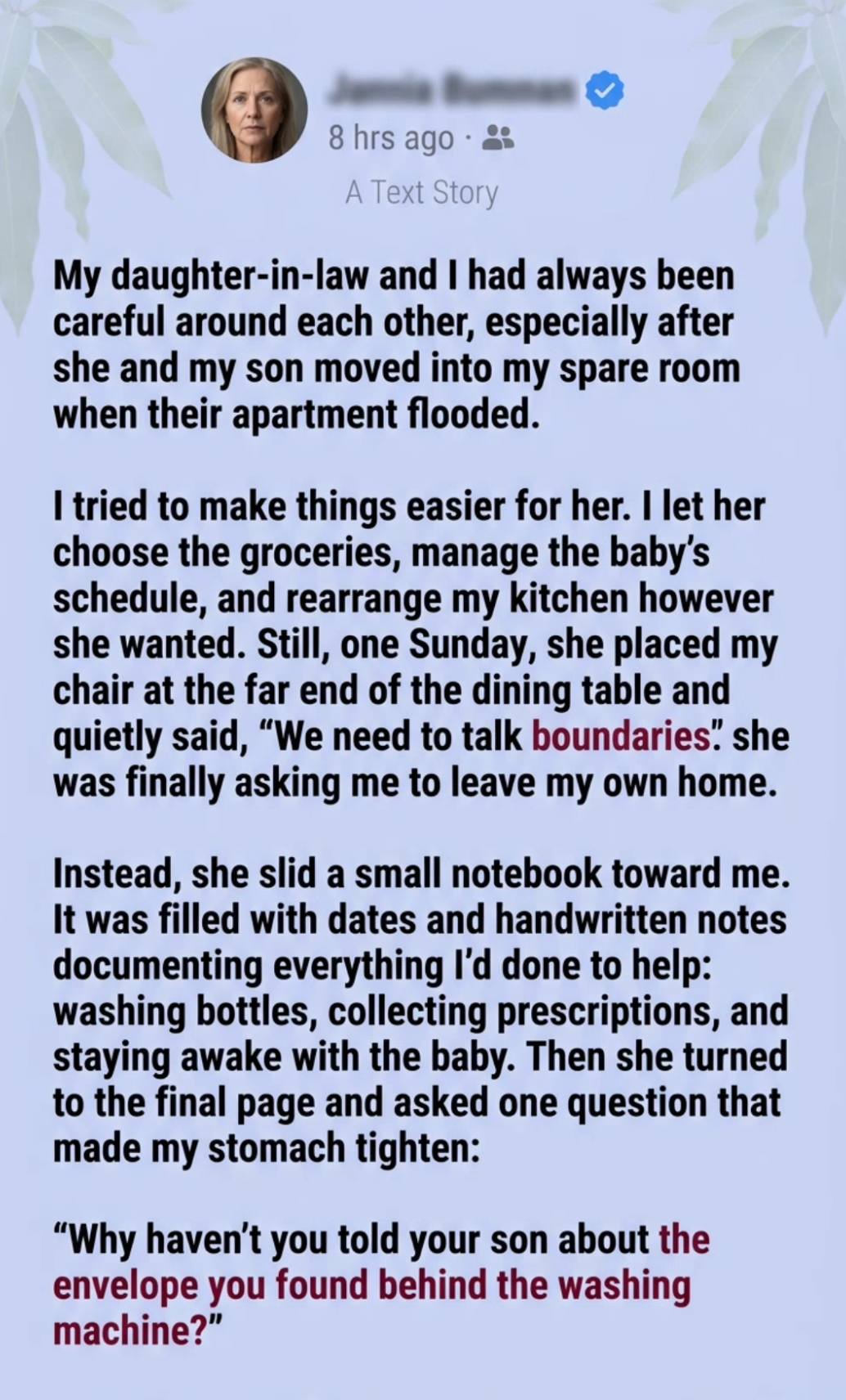
I had always believed that the hardest part of sharing a home with your grown children was learning when to speak and when to remain silent. I was sixty-seven years old, a widow, and had lived alone in the same three-bedroom house for nearly twenty years. My husband, Robert, had passed away seven years earlier, and since then, the house had become my quiet refuge. I enjoyed my morning coffee beside the kitchen window, tending to my roses, and listening to the radio while preparing dinner. I wasn’t lonely, exactly. I had my routines, my neighbors, and my son, Daniel, who visited whenever his work allowed. Then, one rainy Thursday evening, Daniel arrived with his wife, Claire, and their ten-month-old daughter, Lily. Their apartment building had suffered a major water leak after a pipe burst in the unit above theirs. The ceiling in their bedroom had collapsed, the nursery floor was soaked, and the property manager told them repairs could take several weeks. Daniel looked embarrassed when he asked whether they could stay with me temporarily. “Only until the apartment is fixed, Mom,” he promised. “We don’t want to inconvenience you.” I opened the door wider. “You’re my family. You don’t need to ask twice.” I prepared the spare bedroom, cleared space in the bathroom, and moved some furniture so Claire could have room for Lily’s crib. I even gave them the larger bedroom because I thought it would be easier for a young couple with a baby. I moved into the smaller room at the back of the house without complaint. At first, everything went smoothly. Claire was polite, Daniel helped with groceries, and Lily quickly became the center of my days. I loved hearing her little feet patter across the hallway when she began crawling. I offered to help whenever I could, but I was careful not to interfere with Claire’s parenting. If she wanted the groceries arranged differently, I changed them. If she preferred a particular brand of baby formula, I bought it. If she wanted the kitchen shelves reorganized, I moved everything without arguing. I washed bottles, collected prescriptions, folded tiny clothes, and stayed awake when Lily developed a fever. I never expected praise. I thought that was what family did. But as the weeks passed, something changed. Claire began speaking less whenever I entered the room. She would take Lily from my arms without explanation and sometimes rearrange things I had just put away. Daniel seemed caught between us. When I asked whether everything was all right, he always said Claire was tired. I understood that raising a baby was exhausting, especially when you were temporarily living in someone else’s home. So I tried harder to make things comfortable. I stopped inviting my friends over. I postponed my gardening club meetings and began preparing meals according to Claire’s preferences. I even moved my favorite reading chair out of the living room because she said it made the space feel crowded. I told myself that the arrangement was temporary. Then, one Sunday afternoon, Claire did something that I couldn’t understand. We were preparing to have lunch when she moved my usual dining chair from beside Daniel to the far end of the table. She placed a folded napkin beside it and waited until everyone had sat down. Daniel looked confused but said nothing. Lily was playing with a spoon in her high chair. Claire folded her hands. “We need to talk about boundaries.” I looked at her. “All right.” I assumed she was finally going to tell me that she and Daniel had found another place and wanted me to stop helping so much. Instead, she reached into her handbag and placed a small notebook on the table. “I’ve been keeping records,” she said. I glanced at the cover. It was a plain brown notebook with a blue elastic band. “Records of what?” “Everything you’ve done since we moved in.” I felt embarrassed. “Claire, you didn’t need to do that.” She opened the notebook and turned it toward me. There were dates, short descriptions, and carefully written notes. “November 4: Eleanor washed all the bottles after Lily’s evening feeding.” “November 6: Eleanor collected Lily’s prescription from the pharmacy.” “November 9: Eleanor stayed awake until 2:15 a.m. because Lily had a fever.” “November 12: Eleanor prepared meals and bought groceries without asking for money.” I looked at her, uncertain what she wanted me to say. She turned several pages. There were dozens of entries. Every small thing I had done had been recorded. Then she reached the final page and placed her finger beneath a handwritten sentence. “Why haven’t you told your son about the envelope you found behind the washing machine?” My stomach tightened. I stared at her. The room seemed to grow quiet. “What envelope?” Daniel asked. Claire looked at me. I looked at Daniel. And suddenly, I realized that this conversation had nothing to do with my chair. Three weeks earlier, I had found an envelope behind the washing machine while cleaning the laundry area. It had been wedged between the wall and the appliance, partially covered in dust. I had pulled it out because I thought it might contain an old instruction manual or a forgotten bill. Instead, I found several folded documents and a handwritten note. The envelope had no name on the outside, but the papers inside contained information about a financial arrangement connected to my late husband. I had not told Daniel because I hadn’t understood what the documents meant. I had placed the envelope in my bedroom drawer and intended to ask my solicitor about it. I had never mentioned it to Claire. “How do you know about that envelope?” I asked. Claire didn’t answer immediately. Daniel looked between us. “Mom, what envelope?” I took a breath. “I found something behind the washing machine a few weeks ago. I haven’t had time to understand it.” Claire nodded slowly. “I know.” “How?” “Because I saw you put it in your bedroom drawer.” I felt uncomfortable. “You were watching me?” “No. I was looking for the spare laundry detergent. I happened to see it.” I turned toward Daniel. “I wasn’t hiding anything from you. I simply didn’t know what I had found.” Claire closed the notebook. “That’s why I wanted to talk.” Daniel leaned forward. “Then explain it.” Claire took a moment before speaking. “When the apartment flooded, we had to move quickly. Some of our belongings were damaged, and we were trying to recover important documents. While we were staying here, I noticed that your washing machine had been moved slightly away from the wall. I was trying to clean behind it because Lily’s toys kept rolling into the laundry area. That’s when I noticed an old envelope.” I frowned. “But I found it.” “I know. I saw you pick it up later.” “Why didn’t you say anything?” Claire looked at Daniel. “Because I wasn’t sure what it was, and I didn’t want to start a conversation without knowing the full story.” I felt a strange mixture of embarrassment and suspicion. “Then why write it in your notebook?” Claire opened the notebook again. “Because I wanted to remember what happened, including the things you did for us. But the envelope was different. I recognized the name on one of the documents.” Daniel looked at her sharply. “Whose name?” Claire reached into her handbag and took out a photocopy. She placed it beside the notebook. The document contained the name of a company my husband had once worked with. I recognized it immediately. Robert had been a partner in a small property investment business before he retired. He had sold most of his interest years before his death, or so I had believed. The document appeared to concern an unresolved payment connected to that company. “Where did you get this?” I asked. “I photographed the page when I saw it,” Claire admitted. “I know I shouldn’t have done that without asking. I’m sorry.” Daniel picked up the photocopy. “Mom, why would Dad have documents about this company hidden behind the washing machine?” “I don’t know.” I felt my hands growing cold. The envelope had contained more than one document. There was a bank statement, a letter from a solicitor, and a note in Robert’s handwriting. I had read the note only once. It said that a particular payment had been placed into a separate account for “the family matter,” and that I should speak with his solicitor if anything happened to him before the matter was resolved. I had assumed it referred to an old business dispute. But now Claire had recognized the company name. “Did you know something about this?” I asked her. She shook her head. “Not until I saw the document.” Daniel looked troubled. “Why didn’t you tell me when you first found it?” Claire answered quietly. “Because I didn’t know whether it was something your father wanted kept private.” I turned toward her. “You have no right to decide what information I should share with my son.” She lowered her eyes. “You’re right.” The honesty in her answer surprised me. I had expected an argument. Instead, she pushed the notebook toward me again. “I didn’t write this to accuse you. I wrote it because I was trying to understand how much you had been doing for us. And because I wanted to remember something else.” “What?” “That you were helping us while carrying something important alone.” Daniel leaned back. “I still don’t understand why you moved Mom’s chair.” Claire looked at him. “Because I wanted her to sit where she could see both of us. I didn’t want this conversation happening with her at the end of the table, feeling like she was being surrounded. But I realize now that it looked like I was putting her in her place.” I looked at the chair. It was still at the far end of the table. I didn’t know whether to laugh or cry. “It certainly felt that way.” Claire nodded. “I’m sorry.” I studied her face. For weeks, I had believed she resented me. Perhaps she did, at least sometimes. But there was something else in her expression now: anxiety, embarrassment, and a determination to finish what she had started. I stood up and went to my bedroom. I returned with the envelope. Daniel opened it carefully. The first paper was an old statement from a bank account I had never seen before. It showed a balance of just over $620,000 at the time of Robert’s death. The account had been established years earlier in connection with the property investment company. The second document was a letter from Robert’s solicitor, dated eight months before he died. It stated that Robert had retained a financial interest in a property development project and that certain payments remained outstanding. The third document was a handwritten note. I recognized Robert’s writing immediately. “Eleanor, if these papers are found, please do not sign anything until Jonathan Price has reviewed them. The money was never intended for the company directors personally. It was set aside for the family, and I want you to have the full explanation.” I read it twice. Daniel looked at me. “Who is Jonathan Price?” I shook my head. “I don’t remember that name.” Claire spoke softly. “It’s on the solicitor’s letter.” We checked the address and contact details. The letterhead belonged to a law firm that had since merged with another practice. Daniel suggested we contact the current firm rather than make assumptions. I agreed. The next morning, I called and arranged an appointment. The solicitor who met us was a woman named Rebecca Collins. She reviewed the documents carefully and explained that the account appeared to relate to a long-running property investment arrangement. Robert had been one of several investors in a development project. The company had later sold the property, but a portion of the proceeds had been held in a separate account pending the resolution of a dispute involving the original partnership. The account was not automatically mine simply because my husband had died. The documents would need to be verified, the partnership records reviewed, and the estate’s legal position established. But the papers suggested that Robert had intended for his share of the proceeds to pass to his family through his estate. Rebecca requested the original documents and began contacting the former administrators of the partnership. Over the following weeks, she obtained archived company records, bank statements, and correspondence. The account had not been abandoned. It had been maintained under a separate arrangement while a dispute between two former business partners was resolved. The original amount had grown through interest and investment returns, but there were also outstanding fees and tax questions. The final value could not be confirmed until the accounting was complete. Daniel was stunned. “Dad never told us about this.” I looked at the old note. “Maybe he was waiting until everything was settled.” Rebecca cautioned us against making assumptions. She explained that Robert’s estate documents and the partnership agreement would determine who was entitled to the funds. She also warned us not to share the financial information widely until the review was complete. I agreed. I didn’t want money to become another source of conflict in the family. But the situation had already changed something between Claire and me. She had known about the envelope before Daniel did. She had kept notes about my help. And she had chosen to bring the issue into the open rather than quietly use the information. I still didn’t understand why she had been so careful around me. A few days later, I asked her directly. Daniel was at work, and Lily was asleep in her crib. Claire was sitting at the kitchen table, sorting baby clothes. “Can I ask you something?” I said. She looked up. “Of course.” “Have I made you uncomfortable since you moved in?” She paused. “Sometimes.” I appreciated her honesty. “Why?” She placed a folded shirt on the pile. “I know you mean well. But sometimes I feel like I can’t do anything without worrying that I’m disappointing you.” I was surprised. “I have never wanted you to feel that way.” “I know. But when you buy groceries, cook dinner, wash bottles, and take Lily whenever I look tired, I sometimes feel like I’m failing as her mother.” I sat down. “Claire, I help because I love you both. Not because I think you can’t manage.” She nodded. “I understand that now. But when we first moved in, I felt like I had lost control of everything. Our apartment was damaged, our belongings were in storage, and we were depending on you. I was grateful, but I was also ashamed that I couldn’t give Lily a stable home.” I thought about that. I had seen her distance as rejection. She had experienced my kindness as a reminder of how much she needed help. “You could have told me,” I said. “I was afraid you’d think I was ungrateful.” “And I was afraid you didn’t like me.” Claire looked at me for a long moment. Then she smiled faintly. “I think we both made things harder than they needed to be.” We agreed on a few practical boundaries. I would stop rearranging the kitchen unless Claire asked. She would tell me when she needed help instead of silently withdrawing. We would respect each other’s private spaces, and no one would photograph or copy another person’s documents without permission. Most importantly, we would speak directly rather than allowing assumptions to grow. It was not a perfect solution, but it was a beginning. Meanwhile, Rebecca’s investigation continued. She eventually confirmed that Robert’s share of the property investment proceeds had been held in the separate account for several years. The partnership dispute had been resolved shortly before Robert died, but the final distribution had not been completed because the administrator had been unable to locate one of the beneficiaries. The records showed that Robert had been entitled to a substantial payment. His estate had a valid claim to it, subject to the final accounting and applicable taxes. After several months of review, the amount available to the estate was confirmed at approximately $780,000. It was a life-changing sum, but it wasn’t a mysterious fortune that could be withdrawn immediately. The estate needed to complete the required documentation, resolve the tax treatment, and verify the beneficiary arrangements. Rebecca handled the legal process, and I followed her advice. Daniel never demanded a share. He simply wanted to understand why his father had kept the matter private. One evening, he sat with me in the garden. “Do you think Dad was hiding it from us?” he asked. I shook my head. “I think he was trying to protect something until it was settled. He may have believed it would be easier to explain when everything was final.” Daniel looked at the roses. “I wish he had told me.” “So do I.” Then he asked about Claire’s notebook. I had kept it on the kitchen shelf. “Why did she write down everything you did?” he asked. “She said she wanted to remember.” “Do you believe her?” I considered the question. “I think she was overwhelmed. I think she was trying to make sense of a situation where she felt dependent on someone else. And I think she eventually realized that I was helping because I loved her, not because I wanted control.” Daniel nodded. “I should have noticed how uncomfortable you both were.” I placed my hand on his arm. “You were trying to manage a damaged apartment, a new baby, and a job. You weren’t going to notice everything.” He smiled sadly. “Still, I could have done better.” “We all could have.” A month later, the apartment repairs were completed. Daniel and Claire began moving their belongings back. I helped them pack, but this time I waited for Claire to ask before doing anything. She thanked me for every small thing. On their final evening, she brought Lily into my room. The baby was wearing a yellow sweater and holding a soft rabbit. “We wanted to say thank you,” Claire said. I smiled. “You don’t have to thank me.” “I know. But I want to.” She placed Lily in my arms. “You helped us when we had nowhere else to go. I was too overwhelmed to appreciate it properly.” I kissed Lily’s forehead. “You were going through a difficult time. I understand.” Claire then handed me the little brown notebook. “I thought you should have it.” I opened it. The pages still contained every date and every task. But she had added a final entry. “The day I learned that help is not the same as control, and that gratitude should never be confused with debt.” I looked at her. “You don’t owe me anything.” “I know,” she said. “That’s why I wanted to give this back.” After they moved out, the house became quiet again. But it no longer felt as empty as it had before. Daniel and Claire visited regularly, and Claire began calling me when she needed advice rather than waiting until she felt overwhelmed. I also learned to ask before offering help. The money from Robert’s investment was eventually distributed through the estate according to the verified legal documents. I used a portion to strengthen my retirement savings, set aside funds for Lily’s education, and make a modest donation to a local family-support organization. I didn’t give anyone large gifts or make promises I couldn’t sustain. I wanted the money to provide security, not create expectations. One afternoon, several months after the move, Claire invited me to lunch at their repaired apartment. She had prepared my favorite vegetable soup. Lily was sitting in her high chair, banging a spoon against the tray. When I arrived, Claire pulled out a chair beside her. “I saved this seat for you,” she said. I smiled. “Thank you.” As we ate, she asked whether I still had the notebook. I told her I did. “Sometimes I read the last page,” I admitted. She looked embarrassed. “I hope it doesn’t upset you.” “No. It reminds me that we nearly misunderstood each other completely.” Claire reached across the table and squeezed my hand. “I’m glad we didn’t.” I looked around the apartment. The walls had been repainted, the nursery had new flooring, and the living room was filled with sunlight. Their lives had returned to normal, but our relationship had changed in ways that I hoped would last. I used to think boundaries were walls people built when they wanted distance. Now I understood that healthy boundaries could also protect love. They allowed people to help without controlling, to accept help without feeling powerless, and to speak honestly without turning every disagreement into a rejection. The notebook had begun as a record of everything I had done. But the final page had become something more important. It reminded us that kindness should not be measured like a debt, and family should never require anyone to surrender their dignity to prove they belong. As for the envelope behind the washing machine, I eventually placed the original documents in a secure file with my solicitor. I no longer kept important things hidden in forgotten corners. And I no longer assumed that silence was the kindest way to protect the people I loved. Sometimes the most loving thing a family can do is sit at the same table, ask the difficult question, and finally listen to the answer. The End