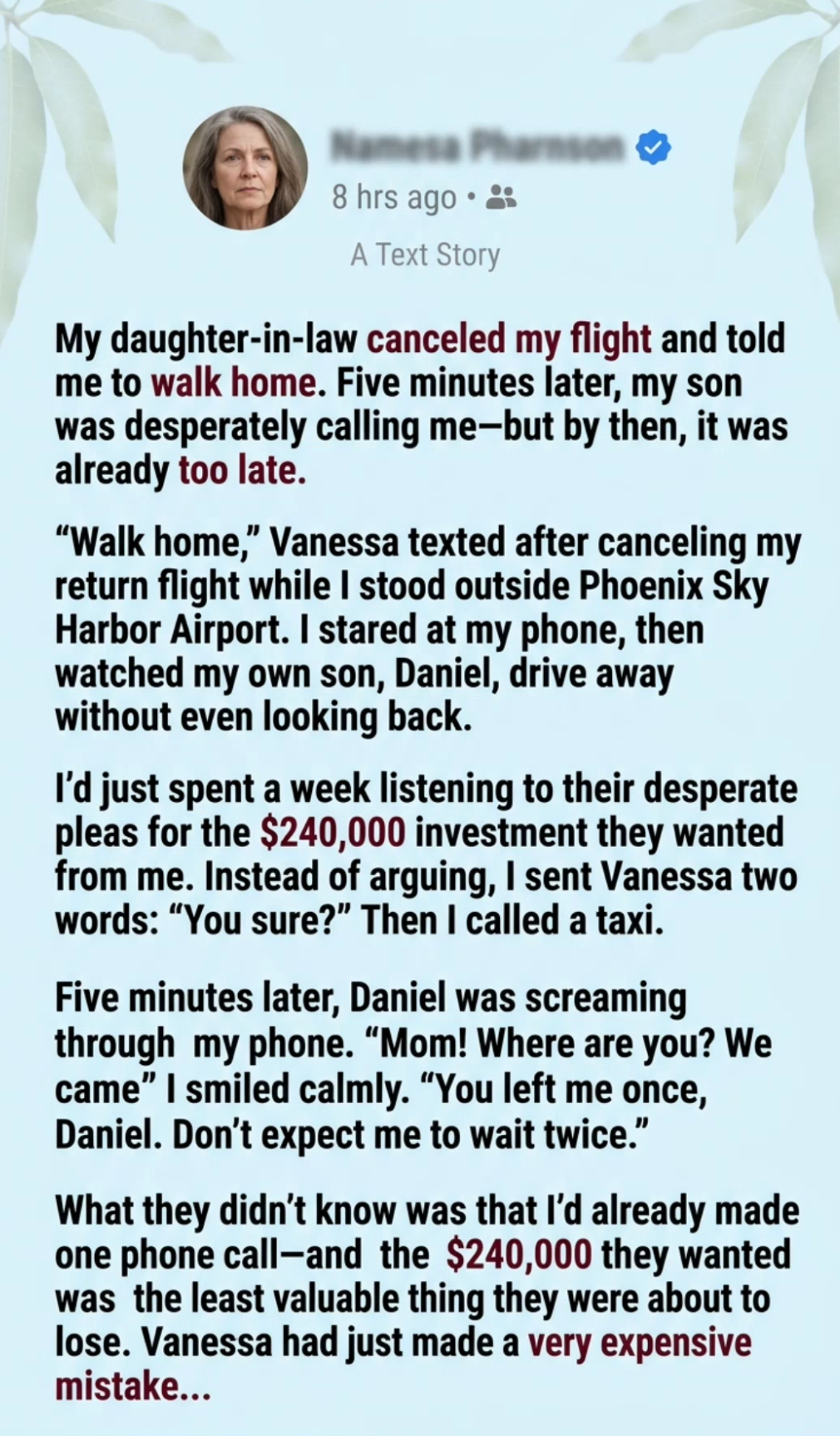
At seventy-one, I never imagined my own son would drive away from an airport while I stood on the pavement holding my suitcase. My daughter-in-law, Vanessa, had canceled my return flight and sent me a message that simply read, “Walk home.” I stared at the screen, unable to believe what I was seeing. Daniel, my only son, had been sitting behind the steering wheel of their expensive SUV, watching his wife make the decision. He didn’t argue. He didn’t ask whether I was all right. He simply drove away. I’d just spent a week listening to their desperate pleas for the $240,000 investment they wanted from me. They had told me their business was in danger, their mortgage payments were becoming difficult, and this money would give them a fresh start. I had come to Phoenix because Daniel insisted we needed to discuss everything in person. Instead of arguing at the airport, I sent Vanessa two words: “You sure?” Then I called a taxi. Five minutes later, Daniel was desperately calling my phone. “Mom! Where are you? We came back!” I looked at the airport road and smiled sadly. “You left me once, Daniel. Don’t expect me to wait twice.” What they didn’t know was that I had already made one phone call before they drove away. And the $240,000 they wanted was the least valuable thing they were about to lose.
My name is Eleanor Bennett. I was seventy-one years old, a widow, and the mother of one son.
My husband, Robert, had died six years earlier after a short battle with cancer. We had been married for forty-four years, and his death left a silence in our house that took a long time to get used to.
Robert had been a practical man. He worked in commercial construction, saved carefully, and believed that money should provide security rather than become a reason for people to control one another.
Together, we had built a comfortable life.
We owned our home outright, maintained retirement investments, and had a separate investment portfolio that Robert had spent decades growing. We were never the richest people in our neighborhood, but we had enough to live without worrying about every bill.
After Robert died, I became responsible for managing everything.
It was difficult at first.
I had to learn how to communicate with financial advisers, review investment statements, manage insurance matters, and make decisions that Robert had once handled.
But I learned.
I also discovered something important.
Being a widow did not mean I had become incapable.
I could still understand contracts, make financial decisions, travel alone, and recognize when someone was asking me for something that did not make sense.
My son Daniel was thirty-nine when the airport incident happened.
He had been married to Vanessa for eight years.
When they first met, I liked her. She was confident, attractive, and ambitious. She worked in marketing and spoke often about building a successful future.
Daniel had always been a little impulsive, but he seemed happy with her.
They had two children, Sophie and Lucas.
I loved my grandchildren more than anything, and I tried to be a supportive mother-in-law.
I attended birthdays, helped with school expenses when necessary, and visited whenever my schedule allowed.
But over the years, Vanessa began treating my financial help as something she was entitled to receive.
At first, the requests were small.
A few hundred dollars for an unexpected car repair.
A contribution toward a family holiday.
Help with a medical bill.
I rarely refused.
Then the amounts increased.
Daniel asked me for $8,000 to cover a business expense. Vanessa later requested $12,000 for a home renovation. They needed another $5,000 when their car required repairs.
Each time, they promised to repay me.
Most of the money never came back.
I didn’t make an issue of it because I considered it help for my son.
But something changed when they started talking about a new business venture.
Daniel told me he and Vanessa wanted to purchase a small commercial property in Arizona and convert it into a specialized home-furnishing showroom.
They had found what they believed was an excellent location.
They said the property was available at a favorable price, and they had already spoken with potential suppliers.
Their plan sounded ambitious.
It also sounded expensive.
One evening, Daniel called me.
“Mom, I think we have an opportunity that could change everything.”
“What kind of opportunity?”
He explained the business plan.
The property required a substantial initial payment. They also needed money for renovations, inventory, licensing, and operating expenses.
They had some savings, but not enough.
Vanessa joined the call.
“We’ve done the research,” she said. “We just need a little support to get started.”
“How much?”
There was a pause.
Daniel answered.
“Two hundred and forty thousand dollars.”
I thought he had said something else.
“How much?”
“$240,000, Mom.”
I sat down.
That was not a small family loan.
It was a major financial commitment.
I asked them to send me the business plan, the property information, the proposed ownership structure, and a detailed budget.
Daniel sounded disappointed.
“Can’t we just discuss it when you come out?”
“I can discuss it, but I need to see the documents first.”
Vanessa laughed.
“You’re treating us like strangers.”
“No,” I replied. “I’m treating a $240,000 investment like a $240,000 investment.”
The conversation ended awkwardly.
Two days later, Daniel sent me a short presentation.
It contained attractive photographs, projected revenue figures, and an optimistic estimate of how quickly the business would become profitable.
But several important things were missing.
There was no complete property appraisal.
There was no independent market analysis.
The renovation estimate was unusually low.
And the document did not clearly explain who would own the business or what would happen if the company failed.
I sent Daniel a list of questions.
He answered some.
Vanessa ignored the rest.
Then they invited me to Phoenix.
Daniel said it would be easier to understand the opportunity if I saw the property myself.
I agreed, but I told him I would not transfer any money until an independent professional reviewed the proposal.
He promised that would be fine.
I booked my own flight.
I also arranged my own accommodation for the first two nights, although Daniel insisted that I stay with them afterward.
When I arrived in Phoenix, Vanessa greeted me at the airport with a smile.
“Finally! We can get everything moving.”
I hugged Daniel.
He looked tired.
The first day was pleasant enough.
We visited the proposed commercial property, walked through the neighborhood, and met a real estate representative.
The location was attractive, but the building required more work than the photographs suggested.
I noticed water damage near the rear entrance and electrical equipment that appeared outdated.
I asked whether the renovation estimate included those repairs.
Daniel said the contractor had already considered them.
I asked to see the contractor’s written assessment.
He said he would send it later.
The following day, we met with a business consultant.
He presented financial projections that suggested the showroom could generate strong revenue within eighteen months.
But when I asked about the assumptions behind those projections, he became vague.
He said the figures were based on comparable businesses.
I asked which businesses.
He said he would provide the information.
He never did.
That evening, I sat at the dining table reviewing the documents.
Vanessa came into the kitchen.
“You’re still looking at those papers?”
“Yes.”
She sighed.
“We’ve already explained everything.”
“I have some questions about the ownership structure.”
“Daniel is your son.”
“I know.”
“Then why are you making this so difficult?”
I looked up.
“Because I don’t hand over $240,000 without understanding where it is going.”
Her expression hardened.
“We’re not asking you to give us a gift.”
“Then the agreement should be straightforward.”
She crossed her arms.
“Family should be able to trust each other.”
“Trust and documentation are not opposites.”
She walked away.
The next morning, Daniel asked whether I had decided.
“Not yet.”
His face fell.
“Mom, we need to move quickly. Someone else is interested in the property.”
“Then you should be especially careful.”
He rubbed his forehead.
“Vanessa says you don’t believe in us.”
I looked at him.
“Do you believe in this business?”
“Of course.”
“Then answer my questions.”
He sighed.
“Can we please stop talking about money for one day?”
I agreed.
We spent the afternoon with Sophie and Lucas. I took them for ice cream and listened to their stories about school.
They were happy children.
I didn’t want them to become part of an adult financial dispute.
But I was beginning to understand that Daniel and Vanessa had expected me to make the decision emotionally rather than financially.
And that made me more cautious.
On the fourth day, I received an email from an independent accountant I had contacted before traveling.
His name was Martin Shaw.
He had reviewed the preliminary documents I had provided and wanted to speak privately.
I called him from my hotel room.
“Mrs. Bennett,” he said, “I need to ask you something. Have you been told that the $240,000 would be used only for the property purchase and initial business expenses?”
“Yes.”
“Because the documents suggest otherwise.”
My stomach tightened.
“What do you mean?”
He explained that the proposed business structure included several payments that were not clearly related to the property.
One substantial amount was described as repayment of an existing private loan.
Another was listed as a consulting fee.
A third payment appeared to be directed toward a company associated with Vanessa’s brother.
The documents did not prove that the money would be misused, but they raised serious questions.
Martin also found that the property purchase price was higher than the most recent independent valuation.
He advised me not to transfer anything until the full financial structure had been verified.
I thanked him.
Then I called Daniel.
“Have you included repayment of an existing loan in the $240,000 request?”
He was quiet.
“What loan?”
“The one listed in the business budget.”
“Oh, that’s just an arrangement with a supplier.”
“Then why is it described as a private loan?”
“Mom, it’s complicated.”
“Explain it.”
He sighed.
“Vanessa’s brother helped us with some expenses. We need to settle that before we open.”
“How much?”
“About $38,000.”
I closed my eyes.
“Why wasn’t that explained to me?”
“Because it isn’t really relevant to the property.”
“It is relevant if you’re asking me to finance it.”
He became irritated.
“You’re looking for reasons not to help us.”
“No. I’m asking where my money would go.”
He ended the call.
That evening, Vanessa confronted me in the living room.
“Daniel told me you contacted an accountant.”
“Yes.”
“Without telling us?”
“I’m entitled to obtain independent advice before making a financial decision.”
She laughed.
“You’re acting as though we’re trying to rob you.”
I looked at her.
“I haven’t said that.”
“But that’s what you think.”
“I think the proposal is incomplete.”
She stepped closer.
“You know, Eleanor, sometimes people wonder why Daniel is so stressed. He has to spend half his life worrying about whether you’re going to approve something.”
I felt a sharp sting.
“Daniel is an adult. He is responsible for his own business decisions.”
“He’s your son.”
“That doesn’t mean I should take responsibility for every financial risk he chooses.”
She turned away.
The next morning, I told Daniel I would not invest the $240,000 under the current proposal.
He looked devastated.
Vanessa was furious.
They argued with me for nearly an hour.
Daniel said the property would disappear if I waited.
Vanessa said I was destroying their children’s future.
I told them I was willing to consider a smaller, properly documented loan or investment after an independent review.
They refused.
They wanted the full amount.
And they wanted it immediately.
I began to suspect that the business was not as healthy as they had described.
Later that afternoon, I received a message from Martin.
He had found another issue.
A company listed as the proposed operating business had recently changed its registered ownership details. The changes were not necessarily improper, but the timing and incomplete disclosure required clarification.
He recommended that I avoid signing anything until an attorney reviewed the entire arrangement.
I thanked him and arranged a call with my lawyer, Rebecca Collins.
Rebecca had handled my estate planning for years.
She reminded me that the money was mine, that any investment should be made through a proper agreement, and that I should never allow a family member to pressure me into signing a document I did not understand.
I also told her something else.
Daniel had asked whether I would consider transferring the money into an account that Vanessa controlled temporarily because the property seller supposedly needed proof of funds.
Rebecca immediately told me not to do that.
“Never transfer a large sum into someone else’s account based on an informal promise,” she said. “If this is a legitimate investment, the payment structure can be documented and sent directly to the appropriate verified recipient.”
I agreed.
Then I asked her to prepare a formal letter explaining that I was not authorizing any transfer of funds and that no one had permission to act on my behalf.
She sent it that afternoon.
I did not tell Daniel immediately.
I wanted to finish my visit peacefully.
But Vanessa had other plans.
On my final evening in Phoenix, she announced that she and Daniel would take me to the airport the following morning.
“We’ll make one last attempt to settle this on the way,” she said.
I smiled politely.
“I don’t think there is anything left to settle.”
Daniel looked miserable.
“Mom, please.”
I shook my head.
“I love you. But my answer hasn’t changed.”
The next morning, we left their house at 8:15.
My return flight was scheduled for late morning.
Daniel drove.
Vanessa sat in the passenger seat.
I sat in the back with my suitcase beside me.
Nobody spoke for the first fifteen minutes.
Then Vanessa turned around.
“Have you thought about what happens if we lose the property?”
“That’s your business decision.”
“You’re comfortable watching your own son fail?”
“Daniel is responsible for his business. I am responsible for my money.”
She laughed bitterly.
“That’s a convenient way to look at family.”
I said nothing.
Daniel pulled into the airport departure area.
He stopped near the curb.
I reached for my suitcase.
“Thank you for the ride,” I said.
Vanessa turned toward me.
“Don’t bother thanking us.”
I looked at her.
“What?”
She held up her phone.
“I canceled your return flight.”
For a moment, I thought she was joking.
“You what?”
“Your ticket was booked through the travel account Daniel controls. I canceled it.”
I looked at my phone.
An airline notification had arrived.
My flight had indeed been canceled.
“Why would you do that?”
Vanessa smiled coldly.
“Maybe now you’ll understand what it feels like when someone refuses to help you.”
Daniel looked straight ahead.
“Vanessa, that’s enough.”
But he didn’t restart the conversation.
He didn’t tell her to reverse the cancellation.
He didn’t even turn around.
I looked at my son.
“Daniel, did you know she was going to do this?”
He avoided my eyes.
“Mom, just go inside and figure something out.”
I felt something break inside me.
Not because of the canceled flight.
A replacement ticket could be purchased.
A taxi could be called.
A hotel could be booked.
I had the money and the ability to take care of myself.
What hurt was watching my son sit behind the steering wheel while his wife deliberately stranded his seventy-one-year-old mother.
I opened the car door.
Vanessa leaned toward the window.
“Walk home.”
Then Daniel drove away.
I stood on the pavement, holding my suitcase.
For a few seconds, I simply watched the SUV disappear into traffic.
Then I took out my phone.
I sent Vanessa a message.
“You sure?”
She read it almost immediately.
No reply came.
I called a licensed taxi service and arranged a ride to a nearby hotel.
Then I made another call.
It was to Rebecca.
She answered quickly.
“Everything all right?”
“No.”
I told her what had happened.
She became quiet.
Then she asked whether I was safe.
“Yes. I’m at the airport.”
“Did you authorize anyone to cancel your ticket?”
“No.”
“Was the ticket purchased through an account you control?”
“Daniel arranged it.”
“All right. Keep the cancellation notification. Don’t argue with them. I’ll send you a written notice confirming that no one has authority to access your financial accounts or act on your behalf.”
I paused.
“Rebecca, I want to proceed with the changes we discussed.”
She understood immediately.
“Are you sure?”
“Yes.”
“Then we’ll do it properly.”
The changes were not about punishing Daniel.
They were about protecting my financial independence and ensuring that my estate plan reflected my actual intentions.
Before I had traveled to Phoenix, I had been considering a review of my estate documents. I had delayed it because I wanted to give Daniel time to establish his own financial stability.
But the airport incident removed any remaining uncertainty.
I was no longer comfortable allowing the expectation of a future inheritance to influence how my son treated me.
I wanted my estate plan reviewed independently, with clear provisions for my grandchildren and no automatic assumption that Daniel would receive control over everything.
Rebecca arranged a meeting with the estate attorney who had prepared my husband’s trust documents.
She also advised me to review my bank security, remove outdated third-party access permissions, and make sure that no one had authority to request information or move money without my direct approval.
I agreed.
Then I called the taxi driver.
He arrived in a few minutes.
As I was placing my suitcase in the trunk, my phone began ringing.
Daniel.
I answered.
“Mom! Where are you?”
“At the airport.”
“We came back. Where are you?”
I looked at the taxi.
“You left me here.”
“Vanessa was upset. We didn’t mean for you to be stranded.”
“Your wife canceled my flight.”
“We can get you another one.”
“I already have a ride.”
“Mom, please. Where are you?”
I remained calm.
“You left me once, Daniel. Don’t expect me to wait twice.”
He sounded desperate.
“Mom, we need to talk.”
“We had a week to talk.”
“Please don’t do this.”
I looked at the airport road.
“What exactly do you want to talk about?”
“The investment.”
I almost laughed.
Even now, after leaving me at the airport, he was thinking about the money.
“Daniel, the investment is over.”
“Mom, don’t say that.”
“I have made my decision.”
Then I ended the call.
Five minutes later, he called again.
I didn’t answer.
Another message arrived.
“Please. We need your help.”
I placed the phone in my purse.
The taxi took me to a hotel near the airport.
I checked in, bought a replacement flight for the following day, and spent the afternoon speaking with Rebecca.
She had already begun the formal review of my financial arrangements.
The first thing she asked was whether I had ever given Daniel or Vanessa authority over any of my accounts.
I told her I had not.
She asked whether they had copies of my identification, bank statements, or estate documents.
I explained that Daniel had once helped me organize paperwork after Robert died, so he might have seen some older financial records.
Rebecca advised me to notify the relevant institutions that I was reviewing access permissions and to require direct verification for any significant transaction.
I followed her advice.
The next morning, I returned home.
Daniel and Vanessa did not contact me for several days.
Then Daniel sent a long message.
He apologized for leaving me at the airport.
He said Vanessa had become emotional because she believed I was abandoning them.
He claimed he had panicked and made the wrong decision.
He also said the property seller was threatening to withdraw from the deal.
I read the message twice.
Then I replied.
“I love you, but I will not finance a business I do not understand, and I will not accept being mistreated because I refuse to give you money.”
He responded immediately.
“You’re making this about the airport.”
I stared at the screen.
“No, Daniel. The airport simply showed me what you were willing to do when I said no.”
He did not reply.
A week later, Rebecca contacted me.
The independent review of the proposed investment had uncovered further concerns.
The business plan had included obligations that were not disclosed in the original presentation. The property had a higher expected purchase cost than Daniel had told me, and the renovation estimate did not include several necessary repairs.
There was also a proposed payment to a company linked to Vanessa’s brother.
The payment had been described differently in different versions of the documents.
Rebecca advised me not to invest.
She also suggested that I preserve all communications concerning the request.
I agreed.
Then something unexpected happened.
The bank contacted me.
A representative asked whether I had recently attempted to authorize a large transfer from my investment account.
I felt my stomach tighten.
“No.”
The representative explained that an inquiry had been made about a possible transfer of $240,000 to a business account.
No money had been transferred.
The request had not been completed because the required verification was missing.
I asked who had made the inquiry.
The representative said the details would need to be reviewed through the bank’s security process.
I immediately contacted Rebecca.
She advised me to make a formal report and request preservation of the relevant records.
The bank investigated.
It eventually established that someone had attempted to submit a transfer request using information that appeared to come from an old financial document.
The request was rejected before funds moved.
The bank would not disclose personal account details to an unauthorized third party, but the attempted transaction was serious enough to trigger an internal security review.
I asked Rebecca whether this could be connected to Daniel and Vanessa.
She told me not to assume that without evidence.
We waited for the records.
A few weeks later, the bank provided information through the proper legal and security channels.
The attempted request had been submitted using contact details associated with the proposed business venture.
The bank could not establish from that fact alone who had personally prepared it.
But the inquiry had been made shortly after Daniel and Vanessa learned I had refused to invest.
I was devastated.
I had spent months trying to help my son.
I had offered to review a smaller investment, asked for proper documents, and suggested that he seek independent financing.
Instead, someone had attempted to move money from an account without my authorization.
I called Daniel.
He answered on the fourth ring.
“Mom?”
“Did you try to transfer $240,000 from my investment account?”
Silence.
“What?”
“The bank received an unauthorized transfer inquiry.”
“I don’t know anything about that.”
“Your business contact information appeared in the records.”
“That’s impossible.”
“Then help me understand it.”
He became defensive.
“Vanessa handles most of the business paperwork.”
“Did you give her my financial documents?”
“I might have sent her the old investment summary you gave me.”
“Why?”
“She needed to show the bank we had a potential source of funding.”
I closed my eyes.
“Did you tell her she could use my documents to request money?”
“No.”
“Did you authorize anyone to submit a transfer request?”
“No.”
I believed that he was frightened.
But I also knew that fear was not an answer.
I told him the matter had been referred for review and that he should preserve all relevant messages and documents.
He became angry.
“You’re reporting your own son?”
“I’m reporting an unauthorized financial request.”
“You don’t understand what this business means to us.”
“I understand exactly what it means. It means you were willing to put my financial security at risk.”
He hung up.
The bank completed its review and confirmed that no funds had been transferred. It strengthened the account restrictions and required additional verification for future transactions.
The attempted request was also included in the wider legal review of the proposed investment.
I did not immediately accuse Daniel of fraud.
I waited for the evidence.
Then Rebecca discovered something else.
The proposed business agreement contained a clause that would have allowed the company to claim that the $240,000 was a capital contribution rather than a loan.
That meant I might have lost the money if the business failed, even if Daniel had promised to repay me.
The agreement also gave Vanessa’s company significant authority over the business’s financial operations.
My name appeared in a section identifying the proposed funding source.
But I had never signed the agreement.
A signature page had been included in a draft, and the space for my signature was blank.
Rebecca told me that this was another reason to preserve the documents.
She also reminded me that the proposed arrangement had never become binding simply because my name appeared in a draft.
I felt relieved.
Then I felt angry.
Daniel had been willing to present my money as part of a business agreement before I had agreed to anything.
I decided that I needed a complete review of my estate plan.
Robert and I had originally planned for Daniel to inherit most of our estate, with a separate provision for our grandchildren.
We had assumed that our son would grow into a responsible adult and that our family relationships would remain strong.
But estate planning should reflect reality, not assumptions.
Rebecca arranged for an independent estate lawyer to meet with me.
We reviewed my will, the family trust, beneficiary designations, retirement accounts, and property arrangements.
I did not remove Daniel from everything simply because I was angry.
I wanted a thoughtful plan.
I decided that a portion of my estate would be placed in professionally managed trusts for Sophie and Lucas, with distributions for education, health, and other appropriate needs.
The arrangements would include safeguards against premature access and would be managed by an independent trustee.
Daniel would not automatically control those assets.
I also revised my personal will so that my remaining estate would be distributed according to my current wishes rather than an outdated plan based on assumptions I no longer shared.
My attorney explained every change.
I signed only after receiving independent advice.
The $240,000 was not transferred.
The investment proposal was formally withdrawn.
The property seller eventually accepted another buyer.
Daniel and Vanessa blamed me for losing the opportunity.
But the independent review later showed that the project had been more financially complicated than they had admitted.
Their business was already carrying significant obligations, and the proposed showroom would have required additional financing.
Without my money, they could not complete the purchase.
I was sorry the venture failed.
But I was not sorry I refused to risk my retirement savings on an incomplete proposal.
Several months passed.
Then Daniel came to my house.
He arrived alone.
He looked exhausted.
I opened the door but did not invite him in immediately.
“Can we talk, Mom?”
I stepped aside.
He sat in the living room.
For a while, neither of us spoke.
Then he said, “I know I handled Phoenix badly.”
I nodded.
“Yes, you did.”
“Vanessa was under pressure.”
“So was I.”
He looked down.
“I should have stopped her from canceling your flight.”
“Yes.”
“I should have made sure you got home.”
“Yes.”
He rubbed his face.
“Things were falling apart. We thought the business would save us.”
I looked at him.
“Then why didn’t you tell me the truth?”
He was silent.
Finally, he admitted that their finances were worse than he had told me.
They had borrowed money from relatives, used credit cards to cover business expenses, and fallen behind on several payments.
The proposed showroom was supposed to solve everything.
Vanessa had convinced him that if they secured the property, they could refinance their existing obligations and eventually repay everyone.
But the numbers did not work.
They needed my $240,000 because no lender was willing to provide the financing on the terms they wanted.
I listened.
“Why didn’t you tell me?”
“Because I was ashamed.”
I felt a deep sadness.
“Daniel, I would have listened. I might even have helped you find a financial adviser. But you cannot hide your debts, demand my savings, and punish me when I refuse.”
He nodded.
Then he said something that hurt more than the rest.
“Vanessa said you would eventually give in because you wouldn’t want the grandchildren to suffer.”
I looked at him.
“And you believed her?”
He didn’t answer.
I stood and walked to the window.
“Your children should never be used as leverage against me.”
“I know.”
“Do you?”
He nodded.
I turned back.
“I love Sophie and Lucas. I will always make sure they have what they need within my ability and through proper arrangements. But I will not finance decisions that put my future at risk.”
Daniel began crying.
“I’m sorry, Mom.”
I wanted to hug him.
But I also needed him to understand that an apology did not erase what had happened.
“Are you sorry because you left me at the airport, or because the money didn’t come?”
He looked at me.
For a long time, he said nothing.
Then he whispered, “Both.”
It was an honest answer, but not a complete one.
I told him that rebuilding trust would take time.
He accepted that.
He asked whether he could bring the grandchildren to visit.
I said yes, as long as the arrangements were made respectfully and the children were not involved in financial discussions.
He nodded.
Then he left.
Vanessa did not come.
For several months, Daniel visited occasionally.
Sometimes he brought Sophie and Lucas. Sometimes he came alone.
He began working with a financial counselor and eventually sold one of their vehicles to reduce their expenses.
The showroom business never opened.
Daniel found another job, and Vanessa returned to full-time marketing work.
Their marriage remained strained.
I did not interfere.
I had learned that helping someone did not mean taking responsibility for every consequence of their decisions.
A year after the airport incident, Sophie came to stay with me for a weekend.
She was eight by then.
While we were making pancakes, she asked, “Grandma, why don’t you come to our house as much anymore?”
I smiled.
“Sometimes grown-ups need a little space to work things out.”
“Is Daddy mad at you?”
“No, sweetheart. Your daddy and I love each other. We just had a disagreement about money and how people should treat one another.”
She considered that.
“Can people still love each other when they’re mad?”
“Yes. But love doesn’t mean you can treat someone badly.”
She nodded and went back to stirring the batter.
I watched her carefully.
I wanted her to grow up knowing that kindness and boundaries belonged together.
That afternoon, Daniel arrived to pick her up.
He stood in the doorway while Sophie collected her backpack.
“Mom,” he said quietly, “I’ve been thinking about something.”
I waited.
“I want to pay back the money you gave us before Phoenix.”
I looked at him.
“How much can you afford?”
He named a monthly amount.
It was modest, but realistic.
I told him to put the arrangement in writing so neither of us would misunderstand it.
He agreed.
We created a repayment schedule through our attorneys.
It did not cover every dollar I had previously helped them with, and I did not demand that it do so.
The important thing was that Daniel was finally accepting responsibility rather than expecting me to solve everything.
Vanessa never apologized for canceling the flight.
She sent a short message months later saying that she regretted how the situation had escalated.
I replied that I was willing to communicate respectfully, but I would not forget what had happened.
I did not need a dramatic reconciliation.
I needed honesty.
Today, I still live in the home Robert and I built together.
I manage my own accounts, travel when I want, and make my financial decisions without seeking permission from anyone.
My estate plan is organized.
My grandchildren have independent provisions for their future.
And Daniel is slowly learning that being my son does not give him ownership of my money.
Sometimes I think about that morning at Phoenix Sky Harbor.
I remember standing beside my suitcase, watching the car disappear.
For a moment, I had felt abandoned.
Then I remembered something Robert used to tell me.
“Never confuse being generous with being powerless.”
He had been right.
I had spent years helping my son because I loved him.
But love should never become a contract in which one person pays and the other person demands.
Vanessa thought canceling my flight would make me feel helpless.
She thought I would panic, call Daniel repeatedly, and eventually agree to give them the money just to restore peace.
She was wrong.
The taxi ride cost me less than the price of a dinner.
The replacement flight cost me a few hundred dollars.
But the experience taught me something worth far more than either amount.
I learned that I could walk away from people who treated my generosity as an obligation.
I learned that my son’s financial problems were not mine to solve.
And I learned that protecting my future did not mean I loved my grandchildren any less.
The $240,000 remained in my accounts.
But that was not the greatest thing I saved that day.
I saved my independence.
I saved the right to make decisions without fear of being punished.
And I saved the part of myself that had spent too many years believing that keeping a family together meant accepting anything from the people I loved.
Daniel eventually understood that I had not rejected him.
I had rejected the idea that love required me to surrender my financial security.
As for the airport, I returned to Phoenix once more, several months later.
This time, I booked my own ticket, arranged my own transportation, and stayed at a hotel I had chosen myself.
When my plane landed, I walked through the terminal without waiting for anyone to come and collect me.
I thought about Robert.
Then I smiled.
I was seventy-two years old.
I had raised a son, built a life, survived loss, and learned to stand on my own.
Nobody was ever going to tell me to walk home again.
The End