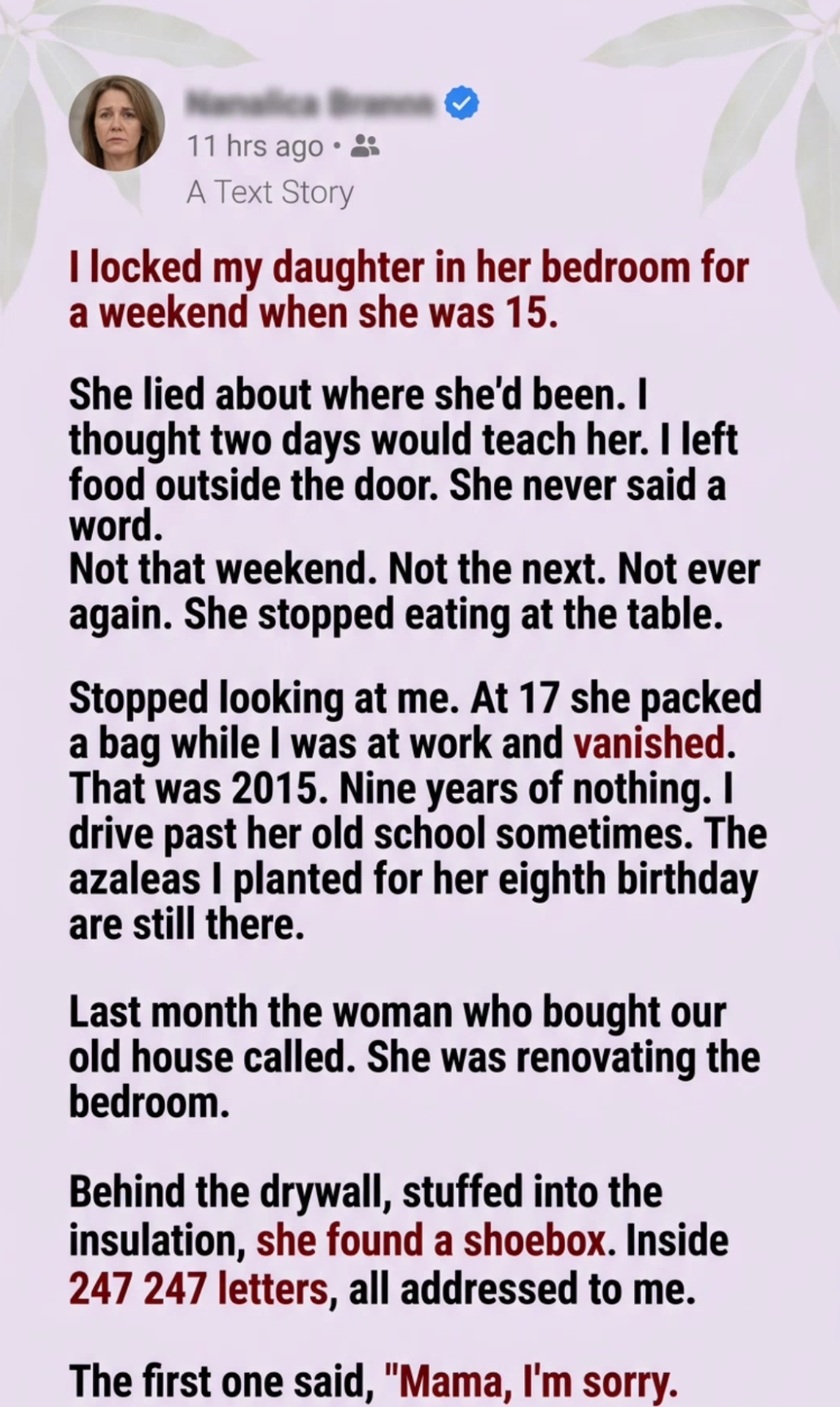
The first letter began with four words that made my knees buckle: “Mama, please unlock the door.” I was standing in the kitchen of my new house when the woman who had bought my old home called to tell me that her renovation crew had discovered something behind the drywall in my daughter’s former bedroom. At first, I thought it was an old school project or forgotten childhood keepsakes. Then she told me there was a shoebox stuffed between the insulation and a wooden support beam. Inside were 247 handwritten letters, all addressed to me. The woman had found them while removing a section of the wall near the old closet. She said the letters looked carefully folded and arranged, as if someone had placed them there deliberately. I asked whether she had read any of them. She said she had only opened the first envelope because my name was written across it. When she read me the opening sentence, I had to sit down. Nine years earlier, I had locked my fifteen-year-old daughter, Emily, in her bedroom for an entire weekend because she had lied about where she had been. I thought two days of punishment would teach her to tell the truth. I left meals outside her door, refused to listen to her explanations, and told myself I was being a responsible mother. She never spoke to me that weekend. Afterward, she stopped eating at the table, stopped looking me in the eyes, and eventually stopped speaking to me altogether. At seventeen, she packed a bag while I was at work and disappeared. That was in 2015. I spent nine years telling myself she was stubborn, ungrateful, and too angry to come home. Now I was holding the first of 247 letters she had written to me, and I was beginning to understand that the silence I had blamed on her might have been something I had created.
My name is Margaret Wilson. I was fifty-six when the woman called, although the years since Emily disappeared had made me feel much older. I had worked as an office administrator for a medical supply company for nearly three decades. My husband, Robert, had died when Emily was eleven, leaving me to raise her alone. I was not a perfect mother, but I had always believed I was a devoted one. I packed her lunches, attended school meetings, helped with homework, and made sure she had what she needed. After Robert died, I became especially protective. I worried about everything: the people she spent time with, the places she visited, the messages she received, and the possibility that something terrible could happen while I was not there to protect her.
I told myself that strictness was love.
I didn’t understand how easily fear could turn into control.
Emily had been a thoughtful child. She loved drawing flowers, collecting postcards, and reading novels with complicated endings. When she was little, she followed me around the house asking questions about everything. She would sit on the kitchen counter while I prepared dinner and tell me stories about her classmates. On her eighth birthday, I planted azaleas beneath her bedroom window because she had once said she wanted flowers that came back every year.
She named them her birthday flowers.
For years, she watered them herself.
After Robert died, those flowers became one of the few things in the house that still reminded me of the happy life we had once shared.
Emily was fifteen when everything changed.
She had started spending more time with a group of students from school. One of them, a girl named Sophie, had recently begun driving. They went to cafés, shopping centers, and occasionally to the park after classes.
I didn’t particularly like Sophie’s influence. I thought she was too independent and that her parents gave her too much freedom.
Emily and I began arguing about curfews.
I wanted her home by six. She wanted more time with her friends. I wanted to know who would be there, where they were going, and how she would get home. She complained that I treated her like a little child.
I heard disrespect where there was sometimes only frustration.
One Friday afternoon in 2015, Emily told me she was going to Sophie’s house to work on a school project. I asked for Sophie’s mother’s phone number.
Emily hesitated.
That small hesitation made me suspicious.
“Why are you hesitating?” I asked.
“I’m not.”
“Then give me the number.”
She said Sophie was busy and that she would send it later.
I told her she wasn’t going anywhere until I had confirmation.
She became upset, accused me of never trusting her, and went upstairs.
A little after seven, I received a message from another parent saying that several students had been seen at a shopping center on the opposite side of town.
I recognized the names of two girls who were friends with Emily.
I called my daughter.
She didn’t answer.
I called again.
Nothing.
When she finally returned home that evening, it was nearly nine.
I was standing in the hallway when she opened the front door.
“Where were you?”
She looked startled.
“At Sophie’s.”
“Don’t lie to me.”
“I’m not lying.”
“I know you were at the shopping center.”
Her face changed.
For a moment, she said nothing.
Then she admitted that she had gone with Sophie and two other students. They had taken a bus because Sophie’s mother had not been available to drive them.
“Why didn’t you tell me?”
“Because you would have said no.”
That answer made me furious.
I saw it as proof that she had deliberately deceived me.
She tried to explain that they had only gone shopping and had returned before it got too late. She said she had been afraid I would take her phone and forbid her from seeing her friends.
I wasn’t interested in the explanation.
I told her that lying had consequences.
She said I was being unreasonable.
I told her to go upstairs.
Then I made a decision that would haunt me for the rest of my life.
I told Emily she would stay in her bedroom for the entire weekend.
I took her phone, removed the spare key from the outside of the bedroom door, and told her she would not be allowed to leave until Sunday evening.
I brought food to her room.
I left breakfast, lunch, and dinner on a tray outside the door. I told myself she had everything she needed. She had a bed, a bathroom, books, and a window. I believed I was giving her time to think about what she had done.
When she first realized I was serious, she knocked on the door.
“Mama?”
I stood in the hallway.
“What?”
“Can we talk?”
“Not until you understand why you’re being punished.”
“But I told you where I went.”
“You lied first.”
“I know. I’m sorry.”
I remember those words because they were the last ones I heard her say to me for a long time.
I told her that apologizing was not enough.
She asked me to unlock the door.
I refused.
The next morning, I left breakfast outside.
The tray remained untouched for hours.
I knocked.
“Emily, you need to eat.”
No answer.
I unlocked the door long enough to see that she was sitting on the floor beside her bed. Her knees were pulled against her chest, and her face was turned toward the window.
I told her the food was there.
She didn’t look at me.
I placed the tray on the desk and left.
That evening, she still hadn’t spoken.
I began feeling uncomfortable, but I convinced myself that she was trying to make me feel guilty.
On Sunday, I finally unlocked the door.
“Your punishment is over.”
Emily stood beside her bed.
She didn’t move toward me.
She didn’t ask for her phone.
She didn’t say she was sorry again.
She simply walked past me, went downstairs, and sat at the far end of the living room.
At dinner, she didn’t join me at the table.
She took a plate to her bedroom.
I told her that was not how our family behaved.
She didn’t answer.
The following week, she continued to avoid me.
She stopped telling me about school. She stopped asking whether I needed anything from the store. When I spoke, she answered with the shortest possible words.
Yes.
No.
I don’t know.
She also stopped watering the azaleas.
I noticed that, but I didn’t connect it to what had happened.
I thought she was being difficult.
One afternoon, I tried to have a conversation with her.
“Emily, this can’t continue.”
She was sitting at her desk, drawing in a notebook.
She didn’t look up.
“I’m talking to you.”
“I heard you.”
“Then answer me.”
“What do you want me to say?”
“I want you to stop acting like I’ve done something terrible.”
She put down her pencil.
“You locked me in my room.”
“I punished you.”
“You locked me in.”
“It was for your own good.”
She looked at me for the first time in days.
“No, Mama. It was because you were angry.”
I felt insulted.
I told her she was being dramatic and that she would understand when she was older.
She turned back to her notebook.
That should have been the moment I stopped defending myself and started listening.
Instead, I walked away.
Over the next year, Emily became increasingly distant.
She attended school, completed her assignments, and maintained acceptable grades. From the outside, nothing seemed terribly wrong. She still smiled occasionally at friends. She still went to school events when I allowed her to attend.
But at home, she became almost invisible.
She ate in her room.
She stopped asking for help.
She no longer told me when she was upset.
When she needed something, she wrote it on a small piece of paper and left it on the kitchen counter.
I began to realize that our relationship was not improving.
But I blamed her.
I told relatives that Emily was going through a difficult teenage phase. I said she had become secretive and uncommunicative. I mentioned that she had lied about going to the shopping center and that I had been forced to discipline her.
Nobody questioned me.
My sister, Linda, told me that teenagers could be difficult and that I should stay firm.
My mother said the same thing.
I accepted their advice because it allowed me to believe I had done nothing wrong.
In reality, I was afraid to admit that I had hurt my daughter.
I was afraid that if I apologized, I would have to accept that my authority had not made me a good mother.
And so I waited for her to return to the girl she had been before.
She never did.
By the time Emily turned seventeen, she had become more independent. She worked a few hours each week at a bookstore and had started talking about college applications.
I was proud of her grades, although I rarely told her so.
She applied to several schools.
I asked whether she had considered staying close to home.
She said she wanted to study in another city.
I told her that was expensive.
She said she would look for scholarships.
We argued about it.
I told her that she needed to be realistic and that she couldn’t simply leave because she didn’t like living with me.
She replied quietly, “I don’t like living here because I can’t talk to you.”
I felt my anger rise.
“You can talk to me whenever you want.”
“No, I can’t.”
“That’s ridiculous.”
She looked at me for a moment.
Then she went upstairs.
A few weeks later, I came home from work and found her bedroom empty.
Her clothes were gone.
Her schoolbooks were missing.
The drawer where she kept her savings was empty.
There was no note on the kitchen counter.
I called her phone.
It went directly to voicemail.
I called her friends.
Nobody gave me a clear answer.
I contacted Sophie’s mother, who told me Emily had been talking about leaving for college and had been looking for a place to stay temporarily.
I was furious.
I called the police to report her missing.
Because Emily was seventeen, they asked several questions about her circumstances and whether there was any reason to believe she was in immediate danger. I explained that she had left without permission and that I had no idea where she was.
They took the report and advised me to provide any information that might help locate her.
A few days later, I received confirmation that Emily had made contact with an adult family friend and was safe.
I asked to speak to her.
She refused.
The officer explained that she did not want her location shared with me and that she was being supported by adults who were helping her arrange safe accommodation and finish school.
I was devastated.
I called Linda and cried.
“She has disappeared,” I said. “My own daughter doesn’t want to come home.”
Linda told me to give her time.
I asked whether she knew where Emily was.
She said she didn’t.
I believed her.
I didn’t know that Linda had been helping Emily for weeks.
I didn’t know that Emily had spent several afternoons at her apartment, talking about college and looking for a safe way to leave.
I didn’t know how many times my daughter had tried to explain what was wrong.
I only knew that she was gone.
The first year was the hardest.
I called her phone every few weeks.
Sometimes I left messages.
I told her I loved her.
I told her she could come home whenever she wanted.
I also told her that she needed to stop punishing me.
That last sentence was something I regretted later.
I didn’t understand that she wasn’t punishing me.
She was protecting herself.
I sent birthday cards.
I mailed a Christmas package.
I contacted her school, hoping someone would tell me how she was doing.
The school could confirm that she had completed her studies, but they would not provide private information without her consent.
I began driving past her old school on my way home from work.
Sometimes I parked across the street and watched students leave.
I imagined Emily among them.
I imagined her carrying her backpack, laughing with friends, and walking toward the bus stop.
I wanted to see her.
I wanted her to look at me.
But she never appeared.
Years passed.
I moved to a smaller house after selling the old one. The old property had become difficult to maintain, and I couldn’t bear walking through Emily’s empty bedroom every day.
I took photographs of the azaleas before the sale.
They were still growing beneath the window.
I had planted them when she was eight, and they had survived years of neglect.
The new owners told me they intended to keep them.
I was grateful.
I had no idea that something else had been left behind the bedroom wall.
For nine years, I told people that Emily had chosen to abandon me.
Sometimes I said she had been influenced by friends.
Sometimes I said she had never appreciated what I had done for her.
I told myself that I had provided a home, food, clothes, and education.
I never mentioned the locked door unless someone specifically asked about the argument that had started everything.
Even then, I described it as a weekend punishment.
I didn’t say how she had knocked.
I didn’t say that she had asked me to unlock the door.
I didn’t say that I had refused after she apologized.
And I certainly didn’t say that I had left her alone in that room while she cried.
Last month, the woman who had purchased our old house called.
Her name was Patricia.
She explained that she and her husband were renovating the upstairs bedrooms. They wanted to replace old insulation, update the electrical wiring, and make the rooms more comfortable for their grandchildren.
During the work, a contractor discovered a loose section of drywall behind the old closet.
There was a narrow space between the wall and a support beam.
Inside was a shoebox.
Patricia said she had found it herself after the workers removed the damaged section.
The box was dusty, but it had been wrapped in a plastic bag.
There were envelopes inside.
Hundreds of them.
All addressed to me.
I asked whether there was a return address.
She said no.
I asked whether my name was on every envelope.
“Yes,” she replied. “Some have dates. Some just say Mama.”
My mouth went dry.
“Did you read any?”
“Only the first one. I thought it might be important. I’m sorry.”
She read the opening line again.
“Mama, I’m sorry. Please unlock the door.”
I sat down.
I couldn’t breathe properly.
Patricia asked whether I wanted to collect the box.
I said yes.
I drove to the old house that afternoon.
When I arrived, the front garden looked different. The porch had been repainted, and a new path led to the front door. The azaleas beneath Emily’s old window were still there, bigger than I remembered.
Patricia met me outside.
She was a kind woman in her early forties. She didn’t ask many questions. She simply led me upstairs and showed me the opened section of the wall.
The shoebox was on a table.
It was an ordinary cardboard box, the kind that once held shoes from a department store.
The plastic wrapping had protected the contents from dust and moisture.
I lifted the lid.
There were letters arranged in small bundles, each tied with a piece of ribbon or string.
Some were written on notebook paper.
Others were on the backs of school assignments, unused stationery, and pages torn from sketchbooks.
The handwriting was Emily’s.
I recognized it immediately.
Her letters had always been small and careful, with the same distinctive way of crossing the letter t.
I picked up the first envelope.
The date was written in the corner.
Saturday, March 14, 2015.
The day after I locked her in her room.
My hands began shaking.
I opened it.
“Mama,
I’m sorry. Please unlock the door. I know I shouldn’t have lied about where I went. I should have told you the truth. I just wanted to spend time with my friends without having to feel like I was doing something terrible. I promise I won’t go there again if you don’t want me to. Please come talk to me. I don’t like being alone in here. I can hear you walking around, and I keep waiting for you to open the door. I miss you even though you’re downstairs.
I love you.
Emily.”
I pressed the paper against my chest.
I remembered that day.
I remembered walking past her bedroom several times.
I remembered hearing the knock.
I remembered choosing not to open the door.
The second letter was dated Sunday.
“Mama,
I haven’t eaten much because I’m not hungry. I know you’re leaving food outside. I don’t want you to think I’m trying to make you feel bad. I just feel strange. I wish you would sit with me for a minute. I want to tell you what happened, but I don’t know how to start. I don’t want to make you angry again.”
The third letter was dated Monday.
“Mama,
You said my punishment is over, but I don’t know what I’m supposed to do now. You walked away when I came downstairs. I wanted to hug you, but I thought you would tell me to stop being dramatic. I don’t know how to be normal with you.”
I began crying.
The letters continued.
Some were short.
Some filled several pages.
There were letters written every day during the first month.
Then the dates became less regular.
I read one from two weeks after the punishment.
“Mama,
I tried to eat dinner with you yesterday. I wanted to sit in my old place, but you asked why I was acting like nothing happened. I didn’t know what to say. I thought you wanted me to come back to the table. I thought maybe we could start again. But when you said I was being difficult, I went upstairs.
I don’t know what you want from me.
I don’t know how to make you understand that I’m still hurt.”
Another letter, dated several months later, was written on the back of a mathematics worksheet.
“Mama,
Today I got a good grade on my test. I wanted to tell you. I almost came into the kitchen, but you were talking on the phone and laughing. I stood there for a little while. I thought about waiting until you finished. Then I remembered that you don’t really ask about my school anymore.
I put the paper in my drawer.
I wish I could tell you things without feeling like I’m bothering you.”
I had to stop reading.
Patricia brought me a glass of water.
She didn’t ask me what the letters said.
She simply sat beside me.
After a few minutes, I opened another envelope.
The date was from the summer before Emily left.
“Mama,
I applied for the scholarship today. I didn’t tell you because I don’t know whether you would be proud or angry that I want to go away. I don’t want to leave because I hate you. I want to leave because I don’t know how to live here without being afraid of upsetting you.
I wish you would ask me why I am quiet.
I wish you would believe me when I say I am not trying to hurt you.”
I covered my face.
For nine years, I had believed Emily had simply become cold.
Now I was reading proof that she had spent years trying to reach me.
The letters were not all apologies.
Some were angry.
Some were confused.
Some were written in a way that sounded like a girl trying to convince herself that she wasn’t wrong for feeling hurt.
One letter said:
“Mama,
I know you think I am ungrateful. I know you think you gave me everything. I am grateful for the things you gave me. I know you worked hard. I know Dad died and you had to do everything alone. I know you were scared.
But being scared doesn’t make it okay to lock me in a room and refuse to listen when I ask you to talk to me.
I was fifteen.
I needed my mother.
I didn’t need to be taught that I couldn’t leave a room until she decided I had suffered enough.”
I couldn’t finish the page.
I had spent years explaining the punishment as a difficult parenting decision.
Emily had experienced it as something much more frightening.
The next letter was dated several months later.
“Mama,
I don’t think you remember what I said when you opened the door.
I asked if we could talk.
You said the punishment was over and walked away.
I wanted you to ask whether I was okay.
I wanted you to tell me you were sorry.
I wanted you to understand that I was scared, not just angry.
I waited for you to come back.
You never did.”
I felt sick.
I remembered that moment differently.
I had told myself that she walked past me because she wanted to continue the argument.
I had never considered that she might have been waiting for me to follow.
The letters explained how Emily gradually stopped speaking because she believed every attempt to communicate would become another argument.
She described how she began writing letters because paper was safer than conversation.
She could say everything without seeing my face change.
She could write without being interrupted.
She could admit that she was angry without being accused of disrespect.
She could apologize without having to surrender every feeling that came with the apology.
At some point, she began hiding the letters.
She wrote that she had originally planned to put them in a drawer and give them to me when she was ready.
But whenever she imagined handing them over, she became afraid.
She worried I would read them aloud to relatives.
She worried I would call her ungrateful.
She worried I would tell her that she was exaggerating.
So she began placing the letters behind the wall.
The first ones had been written before I knew she was doing it.
The later ones were hidden after she had already decided to leave.
One letter from the month before she disappeared said:
“Mama,
I found a place where I can stay for a while. Linda said she will help me finish school. I know you will be angry. I know you will say I am abandoning you.
I am not leaving because I don’t love you.
I am leaving because I don’t know how to make you hear me.
I have tried talking.
I have tried being quiet.
I have tried apologizing.
I have tried acting normal.
Nothing changes.
I don’t want to spend the rest of my teenage years waiting for you to decide that I deserve to be listened to.”
I stopped.
Linda.
My sister had known.
I picked up the phone and called her.
She answered on the second ring.
“Margaret?”
“Did you help Emily leave?”
There was a long silence.
Then Linda sighed.
“Yes.”
I felt my face grow hot.
“You knew where she was?”
“I knew she was safe.”
“You let me spend nine years believing she had disappeared.”
“I didn’t know what else to do.”
“You could have told me.”
“I tried, Margaret.”
“When?”
“Several times. You kept saying Emily was punishing you. You kept telling me that she needed to come home and apologize. You never asked what had happened from her side.”
I looked at the letters scattered across the table.
“Why didn’t she call me?”
“She was afraid.”
“Afraid of me?”
Linda’s voice softened.
“She was afraid you would make her feel guilty for leaving. She was afraid you would ask her to come home before she was ready. She was afraid that if she explained how much the punishment had hurt her, you would tell her she was being dramatic again.”
I couldn’t speak.
Linda continued.
“She stayed with me for a while. Then she found a room with another student. She finished school. She got into college. She worked part-time. She was safe, Margaret. I checked on her. I made sure she had support.”
“Why didn’t you tell me all of that?”
“Because she asked me not to give you her address. She needed time to feel safe making her own decisions.”
I began crying.
“Did she ever ask about me?”
“Yes.”
“How often?”
“More than you know.”
I closed my eyes.
Linda told me that Emily had asked about my health, whether I was still working, and whether the azaleas were still growing. She had even asked whether I had kept her old drawings.
But she had not wanted direct contact.
“She didn’t hate you,” Linda said. “She just didn’t know how to be close to you without getting hurt again.”
I sat quietly.
Then I asked, “Where is she now?”
Linda hesitated.
“I don’t know if I should give you that information.”
“I understand.”
“She’s an adult now. She has her own life.”
“I know.”
“She has to decide whether she wants contact.”
“I know.”
Linda gave me an email address.
She said Emily had recently agreed that it was acceptable for her to receive a message, but that I should not pressure her for a response.
I thanked my sister.
Then I looked down at the shoebox.
There were still dozens of letters unread.
I spent the next three days going through them.
I read them at the kitchen table, sometimes two at a time, sometimes only a few sentences before I had to stop.
There were letters about school.
Letters about birthdays.
Letters about missing her father.
Letters about the azaleas.
Letters about the first time she received a scholarship offer.
Letters about a teacher who had encouraged her to study social work.
There were letters in which she apologized for lying about the shopping center.
There were also letters in which she said she wished I had apologized for locking her in her room.
One of the most painful letters was dated the night before she left.
“Mama,
Tomorrow I am going to take my things and go.
I am scared.
I keep thinking about what you will say when you come home and find my room empty.
I want to leave you a note, but I don’t know what to write.
I have written 246 letters, and I still don’t know how to explain this in one sentence.
I don’t want you to think I never loved you.
I love you so much that I keep hoping you will come upstairs and ask me what’s wrong.
But I can’t keep waiting.
I am going to finish school. I am going to work. I am going to build a life where I can speak without being afraid.
Maybe someday I will be able to give you these letters.
Maybe someday you will understand.
I am sorry I couldn’t make things better.
Emily.”
I sat there for a long time.
Then I counted the letters again.
There were 247.
The last one had no date.
It was written on a small sheet of blue paper.
“Mama,
If you ever find these, please don’t read them as proof that I was trying to punish you.
I wrote them because I wanted to talk to you.
I hid them because I couldn’t.
I didn’t know how to tell you that I was hurt without making you angry.
I know you loved me.
I also know that love is not always enough when someone doesn’t feel safe telling the truth.
I hope one day you understand that I didn’t leave because I stopped loving you.
I left because I needed to learn how to love myself too.
Emily.”
I cried until my head hurt.
For the first time in nine years, I stopped telling myself that Emily had abandoned me.
I began asking what I had done to make home feel like a place she needed to escape.
I contacted a counselor and arranged an appointment.
I had spent years believing that therapy was something people needed when they couldn’t handle their own problems. Now I understood that I had been unable to face mine.
During the first session, I told the counselor about the punishment.
I described the argument, the weekend, the meals outside the door, and the years of silence.
I expected her to tell me that I had been a terrible mother.
Instead, she asked me what I believed Emily had experienced.
I couldn’t answer at first.
Then I said, “She must have felt alone.”
The counselor nodded.
“What else?”
“She must have felt that I didn’t trust her.”
“What else?”
I thought about the letters.
“She must have felt that she couldn’t tell me the truth because I would punish her for it.”
The counselor asked whether I could accept that the punishment had been harmful even if I had not intended to hurt my daughter.
I began crying.
“Yes,” I said.
That was the first honest answer I had given about the incident.
Over the next several weeks, I worked through the fear and grief I had carried since Robert died. I began understanding how his death had changed me. I had been terrified of losing Emily too, and that fear had made me controlling.
But my fear did not excuse what I had done.
I had treated obedience as proof of love.
I had treated disagreement as disrespect.
I had treated her silence as defiance instead of asking whether she was hurting.
And when she tried to tell me, I had refused to listen.
I decided to write her an email.
I didn’t ask her to come home.
I didn’t tell her that I had suffered for nine years.
I didn’t mention the sacrifices I had made.
I didn’t ask her to forgive me.
I wrote:
“Emily,
I found your letters.
I have read all 247.
I don’t know how to express what I felt while reading them. I cried, but I understand that my tears do not change what you experienced.
I remember locking your bedroom door. I remember telling myself that I was teaching you responsibility. I remember hearing you ask me to unlock it. I remember refusing.
I was wrong.
You were fifteen. You had lied about where you went, and I was allowed to be concerned and upset. But I was not right to lock you in your room for an entire weekend. I was not right to ignore you when you asked to talk. I was not right to dismiss your feelings afterward.
I am sorry for making you feel that you had to hide your thoughts from me.
I am sorry for treating your silence as disrespect when I should have asked why you were hurting.
I am sorry that you spent years writing letters you were too afraid to give me.
I understand that you may not want a relationship with me. I will not demand one. I will not ask you to forget what happened. I only want you to know that I finally understand that you did not leave because you stopped loving me.
You deserved to feel safe in your home.
I failed to give you that.
I love you, and I am sorry.
Mama.”
I read it several times before sending it.
Then I waited.
One day passed.
Then three.
Then a week.
I checked my email constantly, although I knew that doing so would not make a reply arrive sooner.
On the tenth day, a message appeared.
The subject line was simple.
“I read it.”
I opened it with shaking hands.
“Hi, Mama.
I don’t know what to say yet.
I didn’t expect you to find the letters.
I thought the house might be renovated one day, but I never imagined the box would be discovered.
I appreciate that you apologized without asking me to come home.
I need you to understand that reading your message was difficult. I have spent a long time learning not to expect anything from you.
I don’t hate you.
I just don’t know what being close to you would feel like.
I am willing to exchange emails for now.
Please don’t call without asking first.
Emily.”
I read the message again.
She had not said she forgave me.
She had not said she wanted to see me.
But she had opened a door.
This time, I would not force it.
I replied that email was fine and that I would respect her boundaries.
We exchanged several messages over the next month.
At first, they were brief.
She told me she was living in another state and working as a school counselor. She had completed her education and was now helping teenagers who were struggling with family problems, school pressure, and emotional difficulties.
I told her about my work and my smaller house.
I asked whether she still liked drawing.
She said she did, although she mostly sketched in the evenings.
One day, she sent me a photograph of a small garden outside her apartment.
There were azaleas in it.
I stared at the picture for a long time.
I wrote, “They look beautiful.”
She replied, “I still like them.”
I wanted to tell her about the flowers beneath her old bedroom window, but I didn’t want to turn the conversation into another emotional demand.
A few weeks later, she asked whether I still had the photographs from her eighth birthday.
I told her I did.
She asked whether I could send her a copy.
I scanned the photograph and sent it.
It showed Emily standing beneath the young azaleas, holding a watering can almost as large as her body. Her father was behind her, laughing.
She replied with a single sentence.
“I remember that day.”
I wrote back:
“So do I.”
For a while, that was enough.
Then, almost three months after the shoebox was found, Emily asked whether we could speak on the phone.
I sat at my kitchen table for nearly an hour before the scheduled call.
When the phone rang, I answered immediately.
“Hello?”
There was a pause.
“Hi, Mama.”
Her voice was different from the one I remembered. It was deeper, calmer, and more mature.
But I recognized it.
“Hi, sweetheart.”
I almost cried, but I held myself together.
We spoke for twenty minutes.
She told me about her work. I told her about the house. We talked about Linda, the weather, and an old neighbor who had recently retired.
We did not discuss the locked bedroom.
Not that day.
At the end of the call, Emily said she was glad we had talked.
I told her I was too.
Then she said, “Can we do this again sometime?”
I answered carefully.
“Whenever you’re comfortable.”
We began speaking every few weeks.
Sometimes the calls were short.
Sometimes they lasted an hour.
I learned that she loved her work because she could recognize the quiet signs that a teenager was struggling. She told me that not every withdrawn child was simply being difficult. Sometimes silence was the only way a young person knew how to protect themselves.
I listened.
I didn’t defend myself.
One afternoon, she brought up the letters.
“Did you really read all of them?”
“Yes.”
“Even the angry ones?”
“Especially those.”
She was quiet.
“I was angry.”
“You had every right to be.”
“I said some things I probably wouldn’t say now.”
“You were fifteen.”
“I know.”
I took a breath.
“I wish I had listened when you were trying to tell me.”
She didn’t answer immediately.
Then she said, “I wish you had too.”
I let the words sit between us.
There was no argument.
No explanation.
No attempt to change the subject.
For the first time, I understood that listening meant allowing someone else’s experience to exist without immediately defending my own.
Several months later, Emily agreed to meet me.
She suggested a public garden in the city where she lived. She said she would prefer a place where either of us could leave whenever we needed to.
I agreed.
I arrived twenty minutes early.
I walked along the flower beds, trying to calm my nerves. When I saw her approaching, I almost didn’t recognize her.
She was thirty now.
Her hair was shorter, and she wore a light jacket over a blue dress. She carried a small handbag and walked with the quiet confidence of someone who had built a life through her own efforts.
I stood up.
“Hi, Emily.”
“Hi, Mama.”
We looked at each other.
I wanted to hug her, but I didn’t move.
She noticed.
Then she stepped forward and hugged me.
It was brief.
But it was real.
We sat on a bench and talked.
I told her that I had read the letters more than once. She asked whether I still had them.
I said yes.
She asked whether she could see them.
I had brought the shoebox with me.
I placed it beside her.
She opened the lid and looked at the bundles.
For a moment, she smiled sadly.
“I can’t believe I wrote so many.”
“You were trying to talk to me.”
She nodded.
“I didn’t know what else to do.”
I looked at her.
“I am so sorry.”
She lowered her eyes.
“I know.”
We sat quietly for a while.
Then she said something that I will never forget.
“I don’t want the rest of our relationship to be about that weekend.”
I nodded.
“Neither do I.”
“But I also don’t want us to pretend it didn’t happen.”
“We won’t.”
She looked at the shoebox.
“I kept thinking that if I wrote enough letters, eventually I would find the right words.”
I felt tears in my eyes.
“You shouldn’t have had to.”
“No,” she said. “I shouldn’t have.”
We stayed in the garden for nearly two hours.
Before we left, Emily told me she wasn’t ready to visit my house yet. She also asked me not to surprise her with calls or visits.
I promised.
I kept that promise.
Our relationship did not become perfect overnight.
There were difficult conversations. Sometimes Emily needed space. Sometimes I became emotional and had to remind myself that her boundaries were not rejection.
I learned not to send repeated messages when she didn’t respond immediately.
I learned not to ask relatives for updates about her.
I learned not to turn every good conversation into a request for more closeness.
Most importantly, I learned that an apology did not purchase forgiveness.
It was simply an acknowledgment of harm.
About a year after the shoebox was discovered, Emily invited me to visit her apartment.
She had a small balcony garden with several plants and a comfortable chair near the window. There were bookshelves along one wall and framed photographs from her college years.
On a side table sat a photograph of Robert.
I picked it up.
“Your father would have been proud of you,” I said.
Emily nodded.
“I wish he could have seen me graduate.”
“So do I.”
She showed me the room where she worked from home. There were notebooks, counseling materials, and drawings made by students who had participated in a school art project.
She told me about a fifteen-year-old girl who had stopped speaking to her parents after a conflict at home.
Emily was helping the girl and her family work through their problems with appropriate support.
I listened as she described how important it was for parents to understand that discipline should never replace communication or make a child afraid to ask for help.
I didn’t interrupt.
After dinner, Emily brought out a small envelope.
“I wrote something recently,” she said.
I looked at it.
“Is it another letter?”
She smiled slightly.
“Yes. But this one is different.”
She handed it to me.
I opened it.
“Mama,
I used to think that if you ever read my letters, everything would change immediately.
I thought you would understand every part of me, and we would somehow become the family we were before.
I know now that relationships don’t work that way.
I am still hurt by what happened. I still remember that weekend. I still remember the feeling of knocking on the door and waiting for you to answer.
But I also see that you are trying to understand.
I don’t know what our relationship will look like in five years.
I don’t know whether I will ever stop remembering that weekend.
But I want to keep trying, as long as we both remember that love has to include listening.
I don’t want to hide letters behind walls anymore.
If I have something to say, I want to be able to say it to you.
Emily.”
I folded the paper carefully.
Then I looked at her.
“Thank you for giving me another chance.”
She shook her head gently.
“This isn’t about giving you a chance to prove something. It’s about seeing whether we can build something different.”
I nodded.
“You’re right.”
She smiled.
We talked until late that evening.
When I left, she walked me to the door.
She hugged me again.
This time, she held on a little longer.
On the drive home, I thought about the shoebox and the 247 letters.
For nine years, they had been hidden behind the wall of a bedroom where I believed my daughter had simply chosen to shut me out.
But the truth had been there all along.
She had not stopped trying to reach me after that weekend.
She had written to me again and again.
She had written when she was lonely, when she was angry, when she succeeded at school, when she missed her father, and when she was afraid to leave.
She had written because she still wanted her mother.
And I had never known.
I still have the shoebox.
I keep it on a shelf in my study, not as a reminder to punish myself, but as a reminder that the people we love cannot be expected to communicate through fear.
The azaleas at the old house are still growing. Patricia sends me a photograph every spring when they bloom. Sometimes Emily asks to see the pictures too.
We have started a small tradition of exchanging photographs of flowers each year.
It is not a grand gesture.
It is not a perfect ending.
It is simply something we can share.
I no longer drive past Emily’s old school hoping to catch a glimpse of a girl who has grown into a woman. I no longer tell people that my daughter disappeared without explanation.
If someone asks why we were apart for so long, I tell them the truth.
I was afraid of losing control, and I made my daughter feel unsafe. She tried to tell me. I didn’t listen. She left because she needed space to build a life in which her voice mattered.
I cannot change the weekend when I locked that door.
I cannot return the years when she wrote letters I never read.
But I can make sure that the door between us remains open now.
And every time Emily tells me something difficult, I remind myself not to interrupt, not to defend, and not to turn her honesty into another argument.
Because the greatest lesson those 247 letters taught me was not that my daughter had been angry.
It was that she had been asking for her mother all along.
The End