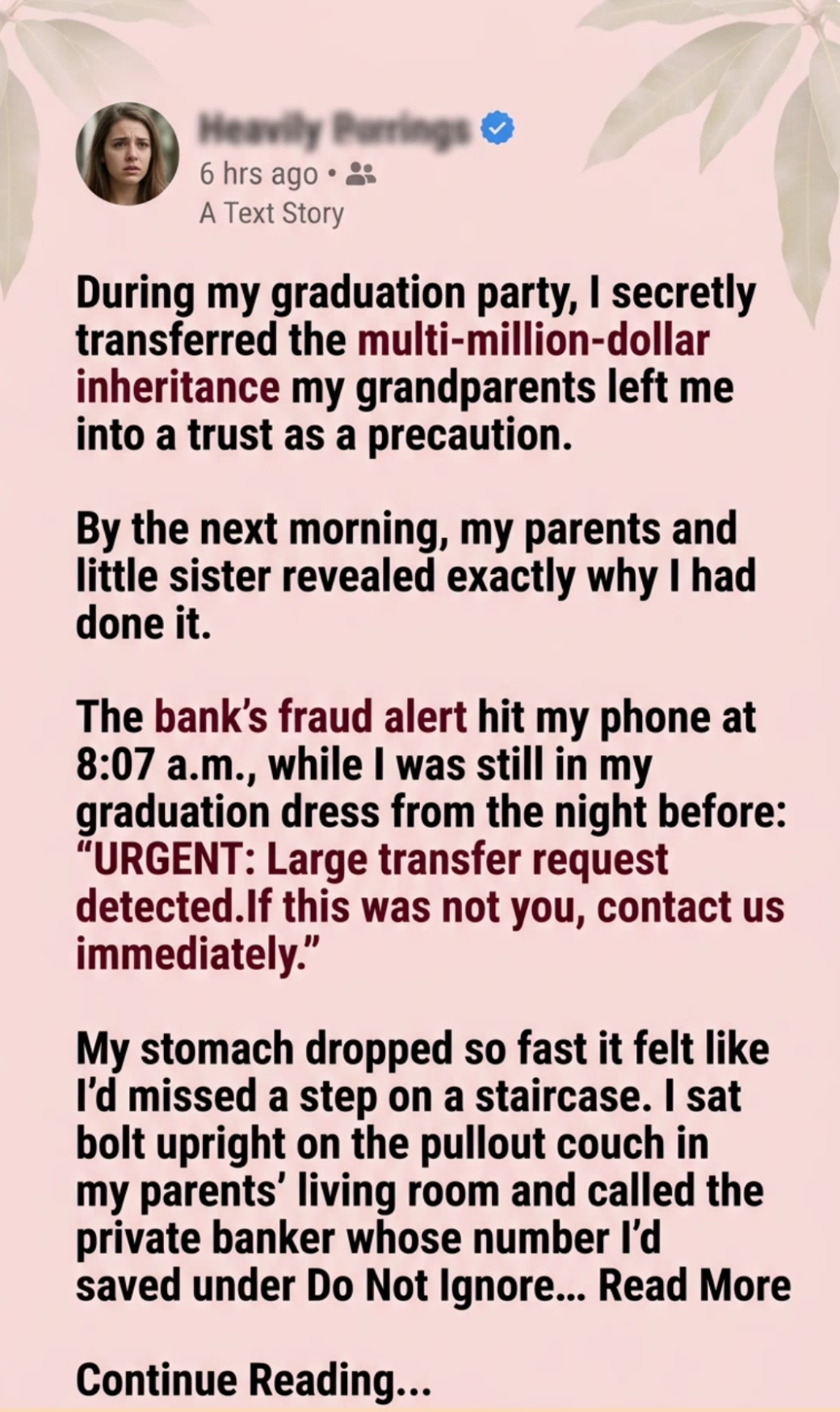
The fraud alert arrived at 8:07 a.m., while I was still wearing the pale blue graduation dress I had worn the night before. My phone vibrated against the coffee table, and I nearly ignored it, thinking it was another congratulatory message. Then I read the words on the screen: “URGENT: Large transfer request detected. If this was not you, contact us immediately.” My stomach tightened. I sat upright on the pullout couch in my parents’ living room, staring at the notification until the letters blurred. Someone had attempted to move a significant amount of money from an account connected to my inheritance. I knew exactly how much was at stake. My grandparents had left me more than $6.8 million, and the previous evening, while everyone was celebrating my graduation, I had quietly completed the final steps of placing the inheritance into an independently managed trust. I had done it because something about my family’s sudden interest in my finances had made me uncomfortable. I never imagined I would need that protection so soon.
I called the private banker whose number I had saved under the name Do Not Ignore.
He answered after the second ring.
“Good morning, Miss Carter. I was expecting your call.”
“Someone tried to transfer money from my inheritance account,” I said. “Was it successful?”
“No,” he replied immediately. “The request was flagged before processing. The funds remain protected.”
I closed my eyes.
“Who submitted it?”
There was a pause.
“Before I disclose the details, I need to verify your identity and confirm that you’re somewhere you can speak privately.”
I looked toward the hallway.
My parents’ bedroom door was closed. From the kitchen came the sound of a cupboard opening and my little sister Madison humming as she prepared breakfast.
“I can speak privately,” I whispered.
The banker asked me several security questions. Once he had confirmed my identity, he explained that an individual had contacted the bank using information associated with my former account profile. The person had requested a transfer of $850,000 to an external business account. The request included a document purporting to authorize the transaction.
“Was my signature on it?” I asked.
“The submitted document contains a signature resembling yours. However, the authorization did not meet our verification requirements. There were also inconsistencies in the supporting information.”
“Who submitted it?”
“The contact information used in the request belongs to your family household. We are conducting a formal review before making any determination about the individual responsible.”
I swallowed.
“Can you tell me whether it was my father?”
“I cannot make that identification based solely on the contact information. We will preserve the submission records and provide them through the appropriate process.”
I thanked him and ended the call.
For several seconds, I remained completely still.
Then I heard my father’s voice.
“She’s awake.”
I looked up.
My father, Richard Carter, stood at the entrance to the living room. My mother, Diane, was behind him, wearing her usual morning robe. Madison, my nineteen-year-old sister, stood beside her with a mug of coffee in her hand.
None of them looked surprised to see me awake.
In fact, they looked as though they had been waiting.
“Morning, sweetheart,” my mother said.
I placed my phone facedown on the couch.
“Good morning.”
My father glanced at the phone.
“Everything all right?”
“Why?”
He shrugged.
“You looked worried.”
“Just a bank notification.”
Madison exchanged a quick glance with my mother.
It was brief, but I noticed.
My father stepped farther into the room.
“Speaking of the bank, we need to discuss something important.”
I felt a cold sensation settle in my chest.
“What is it?”
He pulled out a chair and sat opposite me.
“Your grandfather’s money.”
There it was.
Not congratulations. Not breakfast. Not a question about my future.
The inheritance.
My grandfather, William Carter, had been a successful property developer who had spent decades building a portfolio of commercial buildings, residential investments, and financial assets. My grandmother, Eleanor, had been his partner in nearly every important decision, even though she rarely spoke about business in public.
They had raised me to understand that money was not a measure of someone’s worth. It was a responsibility that required discipline.
When they died within eighteen months of each other, I was devastated.
I had been twenty-one when my grandfather passed away and twenty-three when my grandmother followed him. Their wills and estate documents were handled through separate legal processes, and after taxes, expenses, valuations, and administration, I became the beneficiary of assets worth approximately $6.8 million.
My parents had never been listed as beneficiaries of that particular inheritance.
They received other provisions under my grandparents’ estate plans, but the substantial investment portfolio and the majority of the property interests had been left to me.
My grandparents had explained their decision in a letter.
They believed I had the patience to manage the assets, the willingness to learn, and the ability to distinguish love from financial obligation.
At the time, I thought the letter was simply an expression of confidence.
Now, sitting across from my father, I understood that it had also been a warning.
“We’ve been discussing your inheritance,” he began.
“With whom?”
“Your mother, your sister, and me.”
“Why?”
“Because you’re young. You just graduated. You have no experience managing that kind of money.”
“I have financial advisers.”
“Advisers are not family.”
I looked at him.
“Grandpa hired them.”
My father’s jaw tightened.
“Your grandfather made a lot of decisions without considering how they affected the rest of us.”
My mother sat beside him.
“He was always stubborn about money,” she added. “Your grandmother was the same way.”
I remembered my grandmother’s expression whenever someone described her as stubborn.
She would smile and say, “A woman who understands her own finances is not difficult. She’s simply harder to mislead.”
I kept my face neutral.
“What exactly are you asking me to do?”
My father leaned forward.
“We think the inheritance should be reorganized.”
“Reorganized how?”
“Placed under family management.”
“Whose management?”
“Ours, initially. We can establish a family investment company. Your mother can oversee the accounts, and I’ll handle the business side. Madison can receive a reasonable allocation to help her start her adult life.”
Madison smiled faintly.
I looked at her.
“How much?”
My father answered.
“That’s what we need to determine.”
“An allocation from my inheritance?”
“From the family’s wealth,” he corrected.
“But it’s not the family’s wealth. It’s mine.”
The room became quiet.
My mother’s expression changed first.
“Don’t speak like that.”
“Like what?”
“Like we’re strangers asking you for something.”
“I didn’t say you were strangers.”
“You’re treating us as if we have no right to be involved,” my father said.
“I haven’t said that either.”
He exhaled sharply.
“Then stop making everything difficult.”
I picked up my phone.
“Did someone try to transfer $850,000 from my inheritance account this morning?”
My father’s face changed.
Only slightly.
But enough.
My mother looked at him.
Madison stopped drinking her coffee.
For the first time that morning, nobody seemed to know what to say.
My father recovered quickly.
“What are you talking about?”
“The bank flagged a transfer request.”
“Probably some administrative mistake.”
“An administrative mistake involving $850,000?”
He stood.
“You don’t understand how complicated these accounts are.”
“Then explain it.”
“Your grandfather’s old financial arrangements are confusing. We were trying to simplify things.”
“Who authorized the transfer?”
My mother stood too.
“Your father was only trying to protect you.”
“By transferring money?”
“He knows more about business than you do.”
I looked directly at her.
“Did you know about the transfer?”
Her silence lasted longer than her answer needed to.
Madison placed her mug on the table.
“You’re making this into something horrible,” she said. “Dad was going to put the money somewhere safer.”
“Whose account?”
She looked toward our father.
He said nothing.
I felt my hands begin to tremble.
The attempted transfer had not been a random mistake.
They had discussed it.
They had planned it.
And they had expected me to accept it.
“I’m going to get dressed,” I said.
My father stepped toward the doorway.
“We are not finished.”
“I am.”
He blocked the hallway with his arm.
“You need to listen to your parents.”
I stared at his arm.
Then I looked at him.
“Move.”
For a moment, neither of us moved.
Finally, he lowered his arm.
I walked past him and went upstairs.
In my old bedroom, I locked the door and called my attorney, Rebecca Lawson.
Rebecca had represented my grandparents during their later estate-planning years. After their deaths, she had continued advising me on the administration of the inheritance.
She answered quickly.
“Claire, I was about to call you.”
“Someone attempted to transfer $850,000 from my old account.”
“I know. The bank contacted our office after the alert.”
“Do you know who did it?”
“We’re still establishing that. The bank has preserved the request and the related communications. I don’t want to accuse anyone before the evidence is reviewed.”
“I think it was my father.”
Rebecca was quiet.
“Did he say anything?”
“He admitted the family was trying to reorganize the inheritance. He said he wanted to put it under family management. My mother said he was protecting me. My sister knew about it.”
“Did you sign any authorization recently?”
“No.”
“Did you provide your father with access to your banking credentials?”
“No.”
“Did you give anyone permission to submit a transfer request?”
“No.”
“Good. Do not sign anything. Do not send anyone a verification code. Do not discuss your trust documents with your family until we have reviewed the bank’s records.”
I sat on the edge of my bed.
“Was transferring everything into the trust yesterday the right decision?”
“Yes,” she said. “But I want to be precise. The trust is not a magic shield against every possible problem. It is a legal structure with documented ownership, an independent trustee, and defined distribution rules. We need to confirm that every asset was transferred correctly and that the institutions have updated their records. Your grandparents’ estate documents also contain restrictions that matter here.”
“Could my father still get the money?”
“Not simply because he’s your father. He has no automatic authority over assets he does not own or control. But we need to investigate the attempted transaction and make sure no one has access through an old authorization, outdated account record, or misrepresented document.”
I breathed more slowly.
“What happens now?”
“First, the bank will preserve the records and block any unauthorized activity. Second, the trustee will confirm the trust’s current holdings. Third, we will review the document submitted this morning. If it appears to contain a forged signature or a false authorization, we’ll determine the appropriate legal and reporting steps.”
I looked toward the locked door.
“Rebecca, I think my family is going to make this very difficult.”
“Then we will make sure every decision is documented.”
When I ended the call, I opened my laptop.
I had not slept much the previous night, but I remembered every detail of what had happened during graduation.
My parents had arrived late.
My mother had spent most of the evening telling relatives that I would soon be able to help the family financially.
My father had introduced me to a business associate as “the next generation of the Carter fortune.”
Madison had asked whether I would help pay for her apartment after she moved to the city.
At the time, I had brushed off their comments.
Then, just before midnight, my father had taken me aside.
“Your grandfather left you more money than you know what to do with,” he had said.
“I know what’s in the estate.”
“You’re going to need help.”
“I have help.”
“Professional advisers don’t care about you.”
I had smiled politely.
He lowered his voice.
“Tomorrow, we’ll sit down and sign the documents. I already had someone prepare them.”
That sentence had stayed with me.
I had asked what documents he meant.
He had replied that they were routine family arrangements.
When I pressed him, he became irritated.
Later that night, I called Rebecca.
She reminded me that the trust structure had already been discussed with my grandparents before their deaths. We reviewed the documents, confirmed the trustee’s requirements, and completed the scheduled transfers of the eligible assets through the proper channels.
The timing had been deliberate.
I had not moved the money because I wanted to punish my parents.
I had moved it because I wanted to protect the inheritance before signing anything I did not understand.
Now I knew how important that decision had been.
At noon, my phone began ringing.
My father.
I let it ring.
Then my mother.
I declined.
Then Madison.
I declined that too.
A message appeared.
Madison: You are making Dad look like a criminal. Call him and apologize.
Another message followed.
Mother: Your father has done everything for you. Don’t destroy this family over paperwork.
Then my father sent a longer message.
Father: We need to correct the misunderstanding. You have no idea what you’re doing. Your grandparents trusted me with family matters long before you understood business. Call me before you make this worse.
I read it twice.
Then I forwarded it to Rebecca.
She replied almost immediately.
Rebecca: Save every message. Do not argue. We are arranging a meeting with the bank and trustee.
That afternoon, I left my parents’ house and stayed with my friend Natalie.
I did not tell my family where I was going.
For the next three days, the bank’s fraud department reviewed the attempted transaction. The trust company verified the assets it had received, and Rebecca requested copies of the relevant authorization records.
The investigation uncovered something more troubling than I had expected.
The transfer request had not been submitted directly by my father.
It had been sent through an outside financial consultancy called Carter Legacy Advisory.
The company was registered by a former business associate of his, a man named Peter Lawson.
Its paperwork described the requested $850,000 transfer as a temporary liquidity arrangement for a family investment project.
The supporting document claimed I had approved the transfer during a private family meeting.
There had been no such meeting.
The signature on the document looked similar to mine, but the bank’s verification team identified differences in the writing pattern and formatting. The authorization also referenced an outdated account arrangement that had been superseded by the trust transfer.
The bank had rejected it.
Rebecca arranged for an independent forensic document examiner to review the submitted signature. The examiner’s preliminary report found multiple inconsistencies requiring further investigation.
But there was something else.
The consultancy’s business account had received substantial deposits from my father over the previous year.
I stared at the records in Rebecca’s office.
“Why was Dad paying this company?”
“We don’t know yet,” she said. “The payments could have legitimate explanations. We need the underlying invoices and agreements.”
“Do you think he was planning to take the inheritance?”
“I think the evidence supports a serious concern that someone attempted to obtain funds without your authorization. Whether your father personally prepared or submitted the request is a separate question that needs evidence.”
I appreciated that she refused to jump ahead.
I wanted to believe my father had simply made a terrible mistake.
But the documents were becoming harder to explain.
A week after the attempted transfer, my parents requested a meeting.
They wanted to meet at home.
Rebecca advised against discussing financial matters without independent representation, so we arranged a meeting at her office.
My father arrived in a dark suit.
My mother wore a cream-colored jacket.
Madison came too.
They sat together on one side of the conference table.
Rebecca sat beside me.
Across from us was Martin Hale, the independent trustee’s representative. He had been appointed to oversee the trust’s administration and ensure distributions followed its terms.
My father looked at Martin with visible irritation.
“Why is he here?”
“Because the assets are now held under the trust,” Rebecca replied.
My father turned toward me.
“You transferred everything without telling us.”
“I followed the estate plan and the legal advice available to me.”
“You could have discussed it with your family.”
“I tried to discuss it with you. You told me to sign documents you wouldn’t explain.”
My mother leaned forward.
“Claire, we’re not your enemies.”
“I didn’t say you were.”
“Then why are you treating us this way?”
I looked at her.
“Because someone submitted a request to transfer $850,000 without my permission.”
My father struck the table with his palm.
“Nobody stole anything!”
Rebecca remained calm.
“No one has made a final legal finding. However, the bank has confirmed that the request lacked valid authorization and was rejected.”
“It was temporary,” my father said.
The room became silent.
He seemed to realize what he had admitted.
Rebecca looked at him.
“Temporary?”
My father shifted in his chair.
“It was a proposed business arrangement. The money would have been returned.”
“Who proposed it?” I asked.
He ignored me.
Martin opened a folder.
“The trust documents are clear. The assets transferred into the trust are subject to its terms. No beneficiary or family member may withdraw or redirect them outside the approved distribution procedures.”
My father laughed bitterly.
“You people think paperwork makes you powerful.”
Martin looked at him.
“No. Paperwork makes responsibilities clear.”
My mother began crying.
“We were trying to help Madison,” she said.
Madison looked down.
I turned toward her.
“Did you know about the $850,000?”
She nodded slowly.
“Dad said it was going to help us start something.”
“Something like what?”
“A property development project.”
“Where?”
She hesitated.
“Outside the city.”
“Whose project?”
She looked at my father.
He interrupted.
“That’s enough.”
“No,” I said. “I want to know.”
Madison’s eyes filled with tears.
“Dad said we could use the money to purchase two properties, renovate them, and sell them. He said you would be listed as an investor. He told me it was already approved.”
“Did he tell you I had signed the documents?”
She nodded.
“Did you believe him?”
“Yes.”
I looked at my father.
“You told my sister I had approved a transfer I had never seen.”
He leaned back.
“You would have approved it if you understood the opportunity.”
“You don’t know that.”
“You’re young. You don’t understand how quickly opportunities disappear.”
“I understand that you cannot invest someone else’s money without permission.”
He shook his head.
“You sound exactly like your grandfather.”
I almost smiled.
That was the first honest thing he had said all morning.
My grandfather had been strict about authorization. He never allowed anyone to sign on his behalf without written authority, and he never treated family relationships as substitutes for financial records.
My father had spent years complaining about that.
Now he was angry because I had learned the same lesson.
Rebecca placed another document on the table.
“We have one more matter to discuss.”
She explained that the bank had also identified an attempt to obtain information about the trust’s expected distributions. The inquiry had been made by the same consultancy.
The company had asked whether the trustee could release a substantial advance to support a proposed investment.
The trustee had refused because the request did not satisfy the trust’s distribution requirements.
My father looked away.
My mother stopped crying.
Madison whispered, “Dad, you said it was all arranged.”
He did not answer.
Martin closed his folder.
“Any future requests will be reviewed independently. No one should contact the bank, trustee, or advisers while representing themselves as authorized to act for Claire.”
My father stood.
“This is ridiculous.”
Rebecca looked up.
“Please sit down. We’re not finished.”
He remained standing.
“I have nothing more to say.”
“Then we will communicate through counsel.”
My father looked at me.
“You’re choosing strangers over your family.”
I felt the familiar pressure to apologize.
For years, whenever my father became angry, I had tried to restore peace. I had learned to soften my words, accept blame, and pretend that disagreement was disrespect.
But that morning, I understood something.
Keeping a family together should not require one person to surrender control of everything they own.
“I am choosing not to let anyone use my name to move my money,” I said.
He stared at me.
Then he walked out.
My mother followed.
Madison remained seated for another moment.
“Claire?”
I looked at her.
“I’m sorry.”
“Did you know the documents weren’t real?”
She shook her head.
“No. Dad told me you agreed. I thought you were going to help.”
“Did you want the money?”
She wiped her cheeks.
“I wanted the business. I wanted to have something of my own. I didn’t think about where the money was coming from.”
I believed her.
But believing her did not mean pretending nothing had happened.
“You need to understand that wanting something doesn’t give you the right to take it from someone else.”
“I know.”
“Do you?”
She nodded.
I stood and gathered my papers.
“Then tell the truth if the bank or investigators ask you questions. Don’t protect anyone by lying.”
She looked frightened.
“I don’t know what Dad will do.”
“That’s not your responsibility to manage.”
She left quietly.
The following weeks were difficult.
The bank completed its initial review and referred the suspected unauthorized transaction for further examination. The document examiner’s report identified evidence consistent with alteration or imitation, and the relevant records were provided to the appropriate authorities.
My father denied submitting the false authorization.
He claimed Peter Lawson had acted independently.
Peter, however, told investigators that he had received instructions from my father to prepare a proposal for the transfer. He said he believed the family had authority to proceed.
The evidence was examined carefully.
Emails, messages, financial records, and the original submission were reviewed. The investigation did not rely on anyone’s family status or assumptions about what had happened.
Eventually, the consultancy’s records showed that the proposed transfer was intended to fund a property project in which my father and Peter expected to hold substantial interests.
The project had already accumulated obligations.
Several expected investors had withdrawn.
The company needed capital.
My inheritance had been viewed as a convenient solution.
My father had not simply been trying to help Madison.
He had been trying to rescue a business arrangement that was in financial trouble.
And he had been willing to use my inheritance to do it.
The legal consequences did not arrive overnight.
There were interviews, document requests, independent reviews, and months of correspondence. The bank maintained its protective restrictions, and the trust continued operating under its written terms.
I did not receive a magical victory or a dramatic courtroom announcement.
Instead, I received something more important.
A clear record of what had happened.
The attempted transfer had failed.
The assets remained protected.
And the people responsible could no longer pretend that the transaction had been an innocent family misunderstanding.
During that time, I moved into a small apartment near the university where I had graduated.
I started working with an independent financial adviser who helped me understand the portfolio my grandparents had left behind. I learned how the property holdings generated income, how the investment accounts were structured, and how distributions were reviewed.
I also learned that having money did not mean I had to spend my life defending it.
I could build a career.
I could travel.
I could help people.
I could make mistakes with my own decisions.
And I could say no.
For the first time, those possibilities felt like mine.
Six months later, Madison contacted me.
She asked whether we could meet for coffee.
I agreed.
She arrived looking tired.
Her hair was shorter, and she wore a simple jacket instead of the expensive clothes she had often asked our parents to buy.
She sat across from me and stared at her hands.
“Dad and Mom aren’t speaking much,” she said.
“I heard.”
“Dad blames everyone. Peter, the bank, Rebecca, even Grandpa.”
I said nothing.
“He says Grandpa turned you against him.”
“That isn’t true.”
“I know.”
She took a breath.
“I gave investigators the messages Dad sent me. I didn’t want to, but I realized I couldn’t keep pretending I didn’t know anything.”
“Thank you for telling the truth.”
“He’s furious.”
“I understand.”
Madison looked at me.
“Do you hate him?”
I considered the question.
“No.”
“Then why won’t you forgive him?”
“Forgiveness and trust are different things.”
She lowered her eyes.
“I think I understand that now.”
We sat quietly.
Then she said something I hadn’t expected.
“I don’t want your money anymore.”
I looked at her.
“I never wanted you to feel that you couldn’t have a future without it.”
“I thought the inheritance meant you had everything and I had nothing.”
“That was never how Grandpa and Grandma wanted us to see it.”
“They always talked about you being responsible.”
“They talked about both of us. They wanted us to become capable adults.”
Madison began crying.
“I wish I had listened.”
I reached across the table and held her hand.
“We can still have a relationship. But it has to be honest.”
She nodded.
“I know.”
Our relationship did not become perfect after that meeting.
We still disagreed. There were awkward holidays, difficult conversations, and long periods when we did not know what to say.
But she stopped asking me for money.
And I stopped feeling that every conversation with her was secretly about the inheritance.
My mother contacted me next.
She sent a letter rather than a text.
It was several pages long.
She admitted that she had known about the proposed family investment arrangement. She had not understood every detail, but she had believed my father when he said I had approved it.
She also admitted that she had wanted Madison to receive part of the inheritance because she feared my younger sister would always feel less successful.
She wrote that she had confused fairness with equal access to money that did not belong to her.
The final paragraph was the one I read most carefully.
“I should have protected you from pressure, not helped create it. I am sorry I allowed my fear for one daughter to become a reason to disregard the other.”
I did not reply immediately.
When I finally did, I told her I appreciated the apology but needed time.
She accepted that.
My father was different.
He did not apologize.
He continued insisting that the transfer had been a business proposal, not an attempt to take my money. He claimed the project would have generated profits for everyone.
Perhaps he believed that.
But a profitable plan does not become ethical simply because the person making it expects to benefit.
The legal and financial matters continued through the proper channels. My father and Peter faced separate scrutiny over the consultancy’s conduct and the submitted authorization. Any civil claims, regulatory findings, or other consequences would depend on the evidence and applicable procedures.
I did not attempt to control those outcomes.
I only cooperated when asked and allowed the professionals handling the matter to do their jobs.
A year after my graduation, I visited my grandparents’ graves.
I brought two small bouquets of white flowers.
I sat on the bench nearby and looked at the names engraved on the stones.
For months, I had been angry.
Angry that my father had tried to use my inheritance. Angry that my mother had supported him. Angry that Madison had accepted his explanation without asking whether it was true.
But as I sat there, I realized that my grandparents had given me something more valuable than $6.8 million.
They had given me the confidence to make decisions without needing everyone’s approval.
My grandmother had once told me that the hardest part of becoming an adult was learning that people could love you and still make choices that hurt you.
I had not understood her then.
I understood now.
I placed the flowers beside their names.
“I protected it,” I whispered. “I hope I did what you wanted.”
A light wind moved through the trees.
I stayed for another twenty minutes before returning to my car.
That evening, I opened the letter my grandmother had written to me shortly before her death.
I had read it many times, but one passage had always stayed with me.
“Never let the size of an inheritance convince you that you owe people a piece of yourself. Money can be shared, invested, donated, or spent. Your dignity is not something you distribute to keep other people comfortable. Be generous when you choose. Be careful when you must. And remember that a person who respects you will never ask you to prove your love by surrendering your future.”
I folded the letter carefully.
Then I placed it back in its envelope.
I decided to establish a scholarship in my grandparents’ names for students who were the first in their families to attend university. It would be administered independently, with clear eligibility requirements and an annual review.
I did not announce it at a family gathering.
I did not use it to make anyone feel guilty.
I simply wanted to honor the people who had believed in me.
The following spring, I attended the first scholarship reception.
A young woman named Olivia stood at the front of the room and spoke about her plans to become an architect. Her mother sat in the second row, crying quietly.
When Olivia finished, everyone applauded.
I thought about my own graduation night.
I remembered the blue dress, the photographs, the congratulations, and the way my father had told everyone that the family would soon have access to a fortune.
Then I remembered the next morning.
The alert at 8:07.
The $850,000 request.
The document with a signature that looked like mine but was not mine.
The trust that had protected the inheritance because I had taken the time to understand what my grandparents had created.
I had once believed the inheritance was the most important thing they had left me.
I was wrong.
The money gave me choices.
Their wisdom taught me how to use them.
And perhaps the greatest lesson was that protecting what belonged to me did not make me selfish, disloyal, or ungrateful.
It made me responsible.
My family was still my family.
My sister and I were slowly rebuilding our relationship. My mother and I spoke occasionally, carefully, without pretending the past had disappeared. My father remained distant, and I no longer chased him for an apology he was not ready to give.
I did not need to hate him.
I did not need to rescue him.
And I certainly did not need to hand him control of my future.
On the second anniversary of my graduation, I returned to the university and walked across the same courtyard where my grandparents had taken photographs with me.
I wore a simple white dress.
This time, I came alone.
I stopped beside the fountain, took out my phone, and looked at the photograph of my grandparents standing proudly on either side of me.
For a moment, I could almost hear my grandmother laughing and my grandfather reminding me to stand up straight.
I smiled.
Then I put my phone away and continued walking.
The inheritance remained protected under the trust. The scholarship continued helping students. My life was no longer organized around the fear that someone might take what I had been given.
And I finally understood what my grandparents had meant when they told me that wealth was not simply something a person received.
It was something a person had to be wise enough to protect.
The morning after my graduation, my parents had shown me exactly why I had needed that lesson.
But they had also taught me something they never intended.
I could love my family without surrendering my independence.
I could forgive without forgetting.
And I could build a future that belonged entirely to me.
The End