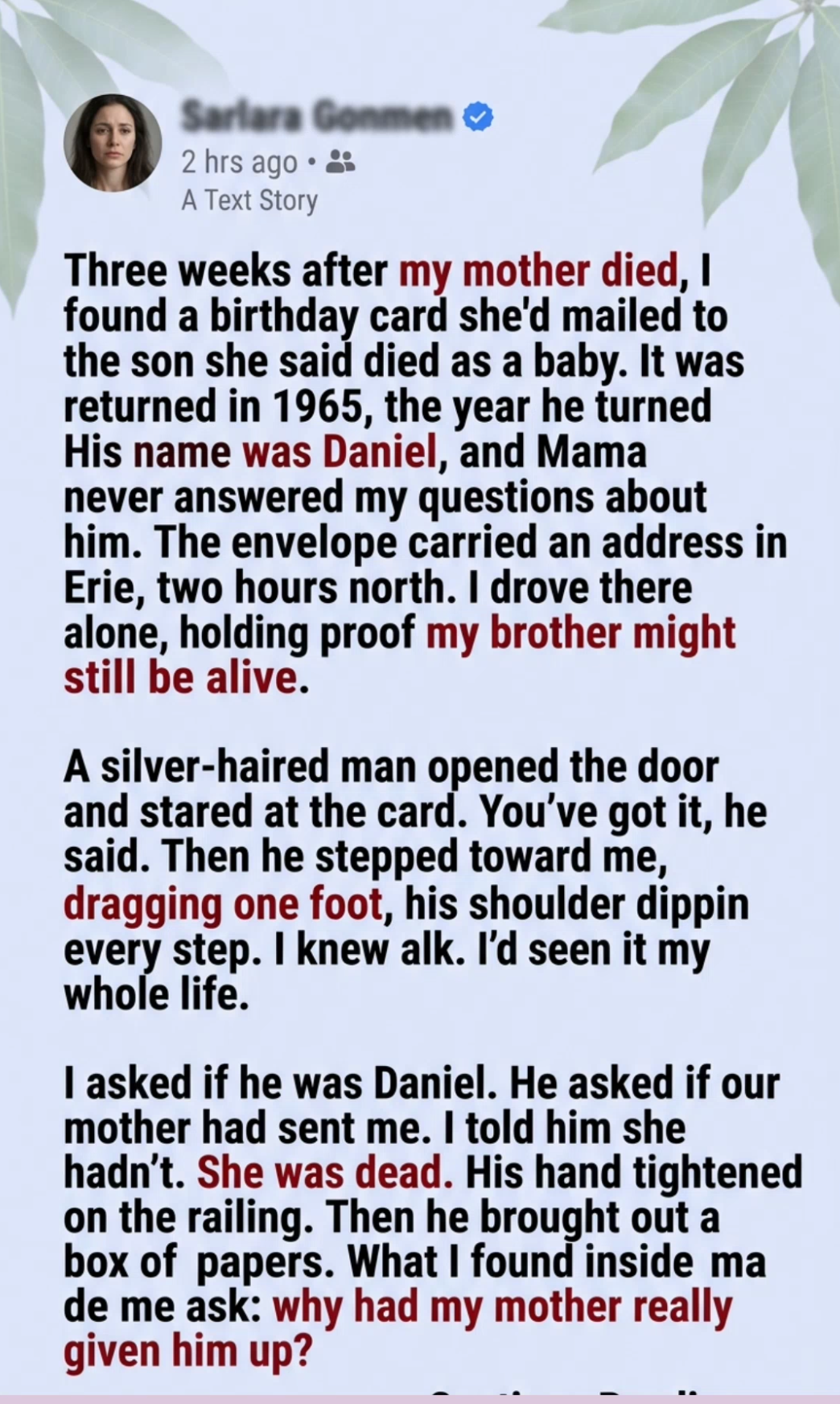
Three weeks after my mother died, I discovered that the most important story of her life was one she had never told me.
I was sixty-two years old, standing in the small bedroom she had used as a sewing room, sorting through drawers that smelled faintly of lavender soap and old paper. My mother, Margaret Wilson, had been a careful woman. She kept receipts, birthday cards, newspaper clippings, warranty papers, and even the instruction booklets for appliances she had stopped owning decades earlier.
She had saved everything.
Except, apparently, the truth.
The birthday card was tucked inside a brown envelope beneath a stack of old photographs. Its corners were soft, and a faded red stamp marked it as returned mail. The envelope had been addressed in my mother’s handwriting:
Daniel Wilson, 214 East Sixth Street, Erie, Pennsylvania.
Beneath the address was a postal marking from 1965.
I stared at the card for several minutes before opening it.
The message inside was short.
Happy birthday, Danny. I hope you are healthy and happy. I think about you every day. Love, Mama.
There was no surname after Danny. No explanation. No mention of where he was living or who was caring for him.
But there was one detail that made my fingers go cold.
My mother had told me my entire life that she had given birth to a little boy before me, a baby who had died shortly after birth. She said his name was Daniel. She had spoken about him only twice, both times when I was very young. Whenever I asked questions, she became quiet and changed the subject.
I had assumed the sadness was too painful for her.
Now I was holding a birthday card mailed to him when he should have been celebrating his first birthday.
And it had been returned.
I checked the year again.
1965.
If the card was genuine, Daniel had not died as a newborn. Someone had been alive to receive—or reject—his birthday card.
I searched the envelope for another address, a forwarding label, or an explanation. There was nothing. Just the old Erie address and the words written in red ink by someone at the post office.
Return to sender.
I sat on the floor surrounded by my mother’s belongings.
For the first time, I wondered whether my childhood had been built around a lie.
My name is Susan Wilson. I was born in 1967, two years after the date on that card. I had grown up in a modest house outside Pittsburgh with my mother and father, Robert Wilson. My father died when I was thirty-eight. My mother had lived alone for the last twenty years, keeping to her routines and refusing most offers of help.
She was not an affectionate woman in the usual sense. She showed love through practical things. She remembered what groceries I liked, repaired my winter coat, and mailed birthday checks to my children long after they were old enough to earn their own money.
She rarely said she missed me.
But she always asked when I was coming back.
I had believed I knew her.
Now I wasn’t sure.
I called my husband, Michael, who was visiting our daughter in Columbus.
“Have you found everything?” he asked.
“No.”
There was something in my voice that made him stop.
I explained about the card.
He listened without interrupting.
“Are you sure it’s your mother’s handwriting?”
“Completely sure.”
“Could it be a different Daniel?”
“She told me she had a son named Daniel.”
He was quiet.
“What are you thinking of doing?”
I looked at the address.
“Going to Erie.”
“Susan, that’s over two hours away.”
“I know.”
“Do you want me to come home?”
I hesitated.
“No. I need to see the address first. I need to know whether anyone is there.”
Michael didn’t argue.
“Call me when you arrive. And don’t make any promises to anyone until you know what’s happening.”
I promised.
The following morning, I placed the card in a plastic sleeve, put it inside my handbag, and drove north.
The journey felt longer than it should have. I kept imagining the man who might answer the door. I imagined a family who knew nothing about my mother, a family who had never heard of me, or perhaps an empty house that would leave me with even more questions.
The address was in an older neighborhood of Erie. The houses stood close together, with narrow front porches and small yards. Some had been renovated. Others looked as though their owners had been fighting the weather for fifty years.
Number 214 was a pale blue house with white trim.
A silver car sat in the driveway.
I parked across the street and looked at it for several minutes.
Then I crossed the sidewalk.
I knocked.
No answer.
I knocked again.
After a moment, I heard movement inside. A lock turned, and the door opened.
A silver-haired man stood in the doorway.
He looked to be in his early sixties, perhaps a little older. His face was narrow, his eyes pale blue, and his expression guarded.
I held the plastic sleeve in front of me.
“Are you Daniel Wilson?”
The man stared at the envelope.
Then his eyes moved to my face.
“You’ve got it,” he said quietly.
Before I could answer, he stepped toward the porch railing. His left foot dragged slightly across the floor. His right shoulder dipped with every step.
I froze.
I knew that walk.
I had seen it my entire childhood.
My father had walked that way after a factory accident in 1974. His left leg had never fully recovered, and his shoulder had tilted because of the way he compensated for it.
The man in front of me moved almost exactly as my father had.
“Are you Daniel?” I asked again.
He looked at me for a long moment.
“Did your mother send you?”
I swallowed.
“No.”
His expression changed.
“Then why are you here?”
“Because she died three weeks ago.”
His hand tightened around the railing.
For a few seconds, neither of us moved.
Then he opened the door wider.
“Come inside.”
The living room was tidy but crowded with books, framed photographs, and wooden furniture. A small lamp glowed beside a recliner. On the wall was a photograph of a younger woman holding a baby.
The man noticed me looking.
“My wife,” he said. “Eleanor.”
“Where is she?”
“She died six years ago.”
“I’m sorry.”
He nodded.
Then he pointed toward the chair.
“Sit down, Susan.”
I had not told him my name.
I sat slowly.
He remained standing.
“How do you know my name?”
He looked toward the hallway.
“Your mother wrote it in a letter.”
My heart began beating faster.
“What letter?”
He didn’t answer immediately. Instead, he walked to a small cabinet, opened the lower drawer, and removed a wooden box.
It was dark brown, with brass corners and a brass clasp.
He placed it on the coffee table.
“I wondered if someone would come eventually,” he said.
“Did you know she had another child?”
He looked at me.
“I knew she had a daughter.”
I couldn’t speak.
“She told me you were born,” he continued. “She sent me one photograph when you were little. I never saw you in person.”
He opened the box.
Inside were envelopes, photographs, official documents, and several letters tied together with a faded blue ribbon.
I recognized my mother’s handwriting immediately.
There were dozens of letters.
Some were dated. Others had no dates at all.
Daniel picked up the oldest envelope.
“This one explains why I was given away.”
He passed it to me.
The envelope was addressed to a woman named Helen Carter in Erie. It had been mailed in 1964, a year before the returned birthday card.
I opened it carefully.
My mother’s words were written in a narrow, precise hand.
Helen, I know you promised to raise him as your own. I know you have given him a home, and I will never forget what you have done. But I need you to understand that I did not give him away because I didn’t love him. I gave him away because Robert said he would leave us if I brought another child home.
I stopped reading.
Daniel sat opposite me.
“Your father was the reason I didn’t grow up with you,” he said.
I looked at him.
“That doesn’t make sense. Dad loved children.”
“Maybe he did. But he didn’t want me.”
He spoke without anger, almost as if he had repeated the explanation so many times that the words had lost their sharp edges.
I returned to the letter.
I was nineteen when Daniel was born. Robert and I were not married yet. His family was already unhappy about the pregnancy. He said we had to put the baby up for adoption or we would have no future together. I was young, frightened, and dependent on everyone around me. Helen promised he would be safe.
My hands trembled.
My mother had not simply lost a baby.
She had made an arrangement.
And my father had been part of it.
“Was Helen your mother?” I asked.
Daniel nodded.
“Not biologically. She adopted me through the proper process.”
“Did she know my mother?”
“Yes. They were cousins.”
I looked at him.
“Your adoptive mother was our mother’s cousin?”
“That’s right.”
The room seemed to tilt.
Daniel explained that Helen and her husband, George Carter, had struggled with infertility. They had wanted a child for years. When Margaret became pregnant, Helen offered to adopt the baby.
At the time, the arrangement had been presented as a solution for everyone.
Margaret could marry Robert without the scandal of an unmarried child. Helen could become a mother. Daniel would grow up in a stable home.
But there was another part of the story.
The adoption had not been a secret to everyone.
Several members of the extended family knew. Some believed it was the best decision. Others thought Margaret had been pressured.
And Robert had insisted that the subject never be discussed again.
“Did you know she had another child?” I asked.
Daniel shook his head.
“I knew she married Robert and later had a daughter. I didn’t know your name until she wrote to me.”
“Why didn’t she visit you?”
“She did. Once.”
I stared at him.
“When?”
“1968. I was four.”
I felt a strange wave of dizziness.
“She came to see you?”
Daniel nodded.
“At my adoptive parents’ house. I remember a woman standing in the hallway. She gave me a small wooden horse. I thought she was a friend of Helen’s.”
He looked toward the cabinet.
“I found out who she was years later.”
I turned another page.
The letter continued.
I came to see him because I needed to know he was happy. He called me Mrs. Wilson because Helen told him I was an old family friend. I wanted to pick him up, but I knew I had no right to confuse him. I left before he could ask questions.
I covered my mouth.
My mother had stood in front of her own son and allowed him to call her a stranger.
Daniel watched me.
“Did she ever tell you about me?”
“She said you died.”
He lowered his eyes.
“Then she lied to both of us.”
I felt a rush of anger.
“Why would she do that?”
He leaned back.
“Maybe because she was ashamed. Maybe because your father demanded it. Maybe because she believed it was the only way to keep the family together.”
I looked down at the papers.
There were more documents in the box.
A legal adoption order.
A certificate showing Daniel’s birth date.
A photograph of my mother holding a newborn.
And a small envelope containing a hospital bracelet.
The bracelet had his name written on it:
Baby Daniel Wilson.
I picked it up carefully.
For years, I had imagined my mother mourning a child who had died.
But she had kept the bracelet of a child who had lived.
“Why did you keep all this?” I asked.
Daniel looked toward the photograph of his adoptive parents.
“Helen told me the truth when I was sixteen.”
I turned toward him.
“Sixteen?”
“She had cancer. She didn’t want me to discover it after she died. She sat me down and told me I had been adopted.”
He paused.
“She said my birth mother was a young woman named Margaret. She told me Margaret had been pressured to give me up, but she also said the adoption had been done legally and that she and George had raised me as their own.”
“How did you react?”
“I was angry. Not because they adopted me. They were my parents. I loved them. I was angry because everyone had decided what I should know and when I should know it.”
He looked at me.
“I wanted to meet Margaret. But Helen was sick, and I didn’t want to hurt her. I waited.”
“Did you ever contact our mother?”
“Yes. I wrote to her when I was eighteen.”
He pulled out another letter.
The envelope was dated 1982.
It had been addressed to Margaret at our childhood home.
“She replied,” he said.
I opened it.
Daniel, I received your letter. I am glad you are well. I hope you understand that I have a family now and that bringing the past into our lives would be difficult. Please do not contact us again. I wish you happiness.
I read it twice.
Then I looked at him.
“She told you not to contact us?”
He nodded.
“I never did.”
“Not even after that?”
“No.”
I couldn’t imagine what it had felt like to receive that letter at eighteen.
To know that your biological mother was alive, that she had another family, and that she had asked you to stay away.
“Did you ever want to find me?”
Daniel looked down at his hands.
“Of course.”
His voice cracked slightly.
“I wondered what you looked like. Whether you had children. Whether you had her eyes. Whether your father was kind to you.”
He stopped.
“Mostly, I wondered whether you knew I existed.”
I couldn’t answer.
Because I hadn’t.
And the truth was worse than that.
I had grown up with a father who had known exactly who Daniel was.
I had eaten dinner at the same table as a man who had helped erase his first son from the family story.
“Did Dad ever contact you?” I asked.
Daniel shook his head.
“Not once.”
I stared at the photograph of my father.
The same man whose walk Daniel had inherited.
The same man who had taught me to ride a bicycle, helped me with mathematics, and sat beside me when I broke my wrist.
I struggled to reconcile the father I remembered with the man described in the letters.
“Did you know he had an accident?” I asked.
Daniel nodded.
“I saw it in the newspaper. Helen saved the article.”
He pointed toward a folded clipping.
It described the factory accident that had damaged my father’s leg.
Daniel had been nine years old.
“Did you ever try to visit him?”
“I thought about it. But he had a daughter, and I didn’t want to destroy her life.”
I looked at him.
“You wouldn’t have destroyed my life.”
He smiled sadly.
“You didn’t know that.”
I sat quietly.
He was right.
I hadn’t known.
And now, at sixty-two, I was learning that my family had been built around a decision made before I was born.
I asked Daniel about his life.
He told me that Helen and George had raised him in Erie. George had worked as a mechanic, and Helen had been a nurse’s assistant. They had lived modestly but comfortably. Daniel had married Eleanor at twenty-four and worked for a regional transportation company for more than thirty years.
They had two children.
A daughter named Rebecca and a son named Thomas.
Rebecca lived outside Buffalo. Thomas lived in Ohio.
Daniel had three grandchildren.
He showed me photographs.
A wedding.
A family camping trip.
A birthday celebration.
A little boy holding a baseball.
I looked at those pictures and realized that my mother had not only kept Daniel from me.
She had kept me from an entire family.
“Do they know about Margaret?” I asked.
“Rebecca does. Thomas knows I was adopted, but he doesn’t know the details.”
“Would they want to meet me?”
Daniel looked uncertain.
“I don’t know.”
I understood.
They had their own lives, their own memories, and their own understanding of family. I was a stranger arriving with a story that could unsettle everything they believed about their grandfather.
I didn’t expect them to welcome me simply because we shared DNA.
“I’d like to meet them someday,” I said. “But only if they want that.”
Daniel nodded.
“That’s fair.”
We spent another hour going through the papers.
One document was particularly important.
It was a letter from my mother dated 1997.
She had written to Daniel after my father died.
Robert is gone now. I thought perhaps I would finally be able to tell Susan about you, but I cannot find the courage. She has children of her own, and I don’t know how to explain what I did. I have spent my life believing I protected everyone. I am beginning to wonder whether I only protected myself.
I read that paragraph several times.
For years, I had thought my mother was silent because she was grieving.
But perhaps she had been afraid.
Afraid of what I would think of her.
Afraid that I would question my father’s memory.
Afraid that I would ask why she had chosen one child over another.
I found another letter, written in 2004.
Daniel, I am getting older. I don’t expect forgiveness. I only want you to know that I have never forgotten the sound of your first cry. I remember the little red mark on your forehead and the way your fingers curled around mine. I told myself you would have a better life with Helen and George. I hope I was right.
My eyes filled with tears.
I looked at Daniel.
“She remembered everything.”
He nodded.
“I know.”
“She remembered your first cry.”
He looked away.
For a long time, neither of us spoke.
Then I asked the question that had been troubling me since I first saw the card.
“Why did she keep sending birthday cards if she knew they were being returned?”
Daniel reached into the box and removed a small stack of envelopes.
Some had been returned.
Others had no postal markings.
He explained that Helen and George had moved several times during Daniel’s childhood. The original Erie address had been valid for only a short period. Margaret had continued sending cards there, sometimes without knowing whether they would reach him.
The returned card from 1965 had been the first.
There were others from 1966 and 1967.
One had been returned in 1970.
Then the letters stopped.
“Why didn’t you forward your address?” I asked.
Daniel gave a small, sad smile.
“Because I didn’t know she was sending them.”
I felt something break inside me.
Two people had been separated by a decision they had not been allowed to make together.
My mother had believed she was protecting him.
Daniel had believed his birth mother wanted nothing to do with him.
And I had grown up believing I had no brother.
The next question was harder.
“What do you want now?”
Daniel looked at me.
“I don’t know.”
I waited.
He continued.
“I spent most of my life trying to make peace with the family that raised me. They were good people. They loved me. I never wanted to disrespect them by acting as though they weren’t my parents.”
“I understand.”
“But I also wanted to know where I came from.”
He looked at the old hospital bracelet.
“I wanted to know why I had been given away.”
I reached across the table.
“I’m sorry.”
He looked at my hand.
“You didn’t do anything.”
“I know. But I’m sorry you spent your life thinking she didn’t want you.”
He swallowed.
“She did want me.”
It wasn’t a question.
I nodded.
“Yes. I think she did.”
For the first time, he cried.
Not loudly.
He simply lowered his head and covered his face with both hands.
I sat beside him.
We were strangers in one sense, but we shared a mother, a father, and a history that had been hidden from both of us.
I didn’t know what to call him.
Brother seemed too large a word to use after an hour.
But it also seemed wrong to avoid it.
After a while, he wiped his eyes.
“Would you like some tea?”
I laughed through my own tears.
“Yes, please.”
He went to the kitchen.
While he was gone, I looked again at the photographs on the wall.
One showed him as a young man standing beside his adoptive father. Another showed him with Eleanor on their wedding day.
I noticed something I hadn’t seen before.
His smile was almost exactly like my father’s.
The same slight lift at one corner.
The same narrow eyes.
The same expression that made it look as though he knew something funny but was waiting for everyone else to catch up.
When he returned, I asked whether he had any photographs of Margaret.
He thought for a moment.
Then he opened another drawer and removed a small photograph.
It was my mother, perhaps twenty-five years old, standing beside a tree.
She wore a light-colored dress and had her hair pinned back.
I had never seen her look so young.
On the back, she had written:
For Danny. I hope someday you understand.
I held it carefully.
“May I have a copy?”
“Of course.”
I stayed another hour.
Before I left, Daniel walked me to the door.
“Will you come back?”
I looked at him.
“If you want me to.”
He nodded.
“I do.”
I hesitated.
“Daniel?”
“Yes?”
“I think I’d like to call you my brother.”
His eyes filled again.
“I think I’d like that, too.”
The drive home was difficult.
I kept replaying the conversation, trying to understand how one family could carry so much silence for so many decades.
When I arrived, Michael was waiting.
He took one look at my face and stood.
“Did you find him?”
I nodded.
“His name is Daniel.”
Michael put his arms around me.
I cried harder than I had expected.
I told him everything.
About the returned card.
About the man at the door.
About the papers.
About the adoption.
About my father.
And about the brother I had never known.
Michael listened quietly.
When I finished, he asked whether I wanted to tell our children.
“Yes,” I said. “But I don’t know how.”
We decided to call our daughter, Emily, first.
She was thirty-six, with two children of her own. I knew the news would surprise her.
I began carefully.
“Emily, there’s something about Grandma that I never knew until after she died.”
“What happened?”
I explained that I had discovered a brother.
She went quiet.
“Wait. Grandma had another son?”
“Yes.”
“And Grandpa knew?”
“Apparently.”
She didn’t speak for several seconds.
Then she asked, “Is he alive?”
“Yes.”
“What’s his name?”
“Daniel.”
Emily began crying.
“Mom, you have a brother.”
I smiled sadly.
“Apparently, I do.”
The next few weeks were filled with phone calls and careful introductions.
Daniel spoke with Emily first. Then he spoke with our son, James.
Neither of them knew what to expect.
Daniel was polite and reserved. He didn’t ask them to call him Uncle Danny immediately. He didn’t make assumptions about their feelings.
He simply told them about his life.
He talked about Helen and George, about his wife Eleanor, and about the children he had raised.
Emily asked whether he had known about her grandmother.
Daniel explained what he knew.
James asked whether he had ever met my father.
Daniel said no.
That answer upset James more than anything else.
He had always admired his grandfather.
He remembered fishing with him, repairing bicycles, and listening to stories about the factory where he had worked.
The idea that his grandfather had helped keep an entire son hidden was difficult to accept.
I understood.
It was difficult for me, too.
I had to learn that a person could be loving in some parts of life and deeply unfair in others.
The truth did not erase the good memories.
But it changed the shape of them.
One month after my first visit, Daniel invited me to meet his daughter Rebecca.
We arranged to have lunch at a small restaurant near Erie.
I arrived early.
Daniel was already there, sitting beside a window.
Rebecca stood when I approached.
She was forty-one, with dark hair and the same pale blue eyes as her father.
For a moment, she looked at me as though she were trying to find her own reflection.
Then she smiled.
“You’re Susan.”
“Yes.”
“I’m Rebecca.”
We shook hands.
The conversation was cautious at first.
We talked about the drive, the weather, and the restaurant. Daniel told a story about a family camping trip, and Rebecca laughed.
Eventually, she asked the question I had been expecting.
“Did your grandmother know about Dad?”
I nodded.
“Yes.”
“Did she ever talk about him?”
“Never openly. I found the letters after she died.”
Rebecca looked down.
“That must have been hard.”
“It was.”
She took a breath.
“I used to ask Dad why he didn’t know anything about his birth family. He always said it was complicated.”
Daniel looked at her.
“I didn’t want you to feel that you needed to solve it.”
She reached for his hand.
“You didn’t have to protect us from the truth.”
He nodded.
I watched them.
And I realized that this family had also been living with a silence.
It had not been exactly the same as mine, but it had grown from the same missing information.
Rebecca asked whether I had children.
I told her about Emily and James.
She smiled.
“Then we have cousins who don’t know each other.”
“Yes.”
“Maybe we can change that.”
It was the first time the possibility of a larger family felt real.
Over the following months, we exchanged photographs and stories.
Daniel sent me pictures of his adoptive parents. I sent him photographs of our childhood home and pictures of my father.
We compared birthdays, habits, and family expressions.
He had inherited our father’s uneven walk, but he had also inherited our mother’s habit of tapping her fingers when thinking.
I had the same habit.
When I mentioned it, he laughed.
“I thought I got that from Helen.”
We discovered that we both disliked raisins, loved old country music, and had the same reaction to people who arrived late without calling.
We also discovered that our childhoods had been shaped by very different families.
Daniel had grown up with Helen and George, who loved him deeply and gave him stability. He never regretted being raised by them.
I had grown up with Margaret and Robert, who provided a home but avoided the truth.
Neither life was perfect.
Neither family was entirely good or bad.
And we had to learn that discovering a biological connection did not mean we had to reject the people who had raised us.
One afternoon, Daniel called.
“I found something else.”
“What?”
“A letter from your father.”
I sat down.
“My father wrote to you?”
“Not directly. It was in a folder Helen kept.”
He explained that George had received a letter from Robert in 1964, shortly after the adoption arrangements had been completed.
Robert had written that he wanted the matter kept private. He said Margaret was young and emotional, and he wanted her to move forward without being reminded of the past.
But there was one sentence that stayed with me.
I am not asking you to raise a child who is unwanted. I am asking you to raise a child whose presence would make our lives impossible.
I read the sentence after Daniel sent me a photograph of the letter.
I felt anger rise in my chest.
My father had not simply feared scandal.
He had treated his first son as an obstacle.
And my mother had spent the rest of her life carrying the decision.
I wondered whether she had truly chosen to give Daniel away or whether she had been cornered by a man she loved and a family that wanted the problem hidden.
I would never know exactly what happened in those rooms before I was born.
But I knew the decision had shaped three generations.
It had shaped Daniel’s childhood.
It had shaped my understanding of my mother.
It had shaped the family our children inherited.
A few months after I found the card, Daniel and I visited our mother’s grave together.
It was a quiet morning.
I brought flowers.
He brought the small photograph she had sent him decades earlier.
We stood beside the headstone.
For a long time, neither of us spoke.
Then Daniel placed the photograph against the base of the stone.
“Hello, Mama,” he whispered.
I looked at him.
He had never called her that in front of me before.
He took a breath.
“I don’t know if I can forgive everything. But I wanted you to know I’m here.”
His voice trembled.
“I had a good life. Helen and George loved me. I had a wife, children, and grandchildren. You didn’t get to see any of it.”
He paused.
“But I hope you knew I was okay.”
I stood beside him, crying quietly.
Then I said something I had not planned.
“She loved you, Daniel. I wish she had found the courage to tell us both.”
He nodded.
We stayed until the wind became cold.
Before we left, I placed my hand on the headstone.
“Goodbye, Mama.”
Then I looked at Daniel.
“Come on, brother.”
He smiled.
And we walked away together.
The relationship did not become perfect overnight.
We had decades of missed birthdays, family celebrations, and ordinary days to make up for. There were awkward moments when we didn’t know whether to speak as siblings or as two people who had only recently met.
Sometimes Daniel became quiet when we discussed our childhoods.
Sometimes I became defensive when he spoke about our father.
We learned to stop when a conversation became too painful.
We learned that we could disagree without abandoning one another.
And we learned that the people who had raised him deserved to remain part of his story.
I eventually visited Helen and George’s graves with Daniel and Rebecca.
I placed flowers there, too.
I thanked them for loving the boy my mother had been unable to raise.
Daniel stood beside me.
“They were good parents,” he said.
“I can see that.”
“I don’t want anyone to think I loved them less because I found you.”
“I wouldn’t ask you to.”
He smiled.
“Good.”
That afternoon, Rebecca invited us back to her home.
Her children were waiting.
When I walked through the door, a little girl came running toward me.
“Are you Grandma Margaret’s daughter?”
I smiled.
“Yes.”
She looked toward Daniel.
“Then you’re Grandpa’s sister?”
Daniel laughed.
“That’s right.”
She thought about it for a moment.
“So you’re my great-aunt?”
I nodded.
She took my hand.
“Come see my room.”
I followed her down the hallway.
And for the first time, I felt the full weight of what my mother had hidden.
She had not only taken a son away from herself.
She had taken a brother away from a sister, an uncle away from nieces and nephews, and an entire branch of a family away from people who might have loved one another.
I couldn’t change what happened in 1964.
I couldn’t give Daniel back the childhood he had spent wondering why his birth mother never came.
I couldn’t give my mother the courage she had lacked.
But I could refuse to let the silence continue.
The returned birthday card remained in my home, protected inside a small frame.
I placed it beside a photograph of Daniel and me standing together at our mother’s grave.
The card had once been evidence of a message that never reached its destination.
Now it reminded me that a story could remain unfinished for decades and still find its way toward the truth.
My mother had written, I think about you every day.
For most of his life, Daniel had believed she had forgotten him.
For most of mine, I had believed he had never lived long enough to become part of our family.
We had both been wrong.
And although the truth arrived far too late to repair everything, it gave us something we had never been allowed to have.
A chance to know each other.
A chance to build a relationship without pretending the past had been fair.
A chance to call one another brother and sister.
Sometimes the most painful family secrets are not hidden because nobody cares.
They are hidden because someone is afraid of what the truth will cost.
My mother spent more than sixty years carrying that fear.
Daniel and I spent our first year together learning that we did not have to carry it for her.
The last time I visited him, he walked me to my car.
His left foot dragged slightly, and his shoulder dipped with every step.
I smiled when I noticed it.
“What?” he asked.
“Nothing. You walk exactly like Dad.”
Daniel stopped.
For a moment, neither of us spoke.
Then he smiled sadly.
“I guess I do.”
I opened the car door but didn’t get inside immediately.
“Next time, come visit us. Emily wants to make dinner, and James says he has questions about the family tree.”
Daniel laughed.
“Tell him to bring a notebook.”
I hugged him.
“Goodbye, brother.”
He hugged me back.
“Goodbye, Susan.”
As I drove away, I thought about the returned birthday card that had started everything.
It had been mailed more than sixty years earlier, but its message had finally reached the person it was meant for.
Not through the postal service.
Not through my mother.
Through the daughter who had been told there was no brother to find.
And that was how a single old envelope brought two families together after a lifetime of silence.
The End