The lawyer’s office smelled of polished wood, expensive coffee, and the kind of silence that makes every small movement feel uncomfortable. I sat between my older sister, Lara, and my father’s longtime attorney, Mr. Whitmore, holding a tissue I had already folded and unfolded a dozen times. My father had been dead for eleven days. Eleven days since I had watched the machines beside his hospital bed go quiet. Eleven days since I had kissed his forehead and whispered that he could finally rest. And now, I was sitting in a room where the final words he had left behind would determine what happened to everything he had spent his life building.
Lara arrived twenty minutes late, wearing a black designer dress, oversized sunglasses, and a perfume so strong that it seemed to announce her before she entered the room. She barely looked at me.
“Sorry,” she said, dropping into the chair. “Traffic was terrible.”
I wanted to tell her that traffic had never stopped her from attending a shopping appointment, a vacation, or a dinner with friends. But I said nothing. I had spent too many years learning that arguing with Lara was like trying to hold water in my hands. Whatever I said would slip away, and somehow I would end up being the unreasonable one.
Mr. Whitmore adjusted his glasses and opened a thick folder.
“Thank you both for coming. Your father wanted this meeting to take place after the funeral, and he was very specific about having both of you present.”
My throat tightened.
Dad had been a quiet man. He never enjoyed arguments, never raised his voice unless he was worried about someone, and never made promises he couldn’t keep. After our mother died, he raised us with the little money he had, working long hours at his hardware business and spending whatever free time remained making sure we had what we needed.
Lara had always been his favorite, or at least that was how it felt to me. She was confident, beautiful, and knew exactly how to make people admire her. I was the practical one. I studied, worked, paid bills, and stayed close to home. When Dad needed someone, I was usually the person he called.
When he became ill, I was the one who took him to appointments, organized his medication, prepared his meals, and helped him bathe when his legs became too weak to support him. I learned how to change his bedding without hurting his back. I learned which foods he could swallow comfortably and which songs helped him sleep.
Lara visited occasionally. Sometimes she brought flowers. Sometimes she stayed for an hour, took a photograph, and left before Dad needed help with anything difficult.
I never complained. He was my father, and I loved him.
That was what made the next moment so devastating.
Mr. Whitmore began reading.
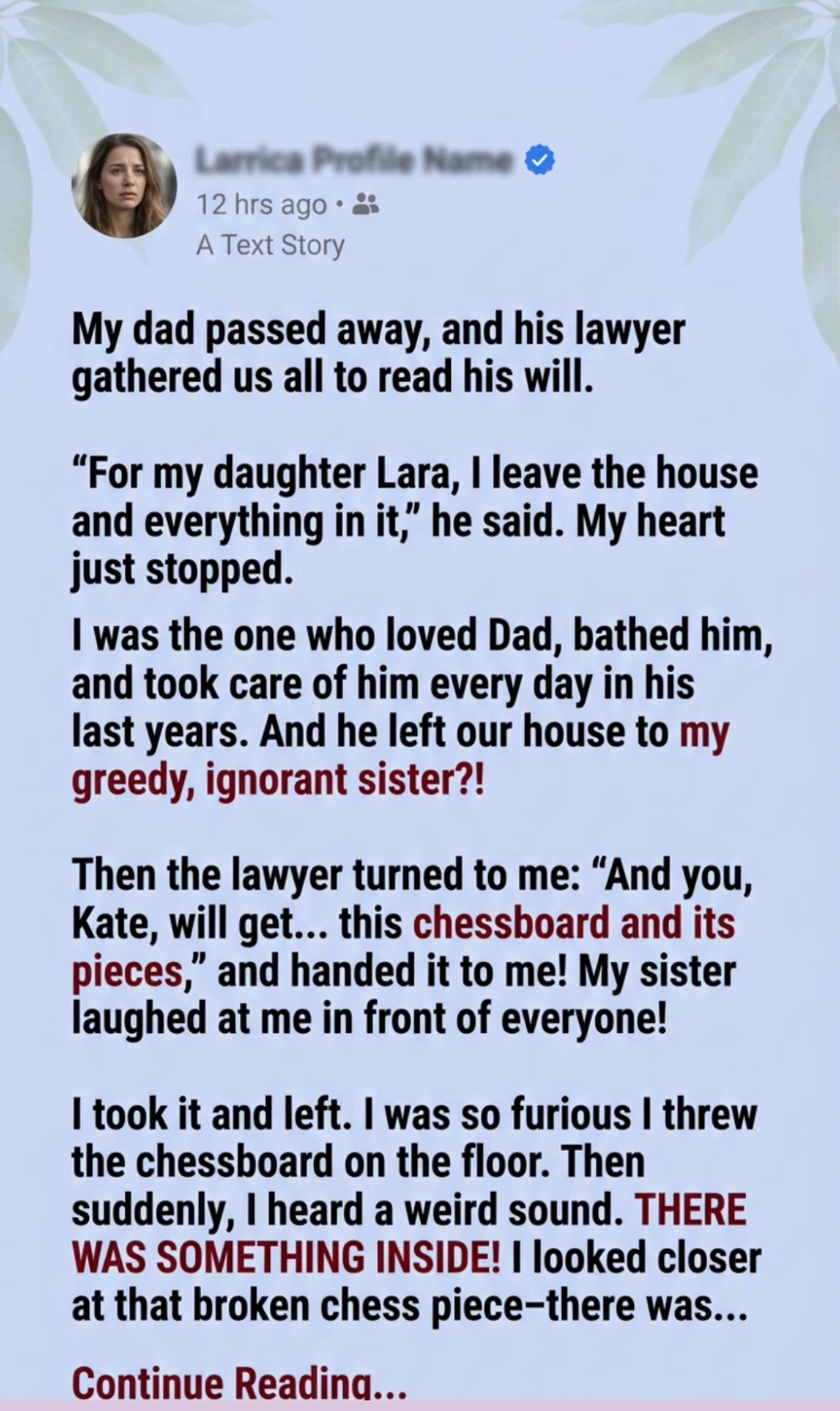
“For my daughter Lara, I leave the family home, together with its furnishings, household contents, and all associated personal property not otherwise specifically bequeathed.”
I stopped breathing.
For several seconds, I thought I had misunderstood him.
The house?
Our childhood home?
The place where I had spent countless nights sleeping in a chair beside Dad’s bed?
The house I had cleaned, repaired, and maintained while Lara visited whenever she wanted something?
Lara sat up straighter. A slow smile appeared on her face.
“Everything in it?” she asked.
Mr. Whitmore nodded. “That is what the document states, subject to the usual estate administration and any applicable legal obligations.”
Lara looked at me.
“Well,” she said softly, “I guess Dad knew who he wanted to have it.”
My fingers tightened around the tissue.
I waited for Mr. Whitmore to correct something. I waited for him to say that there had been another page, another instruction, another provision explaining that I would receive the house because I had been the one caring for Dad.
But he simply turned the page.
“And to my daughter Kate, I leave my personal chessboard and the pieces belonging to it, currently stored in the study.”
I stared at him.
“That’s it?” I whispered.
He looked at me carefully. “That is the specific gift listed for you in the will.”
Lara laughed.
Not a nervous laugh. Not an embarrassed laugh.
She actually laughed.
“Oh, Kate,” she said, covering her mouth. “You always liked that old thing. I suppose Dad thought it was more your style.”
My face burned.
The chessboard had been in Dad’s study for as long as I could remember. It was made of dark walnut, with small scratches along the edges and a faded brass clasp. The pieces were carved from ivory-colored and dark wood, although Dad had once told me they were made from an old synthetic material, not real ivory.
When I was little, he taught me how to play chess on that board. He used to let me win when I was six, then gradually stopped letting me win when I became old enough to understand the rules.
Every Sunday afternoon, we played together.
As I grew older, the games became less frequent. But whenever I visited, he would sometimes sit in his study, turn a piece between his fingers, and smile as if he were remembering something important.
I had assumed it was simply an old possession he treasured.
Now it was the only thing he had left me.
“Your father made this decision himself,” Mr. Whitmore said gently. “The will was properly executed, and I have no indication that he lacked the capacity to make it.”
I nodded, although I could barely hear him.
Lara leaned back in her chair.
“Well, at least the house won’t go to waste,” she said. “It needs a lot of work. Honestly, Kate, you should be grateful you don’t have to deal with all that.”
I looked at her.
“You haven’t even been there in months.”
Her smile disappeared.
“Don’t start.”
“I took care of him.”
“And I loved him too.”
“Then why was I the one sleeping beside him every night?”
“Because you chose to,” she snapped. “Nobody forced you.”
The words struck harder than I expected.
Nobody forced me.
As if love were a punishment I had volunteered to endure. As if every night I had spent checking Dad’s breathing, every appointment I had attended, and every difficult morning I had helped him through had been meaningless.
Mr. Whitmore closed the folder.
“I suggest both of you take some time before discussing the estate further. The transfer process will take place through the appropriate legal channels, and there may be matters requiring additional documentation.”
Lara stood.
“Of course. I’ll contact you about the house.”
She picked up her handbag and walked toward the door.
Before leaving, she turned to me.
“Don’t worry, Kate. You can come visit the chessboard whenever you miss Dad.”
Then she smiled and left.
I remained in the chair for several minutes.
I didn’t cry in front of the lawyer. I didn’t shout. I simply stared at the empty space where Lara had been sitting, wondering how my father could have watched me sacrifice so much of my life and still leave me feeling like the least important person in the family.
When Mr. Whitmore finally handed me a small box containing the chessboard, I accepted it without speaking.
It was heavier than I remembered.
I carried it to my car, placed it on the passenger seat, and drove home through the afternoon rain.
My apartment felt unbearably quiet.
I set the box on the dining table and removed the lid. The chessboard lay inside, wrapped in an old brown cloth. The pieces were arranged in two rows, just as Dad had always kept them.
I touched the little wooden king.
For one brief moment, I remembered his voice.
“Never move a piece because you’re frightened, Kate. Look at the whole board first.”
I pulled my hand away.
The memory made my anger worse.
I thought about the will. I thought about Lara’s laughter. I thought about the house where I had spent years caring for the man who had apparently valued my sister’s future more than mine.
Then I picked up the chessboard.
“I hope you were worth it,” I whispered.
I don’t even remember deciding to throw it.
One second, I was standing beside the table, and the next, the board was falling from my hands.
It struck the hardwood floor with a violent crack.
The wooden frame split near one corner. Several pieces scattered across the room, and one of the darker pieces rolled beneath the dining chair.
I stood there, breathing hard.
Then I heard something.
A small metallic click.
I looked down.
It hadn’t come from the chessboard itself. It had come from one of the pieces.
The black king lay near the broken frame, its wooden base separated from the upper portion. A tiny brass object had slipped out from inside it.
I crouched.
At first, I thought it was a screw. But when I picked it up, I noticed that it was a miniature metal cylinder, no longer than my little finger, with a narrow seam running along its side.
My anger disappeared.
I turned the broken chess piece over.
The base was hollow.
Inside it was a small cavity, carefully carved to hold something.
My hands began to shake.
Dad had hidden something inside the king.
I examined the metal cylinder. It had a tiny threaded cap, and beneath the cap was a tightly rolled strip of paper protected by a thin layer of waxed material.
I carefully opened it.
The paper was yellowed, but the handwriting was unmistakable.
My father’s handwriting.
There were only a few sentences.
Kate, if you are reading this, then you have finally opened the king. I hoped you would never need to. But if the day came when you felt that I had forgotten everything you did for me, I wanted you to know that I never forgot.
I covered my mouth.
For a moment, I couldn’t continue.
I sat on the floor among the scattered chess pieces and read the note again.
Then I turned it over.
On the back, Dad had written a date and a telephone number.
Beneath them were five words.
Ask Mr. Whitmore about the second envelope.
I stared at the page.
A second envelope?
Why hadn’t the lawyer mentioned it?
I immediately called his office. It was after business hours, and the receptionist had already left. I considered calling Lara, but the thought of hearing her voice made my stomach turn.
Instead, I photographed the note and sent it to Mr. Whitmore with a short message.
I found this inside the chessboard. Dad says to ask you about a second envelope. What does it mean?
He called me less than four minutes later.
“Kate,” he said, sounding unusually serious. “Where did you find that?”
“Inside the black king. Dad hid a note there.”
There was a pause.
“Did you read it?”
“Yes. He mentioned a second envelope.”
I heard papers moving on his desk.
“Your father instructed me to keep a separate sealed envelope in the estate file. He told me it was not to be opened during the initial reading of the will unless a specific condition was met.”
“What condition?”
Another pause.
“Finding the message inside the chess piece.”
My heart began pounding.
“Why?”
“Because he wanted to make certain the person who received the chessboard had actually discovered what he had hidden inside it. He was very clear that the message was intended for you.”
I closed my eyes.
“Does it say something about the house?”
“I cannot discuss the contents over the telephone. I need you to come to my office tomorrow morning. Bring the chess piece and the original note.”
I looked at the broken king in my hand.
“Is Lara supposed to know?”
“Not yet. I would prefer that we review the documents first.”
I barely slept that night.
I kept imagining possibilities. Perhaps Dad had left me money. Perhaps there was a letter explaining why he had made the decision. Perhaps he had simply wanted to apologize for something he could no longer say aloud.
But the most troubling thought was that he had deliberately hidden something in a chess piece and arranged for a lawyer to keep another document sealed until I found it.
That meant the will I had heard read was not the entire story.
At eight thirty the next morning, I arrived at Mr. Whitmore’s office.
He was waiting with a file on his desk.
Beside it sat a thick cream-colored envelope bearing my father’s signature across the seal.
He examined the broken chess piece and the small note I had brought.
Then he looked at me.
“Your father was very particular about this arrangement,” he said. “He visited me several times over the last year of his life. Each time, he brought a different document or asked me to review a different possibility. He wanted to be certain that whatever happened after his death would be handled legally and without anyone having to rely on rumors or promises.”
“Why didn’t he tell me?”
“Because he didn’t want you to change how you treated him.”
I looked down.
Mr. Whitmore continued.
“He said that if you knew you might receive something substantial, you would feel uncomfortable accepting it. He believed you would continue caring for him regardless, but he did not want the possibility of an inheritance to become another burden on your shoulders.”
My eyes filled with tears.
The lawyer opened the envelope carefully.
Inside were several pages, a signed statement, and a copy of a document bearing the seal of a financial institution.
He began reading.
The first page was a personal letter.
My dearest Kate,
If you are hearing these words, then I am no longer there to explain myself. I know the will may have hurt you. I know you may believe I rewarded the person who visited me less and overlooked the person who stayed.
I need you to understand something. I did not measure my daughters by the number of hours they spent beside my bed. I knew what you gave me. I knew what you missed. I knew how many times you went home exhausted and returned the next morning because you were afraid I might need you.
I also knew that you would never ask me for anything.
I stopped reading.
Mr. Whitmore placed the letter down and waited.
I wiped my cheeks.
“Please continue.”
He turned to the next page.
There is something I never told either of you. When your mother and I were young, I made a business decision that changed the direction of our lives. I invested in a small industrial property with a friend named Thomas. It was a neglected warehouse near the old railway district. Everyone thought it was worthless.
I kept my share for decades. I never discussed it because I wanted both of you to build lives that did not depend on what I might leave behind.
I frowned.
“What property?”
Mr. Whitmore pointed to the documents.
The warehouse had been purchased decades earlier by a small partnership. My father had owned a substantial interest, and the ownership had remained documented through several reorganizations and legal transfers.
The property was now part of a commercial redevelopment area.
According to an independent valuation included in the file, my father’s remaining interest was worth considerably more than the family house.
I stared at the number.
It was enough to change my life.
But the document was not simply a bank statement or an informal promise. It was a properly recorded ownership interest, accompanied by corporate records, tax documentation, and an estate instruction identifying how that interest was to be distributed.
I looked at Mr. Whitmore.
“Did Lara know about this?”
“No. Your father asked that the information remain confidential until the condition in his letter was met. The documents were kept separately because he wanted the instruction to be handled according to its terms.”
“Why would he leave the house to her and this to me?”
Mr. Whitmore took a breath.
“Because the house and the investment were not the only things he considered. He also made arrangements for certain debts, expenses, and future obligations to be accounted for. He wanted Lara to have a place she could call her own, but he wanted you to have something that would give you independence.”
He handed me another page.
It was a letter addressed to both of us.
Dad had written that he remembered how Lara had always dreamed of owning the family home. She had loved its large garden, the old fireplace, and the room overlooking the street. He believed the house would mean something to her beyond its financial value.
But he had also written that he knew Lara had difficulty managing money. He had arranged for the estate attorney to review any outstanding obligations and ensure that the transfer was handled properly. He did not want her to inherit the house only to lose it through an impulsive decision.
Then came the paragraph that made me cry again.
Kate, I am leaving you the investment because you understand what it means to protect something over time. You have shown patience, discipline, and judgment. I do not want you to spend your life feeling that caring for me cost you your future.
I read the sentence twice.
I had spent so long believing that Dad had failed to see me.
Now I understood that he had been watching more carefully than I ever realized.
Mr. Whitmore explained that the property interest would still need to pass through the estate administration process. There would be tax considerations, valuations, and legal filings. Nothing would happen overnight, and no one could simply hand me a check that morning.
But the ownership documents were genuine.
My father had not left me an empty promise.
He had left me a future.
I sat quietly for a long time.
Then I asked the question that had been troubling me since I entered the office.
“Why did he make the chessboard the key?”
Mr. Whitmore smiled sadly.
“Because it was the first thing he ever taught you to think about.”
He opened a small notebook from the file.
“Your father told me a story. When you were eight years old, you once became upset because you lost a chess game. You pushed the pieces off the board and told him that the game was unfair. He said he told you that you were looking at the piece you had lost instead of the entire board.”
I remembered.
I remembered the afternoon, the sunlight across his study, and the way he had patiently arranged the pieces again.
“He said he wanted you to remember that lesson,” Mr. Whitmore continued. “He believed that when you found the hidden message, you would be angry enough to understand why he had arranged everything this way.”
I laughed through my tears.
“He knew I would throw it?”
“Not necessarily. He said you might discover it while cleaning the board, repairing it, or simply examining it. But he knew you would eventually find it.”
I looked at the broken king.
The little piece that had once seemed worthless now felt like the most precious thing I owned.
Then my phone rang.
Lara.
I watched her name appear on the screen before answering.
“Where are you?” she demanded.
“At Mr. Whitmore’s office.”
“Why?”
“Because I found something in Dad’s chessboard.”
Silence.
Then her voice sharpened.
“What did you find?”
“A note.”
“What kind of note?”
“One that told me to ask the lawyer about a second envelope.”
I heard her breathing change.
“Kate, whatever it is, don’t start making this into something it isn’t. Dad left me the house. That’s in the will. You can’t change that just because you found some old paper.”
“I’m not trying to change anything.”
“Then what are you doing?”
“Finding out what Dad wanted me to know.”
She hung up.
Mr. Whitmore looked at me.
“She may contact the office. I will explain the legal position to her if necessary.”
I nodded.
For the first time since the funeral, I didn’t feel the need to defend myself.
The next few weeks were difficult.
Lara became increasingly anxious when she learned that Dad had left separate instructions concerning the investment. She questioned the documents, demanded copies, and insisted that there must have been another explanation.
Mr. Whitmore provided the appropriate information through the estate process. He explained that the investment interest had been held separately, that the supporting records had been independently maintained, and that the testamentary instructions had been reviewed for legal validity.
Lara eventually hired her own attorney.
That was her right.
The lawyers exchanged documents, reviewed the ownership history, and confirmed the value of the property interest. There were questions about taxes and the estate’s remaining obligations, but nothing suggested that the documents were fraudulent or that my father had been incapable of making his decision.
The house transfer proceeded through the required legal steps.
My investment interest was also formally recognized and transferred according to the estate documents.
Several months passed before everything was finalized.
During that time, Lara and I barely spoke.
She moved into the family home and began making changes. She replaced the curtains, painted the kitchen, and hired someone to redesign the garden. She posted photographs online, smiling beside the fireplace and standing in front of the house where we had grown up.
I didn’t resent her for enjoying it.
I only wished she had understood what it had cost me to keep that home running while Dad was alive.
One afternoon, after the estate matters had been settled, I returned to the old house to collect a few personal belongings that had been specifically set aside for me.
Lara opened the door.
She looked tired.
The expensive clothes were gone, replaced by a simple sweater and jeans. Her hair was tied back, and there was a stack of unopened mail on the hallway table.
“Come in,” she said.
I stepped inside.
The house smelled exactly as it had when Dad was alive, except the familiar scent of his pipe tobacco and old books was fading.
I walked into the study.
The shelves were still there, but the chess table was empty.
I looked at the spot where Dad used to sit.
Lara stood behind me.
“I found the other chess pieces,” she said quietly.
I turned.
She was holding the white king.
“I thought you might want them.”
I accepted it.
For a moment, neither of us spoke.
Then Lara lowered her eyes.
“I didn’t know about the warehouse.”
“I didn’t either.”
“Did he really leave it all to you?”
“He left me his share. The documents were valid. It took months to complete everything.”
She nodded.
“I thought he had forgotten you.”
I looked at her.
“So did I.”
Her eyes filled.
“I shouldn’t have laughed.”
“No. You shouldn’t have.”
She swallowed.
“I was happy about the house. I was thinking about what I wanted. I didn’t think about what you had done for him.”
I didn’t answer immediately.
There were too many memories between us for one apology to erase everything. I remembered the hospital nights, the missed workdays, the arguments about medication, and the times Lara had promised to visit but never arrived.
But I also remembered that we had once been two little girls sitting on the same carpet, waiting for Dad to come home from work.
“I don’t need you to feel guilty forever,” I finally said. “I just need you to understand that I was there because I loved him. Not because I expected to inherit something.”
“I know that now.”
She looked toward the study.
“He used to tell me that I was always looking at the prize instead of the game.”
I smiled faintly.
“He told me the same thing.”
For the first time in months, we laughed together.
Before leaving, I walked into the garden.
Dad had planted a small maple tree there when I was a child. Its branches were taller now, and its leaves moved gently in the afternoon breeze.
I touched the trunk.
I had once believed that my father’s final decision had reduced everything I had done to nothing.
But he had not forgotten.
He had simply found a way to tell me what I had been unable to believe while he was alive.
That evening, I took the broken black king home and placed it on my desk beside the little metal cylinder and the original note.
I could have bought a new chessboard. I could have repaired the old one and restored every piece to its proper place.
Instead, I kept the broken king exactly as it was.
Its damaged base reminded me of the moment I had nearly thrown away the last thing my father had left me.
It also reminded me that appearances can be misleading, that silence does not always mean someone has forgotten, and that a person’s true intentions are not always visible from the first move.
Years later, I still think about that morning in the lawyer’s office.
I remember Lara laughing.
I remember the terrible feeling of believing that my father had valued me less.
And I remember the sound of the chessboard hitting the floor.
If I had not been angry, I might never have examined the broken piece. If I had not opened the little metal cylinder, I might never have read the words my father had written specifically for me.
But the greatest gift was not the property, the money, or the security it eventually provided.
It was knowing that the man I had loved had seen every small act of kindness, every sacrifice, and every moment I thought no one noticed.
I had spent years caring for my father because I wanted him to feel safe and loved.
He spent his final year making sure I would not spend the rest of my life believing that love had gone unseen.
And every time I look at that little black king, I hear his voice again.
“Never move a piece because you’re frightened, Kate. Look at the whole board first.”
The End