For twenty-five years, my wife’s older brother had treated me like a man who had stolen something that belonged to him. At family gatherings, he never missed an opportunity to remind me that I wasn’t good enough for his sister. Sometimes it was a joke about my job. Other times, it was a comment about my modest upbringing, my clothes, or the fact that I hadn’t come from a wealthy family. He always delivered his insults with a smile, making it difficult to challenge him without looking like the unreasonable one.
His name was Richard, and he had been the self-appointed protector of his younger sister, Margaret, for as long as anyone could remember.
When Margaret and I first started dating, Richard made his opinion clear. He told her I was a temporary distraction, someone she would eventually outgrow. When I proposed, he called it a mistake. And when we married, he refused to give a toast at the reception, claiming he had nothing positive to say about the occasion.
I tried to be patient.
Margaret loved her family, especially her father, Thomas. I knew how much it hurt her when her brother and I couldn’t get along, so I avoided arguments. I never demanded that she choose between us. I attended birthdays, Christmas dinners, family reunions, and every other occasion where Richard would inevitably find a way to make me uncomfortable.
For a long time, I convinced myself that ignoring him was the mature thing to do.
But after twenty-five years, even patience begins to feel like a burden.
Our twenty-fifth wedding anniversary was supposed to be a celebration of everything Margaret and I had built together. We had invited close friends and relatives to a private dining room at a restaurant we both loved. Our two grown children, Daniel and Sophie, had helped arrange the evening. There were flowers on the tables, photographs from our wedding displayed near the entrance, and a beautiful anniversary cake waiting for dessert.
Margaret looked happier than I had seen her in months.
She wore a dark blue dress and the small silver necklace I had given her on our tenth anniversary. When she came downstairs that evening, I remember looking at her and thinking how fortunate I was that the girl I had fallen in love with twenty-five years earlier was still the woman I wanted beside me.
“You look beautiful,” I told her.
She smiled. “You always say that.”
“Because it’s still true.”
She laughed, kissed my cheek, and reached for her handbag.
I had no idea that something she had found in her father’s garage would soon change the entire atmosphere of our anniversary dinner.
Richard arrived nearly forty minutes late.
He entered the room wearing an expensive suit, carrying a bottle of wine, and acting as though everyone had been waiting for him. He greeted his relatives, shook hands with a few guests, and then looked at me.
“Well, look at that,” he said. “Twenty-five years. I suppose some things last longer than anyone expects.”
I smiled politely.
“Good to see you too, Richard.”
He gave a short laugh and sat down across from us.
During dinner, he behaved reasonably well. He complimented the food, asked our children about their careers, and told a few stories about their childhood. For a while, I wondered whether the anniversary might pass without another unpleasant remark.
Then the speeches began.
Our son Daniel spoke first. He talked about how Margaret and I had taught him that marriage wasn’t about finding someone who never disappointed you. It was about finding someone who continued to stand beside you when life became difficult.
Our daughter Sophie became emotional while remembering the years when money had been tight, when her mother worked extra shifts, and when I came home exhausted but still made time to help with school projects.
They both thanked us for giving them a stable home.
I felt proud, but more than that, I felt grateful.
Then Richard stood.
He lifted his glass and waited for the room to become quiet.
“I suppose I should say something,” he began. “After all, twenty-five years is quite an achievement.”
People smiled.
Richard looked directly at Margaret.
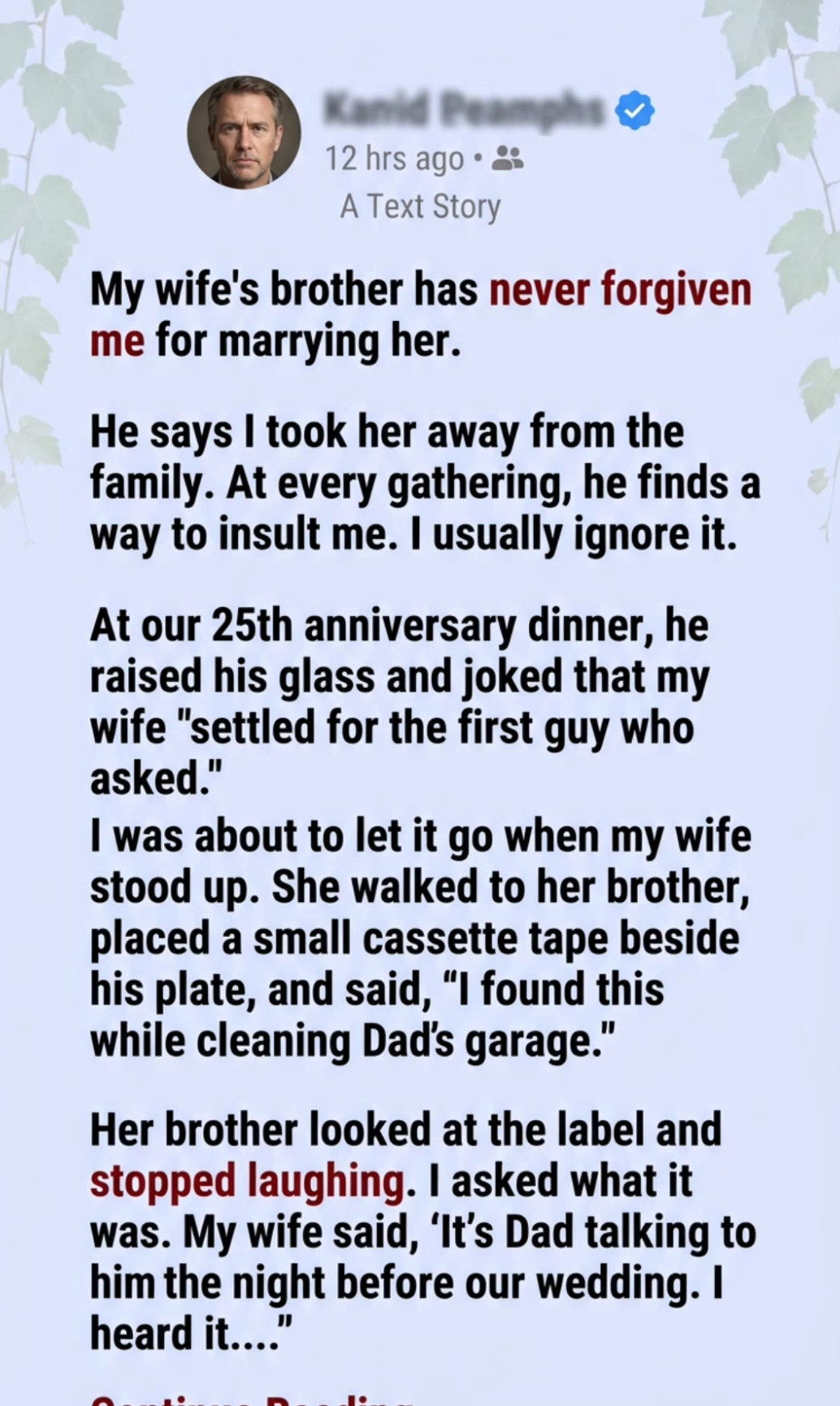
“Although, if we’re being honest, I never thought this marriage would last. My sister was always too trusting. She had so many possibilities, but she settled for the first guy who asked.”
A few people shifted uncomfortably.
He continued.
“Some men are just lucky. They happen to be standing in the right place when a woman makes a decision she’ll spend the rest of her life defending.”
The room became silent.
I looked down at my plate.
I had heard versions of that insult for decades. I could have answered him. I could have reminded him that I had supported Margaret through her father’s illness, that I had worked two jobs when we were struggling financially, or that I had never once asked her to give up her independence for me.
But it was our anniversary.
I wasn’t going to let Richard turn it into another argument.
I reached for Margaret’s hand beneath the table.
She didn’t take it.
Instead, she slowly stood up.
At first, I thought she was going to make a toast. But she didn’t reach for her glass. She picked up her handbag, opened the front pocket, and removed a small rectangular cassette tape.
It was old, with a faded white label and a few scratches along its plastic case.
She walked around the table and stopped beside her brother.
Then she placed the cassette next to his plate.
Richard looked at it.
His smile disappeared.
Margaret spoke quietly.
“I found this while cleaning Dad’s garage.”
Richard didn’t move.
“I was looking through some old boxes last month,” she continued. “There were photographs, receipts, and some of Dad’s old tools. This was inside a small envelope with my wedding invitation.”
Richard’s eyes remained fixed on the cassette.
I glanced at the label.
It was handwritten in their father’s familiar, slightly uneven handwriting.
Richard — The Night Before Margaret’s Wedding.
“What is that?” I asked.
Margaret looked at me.
“It’s Dad talking to Richard.”
Her brother finally lifted his head.
“Where did you get that?”
“From Dad’s garage. I just told you.”
“Why were you going through his things?”
“Because I wanted to preserve them. I thought there might be photographs we hadn’t seen.”
Richard pushed his chair back slightly.
“That tape is private.”
Margaret looked at him for several seconds.
“Apparently, it was private for twenty-five years.”
Nobody at the table said anything.
I could hear the faint sound of dishes being collected in the restaurant beyond the private room.
“What did Dad say?” I asked.
Margaret turned toward me.
“I listened to it three times before I decided to bring it tonight.”
She took a breath.
“He was talking to Richard the evening before our wedding. Dad must have recorded it because he wanted to remember the conversation. I don’t know whether he intended anyone else to hear it.”
Richard shook his head.
“Margaret, don’t.”
But she continued.
“He told Richard something about me. Something Richard has never mentioned in twenty-five years.”
My brother-in-law’s face had gone pale.
“Stop this,” he whispered.
Margaret looked at him.
“Why? Are you afraid they’ll finally hear what happened?”
Richard stood abruptly.
“You have no right to do this.”
For the first time in our marriage, Margaret didn’t step back when her brother raised his voice.
She reached into her handbag again and removed a small portable cassette player.
“I didn’t bring this because I wanted to embarrass you,” she said. “I brought it because I’m tired of listening to you embarrass my husband.”
She placed the player on the table.
Richard stared at it.
Our son Daniel leaned forward. Sophie reached for her mother’s hand.
Margaret pressed the button.
There was a click, followed by a soft mechanical whir. A few seconds of static filled the room.
Then a man’s voice emerged.
It was Thomas.
Margaret’s father had been gone for eight years, but I recognized his voice immediately. It was warm, deep, and slightly rough around the edges.
“Richard, sit down. I need you to listen to me.”
A chair creaked in the recording.
Then Richard’s younger voice answered.
“What’s this about, Dad?”
Thomas sighed.
“It’s about your sister.”
“I know what it’s about. I told you she’s making a mistake.”
“That’s exactly why we’re having this conversation.”
The recording continued.
Richard sounded angry. He said Margaret was rushing into marriage. He complained that I had no money, no family connections, and no impressive career. He insisted she could have married someone who would have provided her with a better life.
Then Thomas spoke again.
“Do you know what your sister told me yesterday?”
Richard said nothing.
“She told me she’s afraid you will never forgive her for choosing her own happiness.”
There was a long pause.
Thomas continued.
“She loves this man. And whether you approve of him or not, she has the right to build a life with him.”
Richard’s recorded voice became louder.
“I’ve looked after her since Mom died. Someone has to make sure she doesn’t throw everything away.”
“You’re her brother, Richard. You’re not her father. And you’re certainly not the owner of her future.”
Margaret closed her eyes.
I felt something tighten in my chest.
For years, I had believed Richard simply disliked me. I had never understood why his resentment was so personal, why he acted as though my marriage had taken something precious from him.
Then Thomas said something that made everyone at the table stop breathing.
“Your sister didn’t abandon this family by marrying him. She was going to leave because she couldn’t breathe under your control.”
Richard’s expression changed.
The voice on the tape continued.
“You’ve been deciding where she goes, who she sees, what she should do with her money, and what kind of man she should marry. You call it protecting her, but protection isn’t supposed to make someone afraid.”
A faint noise came through the speakers.
Then Thomas spoke more softly.
“Richard, I need you to understand something. Margaret has spent years trying to make you happy. She turned down opportunities because you said the family needed her. She stayed home when she wanted to travel because you said I needed help. She even delayed moving away for work because she didn’t want you to feel abandoned.”
Margaret’s eyes filled with tears.
I slowly turned toward her.
I knew she had sacrificed things for her family, but I hadn’t known how much of her life had been shaped by her brother’s expectations.
Thomas continued.
“Tomorrow, she is marrying a man who makes her feel free to be herself. You should be happy for her.”
Richard’s younger voice was barely audible.
“What if he hurts her?”
“Then she will deal with that as an adult. And if she needs us, we will be here. But you cannot punish a man for something he hasn’t done.”
There was another long silence.
Then Thomas said something I would remember for the rest of my life.
“Listen carefully, son. If you spend the next twenty-five years trying to prove that her husband isn’t good enough, you will lose something far more valuable than an argument. You will lose your sister.”
The tape clicked.
A few seconds later, the recording ended.
Nobody moved.
Richard stood beside his chair, staring at the cassette player.
Margaret wiped her cheeks.
“That’s what Dad said the night before our wedding.”
Richard looked at her.
“You don’t understand the whole conversation.”
“Then explain it.”
He opened his mouth but no words came out.
Margaret returned to her chair. She didn’t sit immediately. Instead, she looked around the table at the relatives who had spent years hearing Richard’s version of our marriage.
“All these years, he has told everyone that I chose a stranger over my family,” she said. “He has told people that my husband took me away. He has made jokes about our marriage and acted as though I betrayed him.”
She looked at Richard again.
“But I didn’t leave because of my husband. I left because I wanted a life where my decisions belonged to me.”
Richard lowered his eyes.
I finally understood why she had been so quiet during all those years of insults.
She hadn’t been waiting for me to defend myself.
She had been waiting for her brother to recognize that she had made her own choice.
Richard pulled his chair out and sat down slowly.
“That isn’t fair,” he said.
Margaret’s voice trembled.
“What’s not fair?”
“You make it sound like I controlled everything.”
“Didn’t you?”
“I was trying to protect you.”
“From what? A man who loved me? A job I wanted? A home we chose together?”
Richard rubbed his forehead.
“I was afraid.”
It was the first honest thing I had ever heard him say about our marriage.
Margaret sat down.
“Afraid of what?”
Richard looked at her.
“After Mom died, you were the only person I had left. Dad was working constantly, and I was still young. You took care of everything. You cooked, you helped me with school, you stayed up when I was sick. You were always there.”
He paused.
“Then you met him.”
I felt every eye turn toward me.
Richard continued.
“Suddenly, you had your own plans. You wanted to move. You wanted a house. You wanted children. I thought I was losing the only person who had always been there for me.”
Margaret’s expression softened, but she didn’t interrupt.
“I thought if you married him, you would forget us,” Richard said. “I thought you would stop caring about the family.”
“And did I?” she asked.
Richard shook his head.
“No.”
“Did I stop visiting Dad?”
“No.”
“Did I stop calling you?”
“No.”
“Did I stop helping when you needed me?”
He looked down.
“No.”
Margaret’s voice became firmer.
“Then what exactly did I do to you?”
Richard didn’t answer.
For years, he had treated her independence as an insult. He had mistaken her growing up for abandoning him.
I looked at my wife and remembered the early years of our marriage.
I remembered how she would leave our apartment after dinner to check on her father. I remembered the weekends she spent helping Richard move, repair his car, or sort out financial problems. I remembered how often she changed our plans because her brother needed something.
I had never complained.
I thought I was being a good husband by making room for her family.
But now I wondered whether I had unknowingly helped her carry a burden she had never felt allowed to put down.
Richard turned toward me.
“I suppose you think you won.”
I shook my head.
“No, Richard. I don’t think anyone won tonight.”
He frowned.
“You got what you wanted. She finally stood up for you.”
I looked at Margaret.
“Your sister doesn’t belong to me, and she never did. I didn’t marry her to take her away from anyone. I married her because she chose me. She could have changed her mind at any point in these twenty-five years. She didn’t.”
Richard stared at me.
“I never asked her to stop loving her family,” I continued. “I only wanted her to be happy. But every time you insulted me, you made her feel as though she had to defend the right to be happy with me.”
I paused.
“That isn’t something I can forgive on her behalf.”
Margaret reached across the table and held my hand.
Richard looked at our joined hands.
For a moment, he seemed to be searching for another insult. But the words didn’t come.
Then Sophie spoke.
“Uncle Richard, do you know what I remember about growing up?”
He looked at her.
“I remember Dad driving Mom to see Grandpa even when he was exhausted from work. I remember him fixing things at Grandpa’s house. I remember him sitting in the hospital waiting room for hours when Grandpa had surgery.”
She swallowed.
“And I remember Mom crying in the car after family dinners because she didn’t want to upset you.”
Richard’s face tightened.
“Why didn’t anyone tell me?”
Sophie looked at him sadly.
“Because we all knew how you would react.”
Daniel leaned forward.
“Grandpa understood that Mom needed her own life. Why couldn’t you?”
Richard covered his face with one hand.
The dinner continued, but the atmosphere had changed completely.
Nobody wanted to cut the cake immediately. Nobody knew whether to resume the celebration or allow the family to sit with what they had just heard.
Eventually, Margaret picked up the cassette and placed it carefully inside its case.
“I don’t want this to become a weapon,” she said. “Dad wasn’t recording it so we could use his words to hurt each other. I brought it because I wanted the truth to be heard.”
Richard looked at her.
“Are you going to keep it?”
“Yes.”
“Can I have a copy?”
Margaret considered the question.
“Why?”
He hesitated.
“Because I want to hear it again.”
She nodded.
“I’ll make you a copy.”
Richard looked down at his hands.
Then, in a voice so quiet that several people barely heard him, he said, “I’m sorry.”
Margaret didn’t respond immediately.
She had waited twenty-five years for those words, but an apology could not erase twenty-five years of hurt.
“Sorry for what?” she asked.
Richard looked up.
“For blaming your husband. For making jokes about your marriage. For acting like you owed me your life because I was afraid of losing you.”
Margaret’s eyes filled again.
“And?”
He swallowed.
“For making you feel guilty every time you chose something for yourself.”
She nodded slowly.
“Thank you.”
Richard turned toward me.
“I’m sorry I treated you like an outsider.”
I looked at him for a long moment.
“That means something,” I said. “But I hope you understand that things won’t suddenly be different because you said it tonight.”
“I understand.”
“Trust takes time.”
He nodded.
Margaret finally sat back in her chair.
Then, unexpectedly, Richard reached for his wineglass.
“I suppose I owe you another toast.”
A few relatives exchanged uncertain glances.
Richard stood.
This time, he didn’t smile sarcastically.
He looked at Margaret first.
“To my sister. I spent too many years thinking that loving her meant keeping her close. I was wrong. She deserved to choose her own life, and she deserved to have people celebrate that choice instead of punishing her for it.”
He turned toward me.
“And to the man who has spent twenty-five years being more patient with me than I probably deserved.”
I didn’t know what to say.
Richard raised his glass.
“Happy anniversary.”
Everyone lifted their glasses.
Margaret leaned against my shoulder, and I kissed the top of her head.
For the first time in twenty-five years, Richard had toasted our marriage without making it sound like a mistake.
But the most important change didn’t happen that night.
It happened several weeks later.
Richard called Margaret on a Sunday afternoon.
He asked whether she would meet him for coffee.
She almost declined. She had spent years learning that she was allowed to say no, and she didn’t want to return to a relationship where every conversation became an argument about what she owed him.
But eventually, she agreed.
They met at a small café near the park where they had played as children.
Richard arrived early.
He had brought a photograph of their parents, taken many years before their mother died. In it, Margaret was standing beside him, her arm around his shoulders. Richard was smiling broadly, while Margaret was laughing at something outside the frame.
He placed it on the table.
“I found this in my office,” he said.
Margaret smiled sadly.
“I remember that day.”
“I don’t think I ever thanked you.”
“For what?”
“For taking care of me when we were kids.”
Margaret looked at the photograph.
“You were my little brother.”
“I know. But I think I used that as an excuse to expect you to keep taking care of me forever.”
She didn’t answer.
Richard continued.
“I listened to Dad’s recording again. You were right about what he said.”
Margaret looked at him.
“He was right about more than I wanted to admit.”
For the first time, Richard spoke about their father without turning the conversation toward blame.
He admitted that after Thomas died, he had struggled with the feeling that the family was disappearing. Margaret’s marriage had become a symbol of everything he feared losing. Rather than admitting that he was lonely, he had made her husband the enemy.
He had convinced himself that if he could prove Margaret had chosen the wrong man, she might eventually return to the life he remembered.
But she had never wanted to return to that life.
She had wanted her brother to become part of the life she was building.
Margaret listened.
She didn’t excuse his behavior, but she began to understand it.
They agreed to start slowly.
Richard would stop making remarks about our marriage. Margaret would no longer rearrange her life every time he demanded attention. They would speak honestly rather than using guilt, sarcasm, or silence to control one another.
It wasn’t a perfect reconciliation.
There were awkward conversations, missed calls, and moments when old habits returned. Sometimes Richard would make a careless remark and catch himself halfway through. Sometimes Margaret would feel the familiar urge to apologize for making a decision he didn’t like.
But slowly, they began to change.
A few months later, Richard invited our family to his house for dinner.
When we arrived, he opened the door and shook my hand.
“Come in,” he said. “I’ve been working on the garden. Your wife told me you know something about plants.”
I smiled.
“Enough to keep a few alive.”
“Then perhaps you can tell me what I’m doing wrong.”
It was an ordinary sentence.
But after twenty-five years of hostility, it felt like a door opening.
Later that evening, Richard brought out a small box.
Inside were several photographs of their father, their mother, and the two siblings when they were young. He had arranged them in chronological order and placed them in new frames.
There was one photograph of Margaret and me on our wedding day.
I noticed that it had been placed in the center.
Richard stood beside me.
“I used to hate looking at that picture,” he admitted.
“Why?”
“Because I thought it represented the day I lost my sister.”
He looked at Margaret, who was talking with Sophie in the kitchen.
“Now I think it represents the day she began the life she wanted.”
I nodded.
“That’s a better way to remember it.”
Richard gave a small smile.
“I wish I’d understood that earlier.”
“So do I.”
He looked at me again.
“Do you think Dad knew I would eventually understand?”
I considered the question.
“I think he hoped you would.”
Richard stared at the photograph for a long moment.
Then he said, “He was a wiser man than I realized.”
I agreed.
That night, when Margaret and I returned home, she placed the cassette player on the living room table.
She had decided to preserve the original recording and make digital copies for the family. She also planned to keep the original envelope with her father’s handwriting.
I watched her carefully slide the cassette into its protective case.
“Do you wish you’d found it sooner?” I asked.
She thought for a moment.
“Sometimes. But I don’t know whether Richard would have listened to it ten years ago.”
“Perhaps not.”
She sat beside me.
“Do you know what I keep thinking about?”
“What?”
“Dad didn’t tell Richard to love you. He told him to love me enough to let me choose.”
I took her hand.
“Your father understood something important.”
“What?”
“That love isn’t ownership.”
Margaret leaned her head against my shoulder.
For twenty-five years, I had thought the hardest part of marrying into her family was accepting that her brother would never like me. I had spent so much time trying not to provoke him that I hadn’t realized how deeply his behavior had hurt the woman I loved.
The cassette didn’t make Richard a different person overnight. It didn’t erase the insults, restore the lost years, or guarantee that our family would never face another disagreement.
But it gave us something we had been missing.
The truth.
And sometimes, the truth is the only place where a damaged relationship can begin to heal.
On our twenty-sixth anniversary, we held another family dinner.
This time, Richard arrived early.
He helped me carry the food from the kitchen, asked Daniel about his new job, and spent nearly an hour listening to Sophie describe a project she was working on.
When it was time for the toast, he stood without waiting for anyone to ask.
He raised his glass.
“Last year, I made a joke about my sister settling for the first man who asked her to marry him,” he began.
Margaret looked at him.
Richard smiled faintly.
“I was wrong. She didn’t settle. She chose someone who stood beside her when I made it difficult. Someone who never asked her to choose between her husband and her family. And someone who gave me more chances than I deserved.”
He turned toward me.
“Thank you for loving my sister. And thank you for never making her feel that loving you meant abandoning us.”
Then he looked at Margaret.
“And thank you for not giving up on your little brother, even when he made it very difficult to love him.”
Margaret stood and embraced him.
I watched them for a moment, remembering the cassette on the anniversary table and the voice of a father who had been gone for years but had somehow managed to bring his children back to one another.
After dinner, Richard asked whether he could borrow the digital recording.
Margaret smiled.
“Of course. But don’t forget to bring it back.”
“I won’t.”
He slipped the small device into his jacket pocket.
Then he paused.
“Actually, I think I want to keep a copy at home. Not because I need to hear Dad tell me I was wrong.”
He looked at his sister.
“But because I don’t want to forget what he was trying to teach me.”
I understood then that the cassette had never really been about proving that I was worthy of Margaret.
I had never needed her brother’s approval to know why she had married me.
The recording was about something much more important: a man learning that the people he loved were not possessions to hold, but people to respect.
And after twenty-five years of being treated like the man who stole his sister away, I finally understood that I had never taken Margaret from her family.
I had simply loved her enough to let her become herself.
And, at last, her brother was learning to do the same.
The End