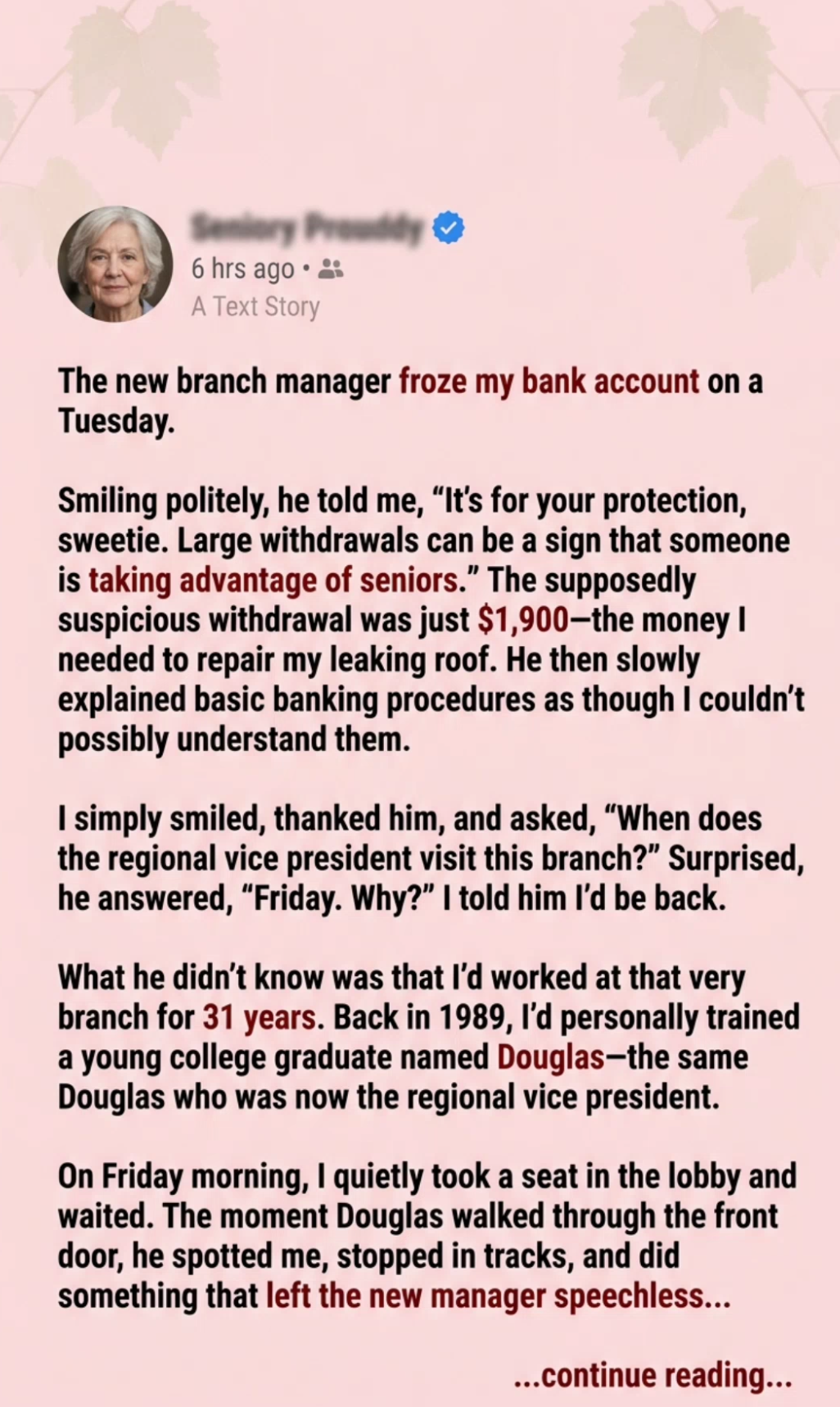
The new branch manager froze my bank account on a Tuesday morning. He did it with a polite smile, a soft voice, and the kind of expression people use when they believe they are being exceptionally patient with someone who cannot understand what is happening.
“It’s for your protection, sweetie,” he explained. “Large withdrawals can sometimes be a sign that someone is taking advantage of seniors.”
I stared at him across the polished desk.
The withdrawal in question was $1,900.
Not nineteen thousand. Not a suspicious transfer to some stranger overseas. Not an attempt to empty my savings. Just $1,900 to repair the leaking roof above my bedroom before the next heavy rain destroyed the ceiling.
My name is Margaret Ellis. I was seventy-one years old that year, and I had lived in the same little house for nearly four decades. I had paid my bills on time, balanced my accounts, and managed my own finances since I was a young woman. I had never needed anyone to explain to me what a withdrawal was.
Yet there I sat, listening to a man barely old enough to remember the 1990s explain how a checking account worked.
His name was Brandon Cole. He had become the branch manager three months earlier, replacing a woman named Patricia who had retired after a long career. I had met Patricia many times. She knew my name, remembered that I preferred paper statements, and never made me feel like I was taking up too much of her time.
Brandon was different.
He glanced repeatedly at his computer while speaking to me, as if the screen contained more truth than the person sitting directly in front of him.
“Our system flagged your requested withdrawal,” he said. “Given your age, we have to be cautious.”
“My age?” I asked.
“I’m not saying there’s anything wrong with being older,” he replied quickly. “But financial exploitation is a serious concern. Sometimes family members, contractors, or even acquaintances pressure seniors into withdrawing money.”
“The contractor is repairing my roof,” I said. “He gave me an estimate. I brought it with me.”
I slid the estimate across his desk.
He barely glanced at it.
“I understand, Mrs. Ellis, but these safeguards exist for a reason.”
“Then I assume you can explain exactly which transaction violated my account agreement.”
His smile tightened.
“It’s not necessarily a violation. It’s a precaution.”
“Then why is my account frozen?”
He folded his hands.
“Because we need to make sure you’re making this decision independently.”
For a moment, I said nothing.
I had spent thirty-one years working in banking. I had started as a teller, moved into operations, trained new employees, handled customer disputes, and eventually supervised the branch’s service department. I knew the difference between a legitimate fraud alert and an unnecessary restriction. I knew what documentation could be requested, what procedures were required, and what questions a customer had every right to ask.
I also knew that a bank could have a responsibility to investigate suspicious activity without treating every older customer as though age alone made them incapable of managing money.
But Brandon didn’t know any of that.
He saw a seventy-one-year-old woman with silver hair, a worn handbag, and a modest coat.
He didn’t see the person who had once trained half the employees in that building.
I took a slow breath.
“May I ask you something, Mr. Cole?”
“Of course.”
“When does the regional vice president visit this branch?”
He looked surprised.
“Douglas? He’ll be here Friday morning. Why?”
I smiled politely.
“I’d like to speak with him.”
Brandon leaned back.
“There’s really no need to escalate this. I can handle it.”
“I’m sure you can,” I replied. “I’ll be back Friday.”
I collected my roof estimate, placed it carefully inside my handbag, and stood.
As I walked toward the door, I heard him say, “Please don’t worry. We’ll get everything sorted out.”
I didn’t turn around.
I had learned long ago that some people mistake silence for surrender.
And Brandon Cole was about to discover that he had made a very expensive mistake.
I was twenty-four years old when I first walked into that bank.
It was 1989, and the building looked very different. The carpet was dark green, the counters were wooden, and the tellers worked with paper ledgers, adding machines, and thick bundles of deposit slips.
I had been hired as a junior teller after spending two years working in a small accounting office. I was nervous on my first morning, but determined to prove that I belonged there.
The branch manager at the time, Mr. Franklin, was a serious man who believed customers deserved patience even when they were difficult.
“People don’t come here because they want to stand in line,” he told me during my first week. “They come because they trust us with something important. Never forget that.”
I never did.
Over the years, I watched the banking industry change. Computers replaced handwritten ledgers. ATMs appeared. Online banking became normal. Procedures grew more complicated, and regulations became more detailed.
I changed with them.
I learned new systems, studied updated policies, and trained employees who were younger than some of my shoes.
One of those employees was Douglas Bennett.
Douglas arrived in the summer of 1989, fresh out of college, wearing a navy suit that was slightly too large and carrying a briefcase that looked as if it had been borrowed from his father.
He was intelligent, ambitious, and painfully nervous around customers.
On his third day, he accidentally entered a deposit under the wrong account number. The mistake was caught before the day’s records were finalized, but he was so embarrassed that he nearly resigned.
I found him sitting alone in the break room.
“You planning to hide in here until retirement?” I asked.
He looked up, startled.
“I made a mistake.”
“Good.”
He frowned. “Good?”
“Now you know what it feels like. The next time you check your work, you’ll remember why accuracy matters.”
He stared at me.
I pulled out a chair.
“Listen, Douglas. Everyone makes mistakes. The important part is whether you correct them, learn from them, and make sure the customer isn’t left carrying the consequences.”
That afternoon, I stayed late to teach him how to reconcile his transactions.
Over the next several months, I trained him on account procedures, customer complaints, daily balancing, and the small details that never appeared in the training manuals.
I taught him that a customer asking the same question twice wasn’t necessarily difficult. Sometimes they were frightened.
I taught him that a person with a large balance deserved the same respect as someone depositing fifty dollars.
And I taught him that the bank’s reputation wasn’t built by its signs, advertisements, or executive speeches.
It was built one conversation at a time.
Douglas listened.
He asked questions. He took notes. He made mistakes, corrected them, and gradually became one of the best young employees in the branch.
When he was promoted to assistant manager several years later, he brought me a small bouquet of flowers.
“You taught me more than anyone here,” he said.
I laughed.
“I taught you how to balance accounts. The rest is up to you.”
He smiled.
“Then I hope I remember the important parts.”
I watched him move through the company over the following decades. He became a branch manager, then a district manager, and eventually a regional vice president.
We exchanged occasional holiday cards, but we hadn’t spoken in person for several years.
I had retired long before his latest promotion.
I was proud of him.
And I had no idea that one day I would need to remind him of the lessons we had learned together.
After leaving the bank on Tuesday, I drove to the roofing contractor’s office.
His name was Samuel Price, and he had been working in the neighborhood for more than twenty years. He had inspected my roof the previous week and given me a written estimate for replacing damaged shingles and repairing a section of flashing.
The total was $1,900.
I explained what had happened.
Samuel looked genuinely confused.
“They froze your entire account because you wanted to pay me?”
“Apparently.”
He shook his head.
“Mrs. Ellis, I can wait a few days. I don’t want you worrying about it.”
“Thank you, Samuel. But I don’t want you waiting because someone at the bank has decided I’m incapable of making my own decisions.”
He nodded.
“Fair enough.”
I returned home and called the bank’s customer service department.
The representative who answered was polite. I gave her my account information, explained the restriction, and asked for the specific reason my account had been frozen.
She placed me on hold.
After several minutes, she returned.
“Mrs. Ellis, I can see a temporary restriction related to a senior financial protection review.”
“Was there a report of suspected fraud?”
“I can’t see a detailed note in my system.”
“Was there an unauthorized transaction?”
“Not according to the information available to me.”
“Did I request assistance managing my account?”
“No.”
“Then could you please explain what specific evidence led to the restriction?”
Another pause.
“I may need to refer this to the branch.”
“I have already spoken with the branch manager. He told me it was because of my age and the amount I wanted to withdraw.”
The representative sounded uncomfortable.
“I’m sorry you’ve had this experience. I can create a complaint record.”
“Please do. I would also like the complaint reference number and a written explanation of the restriction.”
She gave me the number.
I wrote it down.
Then I requested a copy of my account agreement, the bank’s current procedures for placing and removing restrictions, and information about the bank’s process for reviewing complaints involving possible age discrimination.
The representative promised to submit the requests.
I thanked her and ended the call.
I wasn’t trying to make a scene.
I wanted my money available, my roof repaired, and a clear explanation of why a legitimate transaction had been stopped.
But I also knew that if I simply waited and hoped someone would correct the situation, the same thing could happen to another customer.
That evening, I opened a drawer in my study.
Inside were old photographs, retirement documents, handwritten notes, and a collection of employee recognition cards from my banking years.
I found a photograph from 1991.
I was standing beside Douglas in the old branch lobby. He looked impossibly young, his hair neatly combed, his smile nervous.
I was holding a certificate from an internal training program.
On the back, someone had written:
To Margaret, who taught me that customers are people before they are account numbers. Thank you for believing in me.
The handwriting was Douglas’s.
I held the photograph for a long moment.
Then I placed it inside my handbag.
Wednesday passed without a resolution.
I received a call from a different employee at the branch. She introduced herself as Natalie and said Brandon had asked her to verify some information.
“Mrs. Ellis, I just need to ask whether anyone has recently requested money from you.”
“No.”
“Has anyone pressured you to make a payment?”
“No.”
“Are you aware of the purpose of the withdrawal?”
“I am paying a licensed roofing contractor to repair my home.”
“Do you have an estimate?”
“Yes. I presented it to Mr. Cole on Tuesday.”
She paused.
“I don’t see it attached to the review.”
“That is interesting, because I watched him look at it.”
“I’ll make a note.”
“Thank you. Could you also tell me whether the restriction applies only to the requested withdrawal or to all transactions?”
“It appears to affect the account generally.”
“Does that mean I cannot pay my utility bills?”
“I believe the restriction may prevent certain transactions.”
“Does it affect my pension deposit?”
“No, deposits should still arrive.”
I closed my eyes.
“So the bank will accept my money but may prevent me from using it?”
Natalie sounded uncomfortable.
“I don’t want to give you incorrect information.”
“Then please find out.”
She promised to call back.
She didn’t.
On Thursday morning, I went through my household paperwork and found the roofing estimate, my account statements, and the receipt from the contractor’s inspection.
I made copies.
I also wrote a short timeline of events:
Tuesday, 9:15 a.m. — Requested $1,900 withdrawal for roof repairs.
Tuesday, approximately 9:30 a.m. — Branch manager Brandon Cole stated that the transaction was suspicious because of my age.
Tuesday, approximately 9:40 a.m. — Account restriction confirmed.
Tuesday, 10:00 a.m. — Asked when the regional vice president would visit.
Wednesday — Customer service confirmed a senior financial protection review but could not identify evidence of fraud.
Wednesday — Branch employee requested additional information.
Thursday — No written explanation or resolution received.
I printed two copies.
One would go to Douglas.
The other would go into the bank’s formal complaint process.
I wasn’t interested in humiliating anyone. I had managed employees long enough to understand that people sometimes made poor decisions under pressure.
But there was a difference between a mistake and refusing to correct one.
Friday morning arrived with clear skies.
I dressed carefully.
I wore a cream blouse, a navy cardigan, dark trousers, and the small gold watch my late husband, Robert, had given me for our thirtieth anniversary.
I placed the photograph of Douglas and me in my handbag, along with the documents.
Then I drove to the branch.
The building had been renovated several times since I worked there. The wooden counters were gone. The carpet was now a soft gray, and the lobby had comfortable chairs arranged near the windows.
A young teller greeted me.
“Good morning. How can I help you?”
“I have an appointment with the regional vice president.”
She checked her computer.
“May I have your name?”
“Margaret Ellis.”
Her expression changed slightly.
“Are you here to see Mr. Bennett?”
“Yes.”
She picked up the phone.
“He should be arriving shortly. Please have a seat.”
I chose a chair near the entrance.
Brandon was standing behind the manager’s desk, speaking to another employee. When he noticed me, he gave a small nod.
“Mrs. Ellis. You’re back.”
“I said I would be.”
He glanced toward the entrance.
“Mr. Bennett is very busy. I’m sure we can resolve this without taking up his time.”
“I hope so.”
He approached me.
“I’ve reviewed the matter. These protections can be frustrating, but they’re designed to keep customers safe.”
“Have you reviewed the contractor’s estimate?”
He hesitated.
“I don’t believe that is the central issue.”
“Then what is?”
“It’s the pattern of activity.”
“What pattern?”
He looked toward the employee beside him.
“We’ll discuss that when Mr. Bennett arrives.”
I nodded.
I had no intention of arguing in the lobby.
At 9:02 a.m., a dark sedan pulled into the parking lot.
A moment later, a man in a charcoal suit stepped through the front door carrying a leather portfolio.
He was taller than I remembered, with silver beginning to show at his temples. His walk was confident, but his eyes moved quickly around the lobby.
Douglas Bennett.
He stopped near the entrance.
His gaze passed over the tellers, the waiting customers, and the reception desk.
Then he saw me.
For a moment, he didn’t move.
His expression changed from professional concentration to complete astonishment.
“Margaret?”
I stood.
“Good morning, Douglas.”
He put down his portfolio.
Then, in front of everyone, the regional vice president walked straight across the lobby, took both my hands, and embraced me.
“Margaret Ellis,” he said, his voice full of emotion. “I can’t believe it’s you.”
I laughed softly.
“It’s been a while.”
He stepped back and looked at my face.
“It’s been far too long. How are you? Why didn’t you tell me you were coming?”
“I did tell the branch manager I would be here.”
Douglas smiled, then turned toward Brandon.
“Brandon, do you know Margaret?”
Brandon straightened.
“Yes. Mrs. Ellis has been in a few times this week regarding an account restriction.”
Douglas looked back at me.
“An account restriction?”
“Yes,” I replied. “That’s why I’m here.”
The warmth in his expression faded.
“What happened?”
Brandon stepped forward.
“We identified a potentially unusual withdrawal and initiated a senior financial protection review.”
Douglas looked at him.
“What amount?”
“Nineteen hundred dollars.”
“For what purpose?”
“Roof repairs, apparently.”
“Apparently?”
Brandon seemed unsure how to respond.
Douglas turned to me.
“Margaret, would you mind telling me exactly what happened?”
I took the documents from my handbag.
“Certainly. I would also like you to read the complaint reference number and the written timeline.”
Douglas accepted the papers.
He began reading.
The lobby had become unusually quiet.
A customer sitting near the windows lowered his newspaper. One of the tellers stopped typing.
Douglas read the first page, then the second.
When he reached the note about Brandon’s comment regarding my age, his jaw tightened.
He looked up.
“Did you actually tell Mrs. Ellis that her withdrawal was suspicious because she was seventy-one?”
Brandon shifted his weight.
“I explained that seniors can be vulnerable to financial exploitation.”
“That’s not what I asked.”
“I was following the protective procedures.”
“Which procedure?”
Brandon opened his mouth.
Then closed it.
Douglas looked down at the papers again.
“Did you document a specific concern that someone was coercing her?”
“We had an unusual withdrawal request.”
“Is a $1,900 withdrawal unusual for this account?”
“I’d have to review the history.”
“Did you review it before placing the restriction?”
Brandon hesitated.
“I saw the alert.”
“That wasn’t my question.”
Douglas’s voice remained calm, but there was no warmth in it now.
“Did you review her transaction history?”
“No, not in detail.”
“Did you ask whether she understood the transaction?”
“Yes.”
“Did she answer?”
“Yes.”
“Did you ask whether she was being pressured?”
“Yes.”
“Did she say she was?”
“No.”
“Did you review the contractor’s estimate?”
“I saw it.”
“Did you verify it?”
“No.”
Douglas looked at him for several seconds.
Then he turned toward the senior operations employee, who had been standing near the reception desk.
“Please bring me the complete restriction record and the applicable procedure.”
The employee nodded and disappeared into the back office.
Brandon looked increasingly uncomfortable.
Douglas returned his attention to me.
“Margaret, may I ask you something?”
“Of course.”
“Why didn’t you call me directly?”
I smiled.
“Because I wanted to give the branch an opportunity to resolve its own problem first.”
He nodded slowly.
“That sounds like you.”
I glanced at the old photograph in my handbag.
“I also thought you might appreciate seeing this.”
I handed it to him.
Douglas took it.
His expression softened immediately.
“Where did you find this?”
“An old drawer.”
He looked at the photograph, then at me.
“I remember that day.”
“You had just balanced your first month without a correction.”
He laughed.
“I thought I was going to get fired during my first week.”
“You nearly did.”
He shook his head.
“You stayed late to help me fix that deposit.”
“And you learned to check the account number twice.”
He looked down at the writing on the back.
His voice became quieter.
“I wrote that?”
“You did.”
He read it again.
Then he looked at Brandon.
“This woman trained me when I was a new college graduate. She taught me how to handle customers, how to follow procedures, and how to understand the responsibility that comes with working in a bank.”
Brandon nodded stiffly.
Douglas continued.
“She also taught me that a customer’s age, appearance, or income does not tell you whether they understand their own financial decisions.”
The silence in the lobby grew heavier.
“I don’t expect you to recognize every former employee who walks through the door,” Douglas said. “But you are expected to recognize that every customer deserves to be treated with dignity.”
Brandon looked down.
The operations employee returned with a folder and a printed transaction history.
Douglas moved to a nearby conference room and invited me to join him. He also asked the branch’s compliance officer, Helen Morris, to attend.
Brandon followed.
Inside the room, Douglas placed the restriction record on the table.
Helen reviewed it carefully.
The system had generated an alert because the withdrawal exceeded a threshold configured for additional review. The alert itself was not evidence of fraud. It was an instruction to examine the circumstances and determine whether further action was justified.
There was no report from a family member.
No suspicious recipient.
No documented threat.
No history of unauthorized transactions.
The bank had simply identified a transaction requiring review.
Helen looked at the record.
“Mr. Cole, the alert required an assessment. It did not automatically authorize a blanket restriction without the appropriate justification.”
Brandon frowned.
“I believed the protective measure was appropriate.”
“Based on what evidence?” Helen asked.
He didn’t answer immediately.
Douglas turned to her.
“Can we establish whether the restriction is still necessary?”
Helen reviewed the account history and the notes from the previous two days.
“Based on what I can see, there is no documented basis for continuing the full restriction. We should complete the required verification, record the customer’s instructions, and remove the restriction if no other legitimate concern exists.”
Douglas nodded.
“Please proceed according to policy.”
Helen turned to me.
“Mrs. Ellis, I apologize. I would like to confirm a few details before we restore access.”
I answered her questions.
She verified my identity, reviewed the contractor’s estimate, and confirmed that I understood the purpose and amount of the withdrawal.
She also asked whether anyone had pressured me into making the payment.
“No,” I said. “I chose the contractor, reviewed the estimate, and approved the work myself.”
Helen recorded my answers.
After completing the required checks, she submitted the request to remove the restriction.
A few minutes later, she received confirmation that my account access had been restored.
She printed a copy for me.
“Mrs. Ellis, your account is available again. I would still recommend that you review your online and account security settings regularly, but there is no reason to prevent you from making the withdrawal you requested.”
I looked at the paper.
For the first time that week, I felt my shoulders relax.
“Thank you.”
Douglas leaned back in his chair.
“Is there anything else you need?”
“Yes,” I said. “I want to understand how this happened.”
He nodded.
“That’s fair.”
I pointed to the account record.
“I understand the bank has responsibilities when it suspects financial exploitation. I would never ask a bank to ignore a genuine warning. But I don’t want employees treating age as proof that a customer cannot make a decision.”
Douglas looked at Helen.
“She is right.”
Helen nodded.
“We need to examine how the branch handled the alert, including the decision to impose the restriction and the way the customer was approached.”
I continued.
“If an older customer is confused, frightened, or being pressured, help them. Ask appropriate questions. Speak respectfully. But if someone can explain their transaction, provide documentation, and answer questions clearly, that should matter.”
“It does matter,” Helen replied. “And we need to make sure our staff understand the distinction.”
Douglas folded his hands.
“Margaret, I want to apologize. Not just for what happened to your account, but for the way you were spoken to.”
I looked at him.
“You didn’t do it.”
“No. But it happened under our responsibility.”
That answer meant something to me.
I had spent much of my career watching people defend mistakes because admitting them felt more uncomfortable than making them.
Douglas wasn’t doing that.
He was accepting responsibility for the institution he represented.
The roof repair was completed the following week.
Samuel replaced the damaged shingles, repaired the flashing, and inspected the surrounding area to make sure the leak hadn’t spread beneath the roof.
I paid him the $1,900 as agreed.
He handed me a receipt.
“Everything is taken care of,” he said.
I stood in the yard and looked up at the repaired roof.
It was an ordinary thing, perhaps, but after that week it felt like a victory.
I had my home protected.
I had my money back.
And I had not needed anyone’s permission to make a reasonable decision about my own life.
But the story didn’t end there.
Two weeks later, I received a letter from the bank’s regional office.
It confirmed that the complaint had been reviewed and that the branch’s handling of the restriction had not met the bank’s internal expectations.
The letter also stated that the bank would review its training procedures for senior customer protection alerts.
It did not say Brandon had been fired.
It did not promise that every employee involved would be punished.
Instead, it explained that the bank would conduct a management review, retrain relevant staff, and examine whether similar restrictions had been imposed without adequate documentation.
I appreciated the letter.
It sounded like an actual response rather than a public-relations apology.
Then, several days later, Douglas called me.
“Margaret, do you have a few minutes?”
“Of course.”
“I’ve been thinking about our conversation.”
“That sounds dangerous.”
He laughed.
“I deserve that.”
His voice became serious.
“We’ve reviewed a number of recent customer protection cases across the region. Some were handled properly. Others involved restrictions that were broader than necessary, and our documentation wasn’t always as clear as it should have been.”
I listened.
“We’re going to update the training,” he continued. “I want the branch managers to understand that protecting customers doesn’t mean taking away their independence without a legitimate reason.”
“That’s good.”
“I also want to invite you to participate in a staff training session.”
I was quiet for a moment.
“Me?”
“Yes. You understand the procedures, and you understand what it feels like to sit on the other side of the desk.”
I smiled.
“Douglas, I’m retired.”
“I know.”
“I don’t want another full-time job.”
“I wouldn’t ask you to take one.”
He explained that the bank was organizing a regional customer-service workshop. He wanted a former employee with practical experience to speak about respectful communication, customer independence, and the difference between a legitimate warning and an assumption based on appearance or age.
I considered it.
Then I agreed.
Not because I wanted to return to banking.
Because I remembered how many customers had sat across from me over the years, frightened by paperwork, embarrassed by questions, or worried that someone would think they were foolish.
I remembered Mrs. Patterson, who came in every month to deposit her pension and always apologized for taking too long.
I remembered Mr. Alvarez, who had lost his wife and needed help understanding the bills they had once managed together.
I remembered the young father who withdrew his savings to repair his car because he needed it to get to work.
None of those people needed to be treated like children.
They needed someone who would listen.
The workshop took place the following month in a conference room at the regional office.
There were about forty employees in attendance: branch managers, tellers, operations staff, and customer-service representatives.
Douglas introduced me.
“Some of you may know Margaret Ellis as a former employee of the company,” he said. “She worked here for thirty-one years. She trained employees, supervised customer operations, and helped build the standards many of us still use.”
He paused.
“She also trained me.”
A few people smiled.
I stood and looked around the room.
I had not spoken to a group of bank employees in years, but the familiar setting brought back a surprising amount of confidence.
“I don’t have a complicated speech,” I began. “I only want to tell you something I learned during thirty-one years behind a bank counter.”
I placed my hands on the table.
“People don’t stop being capable because they get older.”
The room became quiet.
“Some customers will need help. Some will be confused. Some may be victims of financial abuse. You must pay attention, ask questions, follow procedures, and take genuine concerns seriously.”
I paused.
“But don’t confuse protection with control.”
I looked around the room.
“If a customer requests a withdrawal, don’t assume they are being manipulated simply because they have gray hair. If they ask you to explain a form, explain it. If they make a decision you wouldn’t make, that doesn’t automatically mean they don’t understand it.”
A young employee near the front raised her hand.
“What if you’re genuinely concerned but the customer becomes angry when you ask questions?”
“Then remain respectful,” I replied. “You can explain why you’re asking. You can offer privacy. You can follow the bank’s established procedures. But you should never use embarrassment as a tool.”
Another employee asked, “What if a family member says the customer isn’t capable of managing their finances?”
“Then you verify the facts. A family member’s opinion does not automatically give them authority over another adult’s account.”
Douglas nodded.
I continued.
“Your job is not to decide that an older person should stop making decisions. Your job is to recognize when there is a real reason to intervene and to respond appropriately.”
I finished with the sentence I had heard from my first branch manager decades earlier.
“People don’t come here because they want to stand in line. They come because they trust us with something important. Never forget that.”
The room remained silent for a moment.
Then the employees began to applaud.
I hadn’t expected it.
I glanced at Douglas.
He was smiling.
After the workshop, several employees came over to speak with me. One young teller said she had never thought about how a routine security question could sound to someone who had been managing their money independently for decades.
Another said her grandmother had recently experienced something similar at a different bank.
I listened to each of them.
I didn’t want the workshop to become a story about me.
I wanted the lesson to continue after I left the room.
Brandon Cole was not present during the first part of the workshop.
He had been placed on administrative review while the bank examined the incident and his handling of other customer restrictions.
A few weeks later, Douglas called to tell me the review had been completed.
The bank had found that Brandon had made an incorrect judgment in my case and had failed to document the necessary reasons for the broader restriction. The review also identified weaknesses in how he had handled several other customer protection alerts.
He was required to complete additional training and was removed from certain approval responsibilities while the bank monitored his performance.
Douglas didn’t tell me every personnel detail, and I didn’t ask.
I didn’t want revenge.
I wanted the bank to become better.
Several months later, I returned to the branch for an ordinary transaction.
Brandon was no longer the manager. He had been reassigned while the company continued its management review. The new branch manager was a woman named Denise Carter.
She greeted me warmly.
“Mrs. Ellis, it’s nice to see you again.”
“Thank you. How are things?”
“Busy, but good.”
I completed my transaction and was about to leave when I noticed Brandon sitting in a small office near the back.
He looked up.
Our eyes met.
For a moment, he seemed uncertain whether to acknowledge me.
Then he stood.
“Mrs. Ellis?”
I stopped.
“Yes?”
“Could I speak with you for a moment?”
I considered it, then nodded.
He stepped into the lobby.
“I wanted to apologize.”
I said nothing.
He looked uncomfortable, but he continued.
“I made assumptions about you. I thought I was being careful, but I didn’t take the time to understand your situation. I should have reviewed the documents you brought in. I should have asked better questions. And I shouldn’t have spoken to you the way I did.”
His voice was quieter now.
“I’ve had a lot of training since then. I understand the difference between a warning and an assumption better than I did before.”
I looked at him.
“Do you?”
“Yes.”
“Then remember it the next time someone sits across from your desk.”
He nodded.
“I will.”
I could have reminded him of every word he had said that Tuesday.
I could have told him how humiliating it felt to be spoken to like a confused child.
But I didn’t need to.
He had apologized.
And I hoped he had learned something from the experience.
“Thank you for saying that,” I told him. “I wish you well.”
Then I walked toward the door.
Nearly a year passed.
My roof remained dry. My account was in good standing, and I continued managing my own finances.
I still preferred paper statements, although I had finally learned how to use the bank’s mobile app. I even discovered that I could deposit a check by taking a photograph of it, something I had once believed sounded unnecessarily complicated.
Douglas and I exchanged occasional messages.
One afternoon, he sent me a photograph of a new training document the bank had introduced.
Its title was simple:
Respectful Customer Protection: Recognizing Risk Without Making Assumptions.
He wrote:
I thought you might like to see this. Your words are part of the training now.
I printed the document and placed it in the same drawer where I kept the old photograph from 1991.
I sometimes thought about that Tuesday morning.
I remembered Brandon’s polite smile.
I remembered the way he said “sweetie.”
I remembered sitting in that office while a man who knew almost nothing about my life explained how I should manage my money.
And I remembered Friday morning, when Douglas walked through the door and recognized me.
But the moment that mattered most wasn’t his embrace.
It wasn’t the way Brandon went silent.
It wasn’t even the restoration of my account.
It was what happened afterward.
A bank changed its training because one customer refused to accept that age was a reason to surrender her independence.
I had spent thirty-one years teaching people how to serve customers.
I never expected that retirement would give me one more opportunity to teach the same lesson.
One evening, I sat at my kitchen table with a cup of tea and watched the rain fall outside.
Water ran along the repaired gutters. The roof held firm.
I thought about my husband, Robert, who used to tell me that growing older was not the same as becoming smaller.
He had been right.
I was seventy-two years old. My hair was silver, my knees complained when the weather changed, and I sometimes needed reading glasses to find the remote control.
But I still knew how to read a contract.
I still knew how to question an unexplained decision.
I still knew how to manage my money.
And I still knew when someone was confusing politeness with respect.
The next morning, I received another message from Douglas.
Margaret, we’re opening a customer advisory program in the region. Would you consider joining us as a volunteer adviser?
I read it twice.
Then I smiled and typed my reply.
I’d be happy to help. But I have one condition.
He responded almost immediately.
What’s that?
I wrote:
Never let anyone forget that the person sitting across the desk is not an account number, a risk category, or an age group. They’re a human being.
Douglas sent back three words.
I promise you.
I placed my phone beside my tea.
For thirty-one years, I had believed that the most important part of banking was handling people’s money accurately.
I still believed that mattered.
But I had learned something even more important.
Money can be counted. Transactions can be recorded. Rules can be written and procedures can be revised.
Trust is harder to measure.
And once a person feels that their dignity has been taken away, no amount of paperwork can immediately restore it.
That Tuesday, the bank had frozen my account over $1,900.
By Friday, I had reminded an entire branch of something far more valuable.
A person’s age does not erase their experience.
A person’s quiet voice does not mean they are powerless.
And a polite smile does not make disrespect acceptable.
I never needed Douglas to rescue me.
I had already spent decades learning how to stand up for myself.
But when he walked through those doors and recognized the woman who had once believed in him, he gave me something I hadn’t expected.
He reminded me that the lessons we leave behind can travel much farther than we ever imagine.
And sometimes, after all those years, the people we once taught are the ones who help carry those lessons forward.
The End