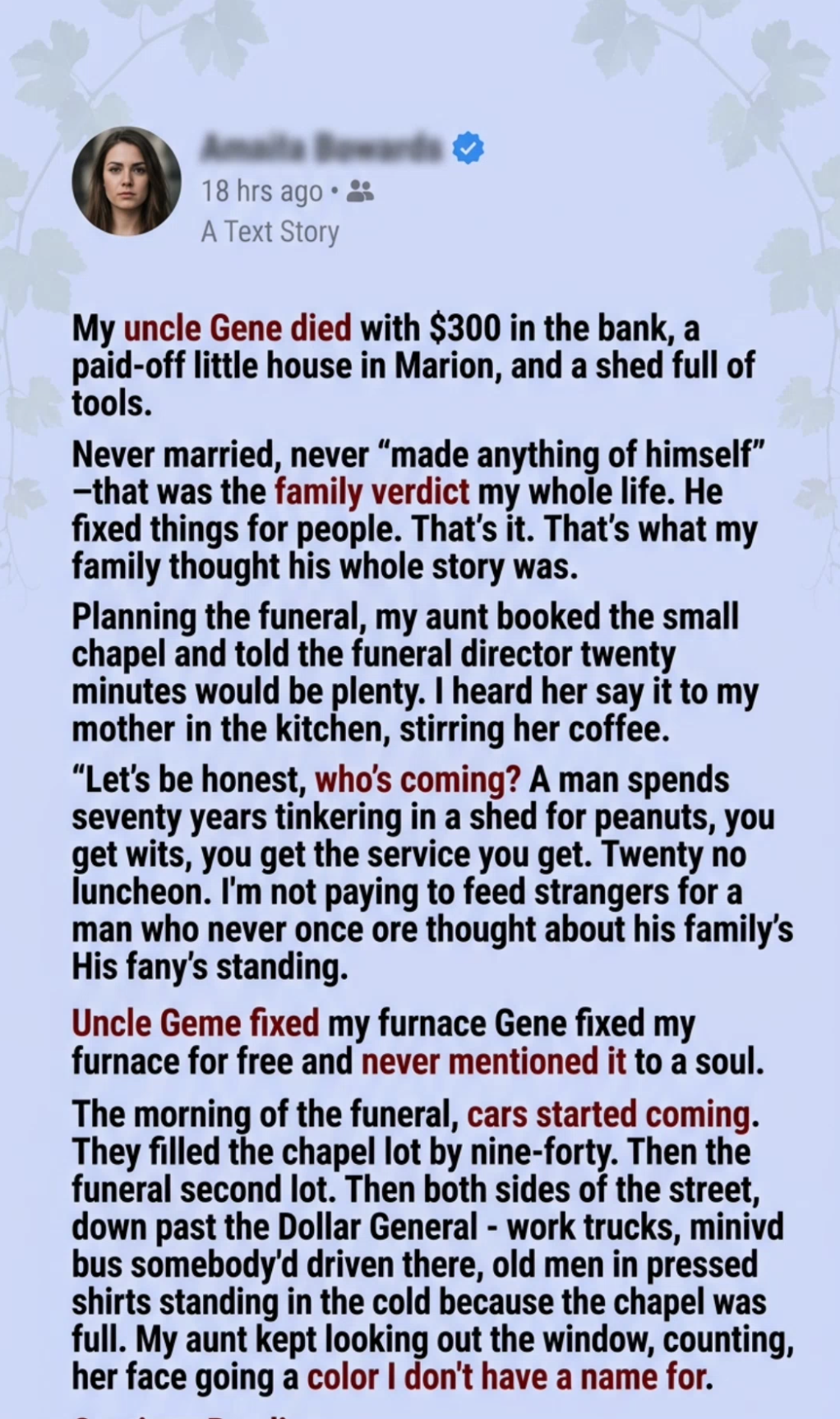
My uncle Gene died with $300 in the bank, a paid-off little house in Marion, and a shed full of tools.
That was what my aunt told everyone.
She repeated those details as if they were the final accounting of his life.
No wife. No children. No impressive career. No retirement portfolio. No expensive vacations. No property beyond the modest house he had lived in for most of his adult life.
According to my family, Gene had never made anything of himself.
He fixed things for people.
That was it.
He repaired lawn mowers, patched leaking roofs, replaced broken furnace motors, sharpened blades, rebuilt old engines, and helped neighbors with whatever they couldn’t afford to pay someone else to do.
He spent most of his days in a faded work shirt, with grease under his fingernails and a pencil tucked behind one ear.
He never talked about his accomplishments.
He never bragged about the people he helped.
And he rarely accepted payment.
My mother used to say he had wasted his potential.
My aunt called him stubborn.
My father described him as a man who had never learned how to get ahead.
But I remembered something different.
When I was eleven, our furnace stopped working during the coldest week of January. My mother was worried because replacing it would cost more than we could afford.
Gene arrived in his old pickup truck, carrying a toolbox.
He spent most of the afternoon in the basement.
When he finally came upstairs, he wiped his hands on a rag and said, “Try it now.”
The furnace started.
My mother asked how much she owed him.
He shook his head.
“Just keep the house warm.”
She insisted.
He refused.
A week later, I saw him in the kitchen putting a small bag of groceries into my mother’s pantry.
He didn’t say anything about it.
That was Gene.
He helped people and moved on.
He never expected applause.
He never demanded recognition.
And perhaps that was why my family had mistaken his quietness for insignificance.
I would learn how wrong they were on the morning of his funeral.
Uncle Gene’s full name was Eugene Miller.
He was seventy-two when he died.
He had lived in Marion, Ohio, in a small white house with a narrow front porch and a maple tree that dropped leaves into his gutters every autumn.
The house wasn’t much to look at.
The paint was peeling around the back door. The kitchen cabinets were old. The bathroom had a stubborn faucet that Gene had repaired so many times that he finally labeled the handle with a little strip of tape explaining which direction to turn it.
His shed was the most important building on the property.
It was crowded with tools, spare parts, coffee cans full of screws, old lawn mower engines, and wooden shelves that reached almost to the ceiling.
Every tool had a place.
Every broken object had a reason for being there.
Gene could identify a socket by touch in the dark.
He could listen to an engine for thirty seconds and tell you which part was failing.
He could repair a furnace that another technician had declared beyond saving.
And he could make a child feel that helping with a simple job was the most important thing in the world.
When I was younger, I spent many afternoons in that shed.
I would sit on an overturned bucket while he worked.
Sometimes he let me hold a flashlight.
Sometimes he gave me a rag and asked me to clean a tool.
He never made me feel useless.
“Everything has a purpose,” he once told me, holding up an old wrench with a cracked handle.
“Even that?”
“Especially that. You just have to know what it can still do.”
I remembered those words years later.
At the time, I thought he was talking about the wrench.
My aunt Lorraine was Gene’s younger sister.
She had always been concerned with appearances.
She liked expensive clothes, polished furniture, and family gatherings where everyone could talk about promotions, vacations, and property purchases.
Gene made her uncomfortable because he didn’t fit the picture of success she wanted the family to present.
He wore the same boots for years.
He drove an old truck.
He rarely attended formal dinners.
He didn’t discuss investments or business opportunities.
When relatives asked what he had been doing, he usually said something like, “A little of this, a little of that.”
Lorraine interpreted that as proof that he had never accomplished anything.
She was particularly irritated that Gene had never married.
She believed he had been too selfish to build a family.
She never considered that he might have chosen a different kind of life.
My mother, Patricia, often agreed with her.
“He could have done more,” she would say. “He was smart enough.”
I used to wonder what they expected him to do.
Gene had spent his life helping people.
Was that not enough?
When I asked my mother once, she told me that helping people was admirable, but a person needed to build something of their own.
I never argued.
I simply remembered the furnace.
Gene died on a Tuesday morning.
He had gone to bed the night before and never woke up.
The doctor later told the family that his death appeared to have been natural.
There was no dramatic emergency.
No accident.
No final argument.
Just a quiet ending in the little house where he had lived for decades.
My cousin Mark called me first.
“Uncle Gene is gone,” he said.
I sat down.
“What happened?”
“He didn’t wake up.”
I closed my eyes.
For several seconds, I couldn’t speak.
I had visited Gene only a few weeks earlier.
He had been working on an old riding mower for a neighbor and complaining that his coffee wasn’t strong enough.
He had asked about my job.
He had remembered my daughter’s birthday.
He had given me a small wooden box he had made from leftover oak.
I hadn’t realized it would be the last time I saw him.
The family gathered at Lorraine’s house that evening.
She had already contacted the funeral home.
She wanted a simple service.
That wasn’t unreasonable.
Gene had lived simply, and a modest funeral would have been appropriate.
But Lorraine’s explanation had nothing to do with simplicity.
She stood in the kitchen stirring her coffee while my mother sat at the table.
“Let’s be honest,” she said. “Who’s coming?”
My mother nodded.
“He didn’t have many friends who were close.”
“Exactly. A man spends seventy years tinkering in a shed for peanuts, and you get the service you get. Twenty minutes. No luncheon. I’m not paying to feed strangers for a man who never once thought about his family’s standing.”
I stood near the doorway.
I felt my face grow hot.
“Those people weren’t strangers to him.”
Lorraine turned.
“What?”
“The people he helped. They weren’t strangers.”
She gave me a tired look.
“Oh, please. He fixed a few things for people. That doesn’t mean they were his friends.”
I looked at my mother.
She didn’t say anything.
Lorraine continued.
“The funeral director said the small chapel is available. Twenty minutes should be plenty.”
I wanted to argue.
I wanted to tell her that Gene deserved more than twenty minutes.
But I knew how she would respond.
She would say I was emotional.
She would say I didn’t understand the cost.
She would say we had to be realistic.
So I left the kitchen.
The following day, I went to Gene’s house to help organize the paperwork.
The little house was quiet.
His coffee mug sat beside the sink.
A pair of reading glasses rested on the kitchen table.
His work jacket hung behind the back door.
I walked through the living room and opened the door to the shed.
The familiar smell hit me immediately.
Machine oil.
Old wood.
Metal.
Dust.
I stood in the doorway for a long time.
Everything was exactly where he had left it.
A lawn mower sat on a wooden platform.
A small engine was partially disassembled on the workbench.
There were boxes of screws, washers, bolts, and fittings.
A calendar hung on the wall.
Gene had written several names beside different dates.
I looked closer.
They weren’t appointments for himself.
They were reminders.
“Mrs. Allen — check heater.”
“Tom — trailer lights.”
“Bobby — mower belt.”
“Church basement — fan motor.”
“Mr. Harris — ramp rail.”
I smiled sadly.
Even in his final weeks, Gene had been arranging to help people.
I moved toward the workbench.
There was a small notebook beneath a stack of manuals.
I opened it.
The pages were filled with handwritten notes.
Names.
Phone numbers.
Repair descriptions.
Parts purchased.
Payments received.
Many entries had a zero written in the payment column.
Others simply said:
No charge.
At the back, I found a list titled:
People Who Still Need Help.
There were seventeen names.
I closed the notebook.
For a moment, I felt as though Gene was still there, just outside the shed, coming back with another cup of coffee.
Then my phone rang.
It was Lorraine.
“Are you coming back? We need to finalize the funeral arrangements.”
“I’ll be there.”
“Don’t spend all day in that shed. There’s nothing valuable in it.”
I looked around at the tools.
“I’ll be there soon.”
The funeral was scheduled for Friday morning.
Lorraine booked the smallest chapel at the funeral home.
She told the director to prepare for approximately twenty people.
She also refused the offer of a luncheon.
“We don’t need all that,” she said. “It’s a simple service.”
I asked whether we could at least arrange coffee afterward.
She said no.
The funeral director, a kind man named Robert, looked uncomfortable.
He turned toward me.
“Would you like to leave some time afterward for visitors to pay their respects?”
Lorraine answered before I could.
“Twenty minutes is enough.”
I looked at Robert.
“Could you leave the doors open a little longer if people come?”
He nodded.
“We can do that.”
Lorraine sighed.
“Fine. But we’re not extending the service.”
I didn’t argue.
I went home and posted a short notice on my personal social media page.
I included Gene’s name, the funeral home, the date, and the time.
I wrote:
My uncle Eugene Miller passed away this week. He was a quiet man who spent his life fixing things for others. If he ever helped you, repaired something for you, or made your day a little easier, we would be grateful if you joined us Friday to remember him.
I didn’t expect much.
I thought perhaps a dozen people might come.
I didn’t know that Gene had spent decades building a community one small act at a time.
Friday morning was cold.
The sky was gray, and a light wind moved through the trees outside the funeral home.
I arrived at 9:15.
The service was scheduled for ten.
Lorraine was already inside, speaking with the funeral director.
My mother sat in the front row.
Mark was standing near the entrance, checking his phone.
I looked around.
The chapel was small.
There were perhaps thirty chairs.
I thought we might have enough space.
Then I heard the sound of a truck pulling into the parking lot.
A man stepped out wearing a pressed work shirt and a dark jacket.
He walked toward the entrance carrying a small white envelope.
“Are you Gene’s niece?” he asked.
“Yes.”
He extended his hand.
“I’m Tom Harris. Gene built the handrail on my mother’s porch.”
I nodded.
“I remember him mentioning you.”
Tom looked toward the chapel.
“Is there room?”
“Of course.”
He went inside.
A few minutes later, another vehicle arrived.
Then another.
A white work van.
A pickup truck with a company logo on the door.
A minivan carrying an elderly couple.
An old sedan driven by a woman with a walking cane.
By 9:30, the parking lot was filling.
I stepped outside.
A man in a brown jacket approached me.
“I’m Bobby Allen. Gene rebuilt my father’s tractor.”
I smiled.
“Thank you for coming.”
He shook his head.
“I wouldn’t have missed it.”
Then he looked toward the chapel.
“Is there a place to sit?”
I glanced inside.
The first rows were already full.
“We’ll find somewhere.”
At 9:40, cars were parked along the far edge of the lot.
At 9:45, the second parking area began filling.
People were standing beside their vehicles, talking quietly.
Some carried flowers.
Some held folded cards.
Others simply came with their hands in their pockets and their heads bowed.
I recognized very few of them.
But they all seemed to know Gene.
By 9:50, both parking lots were full.
Cars lined the street beyond the funeral home.
Work trucks occupied the spaces near the Dollar General.
A small church minibus pulled in carrying several elderly people.
Two men in pressed shirts stood beside the entrance because there were no seats left.
Lorraine came to the window.
She looked outside.
Then she looked at my mother.
“Who are all these people?”
My mother stood.
“I don’t know.”
Lorraine watched another vehicle arrive.
Her face slowly changed color.
I had never seen her look so uncertain.
The funeral director approached us.
“I’m sorry,” he said. “The chapel is full.”
Lorraine looked at him.
“What do you mean, full?”
“We have people waiting outside.”
“But there are only supposed to be twenty.”
Robert glanced toward me.
“Apparently, Mr. Miller knew more people than we anticipated.”
Lorraine looked at the parking lot again.
I watched her count.
Ten vehicles.
Twenty.
Thirty.
Then she stopped.
A man approached the entrance carrying a small wooden box.
“Is this the service for Eugene Miller?”
“Yes,” I replied.
He nodded.
“My name is Samuel. Gene helped me after my wife died. I brought something I thought his family should have.”
He opened the box.
Inside was a small brass compass.
“He gave this to me when I was a boy,” Samuel said. “My father had passed away, and I was having a difficult time. Gene told me that when I didn’t know where I was going, I should remember where I came from.”
He looked down.
“I thought he might like it back.”
I felt tears rise.
“Thank you.”
Samuel handed me the box.
Behind him, another man was waiting.
Then another.
And another.
The funeral director asked whether we could move the service to the larger chapel.
Lorraine immediately objected.
“That will cost more.”
Robert looked at her.
“Mrs. Miller, we have people standing outside. We can accommodate them in the larger room.”
She glanced at my mother.
My mother didn’t answer.
I stepped forward.
“I’ll cover the difference.”
Lorraine turned sharply.
“You don’t need to do that.”
“Yes,” I said. “I do.”
Robert nodded.
“We’ll make the arrangements.”
The larger chapel was opened.
People began moving inside.
It took nearly twenty minutes to seat everyone.
Some remained standing along the walls.
Others sat in the adjoining room where the service could be heard.
The funeral home staff brought additional chairs.
The small service Lorraine had planned was no longer possible.
Not because anyone had demanded a grand event.
Because Gene’s life had reached far beyond the room she had chosen for him.
The funeral began shortly after ten-thirty.
The larger chapel was full.
There were farmers, mechanics, teachers, retired factory workers, nurses, church volunteers, small-business owners, and families with young children.
Some wore suits.
Some wore work boots.
A few still had their company uniforms on.
There were people from different generations.
An elderly man sat beside a teenager.
A woman held the hand of a little boy who looked around six.
I sat near the front beside my mother.
Lorraine sat on the other side of her.
She kept looking toward the back.
The funeral director introduced the minister.
He spoke about Gene’s life, his quiet nature, and his years in Marion.
Then he invited family members to share memories.
Lorraine leaned toward my mother.
“Keep it short,” she whispered.
I stood.
I walked to the front.
For a moment, I couldn’t speak.
I looked at the coffin.
Then I looked at the people.
“I was told this morning that Uncle Gene didn’t have many friends,” I began.
Lorraine shifted in her seat.
I continued.
“I think we can all see that wasn’t true.”
A few people smiled.
“Gene never thought of himself as an important person. He didn’t own a business empire. He didn’t collect expensive things. He didn’t have a big house or a long list of awards.”
I paused.
“He had a shed full of tools.”
There was a quiet laugh.
“He also had a habit of helping people without telling anyone.”
I looked toward the back.
“I remember being eleven years old when our furnace stopped working in the middle of winter. My mother was worried because we couldn’t afford to replace it. Gene came over, spent the afternoon in the basement, and got it running again.”
I looked at my mother.
“He never accepted payment.”
My voice became unsteady.
“Years later, I found out he had quietly put groceries in our pantry too.”
My mother lowered her head.
“He never told me how much it cost him. He never told anyone. He just made sure we were warm.”
I looked around the room.
“And I think that’s what many of you remember about him. He didn’t ask whether someone could pay. He asked whether something needed fixing.”
A man near the aisle nodded.
A woman wiped her eyes.
I continued.
“He understood that a broken furnace could leave a family cold. A broken ramp could keep an elderly person trapped inside. A broken mower could make it harder for someone to earn money. A leaking roof could turn a difficult month into a disaster.”
I paused.
“Some people spend their lives trying to become important. Gene spent his trying to make life a little easier for other people.”
My voice cracked.
“I wish our family had understood that sooner.”
The chapel was silent.
Then someone began to clap.
It wasn’t loud.
It was one person.
Then another.
Soon, the entire room was standing.
I stepped away from the microphone.
I couldn’t continue.
After the service, people didn’t leave immediately.
They gathered in the hallway and outside the funeral home.
Some approached the family.
Others waited quietly to speak with me.
A woman named Mrs. Allen came forward.
She was in her late seventies and used a walker.
“Your uncle fixed my furnace every winter,” she said.
I smiled.
“He mentioned you.”
She shook her head.
“Do you know what he did one year?”
I waited.
“My husband had passed away, and I couldn’t afford the repair. Gene came over, replaced the part, and told me the manufacturer had sent it to him by mistake.”
She began crying.
“I found out later he had bought it himself.”
She handed me an envelope.
Inside was a small donation.
“I know you don’t need this,” she said. “But I want it to go toward something he would have liked.”
I tried to refuse.
She shook her head.
“Please.”
I accepted it.
Then a young man approached.
He introduced himself as Bobby.
He was the teenager I had seen sitting near the back.
“Gene helped my dad get a job,” he said.
I looked at him.
“How?”
“My dad had been laid off. His truck broke down, and he couldn’t get to interviews. Gene repaired the transmission and told him to pay when he could.”
Bobby smiled sadly.
“My dad got a job two weeks later. He paid Gene back over several months. Gene never charged interest.”
Another man stepped forward.
“I was one of those people.”
He introduced himself as Frank.
“Gene helped me repair my roof after a storm. I offered him money, but he said I should use it to replace the damaged insulation.”
A woman standing nearby said Gene had repaired the wheelchair ramp at her church.
A retired teacher said he had helped her husband rebuild a porch.
A farmer described how Gene had repaired a tractor during harvest season, refusing to accept payment until the crops were safely brought in.
The stories kept coming.
Each person seemed to have a different memory.
Each memory revealed another piece of Gene’s life.
And all of them had something in common.
Gene had helped when help was needed.
Not because he expected recognition.
Because he believed that was what people should do.
At approximately noon, the funeral director approached me.
“There’s someone outside asking to speak with the family.”
“Who?”
“A woman named Ruth.”
I stepped outside.
An elderly woman stood near the entrance holding a large photograph.
She was wearing a dark coat and a knitted scarf.
“Are you Gene’s niece?”
“Yes.”
She handed me the photograph.
It showed Gene standing beside a young man in a wheelchair.
The young man was smiling.
Behind them was a wooden ramp attached to a small house.
“That’s my grandson,” Ruth said. “He was injured in an accident when he was nineteen.”
I looked at the photograph.
“Gene built the ramp?”
“He did. And he changed the bathroom doorway so my grandson could get through without help.”
Ruth took a breath.
“We couldn’t afford a contractor. Gene came every evening for two weeks. He never asked for a penny.”
She looked toward the chapel.
“My grandson is twenty-six now. He has a job. He drives. He lives independently.”
She smiled through her tears.
“He wanted to come today, but his disability makes long trips difficult. He asked me to give you this.”
She handed me a folded letter.
I opened it.
The handwriting was uneven but clear.
Dear Gene’s family,
I never got to thank him properly. When I came home from the hospital, I thought my life was over. I couldn’t get through the front door without someone lifting me. I couldn’t use the bathroom without help.
Gene didn’t talk to me like I was broken. He talked to me like I was a person who needed a better way to get around.
He built the ramp. He changed the doorway. He fixed my chair when the wheel kept sticking.
He never asked me to feel grateful. He just asked me what else needed fixing.
I have a life now because someone took the time to help me have one.
Please tell his family he mattered.
I folded the letter.
I couldn’t speak.
Ruth placed a hand on my arm.
“He mattered to a lot of people.”
Then she walked away.
By early afternoon, the funeral home parking lot was still crowded.
People were exchanging phone numbers and stories.
Several men had brought photographs of Gene working on their homes and equipment.
One showed him standing beside a tractor in the middle of a field.
Another showed him holding a little girl who was probably four years old.
A third showed him at a church picnic, wearing an apron and turning hamburgers on a grill.
I recognized the church picnic.
It was from more than twenty years earlier.
I had been there.
I remembered Gene spending the entire afternoon fixing a broken freezer while everyone else ate.
I had never thought about it.
Now I realized that he had probably spent hundreds of hours helping that church.
A man approached me with a folder.
“My name is David Collins,” he said. “I used to run the vocational program at the high school.”
He explained that Gene had volunteered for years.
He had repaired tools, donated equipment, and taught students basic mechanical skills.
“Some of those kids didn’t have anyone at home who could show them how to use a wrench,” David said. “Gene would stay after school and teach them.”
“Was he paid?”
David laughed.
“Not a cent.”
He opened the folder.
Inside were photographs of Gene standing beside students.
Some were holding repaired engines.
Others were showing off small woodworking projects.
One photograph showed Gene standing beside a young woman in a graduation gown.
“That’s Emily,” David said. “She became an automotive technician. She told me Gene was the first person who made her believe she could work with machines.”
I looked at the photograph.
Gene was smiling.
Not a large smile.
Just the small, quiet expression I remembered.
David closed the folder.
“He never wanted attention. But he changed lives.”
That evening, after most people had left, I returned to Gene’s house.
My mother came with me.
Lorraine had gone home.
The house was quiet.
We sat in the kitchen.
My mother looked at the old coffee mug beside the sink.
“I didn’t know,” she said.
I looked at her.
“Didn’t know what?”
“How many people he helped.”
I didn’t answer.
She continued.
“I thought he was wasting his life.”
I looked toward the back door.
“Why?”
She shook her head.
“Because he never seemed to want anything. He didn’t have a family of his own. He didn’t save much money. He never tried to move up in the world.”
I sat down.
“Maybe he wanted something different.”
My mother looked at me.
“Maybe.”
She picked up the coffee mug and turned it slowly in her hands.
“He fixed our furnace for free.”
“Yes.”
“He helped with the groceries.”
“Yes.”
She closed her eyes.
“I never thanked him properly.”
I reached across the table.
“He knew.”
She began to cry.
For the first time, I saw her understand that the man she had judged for years had given more to the family than anyone had realized.
A week after the funeral, Lorraine called a family meeting.
She wanted to discuss Gene’s estate.
She had already obtained a copy of the will from his attorney.
She believed there would be little to discuss.
The house was paid off.
The bank account contained approximately $300.
The tools were old.
There were no investment statements.
She expected the estate to be settled quickly.
But the attorney, a man named Charles Bennett, had asked all the immediate family members to attend.
When we arrived, he placed a folder on the table.
“Before we discuss the distribution of the estate,” he said, “I want to clarify something.”
Lorraine folded her arms.
“There’s not much to distribute.”
Mr. Bennett nodded.
“That may be true financially. But Mr. Miller left several documents that require attention.”
He opened the folder.
The first document was the will.
Gene had left his small house to a local charitable organization that provided emergency home repairs for elderly and disabled residents.
The tools and equipment in the shed were to be offered to the local vocational school.
His remaining cash was to be used for funeral expenses and any outstanding household bills.
Lorraine looked confused.
“He gave away the house?”
“He did,” the attorney replied.
“To a charity?”
“To the Marion Home Repair Partnership, subject to the terms in the will.”
Lorraine’s face tightened.
“Why would he do that?”
The attorney turned to another document.
“Because he had been involved with the organization for several years.”
I looked up.
I had never heard of it.
Mr. Bennett explained that Gene had quietly helped establish a small community repair fund.
He had donated money whenever he could.
He had also arranged for volunteers to provide labor.
The organization helped elderly residents repair unsafe steps, broken heating systems, damaged roofs, and other essential parts of their homes.
Gene had never been its public director.
He had served as a volunteer adviser and repair coordinator.
The house was to become a small workshop and storage space for the program.
Lorraine shook her head.
“He had $300 in the bank. How could he have been running something like that?”
Mr. Bennett opened another folder.
“Because he wasn’t funding the work alone.”
He explained that Gene had received occasional payments for certain repairs, sold refurbished equipment, and donated a portion of the proceeds to the program.
He had also received donations from people who insisted on paying him.
Some of those funds had been placed in a separate charitable account.
The account was not part of his personal bank balance.
Gene had kept the money separate because he wanted the organization to operate independently.
I stared at the documents.
The little shed full of tools suddenly looked different.
It wasn’t simply where he spent his days.
It was where he had organized years of community work.
The attorney then introduced a woman named Margaret Shaw.
She was the coordinator of the Marion Home Repair Partnership.
She had known Gene for nearly twenty years.
“Eugene didn’t like being called the founder,” she said. “He always said he was just the person who knew how to fix things.”
She explained that the organization had begun informally.
Gene had helped an elderly neighbor whose heating system failed.
Then he helped another family.
A local church began referring people to him.
A vocational teacher offered students who wanted practical experience.
A hardware store donated unused materials.
A retired electrician volunteered his time.
Eventually, the group became a registered charitable organization.
Gene refused to take a leadership title.
He preferred to coordinate repairs and teach volunteers.
Margaret continued.
“He was very careful about money. He never mixed personal funds with charitable donations. He kept receipts, records, and notes for every project.”
Lorraine looked skeptical.
“How much money are we talking about?”
Margaret opened a statement.
The organization had a modest operating reserve.
It wasn’t a fortune.
But it was enough to purchase materials for several emergency repair projects.
There were also pledged donations from local businesses.
The house was valuable because it could serve as a workshop and storage facility.
Gene had left it to the organization because he wanted the work to continue.
My aunt looked at the attorney.
“Are you saying he had all this and never told us?”
The attorney answered carefully.
“He chose not to make his charitable activities a family discussion.”
Lorraine looked offended.
“He was my brother.”
Margaret’s expression softened.
“I know. But he was also his own person.”
The biggest surprise came when Margaret opened a second folder.
It contained letters from people Gene had helped.
There were dozens.
Some were handwritten.
Some were typed.
A few included photographs.
The letters had been collected over several years as part of a private volunteer recognition project.
Gene had never wanted a public award.
But the people who benefited from his work had insisted on writing to him.
Margaret had kept copies.
One letter came from a retired factory worker whose wife had suffered a serious illness.
Gene had repaired their heating system during a winter storm.
Another came from a single mother whose car had broken down before she could take her child to a medical appointment.
Gene had repaired the vehicle and refused payment.
Another came from a veteran who had been struggling to maintain his home after an injury.
Gene had installed handrails and repaired the porch steps.
There were letters from teachers, farmers, mechanics, church members, and young people who had learned their first practical skills in his shed.
I looked through the pages.
There was one from a woman named Susan.
She wrote that Gene had helped her father after he lost his wife.
He had visited every Saturday for nearly a year, repaired small things around the house, and sat with him for coffee.
The final paragraph read:
I don’t know whether Gene understood how much those visits mattered. My father had stopped going outside after my mother died. Gene gave him a reason to open the door again.
I placed the letter on the table.
My mother was crying.
Lorraine was silent.
For the first time, nobody in the family had anything to say about Gene’s lack of success.
The following week, I visited the vocational school.
Margaret had arranged for me to meet the instructor who would receive Gene’s tools.
His name was David Collins.
He showed me the room where the equipment would be stored.
There were benches, old engines, worktables, and shelves waiting to be filled.
“Gene wanted students to have access to real tools,” David explained. “Not just the cheapest equipment we could afford.”
He showed me a list of students who had benefited from Gene’s volunteer work.
Several had gone on to become mechanics.
One had become an electrician.
Another had opened a small repair business.
A young woman named Emily had become an automotive technician and was now helping teach the next group of students.
She came into the room while we were talking.
When she heard my name, she smiled.
“You’re Gene’s niece?”
“Yes.”
She shook my hand.
“I wish I had met you at the funeral. I was there, but it was crowded.”
I laughed softly.
“It certainly was.”
Emily looked toward the shelves.
“He changed my life.”
I smiled.
“How?”
“When I was sixteen, I was failing school and had no idea what I wanted to do. My father told me I should find something practical. I didn’t believe I could do anything with my hands.”
She paused.
“Gene let me help him rebuild an engine. He never treated me differently because I was a girl. He just showed me how the parts worked.”
She pointed to a small wooden toolbox.
“He made that for me when I finished my first project.”
I looked at it.
“Do you still have it?”
“Every day.”
She smiled.
“I keep my most important tools in it.”
I felt my eyes sting.
Gene had never told me about Emily.
He hadn’t told me about most of these people.
He had simply gone to work in his shed.
Several months later, the Marion Home Repair Partnership held a small gathering to open the workshop.
They placed a simple sign above the door:
The Eugene Miller Community Workshop.
There were no expensive decorations.
No speeches from politicians.
Just volunteers, students, neighbors, and families who wanted to honor the man who had helped them.
I stood near the entrance.
The original workbench from Gene’s shed had been moved inside.
His tools were arranged on the wall.
The old coffee cans full of screws had been cleaned and labeled.
His notebook was placed in a glass case beside a photograph of him working.
Margaret spoke first.
“Gene never asked us to remember him. He asked us to keep helping people.”
Then she invited me to say a few words.
I looked at the room.
Many of the people were familiar from the funeral.
Some had traveled from outside Marion.
I began quietly.
“My family once described Gene as a man who spent seventy years tinkering in a shed.”
A few people smiled.
“I think that description was true. But it was incomplete.”
I looked toward the workbench.
“He spent seventy years learning how to repair things. And then he spent those same years using what he knew to make life easier for people who needed help.”
I paused.
“He didn’t leave behind a fortune. He didn’t leave behind a large estate. He left a house, a shed, and a few hundred dollars in his bank account.”
I looked around.
“But he also left a community that knew exactly what kind of man he was.”
The room was quiet.
“I used to think the most important thing Gene owned was that shed. Now I understand that the most important thing he built was the trust people had in him.”
I stepped away from the microphone.
The applause was warm and sustained.
This time, I didn’t feel surprised.
My aunt Lorraine attended the workshop opening.
I hadn’t expected her to come.
She stood near the back, wearing a dark coat and holding a small handbag.
After the ceremony, she approached me.
“I didn’t know he did all this.”
I looked at her.
“Neither did I. Not all of it.”
She glanced toward the workbench.
“I thought he was wasting his time.”
I waited.
She looked down.
“I was wrong.”
It was the first time I had heard her say those words.
She continued.
“I kept thinking about what he didn’t have. A wife. Children. Money. A business. I never thought about what he gave away.”
I nodded.
“He didn’t talk about it.”
Lorraine looked at me.
“Maybe we should have asked.”
I didn’t know what to say.
She stood there for another moment.
Then she walked toward the photograph of Gene.
My mother later told me that Lorraine had cried in the car after leaving.
I didn’t take pleasure in that.
I only wished she had understood him while he was still alive.
A year after Gene’s death, I visited the workshop on a Saturday morning.
A group of students were repairing an old lawn mower.
One boy was struggling with a bolt.
He kept turning the wrench in the wrong direction.
The instructor smiled.
“Remember what Gene used to say?”
The boy shook his head.
“Everything has a purpose. You just have to know what it can still do.”
I stopped walking.
I recognized the words immediately.
The instructor pointed to an old wrench on the workbench.
It had a cracked handle.
The boy picked it up.
“Is this the one?”
The instructor nodded.
“Gene used that for years.”
The boy examined it carefully.
Then he smiled.
I stood near the doorway and watched them work.
For a moment, I could almost see Gene beside the bench, wearing his faded shirt, with a pencil behind his ear and a cup of coffee sitting somewhere it shouldn’t.
I imagined him explaining the repair.
I imagined him telling the boy not to force the bolt.
I imagined him asking whether the boy had eaten breakfast.
Then I looked around the room.
His tools were still being used.
His knowledge was still being passed along.
His work was still helping people.
That afternoon, I finally understood why so many cars had filled the funeral home parking lot.
They hadn’t come because Gene was wealthy.
They hadn’t come because he held an important title.
They hadn’t come because he was famous.
They had come because, at some point in their lives, Gene had made them feel that they mattered.
He had repaired their homes, fixed their vehicles, taught their children, helped their parents, and given them dignity when they needed it most.
My family had measured his life by what he accumulated.
The people of Marion measured it by what he gave.
And when the day came to say goodbye, the people who had received his kindness showed up.
They filled the chapel.
They filled the parking lot.
They lined the street.
They stood in the cold because they wanted to honor a man who had never asked anyone to stand for him.
Uncle Gene had died with $300 in the bank.
But he had not died poor.
He had left behind a house that would shelter a community program, tools that would teach a new generation, and memories that would continue long after his little shed was gone.
I still think about that morning when Lorraine looked through the funeral home window and counted the cars.
She had expected twenty people.
She had expected a short service.
She had expected a quiet goodbye for a man she believed had accomplished very little.
Instead, hundreds came to show her what she had never bothered to see.
Gene had spent seventy years fixing things.
And in the process, he had built something none of us could measure in dollars.
He had built a life that mattered.
The End