I never thought I would reach a point where I genuinely wanted nothing to do with my mother-in-law.
For years, I had tried to be patient.
I had tried to understand her personality, overlook her comments, and remind myself that she was my husband’s mother. I told myself that family relationships were complicated and that sometimes the best thing a person could do was take a deep breath and let things go.
But there comes a point when letting things go becomes letting someone hurt you repeatedly.
And when that person begins treating your child’s medical needs like an inconvenience to their own expectations, something inside you changes.
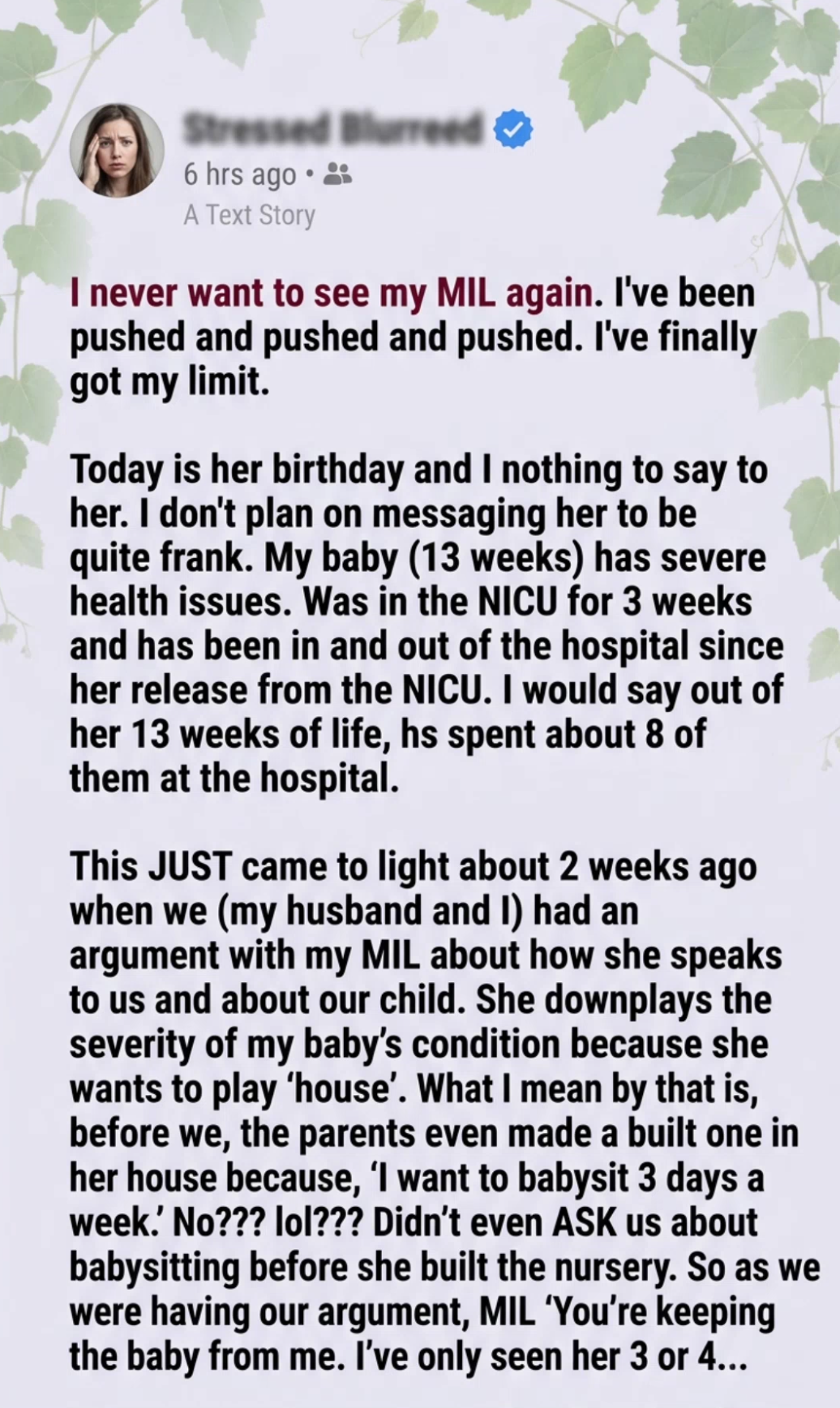
My daughter is thirteen weeks old.
She was born with serious health complications and spent her first three weeks of life in the neonatal intensive care unit. While other parents were bringing their newborns home, taking photographs in matching outfits, and introducing their babies to relatives, my husband and I were learning how to navigate hospital corridors, medical monitors, and conversations with specialists.
We were terrified.
Every time a nurse came into the room, we watched her face carefully.
Every time a doctor asked to speak with us, our hearts sank.
We learned things no new parent should have to learn so early.
Our daughter eventually came home, but home did not mean healthy.
She has been in and out of the hospital since her release from the NICU. Out of thirteen weeks of her life, she has spent approximately eight weeks in the hospital.
Eight weeks.
That is more than half her life.
We have missed sleep, canceled plans, postponed appointments, and spent countless hours waiting for medical updates.
Our lives have revolved around her condition.
We are not living the ordinary newborn experience.
We are trying to keep our baby safe.
And while my husband and I were struggling to understand what our daughter’s future might look like, my mother-in-law was making plans of her own.
She wanted to babysit.
Not occasionally.
Not when we asked.
Not when our daughter was medically stable and we felt comfortable leaving her with someone.
She wanted to babysit three days a week.
And without asking us, she had already built a nursery in her house.
A nursery for our daughter.
A room with a crib, decorations, baby clothes, and everything she imagined she would need to play grandmother.
I found out about it after the fact.
At first, I thought she was simply excited.
I understood that.
Grandparents can be excited about a new baby. They can want to help. They can dream about holding their grandchild, buying little outfits, and spending time together.
But excitement does not give someone the right to make decisions about another person’s child.
She hadn’t asked whether we wanted her to babysit.
She hadn’t asked whether we were comfortable with three days a week.
She hadn’t asked whether our daughter could even safely be cared for outside our home under her current medical circumstances.
She had simply decided.
And somehow, we were expected to be grateful.
I tried to explain that our daughter was not a typical newborn.
She had medical needs that required careful attention.
We were following instructions from her doctors, and we were not going to make childcare arrangements based on anyone else’s wishes.
My mother-in-law did not seem to understand.
Or perhaps she understood perfectly well but didn’t like the answer.
She kept talking about the nursery.
She kept talking about babysitting.
She kept talking about how much she wanted to have the baby at her house.
Meanwhile, my husband and I were barely functioning from exhaustion.
We were taking turns sleeping.
We were trying to keep track of appointments.
We were worrying about every symptom.
And we were trying to be parents while also learning how to be medical advocates for a tiny child who could not tell us what she was feeling.
The nursery became a symbol of everything that was wrong.
It was not simply a room.
It was the expectation that my mother-in-law’s desire to play grandmother should somehow take priority over our daughter’s actual needs.
Two weeks ago, my husband and I finally confronted her.
We had reached the point where we could no longer pretend the situation was harmless.
We told her that the way she spoke to us was unacceptable.
We told her that she had been dismissive about our daughter’s condition.
We told her that building a nursery without asking us had crossed a boundary.
And we told her that babysitting three days a week was not something she could decide on her own.
The conversation quickly became an argument.
My mother-in-law became defensive.
She insisted that she was only trying to help.
She said she had done nothing wrong.
Then she accused us of keeping the baby away from her.
“You’re keeping the baby from me.”
I remember looking at her and feeling completely exhausted.
She had seen our daughter only three or four times.
But instead of asking why our daughter had spent so much time in the hospital, instead of asking what the doctors had told us, instead of asking how we were coping, she was focused on how often she had been allowed to see her.
I wanted to scream.
Our baby had spent weeks connected to medical equipment.
We had watched her struggle.
We had sat beside her hospital bed wondering whether things would get worse.
And somehow, the conversation had become about my mother-in-law’s disappointment.
I told her that our daughter was sick.
I told her that we were not keeping the baby away for fun.
We were trying to protect her.
My mother-in-law responded by downplaying the severity of the condition.
She spoke as though the hospital stays were exaggerations.
As though we were being overly cautious.
As though the doctors were making things sound worse than they were.
I could hardly believe what I was hearing.
This was not a disagreement about visiting hours.
This was not a disagreement about who got to hold the baby first.
This was a disagreement about whether our daughter’s medical needs mattered more than a grandmother’s wish to play house.
And I was done.
I had been pushed and pushed and pushed.
I had swallowed comments.
I had tried to remain polite.
I had tried to keep the peace.
But the peace had always been maintained at my expense.
That night, after the argument, my husband and I sat together in our bedroom.
Our daughter was sleeping nearby.
I looked at him and said, “I can’t do this anymore.”
He knew what I meant.
I told him that I did not want to see his mother.
I told him that I did not want to receive messages from her.
I told him that I could not keep pretending everything was fine just because she was his mother.
He was quiet for a long time.
Then he said something I had been waiting to hear.
“You don’t have to keep putting yourself through this.”
I began to cry.
Not because I wanted to hurt his mother.
Not because I wanted to create a family war.
But because I finally felt that someone understood how exhausted I was.
My husband admitted that he had been uncomfortable with the way his mother had spoken about our daughter.
He had hoped that explaining things calmly would make her understand.
He had hoped that she would recognize how serious the situation was.
But he could no longer deny that she was treating our boundaries as obstacles instead of decisions made by the child’s parents.
He told me that he would handle communication with her.
He told me that she would not be allowed to pressure me.
And he told me that the nursery did not create any obligation for us.
That last part mattered more than he probably realized.
Because I had been feeling guilty.
I had been thinking about the money she had spent.
I had been thinking about the room she had prepared.
I had been wondering whether refusing to let her babysit made me ungrateful.
But my husband reminded me that she had made those decisions without asking.
We had never promised her three days a week.
We had never agreed to leave our daughter with her.
We had never told her that she could build a nursery and expect access in return.
Her expectations were not our obligations.
And our daughter’s health was not something we could compromise to make another adult happy.
Today is her birthday.
I know that some people will say I should send a message.
They will say that it takes only a few seconds to write “Happy Birthday.”
They will say that I should be the bigger person.
They will say that family is family.
But I have nothing to say to her.
And I don’t plan on messaging her.
Not today.
Not while I am still trying to recover from the way she treated us during one of the most frightening periods of our lives.
I don’t want to send a birthday greeting out of obligation and then spend the rest of the day feeling angry.
I don’t want to pretend that the argument never happened.
I don’t want to reward the behavior by acting as though everything has returned to normal.
I want peace.
Real peace.
The kind that comes from not having to explain myself every time I make a decision about my own child.
The kind that comes from knowing that my husband and I are allowed to protect our daughter without being accused of cruelty.
The kind that comes from being able to focus on our baby instead of worrying about whether someone will turn our medical situation into a personal grievance.
I know my mother-in-law may be hurt.
I know she may tell relatives that I am keeping her granddaughter away.
I know she may say that she built a beautiful nursery and that I refused to let her use it.
But the nursery is not the issue.
The issue is that she built it without asking.
The issue is that she expected three days of babysitting before we had even discussed whether babysitting was appropriate.
The issue is that she minimized a serious medical condition.
The issue is that she treated our daughter’s hospital stays as though they were somehow preventing her from enjoying grandmotherhood.
And the issue is that she accused us of keeping the baby from her when we were simply trying to keep our child safe.
I don’t hate her.
I don’t want anything bad to happen to her.
I don’t want my husband to lose his relationship with his mother if he can maintain one in a healthy way.
But I cannot continue sacrificing my own emotional well-being to make her comfortable.
My daughter is thirteen weeks old.
She has already spent far too much of her life in a hospital.
She deserves parents who can focus on her.
She deserves a home where her medical needs are taken seriously.
She deserves adults who understand that loving a child means respecting the people responsible for caring for that child.
And I deserve to be able to recover from the fear and exhaustion of these past weeks without being pressured into managing someone else’s disappointment.
I don’t know what the future relationship with my mother-in-law will look like.
Maybe, with time, she will understand.
Maybe she will apologize.
Maybe she will learn that being a grandmother does not mean having automatic access or the right to make decisions.
Or maybe she won’t.
But I know one thing.
I am no longer willing to be pushed until I break just because someone believes their title gives them permission.
Today, she can have her birthday without a message from me.
I can have my quiet.
My husband can handle his family.
And our daughter can remain the center of our attention, exactly where she belongs.
Because the moment I became a mother, my responsibility was not to keep everyone else happy.
It was to protect my child.
And I will never apologize for doing that.
The End