I had been dating Jason for seven months, and until that evening, I thought he was the kind of man I could build a future with. He remembered little things I told him, called me after difficult days, and always seemed considerate. When he suggested a quiet dinner for two at a nice restaurant downtown, I was genuinely excited. I spent nearly an hour choosing what to wear, bought a small gift because he had recently mentioned how much he missed his mother’s cooking, and arrived ten minutes early.
The moment I walked through the restaurant doors, I knew something was wrong.
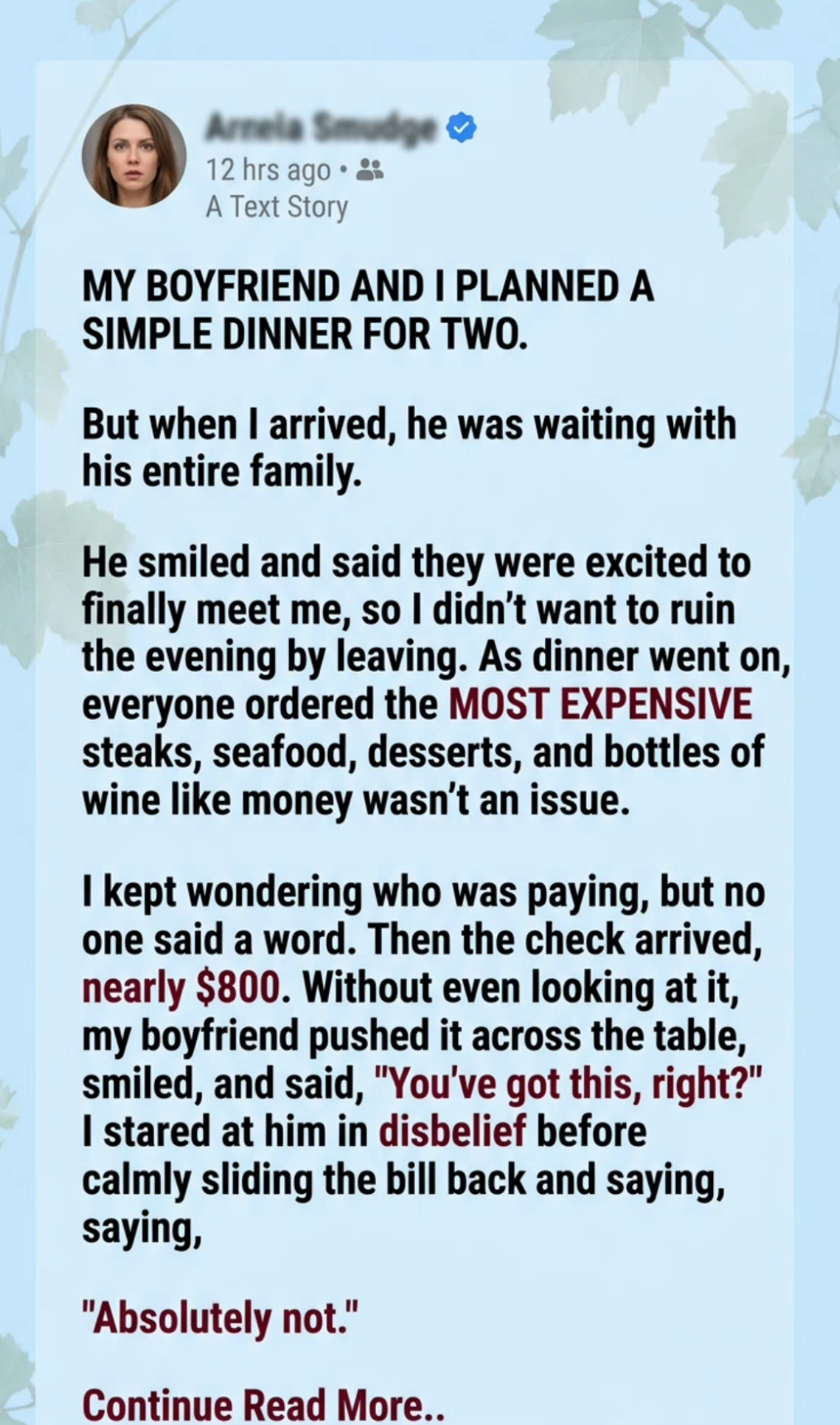
Jason was standing beside a large table surrounded by people. His mother, father, two sisters, a brother-in-law, an aunt, and several cousins were all there. He waved enthusiastically as if this were the most natural arrangement in the world.
“Surprise!” he said. “My family wanted to meet you.”
I stopped beside the table, trying to understand what was happening.
“I thought we were having dinner together,” I said quietly.
“We are,” he replied, smiling. “Just with a few extra people.”
A few extra people.
There were nine of them.
His mother, Lorraine, stood and hugged me before I could decide whether I wanted to. She looked me up and down, then announced that Jason had finally brought home someone worth meeting.
Everyone laughed.
I laughed too, although I felt uncomfortable.
I had already made the mistake of arriving, and I didn’t want to embarrass Jason in front of his family. I told myself that meeting relatives was a normal part of dating. Perhaps he had simply wanted to surprise me.
The restaurant was beautiful, with white tablecloths, low lighting, and a menu that made me check the prices twice. I had expected to pay for my own meal, maybe even offer to cover Jason’s as a special treat. I had not expected to finance an entire family gathering.
When the server came, everyone ordered as if they were celebrating a millionaire’s birthday.
Jason’s father ordered a premium steak. His mother chose lobster and a glass of imported wine. His sisters ordered seafood platters, and one cousin asked for the most expensive bottle of red wine on the menu.
Jason ordered a steak, a side of scallops, and a cocktail.
I ordered grilled chicken and water.
As the server walked away, Jason leaned toward me and whispered, “My family loves this place.”
I looked around the table.
“Do they come here often?”
“Sometimes,” he said.
That was when I began to wonder why he had brought me.
Throughout dinner, his relatives asked questions about my job, my apartment, and whether I had any savings. At first, the questions seemed ordinary.
Then Jason’s aunt asked whether I owned my car outright.
His sister wanted to know if I had a retirement account.
His mother asked whether my parents had helped me buy my apartment.
I answered politely, but the questions became increasingly personal.
“Do you usually pay for things when you go out with Jason?” his mother asked.
I looked at him.
He laughed nervously.
“She’s independent,” he said. “She likes taking care of herself.”
His mother nodded as though that confirmed something important.
The conversation shifted to family expenses. Jason’s sister complained about the cost of her children’s private school. His brother-in-law talked about a new business that needed investment. His father mentioned that the family had been trying to organize a reunion but had postponed it because everyone was busy.
Then Jason’s mother looked directly at me.
“You seem like someone who understands responsibility,” she said.
I smiled uncertainly.
“I try to.”
“That’s wonderful,” she replied. “Families need people like that.”
I did not know what she meant.
By the time dessert arrived, I was exhausted. The table had ordered several cakes, coffees, and another bottle of wine. Jason was laughing with his cousins, apparently enjoying himself.
I leaned toward him.
“Jason, I thought this was supposed to be dinner for two.”
He squeezed my hand beneath the table.
“Relax. It’s just one night.”
I wanted to ask who was paying, but I felt embarrassed bringing up money in front of everyone.
Then the server returned with the check.
The total was $786.42.
For a moment, nobody moved.
Jason glanced at the bill, then pushed it across the table toward me.
“You’ve got this, right?”
He smiled.
The table went quiet.
I stared at him, certain I had misunderstood.
“What?”
He shrugged.
“You said you were independent.”
His mother nodded approvingly.
“It’s nice when a woman can contribute,” she said.
I looked at the check again.
Nearly eight hundred dollars.
I had not invited these people. I had not chosen the restaurant. I had not ordered the wine, the lobster, or the expensive desserts. I had barely touched my own meal.
And now they expected me to pay for everything.
I slowly pushed the bill back toward Jason.
“Absolutely not.”
His smile disappeared.
“What do you mean?”
“I mean I’m not paying this bill.”
His sister scoffed.
“It’s just dinner.”
“Then you can all split it,” I replied.
Jason leaned closer, his voice suddenly sharp.
“Don’t make a scene.”
I looked around the table. Several people were watching me as if I had broken some unwritten rule.
I took a breath.
“I came here expecting dinner for two. I never agreed to pay for nine people.”
His father cleared his throat.
“Jason said you were comfortable financially.”
I turned toward him.
“Jason told you that?”
His father glanced at his son.
Jason’s expression changed.
For the first time that evening, he looked genuinely nervous.
The server stood nearby, waiting.
I opened my purse and placed enough cash on the table to cover my own meal, including tax and tip.
Then I stood.
“I hope you all enjoy the rest of your evening.”
Jason grabbed my wrist.
“Sit down.”
I pulled my hand away.
“Don’t touch me.”
His mother stood too.
“You’re embarrassing him.”
I looked at her calmly.
“No. He embarrassed himself when he invited me to dinner without telling me who was coming and then expected me to pay for it.”
I walked toward the entrance.
Jason followed me outside.
“Are you seriously leaving over a bill?”
I turned to face him.
“I’m leaving because you lied to me.”
“I didn’t lie.”
“You told me dinner for two. You knew your entire family would be there.”
He rubbed his forehead.
“They wanted to meet you.”
“Then why didn’t you tell me?”
He had no answer.
I called a rideshare and waited near the curb. Jason stood beside me, growing more frustrated with every passing minute.
“You’re making this into something it isn’t,” he said.
“Then explain it.”
He looked toward the restaurant.
“They’ve had a rough few months.”
That was the first explanation he offered.
His father had been behind on some bills. His sister had expenses. His mother had been helping everyone. Jason said he thought I could make the evening easier by covering the meal.
I stared at him.
“You thought I could make it easier?”
“Just this once.”
“Why didn’t you ask me?”
He lowered his voice.
“Because you might have said no.”
The rideshare arrived.
I opened the door, but Jason stepped closer.
“Please don’t end things over this.”
I looked at him for a long moment.
“This isn’t about the money, Jason. It’s about the fact that you planned to put me in a situation where saying no would make me look cruel.”
I got into the car.
He stood on the sidewalk as we drove away.
I thought that would be the end of it.
I was wrong.
The next morning, I woke to a series of messages from Jason.
The first said he was sorry.
The second said his family had been offended.
The third said I had misunderstood his intentions.
Then his mother sent me a message of her own.
She wrote that she had raised Jason to value generosity and that she hoped I would reconsider my behavior. She said a future wife should understand that marriage meant supporting a family, not just enjoying romantic dinners.
I read it twice.
Then I blocked her.
Jason called from another number.
I answered because I wanted one final conversation.
He sounded calm, almost rehearsed.
“Look, I know last night was awkward,” he said. “But my family really liked you.”
“Your family liked the idea of me paying.”
“That isn’t fair.”
“Then tell me why you arranged it.”
He hesitated.
I heard a door close in the background.
Finally, he admitted that his family had discussed the dinner beforehand. His mother had suggested inviting everyone because they wanted to see whether I was “the generous type.”
I felt something inside me go cold.
“They were testing me?”
“Not exactly.”
“Jason.”
He sighed.
“Okay. Yes. They wanted to know if you would help when the family needed something.”
I asked what kind of help.
He said his sister had a large credit-card balance, his parents needed assistance with a home repair, and his brother-in-law had been trying to borrow money for his business.
They had assumed that because I had a steady job and lived alone, I would be willing to help.
I asked how much they expected.
Jason said he didn’t know.
But when I pressed him, he finally admitted that his mother had mentioned a number before dinner.
Five thousand dollars.
The restaurant bill had been only the beginning.
His family wanted to see whether I would be willing to contribute to their expenses without being asked directly.
I ended the call.
For the next several days, Jason tried to convince me that I was overreacting. He said his family had never intended to take advantage of me. He claimed they were simply traditional and believed couples should share responsibilities.
But I kept remembering the questions at the table.
My savings.
My apartment.
My car.
My retirement account.
They had not been curious about my life.
They had been evaluating my finances.
A week later, Jason appeared outside my apartment carrying flowers.
I did not invite him in.
He said he had spoken to his mother and promised that nothing like the dinner would happen again.
I asked him one question.
“If your family had asked me directly for five thousand dollars, what would you have said?”
He looked down.
“I would have explained the situation.”
“Would you have told me the truth before asking?”
He remained silent.
That silence answered everything.
I returned the flowers.
Jason left without arguing.
Over the following month, I learned that his family had been struggling financially for longer than he had admitted. His parents had borrowed from relatives. His sister had several overdue payments. His brother-in-law’s business had failed to make a profit.
Jason had been helping them quietly.
I did not blame him for caring about his family. I understood that people sometimes faced difficult circumstances and needed support.
What I could not accept was his decision to make me responsible for those circumstances without my knowledge or consent.
A relationship should allow two people to discuss money honestly.
It should not turn one person into an unsuspecting solution to another family’s problems.
Eventually, Jason sent me a final message.
He said he wished things had gone differently and that he hoped I would remember the good parts of our relationship.
I did remember them.
But I also remembered the restaurant table, the expensive wine, the silent relatives, and the bill sliding toward me.
I remembered how easily he had smiled when he asked me to pay.
And I realized that the most expensive part of that dinner had not been the $786.42.
It had been the price of discovering who he really was before I built a life around him.
I never paid his family’s bill.
I never gave them the five thousand dollars they had expected.
And I never went back to Jason.
The End