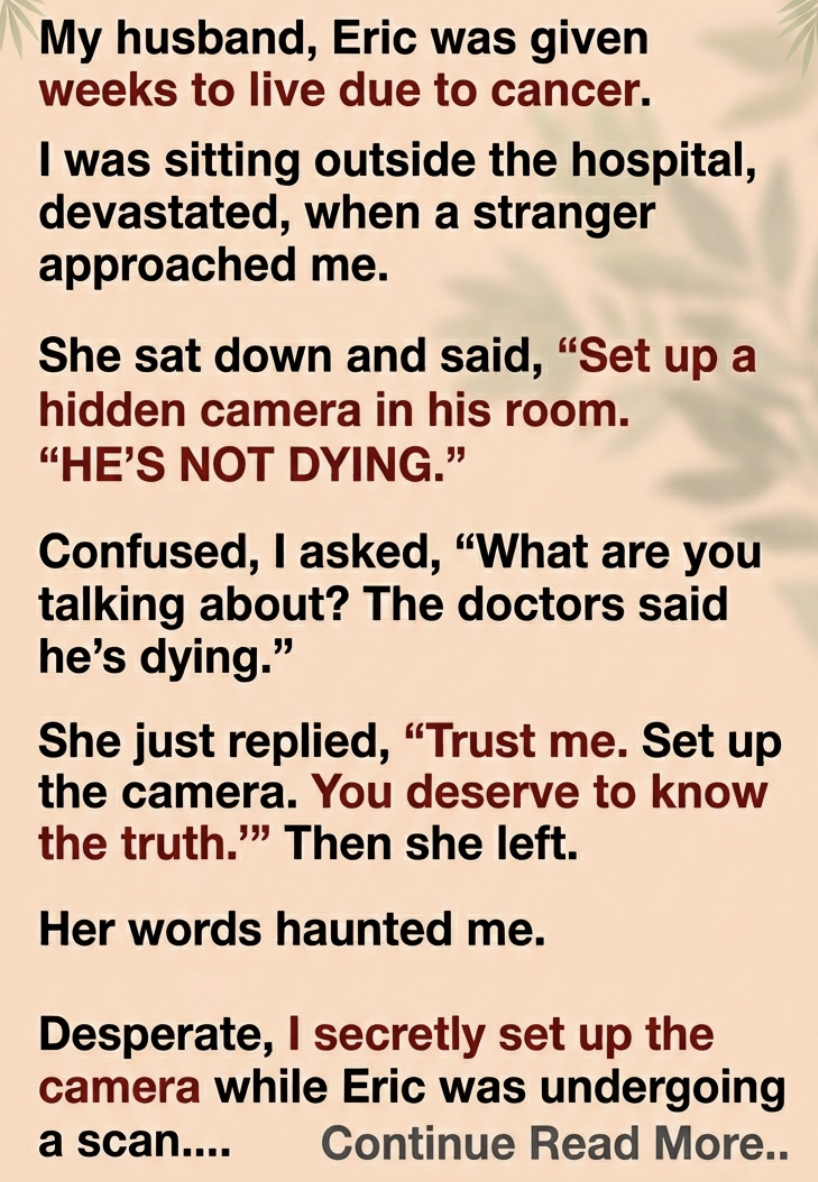
My husband, Eric, was given only weeks to live.
Cancer.
Aggressive.
Terminal.
At least that’s what the doctors told us.
For months, I lived at the hospital.
I slept in waiting rooms.
Ate from vending machines.
Cried in bathroom stalls where nobody could hear me.
I watched the strongest man I’d ever known grow weaker every day.
Or so I thought.
One evening, after another devastating meeting with his medical team, I sat outside the hospital sobbing.
That’s when a stranger approached me.
She looked to be in her sixties.
Well dressed.
Calm.
Almost too calm.
Without asking permission, she sat beside me.
For several moments, she said nothing.
Then she looked directly at me and said:
“Set up a hidden camera in his room.”
I stared at her.
“What?”
“Your husband isn’t dying.”
My heart stopped.
“What are you talking about?”
“The doctors said he has terminal cancer.”
She shook her head.
“Trust me.”
I felt anger rising.
“You don’t know us.”
“No.”
“Then why would you say that?”
She stood up.
Then delivered one final sentence.
“Because you deserve to know the truth.”
And just like that, she walked away.
I never saw her again.
But her words wouldn’t leave me alone.
For days, they echoed in my head.
Finally, curiosity overcame guilt.
While Eric was away for a scan, I placed a tiny camera inside a decorative tissue box.
I hated myself for doing it.
But I needed peace of mind.
That night, after returning home, I watched the footage.
At first, nothing happened.
Eric lay in bed.
Watched television.
Talked to nurses.
Normal.
Then around midnight, everything changed.
The door opened.
A woman entered.
Not a nurse.
Not a doctor.
A woman I’d never seen before.
She walked directly to Eric’s bed.
And kissed him.
My stomach dropped.
I watched in horror.
Eric sat up immediately.
Not weak.
Not exhausted.
Not dying.
He moved with more energy than I’d seen in months.
Then they started talking.
Laughing.
Planning.
For nearly forty minutes.
Every word felt like a knife.
The cancer was real.
But not terminal.
According to their conversation, Eric had exaggerated his diagnosis.
Convincing everyone—including me—that he was dying.
Why?
Money.
Sympathy.
And something even worse.
The woman was his girlfriend.
They’d been having an affair for over a year.
Together they were planning what would happen after his “death.”
Insurance payouts.
Retirement accounts.
Assets.
Even discussing how long they should wait before publicly revealing their relationship.
I couldn’t breathe.
The man I had spent months caring for.
The man I’d cried for every day.
The man I thought I was losing.
Was using my grief as part of a lie.
I watched until dawn.
Then I contacted a lawyer.
The next week became a blur.
Financial investigations.
Medical record requests.
Private consultations.
The truth emerged quickly.
Eric had manipulated information from his diagnosis.
His condition was serious.
But highly treatable.
He was never given weeks to live.
Never.
When confronted, he denied everything.
Until I showed him the footage.
Then he simply sat there.
Silent.
Caught.
The divorce was finalized less than a year later.
I kept wondering about the stranger.
Who was she?
How did she know?
Months afterward, I finally got my answer.
A former hospital employee contacted me.
The stranger had once been married to the same doctor who treated Eric.
Years earlier, she’d discovered another patient running a similar scam against his family.
Something about Eric’s behavior had reminded her of it.
She wasn’t certain.
Just suspicious.
Suspicious enough to warn me.
Today, whenever people hear my story, they ask what hurt the most.
The affair.
The lies.
The betrayal.
But honestly?
None of those.
The worst part was grieving someone who wasn’t actually gone.
I mourned a man who still existed.
A version of him I believed in.
A version that turned out to be fiction.
And that’s a different kind of loss.
Because sometimes the hardest funeral isn’t for a person.
It’s for the truth you thought you knew.