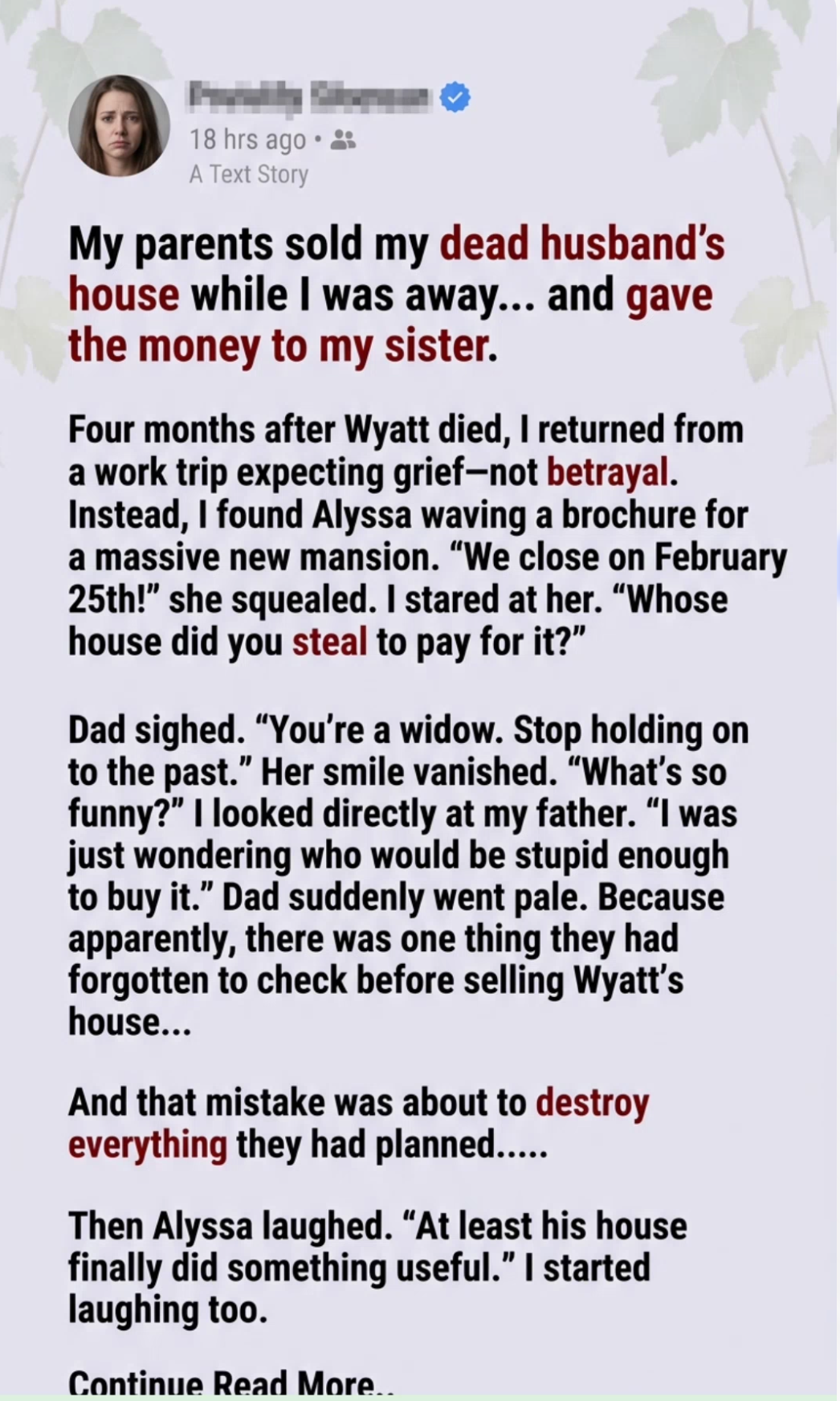
Four months after my husband Wyatt died, I returned from a work trip expecting to find the house quiet, the way it had been since his funeral.
Instead, I found my younger sister, Alyssa, standing in our parents’ living room with a glossy brochure for a mansion spread across the coffee table.
She was smiling so widely that I almost thought she had won a prize.
“We close on February twenty-fifth!” she announced.
I looked at the brochure.
The house had six bedrooms, a swimming pool, a three-car garage, and a kitchen larger than the apartment I had lived in before marrying Wyatt.
“That’s wonderful,” I said slowly. “How are you paying for it?”
Alyssa glanced at our father.
Dad sighed, as if I had asked an inconvenient question.
“We took care of everything.”
I turned toward him.
“What does that mean?”
Mom walked into the room carrying a tray of coffee.
“Your sister finally has a chance to have the life she deserves,” she said. “We didn’t want her to lose the opportunity.”
I looked at Alyssa again.
Then I noticed the address printed on the brochure.
It was a property in the same neighborhood where Wyatt and I had once dreamed of buying a larger home.
I felt something strange in my stomach.
“Where did the money come from?”
Alyssa waved the brochure.
“From the house.”
I stared at her.
“What house?”
She gave me a look that made me feel as though I were being deliberately difficult.
“Wyatt’s house.”
For several seconds, I could not speak.
Then I slowly set my suitcase down.
“You sold Wyatt’s house?”
Dad rubbed his forehead.
“Don’t start, Emily.”
I looked directly at him.
“Whose house did you steal to pay for her mansion?”
Alyssa’s smile vanished.
Mom gasped.
Dad’s expression hardened.
“Your husband is gone,” he said. “You’re a widow. Stop holding on to the past.”
I looked at him.
Then I began to laugh.
Not because anything was funny.
Because I suddenly understood that my parents had done something so reckless that they had no idea what was waiting for them.
Alyssa folded her arms.
“What’s so funny?”
I looked directly at my father.
“I was just wondering who would be stupid enough to buy it.”
Dad suddenly went pale.
Because there was one thing they had forgotten to check before selling Wyatt’s house.
And that mistake was about to destroy everything they had planned.
Four months earlier, Wyatt had died after a sudden medical emergency.
He was forty-two.
We had been married for eleven years, and although we had never been wealthy, we had built a comfortable life together.
Our house was a modest two-story home on a quiet street. It had a small backyard, a detached garage, and a kitchen where Wyatt insisted on making breakfast every Sunday.
He loved that house.
He had spent years repairing it himself.
He replaced the old windows, rebuilt the porch, planted a row of maple trees along the driveway, and installed shelves in the garage for tools he rarely used.
When he finished a project, he would stand back and say, “There. Now this place will last another fifty years.”
The house was not just a building to us.
It was the place where we had celebrated our wedding anniversary, brought home our rescue dog, and watched our nieces and nephews grow.
It was the place where Wyatt had held my hand during the last difficult weeks of his life.
After his death, I could not bear to sleep there alone.
My parents offered to let me stay with them while I traveled for work and handled the paperwork.
They told me I could take as much time as I needed.
I trusted them.
I had always trusted them.
My father, Richard, was a practical man who had spent most of his life working in construction management. My mother, Diane, was the kind of woman who remembered everyone’s birthday and believed family should always help one another.
Alyssa was the youngest.
She had always been the favorite, although my parents denied it whenever I mentioned it.
She had a talent for turning every difficulty into an emergency that someone else needed to solve.
When she wanted a new car, Dad helped.
When she lost her job, Mom paid her rent.
When she decided to start a boutique, our parents gave her money for inventory.
When the boutique failed, they told her she had simply been unlucky.
I had never resented helping my sister.
But I had learned that helping Alyssa often meant sacrificing something I had worked hard to earn.
Wyatt understood that.
He never criticized my family, but he always encouraged me to establish boundaries.
“Love them,” he used to say. “Just don’t let them make every decision for you.”
The house had been one of those decisions.
Wyatt and I had purchased it together after years of saving.
We had a mortgage, but we were close to paying it off.
When Wyatt became ill, he insisted that we review our estate documents.
He had watched a friend lose his home after a complicated family dispute, and he wanted to make sure I would never face that kind of uncertainty.
We met with an estate attorney named Margaret Ellis.
She explained several ways to protect the property and make the transfer easier if one of us died.
Wyatt chose to establish a revocable living trust.
The house was transferred into the trust, and the documents named Wyatt and me as co-trustees while we were both alive.
The trust also named me as the successor trustee and sole beneficiary of the house after Wyatt’s death.
Margaret explained that this arrangement would allow me to manage the property without waiting for the entire estate to pass through probate.
Wyatt signed the documents.
I signed them too.
The deed was recorded with the county.
We kept copies in a locked file cabinet in the home office.
Wyatt even made a list of where everything was.
He was not a man who liked paperwork, but he understood that the paperwork mattered.
When he died, Margaret helped me complete the required steps.
The trust became irrevocable upon Wyatt’s death, and I became the person responsible for administering it.
The house remained in the trust until I decided what to do with it.
I had not decided.
I had barely been able to enter the bedroom without crying.
So when my parents offered to help while I traveled for work, I accepted.
I gave them a key.
I asked them to check the mail and make sure the pipes were safe.
I never gave them permission to sell the house.
I never gave them authority to manage the trust.
I never signed a power of attorney.
I never told them they could use Wyatt’s property to finance Alyssa’s dream.
But apparently, they had decided that my grief made me incapable of protecting what belonged to me.
The day after I discovered the sale, I went straight to Wyatt’s house.
The front door was locked.
I tried my key.
It did not work.
I looked through the window.
The living room was empty.
The furniture was gone.
The photographs had been removed from the walls.
Even the small wooden table Wyatt had built for our anniversary was missing.
I stood on the porch, unable to breathe.
A neighbor named Susan came out of her house.
She had lived beside us for nearly eight years.
“Emily?” she called.
I turned.
“Do you know what’s happening?”
Susan looked uncomfortable.
“I thought you knew.”
“Knew what?”
She walked toward me.
“Your parents came here a few weeks ago with someone from a real estate office. They said they were handling the sale because you wanted to move.”
I felt my hands begin to shake.
“Did I sign anything?”
Susan shook her head.
“I never saw you.”
I looked at the empty house.
“Did they say who bought it?”
“A young couple. They seemed very excited.”
I thanked her and called Margaret Ellis.
When I explained what had happened, she became very quiet.
Then she asked me to send her the address and the trust documents.
I emailed everything from my phone.
Within an hour, she called back.
“Emily, the trust is still the legal owner of the property.”
I closed my eyes.
“So my parents couldn’t sell it?”
“Not without authority from the trustee. And you are the successor trustee.”
I swallowed.
“What do we do?”
“First, we obtain the recorded deed and the closing documents. Then we notify the title company and the buyer that the sale may have been unauthorized.”
I asked whether the house could be taken from me.
Margaret answered carefully.
“That depends on the documents, the applicable law, and whether the buyer qualifies for any protections. But your parents cannot simply transfer trust property because they have a key.”
I looked at the empty porch.
“Then why did the sale go through?”
“That’s what we need to find out.”
The next morning, Margaret obtained a copy of the deed recorded after the sale.
The document listed my father as the seller.
He had signed as trustee of Wyatt’s trust.
But he was not the trustee.
The signature line included a statement that he had been acting under a power of attorney granted by me.
I stared at the page.
I had never signed such a document.
Margaret asked me to check every file I had received from my parents.
I found an envelope in my suitcase.
Inside was a copy of a document titled “Limited Property Authorization.”
It carried my name.
The signature looked like mine.
But I had never seen it before.
I remembered the week after Wyatt’s funeral.
My mother had brought me a stack of forms and told me they were insurance documents.
She said I needed to sign them so she could help organize the estate.
I had been exhausted.
I had barely slept.
I remembered signing several pages at the kitchen table.
But I did not remember signing a power of attorney.
Margaret examined the document.
“This is not the authorization we need to see,” she said. “We need the original, and we need to determine whether it was properly executed.”
I felt sick.
“Could they have used one of those pages?”
“Possibly. But we won’t speculate. We’ll request the original and have the signature examined if necessary.”
The following day, Margaret sent a formal notice to the title company.
The company responded that the sale had been completed based on the documents submitted by the seller.
The buyer had received a deed.
The purchase money had been deposited into an account controlled by my father.
And the title company had issued a policy based on the information it had been given.
The situation was complicated.
The buyers were not necessarily dishonest.
They had paid for a house and believed they were purchasing it properly.
I did not want to punish an innocent couple for my parents’ actions.
But I also could not simply surrender Wyatt’s home.
Margaret arranged a meeting with the title company’s legal department.
I attended with her.
The company’s representative, a man named David, reviewed the trust documents and the recorded deed.
He looked increasingly concerned.
“Your father represented that he had authority to act for the trust,” he said.
“He didn’t,” I replied.
David nodded.
“We need to investigate the authorization he provided.”
Margaret placed the trust certificate on the table.
“This document identifies Emily as the successor trustee. It was recorded before the sale.”
David examined it.
Then he asked whether my father had been informed of the trust.
I told him that Wyatt had explained the arrangement to my parents years earlier.
They knew the house was protected.
They knew I was supposed to receive it.
They knew the trust existed.
David closed the file.
“We will notify the buyer and suspend any further action until the legal review is complete.”
I asked whether the buyers could lose their home.
He replied that the company would work with the parties to determine the appropriate remedy.
I left the meeting feeling exhausted.
I had wanted to protect Wyatt’s home.
Now I was caught in a dispute involving a young couple who had done nothing wrong, a title company, and my own parents.
That evening, I returned to my parents’ house.
Alyssa was sitting on the couch, scrolling through photographs of the mansion.
She looked up.
“Are you still upset?”
I stared at her.
“You knew the house wasn’t yours.”
She rolled her eyes.
“Mom and Dad handled everything.”
“They didn’t own it.”
“Dad said he had permission.”
“From whom?”
She shrugged.
“From you.”
I stepped closer.
“I never gave him permission.”
Alyssa looked annoyed.
“Emily, you were going to sell it anyway.”
“No, I wasn’t.”
She sighed.
“You can’t live in that house forever.”
I felt a wave of anger rise inside me.
“That’s not your decision.”
She put her phone down.
“Why are you making this so difficult? The house was just sitting there.”
I stared at her.
“Wyatt died four months ago.”
She looked away.
Then she said the words that broke something inside me.
“At least his house finally did something useful.”
I began laughing again.
Alyssa frowned.
“What’s so funny?”
I looked at her.
“Nothing. I’m just wondering how you’re going to explain the money when the title company asks for it back.”
Her face changed.
She looked toward the hallway.
Dad appeared a moment later.
“That’s enough,” he said.
I turned toward him.
“Did you forge my signature?”
His expression hardened.
“Don’t use that word.”
“Did you sign my name?”
“I was helping you.”
“You sold a house that belonged to Wyatt’s trust.”
“You were grieving.”
I stared at him.
“So you decided to take advantage of that?”
Dad shook his head.
“We thought it was the best thing for everyone.”
“For everyone except me.”
Mom began crying.
“Emily, please. We didn’t want you to be alone with that house.”
I looked at her.
“You could have asked me.”
She wiped her eyes.
“We knew you would say no.”
That was the moment I understood.
They had not made a mistake because they misunderstood the documents.
They had made a decision because they knew I would refuse.
Alyssa stood up.
“I’m not giving up the mansion.”
I looked at her.
“You may not have a choice.”
Dad pointed toward the door.
“Get out.”
I picked up my purse.
“I will.”
I walked out without saying another word.
The legal process took several months.
The title company investigated the authorization.
A forensic document examiner compared the signature on the power of attorney with my known signatures.
The preliminary report found several inconsistencies.
The examiner noted that the signature appeared to have been copied or traced rather than naturally written.
The original document was eventually produced.
It had been created from a page I had signed during the week after Wyatt’s funeral.
The page had originally been part of an unrelated insurance form.
Someone had removed my signature and placed it onto the authorization.
The document had then been used to claim that my father had permission to act on behalf of the trust.
Margaret explained that the evidence could support a claim of fraud and unauthorized transfer.
The title company began working with the buyer and their attorney.
The buyers, a couple named Daniel and Rachel, had already moved into the house.
They had paid a substantial deposit and taken out a mortgage.
When they learned that the sale was disputed, they were devastated.
Rachel called me.
“I am so sorry,” she said. “We had no idea.”
I believed her.
I told her that I understood.
I did not want them to lose their savings because my parents had lied.
Margaret and the title company’s attorneys eventually negotiated a solution.
The sale would be unwound through a legal process.
The title company would address the buyer’s financial losses according to its obligations and the settlement.
The house would be returned to the trust.
The buyers would receive compensation for the expenses and losses covered by the agreement, and they would be given time to find another home.
It was not a perfect outcome.
But it was fairer than forcing them to fight my parents alone.
The title company also pursued recovery of the money from the account into which the sale proceeds had been deposited.
My father had already transferred much of it to Alyssa.
Some had gone toward the mansion’s deposit.
Some had paid off her debts.
Some had been used for furniture and renovations.
The money was no longer sitting in one account waiting to be returned.
Alyssa’s dream house became the center of a second dispute.
The seller of the mansion had not known about the fraud.
Alyssa had signed a purchase agreement and paid the deposit using funds she believed were legitimately provided by our parents.
When the source of the money came under investigation, the transaction was placed on hold.
She could not complete the purchase without financing the balance herself.
She did not have the income or savings to do that.
The mansion was sold to another buyer.
Alyssa lost the deposit she had already spent on certain nonrefundable costs.
She called me in tears.
“You ruined everything.”
I listened quietly.
“No, Alyssa. I didn’t sell Wyatt’s house.”
“You could have let it go.”
“I could have let you keep money that wasn’t yours.”
She began crying harder.
“Mom and Dad said you would understand.”
I felt a sadness I could not explain.
“I would have understood if you had asked.”
She hung up.
The investigation into my father’s actions continued.
He eventually admitted that he had arranged the sale and used the authorization document to make it appear that he had permission.
He claimed that he believed I would eventually agree.
But the evidence showed that he had proceeded without asking me.
The authorities reviewed the matter, and the family dispute became a legal one.
My parents were required to repay the funds they had received or transferred, subject to the settlement and court orders.
The consequences were serious.
They had to sell investments and refinance their own home to address the financial obligations.
Alyssa was required to return what she still had.
The money that had already been spent became part of the recovery process.
I did not celebrate.
I had never wanted my parents to lose their home.
I had never wanted my sister to lose her dream.
I had simply wanted them to respect the fact that Wyatt’s house belonged to me through the trust he had carefully created.
When the legal process finally ended, I returned to the house.
The front door had been repaired.
The locks were changed.
The furniture had been returned through the settlement, although some of Wyatt’s personal belongings had been lost or damaged.
I stood in the living room.
The walls looked bare.
The house smelled different.
But it was still our home.
I walked into the kitchen and touched the wooden table Wyatt had built.
For a moment, I could almost hear him laughing as he told me that the place would last another fifty years.
I sat down.
And I cried.
Not because I had won a legal dispute.
Not because my parents had been held responsible.
I cried because Wyatt had tried to protect me, and even after he was gone, his careful planning had given me a way to stand up for myself.
The trust had not prevented my family from trying to take the house.
But it had made the truth clear.
The property had never belonged to my parents.
They had never been entitled to sell it.
And they had never been entitled to decide what I should do with it.
A few weeks later, my mother sent me a letter.
She wrote that she was sorry.
She said she had convinced herself that helping Alyssa was more important than asking me what I wanted.
She admitted that she had confused family loyalty with the right to make decisions for someone else.
I read the letter twice.
I did not answer immediately.
Forgiveness was not something I could offer simply because someone had finally apologized.
My father sent a separate message.
He said he regretted the consequences but still believed he had been trying to help.
I did not respond.
Alyssa eventually contacted me too.
She apologized for what she had said about Wyatt’s house.
She admitted that she had known the sale was happening before I returned from my trip.
She said she had wanted the mansion so badly that she had ignored the questions she should have asked.
I accepted her apology.
But I did not give her access to the house.
I did not give my parents another key.
And I did not allow anyone to handle my legal or financial documents without my direct involvement.
The house remained mine through the trust.
I repaired the porch.
I planted new flowers beside the walkway.
I kept Wyatt’s tools in the garage.
And every evening, I sat on the back steps and watched the maple trees move in the wind.
Sometimes I still thought about the brochure Alyssa had waved in my face.
The mansion.
The closing date.
The money they believed they had taken from a widow who would never fight back.
I remembered my father’s pale face when I asked who would be stupid enough to buy the house.
He had forgotten to check the trust.
He had forgotten that the deed had been recorded.
He had forgotten that I was the successor trustee.
And he had forgotten that grief did not make me powerless.
The house was never just a property to be sold.
It was the life Wyatt and I had built together.
And no matter how much money my parents thought it could provide, they had never been the ones who owned it.
The End