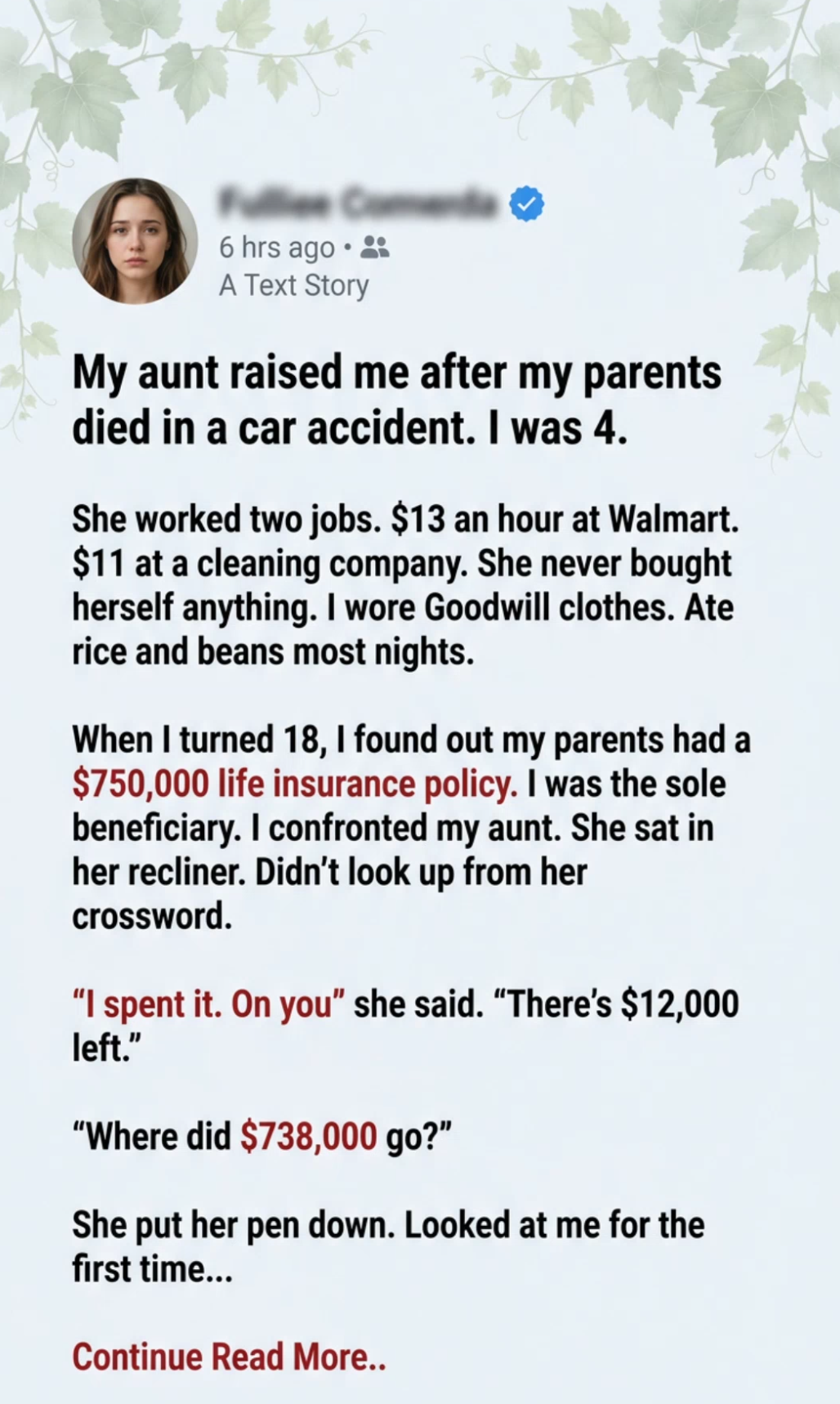
My aunt raised me after my parents died in a car accident. I was four years old. She worked two jobs—$13 an hour at Walmart and $11 at a cleaning company. She never bought herself anything. I wore Goodwill clothes. Ate rice and beans most nights. When I turned eighteen, I discovered my parents had a $750,000 life insurance policy. I was the sole beneficiary. I confronted my aunt. She sat in her recliner, barely looking up from her crossword. “I spent it. On you,” she said. “There’s $12,000 left.” “Where did $738,000 go?” She put her pen down and looked at me for the first time in years. “Before you decide what kind of person I am,” she whispered, “you need to know what your parents asked me to do.”
My name is Hannah, and for most of my childhood, I believed my aunt was the strongest woman in the world.
Her name was Margaret.
She was my mother’s younger sister, and when my parents died, she was only twenty-six years old.
She had no husband, no children, and no savings worth mentioning.
She had a small apartment, an old car that sometimes refused to start, and a job at a grocery store.
Then one rainy afternoon, a police officer knocked on her door.
I was four years old.
I remember the officer’s uniform. I remember my aunt’s hand covering her mouth. I remember her sitting on the floor afterward, holding me so tightly that I could barely breathe.
My parents had been driving home from visiting my grandparents when a truck crossed the center line.
They never made it home.
My aunt became my guardian before the funeral flowers had wilted.
She took me into her apartment and gave me the bedroom she had been using.
She slept on the couch.
At first, I thought it was temporary.
I thought my parents would come back.
Every night, I asked when they were coming to get me.
Every night, my aunt told me the truth as gently as she could.
“They can’t come back, sweetheart.”
I didn’t understand.
I only knew that the people I loved were gone, and the woman who remained was trying desperately not to disappear beneath the weight of it.
Margaret worked at Walmart from six in the morning until two in the afternoon.
Then she drove across town to a cleaning company, where she worked until nearly midnight.
Sometimes she came home smelling of bleach and floor polish.
Sometimes she fell asleep sitting upright, still wearing her work shoes.
I learned to make rice before I learned to ride a bicycle.
I learned how to heat canned beans.
I learned not to ask for things unless I truly needed them.
When other children wore new sneakers, I wore shoes from Goodwill.
When they brought expensive lunches to school, I carried a plastic container of rice and beans.
I never thought much about it.
My aunt always made sure I had enough to eat.
She never complained about being tired.
She never told me I was a burden.
When I had nightmares, she came to my bed and held me until I fell asleep.
When I got sick, she called in to work and stayed beside me.
When I failed a math test, she sat at the kitchen table with me, even though she had been on her feet for sixteen hours.
She was not a perfect parent.
She was strict.
She worried about every dollar.
She sometimes snapped when I left the lights on or forgot to close the refrigerator.
But she loved me.
At least, that was what I believed.
As I grew older, I noticed that she never bought herself anything.
Her winter coat had a broken zipper.
Her glasses were held together with a tiny piece of tape.
She cut her own hair in the bathroom.
She drank coffee from a chipped mug and wore the same three dresses to church.
Whenever I asked why she never bought new clothes, she said, “Because the old ones still work.”
Whenever I asked why we never went on vacation, she said, “We have everything we need right here.”
I believed her.
I believed everything she told me.
Until my eighteenth birthday.
That morning, my aunt made pancakes.
It was unusual.
We usually had oatmeal or toast, but she had bought a small bottle of syrup and a package of strawberries.
She placed a gift beside my plate.
Inside was a simple silver necklace.
It was not expensive, but I knew she had saved for it.
I hugged her.
“Thank you, Aunt Margaret.”
She smiled.
“You’re eighteen now. You’re going to have a big life.”
I laughed.
“I hope so.”
After breakfast, I went to the bank with her to open a checking account.
I had received a small scholarship for community college, and my aunt wanted me to learn how to manage my own money.
While we waited, the bank employee asked whether I had any other accounts or assets.
I shook my head.
“Just this one.”
My aunt looked down at her purse.
The employee glanced at the screen.
“Are you aware that you may have a beneficiary account connected to your parents’ estate?”
I frowned.
“What?”
She turned the monitor slightly.
There was a record of a life insurance policy.
My parents had purchased it several years before the accident.
The amount was $750,000.
I was listed as the sole beneficiary.
I stared at the screen.
“Is that real?”
The employee nodded.
“It appears the policy was paid out after your parents’ deaths. The funds were placed into an account managed by your legal guardian.”
I looked at my aunt.
She did not look surprised.
That was the moment everything changed.
On the drive home, I barely spoke.
My aunt kept both hands on the steering wheel.
Finally, I asked, “Did you know about the insurance?”
She swallowed.
“Yes.”
“How much was it?”
“Seven hundred and fifty thousand.”
I stared at her.
“And you never told me?”
She pulled into the parking lot outside our apartment.
She turned off the engine.
“I was going to explain when you were older.”
“I’m eighteen.”
“I know.”
“Where is it?”
She looked at the dashboard.
“I spent it.”
The words felt like a slap.
“On what?”
“On you.”
I laughed, but it was not a happy sound.
“On me?”
She nodded.
“There’s twelve thousand left.”
My chest tightened.
“Where did $738,000 go?”
She put her pen down.
Then she looked at me for the first time in years.
Her eyes were tired.
Not just from work.
From something deeper.
“Before you decide what kind of person I am,” she said, “you need to know what your parents asked me to do.”
I crossed my arms.
“Then tell me.”
She took a long breath.
“Your parents knew they were underinsured.”
I frowned.
“They had $750,000.”
“They had a mortgage. Your father had a small business. Your mother had medical bills from before the accident. They were trying to protect you.”
She reached into her purse and pulled out a folded envelope.
“I kept this.”
Inside was a letter.
It was written by my mother.
The handwriting was familiar.
I had seen it on birthday cards and school notes.
My hands began to shake.
Margaret,
If something happens to us, please take care of Hannah.
We know this is a lot to ask. We know you have your own life. But you are the person we trust most in the world.
The insurance money is for her future.
We want her to have a safe home, a good education, and the chance to become whatever she wants to be.
Please don’t let her grow up feeling that she has to pay for our absence.
We love you.
And we love our little girl.
Mom and Dad.
I read it twice.
Then I looked at my aunt.
“You had the money.”
“Yes.”
“You could have bought a house.”
“Yes.”
“You could have saved it.”
“Yes.”
“You could have told me.”
She nodded.
“I should have.”
I felt tears burning behind my eyes.
“Then why didn’t you?”
She looked toward the apartment building.
“Because I was afraid.”
“Of what?”
“Of losing you.”
I stared at her.
She continued.
“When your parents died, I was twenty-six. I didn’t know how to raise a child. I didn’t know how to pay for everything. I thought I would make a terrible guardian.”
She wiped her face.
“Then I saw the insurance papers. I thought the money would make everything easier.”
She paused.
“But it didn’t.”
The first expense had been the funeral.
My parents had not left enough in their checking account to cover it.
The insurance company took several months to process the claim.
During that time, my aunt borrowed money from a coworker and used a credit card to pay for the burial.
When the payout finally arrived, she paid off the debt.
Then she paid the mortgage on the house my parents had left behind.
The house had been damaged in the accident’s aftermath and needed repairs before it could be sold.
My aunt had hired contractors, replaced the roof, repaired the plumbing, and paid the property taxes.
The house eventually sold.
But the proceeds were less than expected because of the mortgage and repairs.
She used part of the insurance money to cover the remaining expenses.
Then she made a decision.
She would not put me into foster care.
She would not send me to a distant relative.
She would raise me herself.
The money began to disappear in ordinary ways.
Rent.
Food.
School supplies.
Medical appointments.
Clothes.
Childcare while she worked.
The cost of raising a child alone.
And there were things I had never known.
When I was seven, I needed surgery to remove my tonsils.
My aunt had taken unpaid leave because the hospital required a guardian to stay with me.
When I was nine, I broke my arm falling from a playground.
She paid for the ambulance bill and the follow-up appointments.
When I was eleven, the apartment building had a plumbing problem that forced us to move for three months.
She paid the deposit on another apartment and the moving expenses.
When I was thirteen, I needed braces.
She had been told they were optional, but my dentist explained that my bite could cause serious problems later.
She paid for them.
When I was sixteen, I received a scholarship to a summer academic program.
The scholarship covered tuition but not travel or housing.
My aunt paid for those, too.
She had never told me any of it.
I sat in the car, staring at the letter.
“You could have shown me.”
“I know.”
“You could have told me we were struggling because of the money.”
She shook her head.
“I didn’t want you to feel guilty.”
I looked at her.
“But I did feel guilty.”
She turned toward me.
“What?”
“I felt guilty every time I asked for something.”
My voice broke.
“I thought we were poor because I was expensive.”
My aunt covered her mouth.
“Oh, Hannah.”
I continued.
“I thought you had to work two jobs because I was there.”
She began to cry.
“No. No, sweetheart.”
She reached for my hand.
“You were never the reason I was tired.”
I pulled away.
“I don’t know what to believe.”
She nodded slowly.
“I understand.”
For the next several days, I barely spoke to her.
I went to school.
I attended my classes.
I answered her questions with short sentences.
She did not argue.
She left meals on the table.
She continued going to work.
I felt betrayed.
Even if the money had been spent on me, it was still my inheritance.
I had been the beneficiary.
I had never been told.
I had grown up believing that every sacrifice my aunt made was because she had no choice.
Now I knew she had chosen to spend the money.
And I did not know how to feel about that.
One evening, I came home and found her sitting at the kitchen table.
Beside her was a folder.
She looked up.
“I called the attorney.”
I stopped.
“What attorney?”
“The one who handled your parents’ estate.”
She opened the folder.
Inside were bank statements, receipts, and records from the insurance account.
“I want you to see everything,” she said.
I sat down.
The records were detailed.
Every withdrawal.
Every payment.
Every transfer.
There were no mysterious cash withdrawals.
No expensive vacations.
No jewelry.
No new car.
No house purchased in her name.
The money had gone into bills, repairs, school costs, medical expenses, and living expenses.
Some of it had been invested in a small savings account.
That account had earned interest, but the balance had gradually declined as expenses increased.
The remaining $12,000 was still there.
I looked at the last page.
There was a note from the attorney.
The account had been managed by my aunt as guardian.
The money had been used for my care and benefit.
But there was something else.
The attorney had also discovered that my aunt had been paying some expenses from her own wages.
The insurance money had not covered everything.
She had contributed thousands of dollars of her own earnings over the years.
I stared at the records.
“Why?”
My aunt looked confused.
“Why what?”
“Why did you spend your own money, too?”
She smiled sadly.
“Because you needed things.”
I shook my head.
“You could have stopped.”
She looked at me for a long time.
“Your parents didn’t leave you a life insurance policy so you could sit in an apartment wondering whether you were worth feeding.”
I began to cry.
She reached across the table.
“I know I should have told you. I know I should have explained it as you grew up.”
I wiped my face.
“But you didn’t.”
“No.”
“Why?”
She looked down.
“Because every time I thought about telling you, I remembered your mother’s letter.”
She tapped the paper.
“She wanted you to have a childhood. Not a financial report.”
I looked at her.
“I could have understood.”
“Maybe.”
She sighed.
“But I was afraid you would feel that your parents had left you a fortune and I had taken it away.”
I could not deny that.
That was exactly what I had felt.
She continued.
“I thought if I worked hard enough, you would never have to know how much it cost.”
I stared at her.
“That’s why you never bought anything?”
She smiled faintly.
“I bought things.”
“What things?”
“Your school shoes. Your birthday cake. Your books. Your medicine.”
I laughed through my tears.
She laughed, too.
Then she said something that made me stop.
“I bought the things that mattered to me.”
I looked at her.
“What about the $12,000?”
She pushed the folder toward me.
“It’s yours.”
I shook my head.
“No.”
She looked surprised.
“I want you to keep it.”
“Hannah—”
“I want you to have it.”
She began to protest.
I stopped her.
“You spent eighteen years raising me. You worked two jobs. You gave up your own life.”
She shook her head.
“I didn’t give up my life.”
“You gave up a lot.”
She looked at me.
I took her hand.
“I don’t want the money to be the only thing I remember about my parents.”
She began to cry again.
I continued.
“I want to remember that they chose you because they trusted you.”
She squeezed my hand.
“I did my best.”
“I know.”
That night, we sat together in the living room.
For the first time, my aunt told me stories about my parents that I had never heard.
My father used to sing badly while cooking.
My mother loved old movies and cried at the endings.
They had argued about whether I should learn piano or guitar.
They had planned to take me to the ocean when I turned five.
My aunt had kept photographs.
She brought them out one by one.
I looked at my parents’ faces.
I realized that I had spent years thinking about what they had left me.
But they had left me something more important than money.
They had left me a person who loved me enough to work herself nearly to exhaustion.
And that person had never asked me to repay her.
The next morning, I called the attorney.
I asked him to review the remaining account and confirm that everything had been handled properly.
He did.
The records were complete.
The money had been used for my care.
There was no evidence of theft or personal misuse.
I was relieved.
But I still felt something was missing.
I wanted to do something for my aunt.
I wanted to give her a life that did not revolve around working until midnight.
I wanted her to have a home where she could sit in a comfortable chair without worrying about rent.
I wanted her to buy a coat without checking the price.
I wanted her to travel somewhere beautiful.
But I was eighteen.
I had a scholarship, a part-time job, and twelve thousand dollars that I had decided not to take.
I could not change everything overnight.
So I made a promise.
I would finish college.
I would build a career.
And when I was able, I would give my aunt the kind of rest she had never allowed herself.
She did not know about the promise.
I kept it to myself.
Years passed.
I graduated from college.
I found a job in accounting.
I moved into a small apartment.
My aunt still worked at Walmart, though she had left the cleaning company.
I tried to convince her to retire.
She refused.
“I need something to do,” she said.
I told her she could volunteer.
She told me volunteering did not pay the electric bill.
We argued.
Then we laughed.
Eventually, I bought her a new coat.
She complained that it was too expensive.
I told her I had checked the price twice.
She wore it every winter.
When I was twenty-six, I bought a small house.
It had two bedrooms, a modest kitchen, and a backyard with a maple tree.
I invited my aunt to move in.
She stood in the doorway for a long time.
“Are you sure?”
I nodded.
“You raised me. I want you close.”
She looked at the house.
Then she looked at me.
“I don’t want to be a burden.”
I smiled.
“You taught me that family isn’t a burden.”
She began to cry.
And for the first time, I saw her accept something without trying to pay it back.
I gave her the larger bedroom.
She complained.
I insisted.
We furnished the house slowly.
I bought a comfortable recliner for the living room.
She placed her old crossword books beside it.
One evening, I came home and found her sitting in the chair, wearing her new coat even though she was indoors.
She was smiling at a photograph.
It was my parents.
I sat beside her.
“Do you miss them?”
She nodded.
“Every day.”
I leaned against her shoulder.
“Me too.”
She kissed the top of my head.
“I think they would be proud of you.”
I looked at the photograph.
“I think they would be proud of you, too.”
For a long time, we sat quietly.
The insurance money had been gone for years.
But the love it had helped provide was still there.
And the woman who had spent it had never once asked me to call her a hero.
She had simply been my aunt.
My guardian.
My family.
The person who stayed.
The End