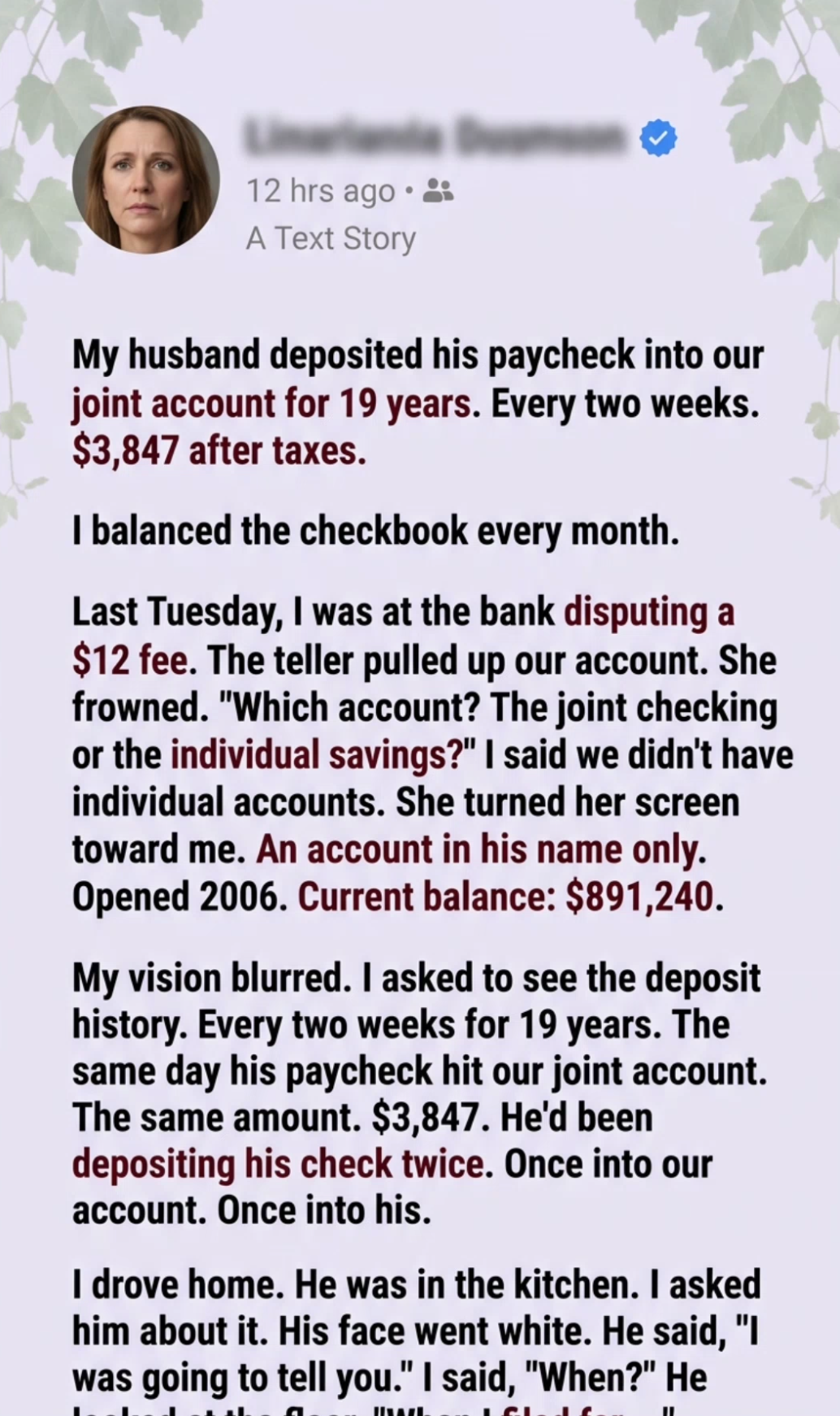
For nineteen years, I believed my husband and I had built our financial life together.
Every other Friday, his paycheck arrived.
After taxes, it was always around $3,847.
He deposited it into our joint checking account, and I paid the mortgage, utilities, groceries, insurance, and everything else that kept our household running.
I balanced the checkbook every month.
I knew how much we spent on electricity in winter. I knew when the car insurance was due. I knew how many dollars we had left after the mortgage payment.
I believed I knew our finances because I had managed them for nearly two decades.
Then, last Tuesday, a bank teller showed me an account I had never heard of.
I had gone to the bank to dispute a $12 fee.
It was a small charge, but I had always been careful about our money. I brought my statements, explained the situation, and waited while the teller reviewed the account.
Her name was Melissa.
She typed something into her computer, frowned, and asked, “Which account are you referring to?”
“The joint checking account.”
She glanced at the screen.
“And the individual savings account?”
I blinked.
“We don’t have individual savings accounts.”
Melissa paused.
Then she turned her monitor slightly toward me.
There was an account listed under my husband’s name.
It had been opened in 2006.
The balance was $891,240.
For several seconds, I couldn’t understand what I was looking at.
I thought perhaps it belonged to another person with the same name.
I leaned closer.
The account number matched the bank’s records for my husband.
The address was our home.
The phone number was his.
I felt my fingers begin to tremble.
“Could you please check the deposit history?”
Melissa hesitated.
“I’m not sure I’m authorized to show you the details of an individual account that isn’t yours.”
I understood.
She wasn’t being cruel.
She was following the rules.
I asked whether my husband could come in and authorize the disclosure.
Melissa explained that he would need to provide permission or that the information would have to be obtained through the appropriate legal process.
I left the bank with the $12 fee unresolved.
But I no longer cared about the fee.
I sat in my car for almost twenty minutes.
I thought about every Friday for nineteen years.
Every paycheck.
Every conversation about money.
Every time my husband, Michael, had told me we needed to be careful because we didn’t have much saved.
I remembered the years we postponed vacations.
The year we drove an old car because he said a new one would be irresponsible.
The times I bought discounted groceries and waited until the following month to replace my winter coat.
I remembered him saying, “We’re doing okay, but we have to keep watching every dollar.”
And now there was nearly nine hundred thousand dollars in an account I had never known existed.
I drove home.
Michael was in the kitchen, making coffee.
He looked up when I entered.
“Everything okay at the bank?”
I put my purse on the counter.
“Michael, do you have a savings account?”
His hand stopped above the coffee mug.
“What?”
“An individual savings account. In your name.”
He stared at me.
I watched the color drain from his face.
“Where did you hear that?”
I felt something break inside me.
“That’s your first question?”
He set the mug down.
“I was going to tell you.”
I looked at him.
“When?”
He lowered his eyes.
“When I filed for—”
He stopped.
The kitchen seemed to grow smaller.
“Filed for what?”
He rubbed his forehead.
“Claire, please sit down.”
I didn’t sit.
“Finish the sentence.”
He looked toward the window.
“When I filed for divorce.”
I stared at him.
For nineteen years, I had believed we were building a future together.
He had been preparing to leave me.
And he had been saving money for that day.
I asked him how long he had planned it.
He said he didn’t know.
I asked whether the account had been opened in 2006.
He nodded.
I asked whether he had been depositing money into it every two weeks.
He looked down.
“Yes.”
I felt sick.
“Was it the same amount as your paycheck?”
He nodded again.
“Every paycheck?”
“Yes.”
I stepped away from the counter.
“So you deposited your paycheck into our joint account, then deposited the same paycheck into your own account?”
He shook his head.
“Not exactly.”
I waited.
He explained that the bank had allowed him to arrange a separate transfer from his payroll account. The deposits were made through a combination of payroll arrangements and transfers that he had concealed from me.
The details didn’t matter as much as the truth.
He had been moving money into an account I didn’t know existed.
For nineteen years.
I asked him why.
He said he had wanted financial security.
I laughed bitterly.
“Financial security for whom?”
He didn’t answer.
I asked whether he had ever intended to share the money.
He said he had.
But he had never told me.
I asked whether he had used our joint account to pay the household bills while saving his own money.
He nodded.
I felt my face grow hot.
“Do you understand what that means?”
He looked at me.
“It means I was trying to protect myself.”
I shook my head.
“No. It means you were protecting yourself while letting me believe we were equally responsible for our future.”
He said he hadn’t meant to hurt me.
I told him that intentions didn’t erase nineteen years of secrecy.
Then I asked the question that had been haunting me since the bank.
“Were you planning to leave me?”
Michael sat down.
“I’ve been unhappy for a long time.”
I looked at him.
“Since when?”
He said he had felt distant from me for years.
He said we had become more like roommates than husband and wife.
He said he had wanted to leave but didn’t know how to start over financially.
I listened.
Some of what he said was painful because it was true.
We had grown distant.
We had stopped going on dates.
We had spent more time discussing bills than dreams.
But I had believed those problems were ours to solve together.
I had never imagined he was secretly preparing to solve them by himself.
I asked him whether he had already spoken to a lawyer.
He said yes.
I asked whether he had filed for divorce.
He hesitated.
Then he admitted that he had met with an attorney the previous week.
I stood there, staring at him.
The bank account wasn’t simply a secret savings account.
It was part of a plan.
I went upstairs and closed the bedroom door.
I didn’t cry immediately.
I sat on the edge of the bed and tried to remember when my marriage had become something I didn’t recognize.
At first, I thought about the money.
Nearly $900,000.
Then I thought about the nineteen years.
The money represented every decision we had made.
Every time I had sacrificed.
Every time I had believed we were building something together.
I called my sister, Laura.
She listened while I explained what had happened.
When I finished, she said, “You need to speak to a lawyer before you do anything.”
I knew she was right.
The next morning, I contacted an attorney named Rebecca Miller.
She specialized in family law and financial disclosure.
I told her about the account.
She asked me to bring every document I had.
I brought the joint account statements, the mortgage records, our tax returns, and the household budget I had maintained for years.
Rebecca reviewed everything carefully.
She explained that the legal treatment of the secret account would depend on the laws of our state, the source of the funds, and the circumstances under which they had been accumulated.
The account being in Michael’s name alone did not automatically mean the entire balance belonged exclusively to him.
Nor did the fact that we were married automatically mean every dollar would be divided equally.
We needed records.
We needed a proper accounting.
And we needed to understand exactly how the money had been deposited.
Rebecca advised me not to confront Michael further about the account until the financial disclosures were requested through the legal process.
I followed her advice.
For the next several weeks, I continued living in the house.
Michael slept in the guest room.
We spoke only about necessary matters.
The silence was painful.
Sometimes I wanted to ask him whether he had ever loved me.
Sometimes I wanted to ask whether the money had been worth it.
But I knew those questions wouldn’t give me the answers I needed.
I focused on the records.
Rebecca requested financial disclosure from Michael’s attorney.
The first response was incomplete.
Several statements were missing.
There were unexplained transfers.
The account history had been summarized rather than provided in full.
Rebecca sent another request.
Eventually, the complete records arrived.
I sat in her office while she reviewed them.
The deposits began in 2006.
At first, the amounts were smaller.
Then they increased.
There were interest payments.
There were transfers from other accounts.
There were years when the balance grew substantially.
The total had reached $891,240.
I stared at the spreadsheet.
Rebecca turned toward me.
“Claire, we need to be careful not to assume every deposit came from the same source. We’ll trace the funds.”
I nodded.
She explained that the account had been funded largely during our marriage.
Some deposits came from wages.
Others came from investment earnings and transfers.
The legal analysis would consider the source of the funds and whether any portion could be classified as separate property.
But the records also showed something else.
Michael had repeatedly transferred money from our joint account into his individual account.
Some transfers were small.
Others were several thousand dollars.
The descriptions were vague.
A few were labeled “savings.”
Others were labeled “investment.”
I felt my stomach tighten.
He had been using the joint account as a place to move money from our shared household finances into his private savings.
I asked Rebecca whether that was allowed.
She said it would need to be evaluated in the context of our state’s law and the full financial history.
If money had been improperly diverted, the court could consider that during the property division.
She didn’t promise me a particular outcome.
She promised to investigate.
That was enough.
The divorce proceedings began.
Michael’s attorney argued that the account was his personal savings because it had been opened in his name and managed by him.
Rebecca responded with the deposit history and our household records.
She showed that the account had been funded during the marriage, while I had been managing the joint account and paying our expenses.
The court ordered further disclosure and a financial review.
Michael became increasingly frustrated.
He called me one evening.
“Why are you making this so complicated?”
I was standing in the kitchen.
“Because you hid nearly a million dollars from me.”
He sighed.
“I earned that money.”
I looked at the bills on the counter.
“And I paid our household expenses.”
“You knew I was saving.”
“I knew we were saving. I didn’t know you were saving everything for yourself.”
He said he had never intended to take advantage of me.
I asked him why he had planned to file for divorce without telling me.
He didn’t answer.
Then he said, “I thought you’d understand eventually.”
I closed my eyes.
“Michael, I spent nineteen years believing we were partners.”
He said nothing.
I ended the call.
The financial review took months.
During that time, I learned that Michael had also been discussing his plans with a coworker.
He had told the coworker that he wanted to retire early and move to another state.
He had planned to use the secret savings to buy a house.
He had already researched properties.
He had even made a list of the furniture he wanted to purchase.
I discovered those details through documents produced during the divorce.
It hurt to read them.
He had planned his future in such detail.
And I had not been included.
The settlement negotiations began after the financial review was completed.
Michael’s attorney proposed that he keep the individual account and that I receive a smaller share of the joint assets.
Rebecca rejected the proposal.
She argued that the account had been accumulated during the marriage and that the transfers needed to be considered in the overall property division.
The parties eventually reached an agreement after several rounds of negotiation.
The final settlement did not simply divide the account in half.
Instead, the assets were allocated based on the applicable law, the documented contributions, the source of the funds, and the value of the other marital property.
I received a substantial portion of the marital assets.
The house was addressed through a fair division.
The joint savings were divided.
The secret account was included in the financial accounting.
Michael was required to make a settlement payment to balance the distribution.
The agreement was approved through the legal process.
It wasn’t a victory in the way people imagine victories.
There were no dramatic courtroom speeches.
No judge shouted at Michael.
No one applauded.
There was only paperwork.
Signatures.
And the quiet end of a marriage.
When the settlement was finalized, I sat in Rebecca’s office and looked at the last page.
I felt strangely empty.
I had spent months fighting for financial fairness.
Now the fight was over.
Rebecca asked whether I was okay.
I nodded.
Then I said, “I wish I had known sooner.”
She looked at me.
“Sometimes the hardest part isn’t the money. It’s discovering that the person you trusted was making plans without you.”
I knew exactly what she meant.
Michael moved out a few weeks later.
He took his clothes, his books, and the furniture that had been assigned to him.
He left the house clean.
He left the keys on the counter.
He left a short note.
I hope we can both find peace.
I read it once.
Then I placed it in a drawer.
I didn’t hate him.
But I no longer wanted to understand him.
For nineteen years, I had balanced the checkbook.
I had managed the bills.
I had kept the household running.
I had believed that every paycheck deposited into our joint account represented a promise.
A promise that we were building something together.
Now I understood that the promise had never been as mutual as I thought.
The money was important.
The financial fairness mattered.
But the greatest loss was the trust I had given him without hesitation.
I began rebuilding my life slowly.
I took a small trip with Laura.
I joined a walking group.
I started cooking meals I liked instead of planning every dinner around Michael’s preferences.
I learned to enjoy quiet evenings without feeling that I was waiting for someone to come home.
One afternoon, several months after the divorce, I received a letter from Michael.
He wrote that he had been afraid of growing old without financial security.
He said he had convinced himself that keeping the account secret was harmless because he was not spending the money.
He admitted that he had planned to tell me after he had secured his future.
He apologized for the deception.
I read the letter carefully.
Then I folded it and placed it in the drawer with the other papers.
I didn’t write back.
I had already said everything I needed to say.
Sometimes, when I pass the bank, I remember the teller turning her screen toward me.
I remember the account number.
The opening date.
The balance.
I remember how my vision blurred when I realized that my husband had been depositing the same paycheck twice in different ways—once into our shared life, and once into a future where I had no place.
But I also remember what happened afterward.
I didn’t sign away my rights.
I didn’t let shame keep me silent.
I asked questions.
I found help.
I gathered the records.
And I learned that being careful with money was not the same as being powerless.
The $891,240 had been hidden from me for nineteen years.
But the truth eventually came to light.
And when it did, I finally stopped balancing a checkbook for a marriage that had already been living two separate lives.
The End