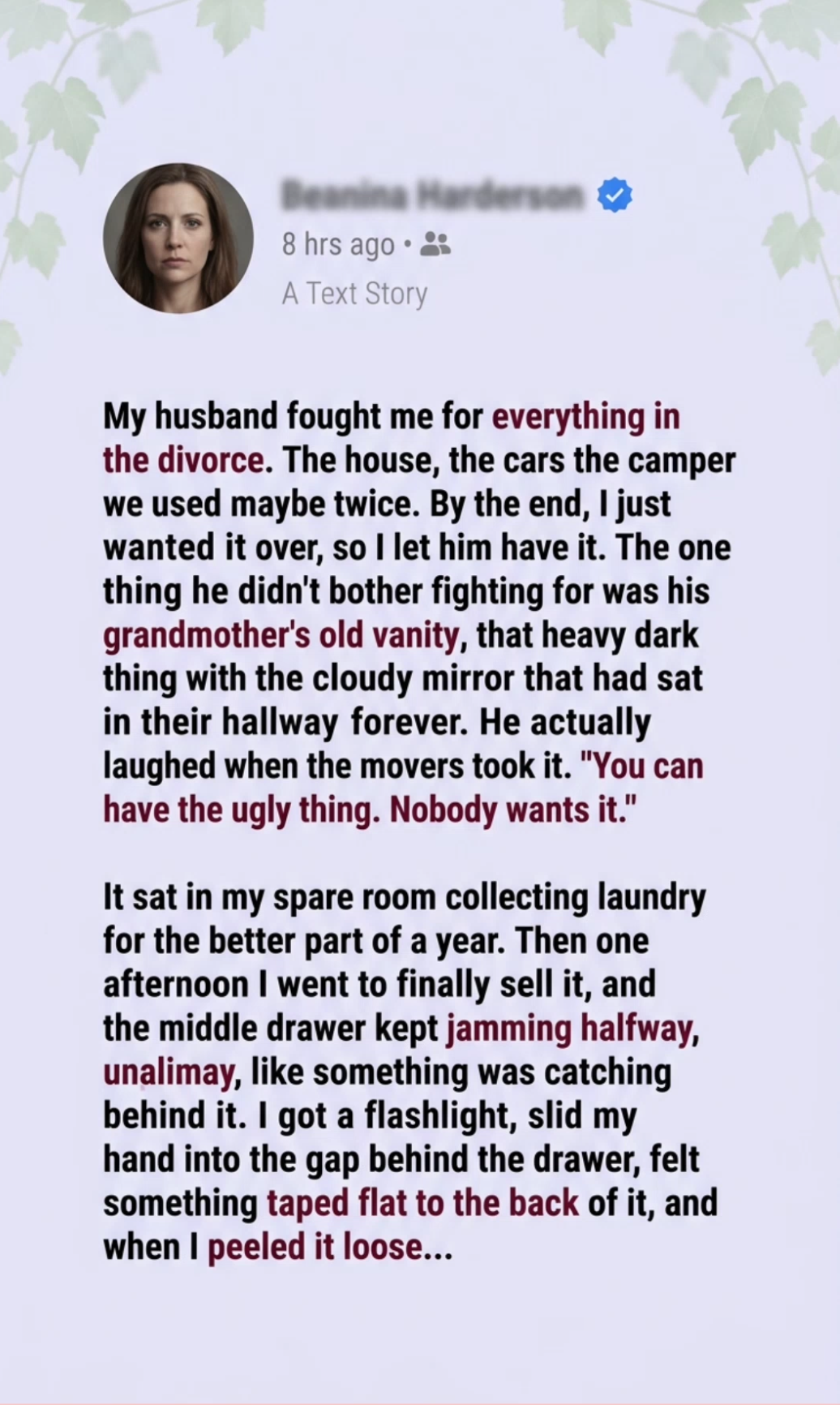
When I peeled the envelope loose from the back of the drawer, I expected to find an old receipt or perhaps a forgotten photograph.
Instead, I found a handwritten letter, a small brass key, and a folded document bearing the name of a bank I had never heard of.
The envelope was yellowed, its edges brittle, and someone had written three words across the front in faded blue ink.
For the woman who stays.
I stood in my spare room, holding the envelope beneath the afternoon light, and felt a strange chill move through me.
My name is Evelyn Parker. I was fifty-eight years old when my marriage ended, and by then, I had become so exhausted by the divorce that I barely cared what I walked away with.
My husband, Richard, had fought me over everything.
The house we had lived in for twenty-six years.
The two cars.
The camper we had used twice before deciding camping was not for us.
Even the expensive patio furniture he had insisted on buying and then complained about every summer.
He hired an aggressive attorney, questioned every expense, and treated every conversation as though I were trying to steal something from him.
I had hired a lawyer too, but I was tired.
I was tired of the accusations.
I was tired of hearing that I had contributed less because I had spent several years working part-time while our children were young.
I was tired of being asked to prove that the life we had built together had belonged to both of us.
By the final months, I wanted peace more than I wanted possessions.
So I let him keep the house.
I let him keep the cars.
I let him keep the camper.
I accepted a settlement that was fair enough to allow me to start over, even though it was not everything I might have received if I had continued fighting.
There was only one thing I asked to keep.
An old vanity that had belonged to Richard’s grandmother, Margaret.
It was a heavy piece of furniture made from dark walnut, with a cloudy oval mirror and three drawers that never opened smoothly.
The vanity had stood in the hallway of Richard’s childhood home for as long as I had known him.
When his grandmother died, his mother had given it to him.
Richard had never cared for it.
He called it ugly, outdated, and impossible to move.
During our divorce, when the movers were loading the furniture, I asked whether I could take it.
He laughed.
“That thing? You can have it. Nobody wants the ugly thing.”
I remember the way he said it.
Not because it hurt my feelings.
But because it was the first time in months he had given me something without making me fight for it.
The vanity was delivered to my small rented house on a rainy afternoon.
I placed it in the spare room and intended to clean it up.
But life had other plans.
I started working longer hours at the accounting office where I had been employed for nearly twenty years. I spent weekends unpacking boxes, organizing documents, and trying to make the unfamiliar house feel like home.
The vanity became a place to pile laundry.
For almost a year, I barely noticed it.
Then, one Saturday, I decided to sell it.
I had found a local antique dealer who was willing to look at old furniture, and I thought I might receive enough money to buy a new dining table.
I removed the clothes from the top, wiped the dust away, and began opening the drawers.
The first drawer slid out easily.
The second stuck halfway.
I pulled harder.
It moved a little, then stopped.
I pushed it back and tried again.
Something was catching behind it.
I crouched down, shone a flashlight into the narrow gap, and saw a small strip of paper or fabric wedged against the back.
I reached inside.
My fingers brushed something flat.
It was taped to the underside of the drawer’s wooden backing.
I carefully peeled it loose.
The envelope was small, perhaps the size of a folded letter, and the tape had hardened over the years.
I opened it slowly.
Inside was a letter written in elegant handwriting.
The first line read:
To the woman who stays,
If you are reading this, then the vanity has finally found its way into the hands of someone who may understand what I could never explain to my own family.
I sat down on the floor.
The letter was signed by Margaret Whitmore, Richard’s grandmother.
I knew her only briefly.
She had died when Richard was in his twenties, long before we married. He had told me stories about her, but he rarely spoke about her with affection.
According to Richard, she had been difficult, stubborn, and old-fashioned.
But the woman who wrote this letter sounded thoughtful and deeply lonely.
She explained that she had hidden the envelope because she did not trust the people around her to understand what it contained.
The brass key was for a safe-deposit box.
The document was a bank certificate.
And the letter was not finished.
I continued reading.
My husband, Thomas, worked for the railroad for thirty-seven years. We saved carefully, even when there was little to save. When he died, I kept the money he left me in an account that I never told my son about.
I stopped.
Richard’s father had been an only child.
The letter explained that Margaret had never wanted the money to become a source of family conflict. Her son had struggled with debt and had repeatedly asked her to help him.
She had helped him many times.
But she had eventually decided that whatever remained should go to someone who understood the value of patience, kindness, and responsibility.
The next paragraph made my hands tremble.
I have watched my granddaughter-in-law, Evelyn, for years. She does not know that I have noticed her. She brings groceries to my house when she thinks no one is watching. She sits with me when I am ill. She never asks what I will leave behind.
I stared at the page.
Margaret had died before Richard and I married.
How could she have written my name?
I read the letter again.
Then I noticed the date.
It had been written nearly two years before her death.
The letter was addressed to me by name.
I remembered that Richard’s family had kept a collection of old photographs and letters in a box after Margaret died. Perhaps she had met me during one of the family gatherings before her death.
I had been dating Richard for several years by then.
I remembered visiting his grandmother once when she was recovering from surgery.
I had brought her a small basket of fruit and sat beside her bed while Richard went to pick up medication.
I had not thought much of it.
But apparently, she had.
The letter continued.
I have placed the key to my safe-deposit box inside this envelope. The box contains the documents you will need. I have also left instructions with my attorney. If the vanity reaches you, please contact him before you do anything else.
At the bottom of the letter was a name and address.
Harold Bennett, Attorney at Law.
I immediately searched for the name online.
The firm still existed, though Mr. Bennett himself had retired. I called the office and explained that I had found a letter from Margaret Whitmore.
The receptionist asked me to hold.
A few minutes later, a man came on the line.
He introduced himself as James Bennett, Harold’s son, who had taken over the practice.
I told him about the letter and the key.
He became very quiet.
“Mrs. Parker,” he said, “I believe we have been waiting for someone to contact us about that.”
I felt my heart beating faster.
“What do you mean?”
He explained that his father had kept a sealed file concerning Margaret Whitmore’s estate. The file contained instructions that were to be followed if a particular letter and key were presented.
He asked me to come to the office the following Monday.
I spent the rest of the weekend unable to sleep.
I read the letter so many times that I began to memorize it.
I thought about Richard.
I thought about the divorce.
I thought about the vanity sitting in my spare room, the same piece of furniture he had laughed at while the movers carried it away.
And I wondered what Margaret had left behind.
On Monday morning, I arrived at the law office ten minutes early.
James Bennett greeted me in a small conference room.
He had a folder on the table and a photograph of Margaret beside it.
He looked at the letter.
Then he looked at me.
“Your former husband knows nothing about this?”
I shook my head.
“Not that I know of.”
James opened the folder.
He explained that Margaret had established a private investment account in the years after her husband’s death. The account had been funded through savings, bonds, and a small inheritance from her sister.
She had also purchased shares in several companies that later grew considerably in value.
The account had been placed in a trust.
Margaret had named a beneficiary in a separate document, but the name was sealed until the person presented the key and the letter.
I could barely speak.
James turned the document toward me.
The beneficiary was Evelyn Parker.
My name.
I looked at him.
“Why?”
He smiled gently.
“Because Margaret believed you were the only person in the family who had never treated her as though she were a burden.”
He explained that the trust had grown over the years.
The current value was approximately $2.3 million.
I stared at the number.
I thought there must be a mistake.
But James showed me the statements, the trust documents, and the records of the account.
It was real.
Margaret had left me a fortune.
Not because I had married her grandson.
Not because I had been part of the family.
But because she had watched how I treated her when I believed there was nothing to gain.
I began to cry.
James gave me a moment.
Then he explained that the trust had been structured carefully. The money was legally mine under the terms of the trust, subject to the applicable distribution and tax rules.
He also advised me to obtain independent financial advice before making any decisions.
I thanked him.
I left the office with copies of the documents and a feeling I could not describe.
For the first time since my divorce, I felt as though the future might hold something other than exhaustion.
But I knew Richard would eventually find out.
And I knew he would not be happy.
I was right.
Three days later, he called.
His voice was unusually pleasant.
“How are you settling in?”
I almost laughed.
“Fine.”
He asked whether I had sold the vanity.
I told him I had not.
He asked why.
I said I had found something inside it.
There was a long silence.
“What did you find?”
I told him about the letter.
He became angry immediately.
“That letter was meant for the family.”
I corrected him.
“It was addressed to me.”
“Grandmother was old. She probably didn’t understand what she was doing.”
I looked at the trust documents on my table.
“She understood perfectly.”
He accused me of taking advantage of his grandmother.
He said the money should have belonged to him.
I reminded him that he had laughed when I asked for the vanity.
He said that was different.
I told him I would not discuss the matter further without my attorney.
Then I ended the call.
The next morning, Richard arrived at my house.
He stood on the porch holding a copy of the trust documents.
I had no idea how he had obtained them.
He demanded that I give him the money.
I told him I would not.
He said his grandmother had intended the money for the family.
I told him the attorney had explained the trust.
He became furious.
“You were married to me for twenty-six years. That money should be mine.”
I looked at him.
“Then why didn’t you keep the vanity?”
He had no answer.
I closed the door.
For several weeks, Richard tried to challenge the trust.
His attorney contacted James Bennett.
They reviewed the documents, the account history, and Margaret’s written instructions.
The trust was valid.
The beneficiary designation was clear.
Margaret had made her decision years before.
Richard’s attorney eventually advised him that he had no reasonable basis to pursue the money.
The matter ended.
I did not celebrate.
I did not send Richard a message.
I simply returned to my life.
I bought a small house with a garden and a bright kitchen.
I paid off the remaining debts from my divorce.
I established an education fund for my grandchildren.
I also created a charitable fund in Margaret’s name to help older women who were living alone and struggling with housing costs.
The vanity remained in my spare room.
I had it professionally restored, but I kept the original mirror and the old brass handles.
The cloudy glass still showed the faint reflection of the woman who stood before it.
Sometimes I would sit beside it and think about Margaret.
I wondered how many years she had carried her secret.
I wondered whether she had ever regretted not telling her son.
And I wondered whether she had known that the vanity would eventually become the one thing Richard would give away without a fight.
One afternoon, my granddaughter Emily came to visit.
She was twelve by then.
She stood in the spare room looking at the vanity.
“Grandma, why do you keep that old thing?”
I smiled.
“Because sometimes the things people don’t want are the things worth keeping.”
She ran her fingers over the wooden surface.
“Can I have it someday?”
I looked at her.
“Maybe.”
Then I told her the story.
Not the details of the money.
Not the arguments with her grandfather.
I told her about Margaret.
I told her about the woman who had been kind to me when I was young, who had noticed the small things I did, and who had left a letter for someone she believed would understand.
Emily listened quietly.
When I finished, she looked at the vanity again.
“I think Great-Great-Grandma Margaret was smart.”
I laughed.
“She certainly was.”
That evening, after Emily left, I sat alone beside the vanity.
The sun was setting through the window.
I thought about the divorce, the house Richard had kept, the cars, the camper, and all the things we had fought over.
None of those things mattered as much as I had once believed.
The vanity had been the one thing he considered worthless.
Yet it had carried a message from a woman who had understood something important.
A person’s value is not measured by what they can take.
It is measured by what they give when no one is watching.
And sometimes, the greatest inheritance is not the money itself.
It is the proof that someone saw who you really were.
The End