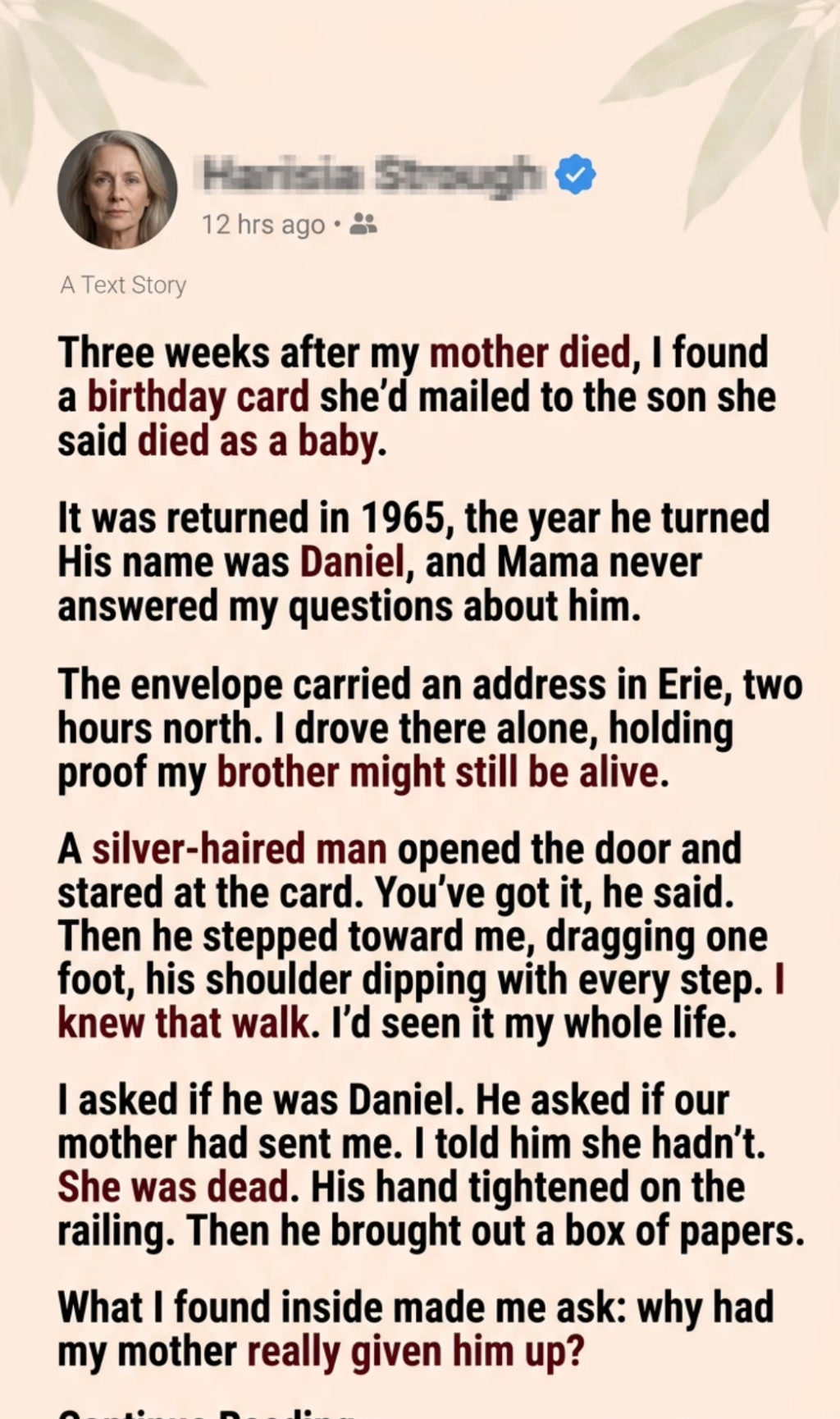
Three weeks after my mother died, I found a birthday card she had mailed to the son she always claimed had died as a baby.
The card had been returned in 1965, the year he turned one.
His name was Daniel.
For sixty years, my mother had spoken of him only when someone asked directly. She never told stories about his first steps, his first words, or what he might have looked like. She never kept a photograph where anyone could see it. When I was young, I once asked whether I had a brother in heaven.
Mama had stopped washing the dishes, stared out the kitchen window, and said, “Some things are better left buried.”
I never asked again.
Until I found that card.
The envelope was tucked inside a wooden sewing box beneath a bundle of old receipts and a photograph of my father in his Army uniform. The paper had turned yellow at the edges. My mother’s handwriting was unmistakable, even after all those years.
Happy first birthday, my precious Daniel.
I hope you are warm. I hope you are loved. I hope someday you understand.
The address was in Erie, Pennsylvania.
I sat on the bedroom floor for nearly an hour, holding the envelope in both hands.
My mother had died at eighty-seven. She had lived a quiet life, worked as a seamstress, raised me, and buried my father twenty-two years earlier. I had always believed I knew the shape of her sorrow. I had thought Daniel was a tragedy she had survived.
But the returned card told me something different.
She had tried to reach him.
And someone had sent it back.
The following morning, I searched the address online. The house still existed, a narrow brick home on a tree-lined street not far from the lake. It had been built in the 1940s, and the current property records listed a man named Daniel Mercer.
I stared at the name until the letters seemed to blur.
Then I called the number listed beside it.
A woman answered.
“Hello?”
“I’m sorry to bother you,” I said. “I’m trying to reach Daniel Mercer.”
“Who is calling?”
“My name is Margaret Ellis. I believe he may be my brother.”
There was a long silence.
Then the woman said, “Please come tomorrow.”
She gave me a time and hung up before I could ask anything else.
I drove to Erie the next morning.
The weather was cold, and the sky hung low over the highway. I kept the birthday card in my purse, folded inside a plastic sleeve. Every few miles, I reached over and touched it, as if it might disappear if I stopped paying attention.
When I arrived, I parked across the street from the brick house.
A silver-haired man stood behind the front window.
He was tall, but his right shoulder sat lower than his left. When he moved toward the door, his right foot dragged slightly, and his body leaned to one side.
I had seen that walk my entire life.
My own right foot had turned inward since childhood. My father used to call it my little crooked step. Doctors had told my parents it was a congenital condition, something I had been born with. I had worn special shoes for years, and even after surgery, the unevenness remained.
The man opened the door.
He looked at me, then at the card in my hand.
“You found it,” he whispered.
I swallowed.
“Are you Daniel?”
His fingers tightened around the doorframe.
“Did our mother send you?”
“No,” I said. “She didn’t.”
His eyes searched my face.
“Is she still alive?”
I could not find a gentle way to say it.
“She died three weeks ago.”
The man stepped back as if I had struck him.
For a moment, neither of us spoke.
Then he opened the door wider.
“Come inside.”
The house smelled of coffee and old books. A woman sat in the living room, her hands folded in her lap. She introduced herself as Ruth, Daniel’s wife. She had kind eyes and a worried expression.
Daniel sat across from me in a chair near the fireplace.
“I haven’t seen that handwriting in sixty years,” he said.
He reached for the card, but his hand trembled.
I placed it on the table between us.
“Why did she say you died?”
Daniel looked down at the envelope.
“Because that’s what they told her.”
“Who?”
He rubbed his forehead.
“My adoptive parents.”
The words seemed to settle heavily into the room.
I leaned forward.
“Were you adopted?”
“Yes.”
“Did you know you had a sister?”
He shook his head.
“No. I knew my birth mother had been young. I knew she had signed the papers. I knew she had left a note saying she hoped I would have a good life. But I never knew her name.”
He paused.
“Not until I was twenty-one.”
I looked at him carefully.
“Then how did you know she was our mother?”
Daniel rose slowly and walked toward a cabinet.
That uneven walk again.
He opened a drawer and pulled out a small cardboard box.
“I think you should see this.”
He placed it on the table.
Inside were papers, photographs, a hospital bracelet, and a letter folded so many times that the creases had nearly split.
Daniel took the letter out first.
“This was given to me when I turned twenty-one,” he said. “My adoptive mother had kept it in her desk. She told me I could read it when I was old enough to understand.”
He handed it to me.
The paper was thin and brittle.
The letter was written by my mother.
My dear son,
If you are reading this, then you are old enough to ask questions about where you came from. I pray the people who raised you have loved you well. I pray you have never felt unwanted.
I did not give you away because you were unwanted.
I gave you away because I was afraid.
My hands began to shake.
Daniel continued.
“My adoptive parents told me my birth mother had been a young woman who couldn’t care for me. They said she had chosen a family that could give me a better life. I believed them.”
He looked at the letter.
“But when I was twenty-one, my adoptive father told me something else. He said my birth mother had tried to contact them. They refused to answer.”
“Why?”
Daniel looked toward Ruth.
“My adoptive mother couldn’t have children. She wanted a baby more than anything. My adoptive father believed that if they allowed my birth mother to visit, she might take me back.”
I stared at him.
“They knew she was trying to reach you?”
“Yes.”
“And they sent the card back?”
Daniel nodded.
“They returned every letter they received.”
I felt a sharp pain in my chest.
My mother had not simply lost her son.
She had been kept away from him.
I turned to the next paper in the box.
It was a birth certificate.
The date matched the year on the card.
The hospital was in a small town outside Pittsburgh. The mother’s name was Margaret Ellis.
Mine.
I covered my mouth.
Daniel looked at me with tears in his eyes.
“I’m sorry,” he said.
“Why are you sorry?”
“Because I grew up believing she never wanted me.”
I shook my head.
“She wanted you.”
For the first time, I felt the full weight of the secret my mother had carried.
She had not forgotten him.
She had been remembering him every day.
I asked Daniel if he had ever tried to find her.
He nodded.
“When I was thirty, I hired a search service. They found a possible address, but the woman living there had moved. I wrote a letter anyway. It came back.”
“Did you keep it?”
He nodded and pulled another envelope from the box.
It was addressed to my mother.
The return address was Daniel’s old apartment in Erie.
The date was 1974.
My mother had never mentioned it.
I opened the letter carefully.
Dear Margaret,
I don’t know if you will ever receive this. I don’t know if you remember me or if you have chosen to forget.
I am married now. My wife is expecting our first child. I want to know whether I have brothers or sisters. I want to know what you looked like when you were young. I want to know whether I have your eyes.
I am not angry.
I only want to know where I came from.
Daniel.
I could barely breathe.
My mother had received none of it.
Or perhaps she had.
I looked at Daniel.
“Did you ever send another letter?”
“No. I thought she didn’t want to hear from me.”
I thought of Mama sitting alone at her kitchen table, turning the same birthday card over and over. I thought of the way she used to pause whenever a little boy walked past us in a grocery store. I thought of the photograph she kept hidden in the sewing box.
I suddenly understood why she had never answered my questions.
She had not wanted me to hate her.
But there was something else in the box.
A newspaper clipping.
It was from 1964.
The headline read:
Young Mother Injured in Highway Accident; Infant Son Placed in Temporary Care
I read the article twice.
The accident had happened only days after Daniel’s birth.
My mother had been driving home from the hospital when another car crossed the center line. She suffered a broken leg and a head injury. Daniel had been in the back seat.
The article said the infant was taken to a nearby hospital and later placed in foster care.
I looked at Daniel.
“Were you injured?”
He nodded.
“My right leg. The doctors said the damage happened when I was very young. I needed several surgeries.”
I felt cold.
My mother had always told me I was born with my crooked foot.
But Daniel had the same condition.
I pulled my own medical records from my purse. I had brought them because I thought they might help identify our connection. My mother had kept my childhood hospital papers in a folder.
The diagnosis was written in faded ink.
Congenital deformity of right foot.
Daniel leaned forward.
“May I see that?”
I handed it to him.
He looked at the page, then at his own records.
His adoptive parents had kept every medical document.
The diagnosis was nearly identical.
For a long time, we sat quietly.
Then Daniel said, “I think we were born with the same condition.”
I nodded.
“But yours may have been worse because of the accident.”
He looked down at his leg.
“I always wondered why my birth mother had been so afraid.”
I closed my eyes.
My mother had been young, injured, frightened, and alone.
My father had been away working in another state when Daniel was born. He returned after the accident and found his wife in a hospital bed, unable to walk without assistance. The family had little money. My mother had been told that Daniel would need years of medical care.
And then someone had convinced her that giving him up was the only way to save him.
I asked Daniel whether he knew the name of the doctor who had arranged the adoption.
He reached into the box and found a small card.
It belonged to a social worker named Evelyn Hart.
The name meant nothing to me.
But Daniel said he had once tried to contact her.
“She died in the late seventies,” he said. “Her daughter still lives nearby. I wrote to her years ago, but she never replied.”
I asked if he still had the address.
He did.
We drove there together that afternoon.
The house was small, with a white porch and a garden full of dried flowers. A woman in her seventies answered the door.
When Daniel introduced himself, she looked startled.
“Daniel Mercer?”
“Yes.”
She glanced at me.
“And you are?”
“His sister.”
The woman closed her eyes.
“Oh,” she whispered. “I wondered whether someone would come someday.”
Her name was Patricia Hart.
She invited us inside and made tea. Then she went to a bedroom and returned with a thick folder.
“My mother kept records of every adoption she handled,” she said. “She believed children deserved to know the truth when they were old enough.”
She opened the folder.
Inside was a document with my mother’s name.
I felt my heart pounding.
Patricia read aloud.
“Margaret Ellis, age twenty-four. Infant male, Daniel. Mother injured in automobile accident. Father unavailable. Family under financial strain.”
She turned the page.
“Recommendation: temporary placement pending recovery.”
I stared at her.
“Temporary?”
Patricia nodded.
“My mother told me the adoption was supposed to be temporary. She believed your mother would recover and bring him home.”
Daniel’s face went pale.
“Then why was it permanent?”
Patricia looked at the next page.
There was a signature.
My mother’s.
But beside it was a note written in another hand.
Mother has been advised that child will receive superior medical care and that continued contact may cause emotional distress.
I felt anger rising inside me.
“Who wrote that?”
Patricia pointed to the initials.
“E.H. My mother.”
She looked ashamed.
“She was young and believed she was doing the right thing. The adoptive parents had promised to provide excellent care. They were stable, respected, and financially secure. Your mother was recovering from an injury and had another child to raise.”
I swallowed.
“Did my mother understand that she was signing away her son forever?”
Patricia hesitated.
“According to the file, she asked whether she could visit him. My mother told her that visits might confuse him and make the transition harder.”
Daniel’s eyes filled with tears.
“She was told not to come.”
Patricia nodded.
“And then the adoptive parents requested that all correspondence be returned. My mother approved it.”
I looked at the folder.
There was one final document.
A letter dated 1965.
It was written by my mother, but it had never been mailed.
Dear Daniel,
I don’t know where you are today. I don’t know whether you are happy or whether you cry at night.
I have tried to find you, but every door has been closed.
Your sister Margaret asks about you. She is a good girl. She has your eyes, though she does not know it.
I want to tell her about you. I want to tell everyone.
But I am afraid that if I speak, I will lose the little life I have managed to build.
Please forgive me.
Your mother.
I began to cry.
Daniel reached across the table and held my hand.
We had both spent our lives believing a different story.
He had believed he was unwanted.
I had believed my mother had buried a child.
The truth was more painful than either of us had imagined.
She had tried to reach him.
And every time she tried, someone had stopped her.
Patricia gave us copies of the records.
Before we left, she said something I never forgot.
“My mother made mistakes. She believed the rules were protecting children. Sometimes the rules protected the adults instead.”
Daniel thanked her.
Then we drove back to Erie.
Neither of us spoke much during the journey.
When we arrived at his house, Ruth had prepared dinner. She had set an extra place at the table.
I looked at it and felt something inside me soften.
For the first time in sixty years, Daniel had a sister sitting across from him.
We talked until midnight.
He told me about his childhood, his adoptive parents, his surgeries, his marriage, and his children. He showed me photographs of his two sons and four grandchildren.
One of his granddaughters had the same crooked foot.
I touched the photograph.
“She has our walk.”
Daniel smiled.
“Yes.”
He asked about Mama.
I told him she had loved gardening, hated cold coffee, and always kept a small jar of buttons beside her sewing machine. I told him she had sung while she worked, especially when she thought no one was listening.
I told him about my father.
I told him about the house where I grew up.
I told him everything I could remember.
Then I gave him the birthday card.
He held it for a long time.
“Do you think she knew I was alive?”
“I don’t know.”
He looked at the faded handwriting.
“I wish I could have heard her voice.”
I reached into my purse and took out my phone.
I had saved a recording of my mother from the previous Christmas. She had been telling a story about my father, laughing at the end.
I played it.
Daniel listened without moving.
When the recording ended, he pressed his hand against his mouth.
“That is her,” he whispered.
We sat together in silence.
The next morning, I returned home.
I went straight to my mother’s bedroom and opened the sewing box again.
This time, I looked carefully beneath the lining.
There was a small photograph hidden inside.
It showed my mother holding a baby.
On the back, in her handwriting, were four words:
My Daniel. My firstborn.
I took the photograph to Erie the following weekend.
Daniel placed it beside the birthday card.
For a long time, he simply looked at it.
Then he said, “I think I look like her.”
“You do.”
He turned toward me.
“And you look like me.”
We laughed, and then we cried.
That afternoon, Daniel asked whether I would help him visit our mother’s grave.
I said yes.
We drove back together.
The cemetery was quiet. The trees had begun to lose their leaves, and the wind moved gently through the grass.
Daniel stood beside the headstone.
He leaned on his cane, his shoulder dipping as he stepped forward.
I watched him kneel.
He placed the birthday card on the ground and rested his hand on the stone.
“I’m here, Mama,” he whispered. “I finally found you.”
I stood behind him, unable to speak.
After a while, he rose and turned toward me.
“I don’t know whether I can forgive everything,” he said. “But I don’t want to spend the rest of my life being angry.”
I nodded.
“I don’t think she wanted you to be angry.”
He looked at the grave again.
“I think she wanted me to know I was loved.”
I took his hand.
“She did.”
We left the card there for a few minutes, then brought it back with us.
It belonged to Daniel.
It had always belonged to him.
In the months that followed, we became part of each other’s lives.
He visited me for Thanksgiving. I traveled to Erie for his birthday. We exchanged photographs, family stories, and old memories that had been waiting decades to be told.
His sons began calling me Aunt Margaret.
His granddaughter sent me a drawing of two people walking together.
One had a crooked foot.
The other did too.
Underneath, she had written:
This is Grandpa and Aunt Margaret.
I framed it and placed it beside the photograph of our mother holding Daniel.
Sometimes I still feel angry when I think about what happened.
I think about the letters that were returned, the years that disappeared, and the birthdays my mother spent alone with a card she could never deliver.
But I also think about the day Daniel opened his door.
The day he looked at me and recognized the walk he had carried since childhood.
The day I learned that a family secret can survive for sixty years, but love can survive it too.
My mother never got to meet the man her son became.
She never got to hear his voice, hold his children, or apologize in person.
But Daniel found her handwriting.
He found her photograph.
He found the words she had been trying to send him all his life.
And at last, he knew the truth.
He had never been forgotten.
He had never been unwanted.
He had been loved by a mother who was frightened, misled, and powerless in ways I had never understood.
And he had a sister who would spend the rest of her life making sure he never had to wonder again.
The End