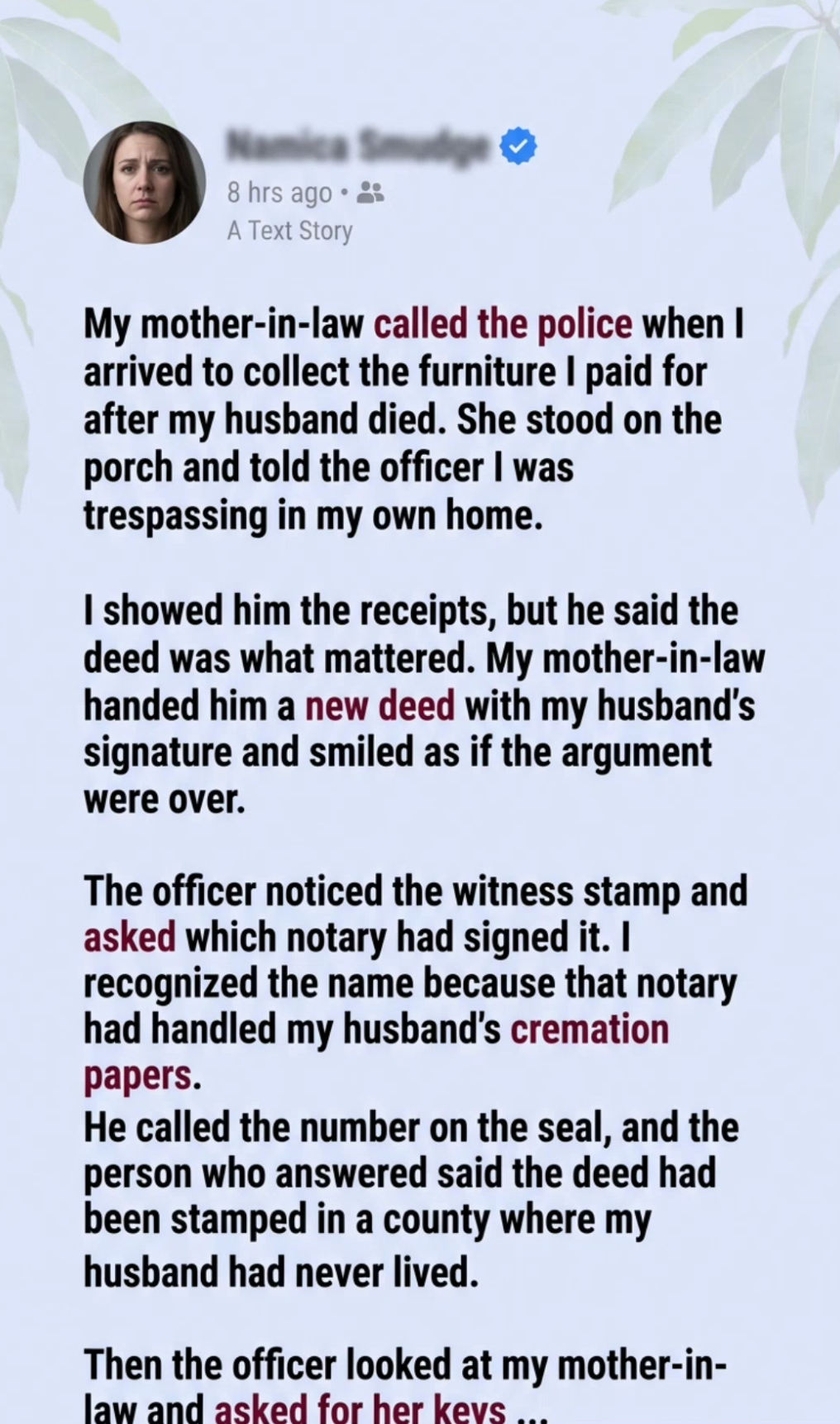
The first thing my mother-in-law said when I stepped out of my car was, “You have no right to be here.”
I was standing in the driveway of the house my husband and I had lived in for eleven years, holding a folder of receipts and trying to keep my hands from shaking.
I had not come to argue.
I had come to collect the furniture I had paid for.
My husband, Thomas, had died six weeks earlier after a sudden heart attack. He was fifty-eight. One minute he was complaining about the rain, and the next I was sitting in an emergency room while a doctor explained that they had done everything they could.
I had barely begun to understand that he was gone when his mother, Eleanor, started making decisions about his belongings.
She took his watch, his grandfather’s pocketknife, his winter coat, and the small wooden desk he had used since college. She told me she was keeping them safe.
I asked her to wait until the estate had been settled.
She said I was being selfish.
When I discovered that she had also taken several pieces of furniture from our home, I called her and asked when I could come by to collect them.
She told me to come on Saturday.
So I did.
I parked outside the house and walked toward the porch. Eleanor was already standing there, wearing a navy coat and holding her phone.
“I called the police,” she said.
I stopped.
“Why?”
“Because you are trespassing.”
I looked at the house.
The porch swing Thomas and I had bought on our tenth anniversary was gone. The flowerpots I had painted were missing. Even the brass house numbers had been replaced.
“What have you done?” I asked.
Eleanor folded her arms.
“This property belongs to my family.”
“It belonged to Thomas and me.”
“Not anymore.”
A police cruiser turned into the driveway.
The officer stepped out and introduced himself as Officer Bennett. He asked what was happening.
Eleanor answered before I could.
“This woman is trying to remove property from my home. She refuses to accept that she has no legal right to be here.”
I opened my folder.
“Officer, I lived here with my husband for eleven years. I paid for the furniture she removed. I have the receipts.”
He glanced at the papers.
Then he looked toward the front door.
“Do you have a deed?”
I shook my head.
“The house was in my husband’s name. We were married, and I believe I have rights as his surviving spouse.”
Officer Bennett nodded carefully.
“I understand. But I can’t decide ownership based on receipts alone. The deed is an important document.”
Eleanor smiled.
It was a small smile, almost polite.
Then she reached into her handbag and pulled out a folded paper.
“Here,” she said. “This proves everything.”
She handed it to him.
I watched the officer unfold the document.
It was a deed transferring the house from Thomas to Eleanor.
My husband’s signature appeared at the bottom.
For a moment, the world seemed to tilt.
“That isn’t possible,” I said.
Eleanor’s smile widened.
“Thomas signed it before he died.”
I stepped closer.
“Thomas never told me he was transferring our home.”
Officer Bennett examined the document.
There was a witness signature, a notary stamp, and a date.
I recognized the name printed beneath the seal.
Harold Pike.
My stomach tightened.
Harold had been the notary who handled Thomas’s cremation authorization and several documents at the funeral home. I remembered his name because he had been kind to me when I could barely speak.
I looked at the officer.
“Can you call that notary?”
Officer Bennett raised his eyes.
“Do you know him?”
“Yes. He handled my husband’s cremation papers.”
Eleanor’s expression changed.
Only slightly.
But I saw it.
Officer Bennett studied the stamp again.
“That’s unusual.”
He took out his phone and called the number printed on the deed.
Eleanor began to speak.
“Officer, there’s no need—”
“Ma’am, please let me verify the document.”
The call rang several times.
Then someone answered.
Officer Bennett identified himself and read the document number.
I could hear the faint sound of a man’s voice through the phone.
The officer’s expression grew serious.
“Could you repeat that?”
He listened.
Then he asked, “What county was the deed notarized in?”
Another pause.
“Thank you.”
He ended the call.
Eleanor’s face had gone pale.
Officer Bennett looked at her.
“Ma’am, this deed appears to have been notarized in Mercer County.”
Eleanor swallowed.
“That’s correct.”
The officer glanced at me.
“Your husband lived in this county, correct?”
“Yes,” I said. “He lived here his entire life.”
Officer Bennett looked back at Eleanor.
“The notary’s records indicate this document was stamped in a county where your husband never lived, and the notary says he did not notarize this deed.”
The silence was so complete that I could hear a car passing on the street.
Eleanor tightened her grip on her handbag.
“That must be a mistake.”
Officer Bennett folded the deed.
“Then I need you to explain why you have the keys to this property.”
Eleanor stared at him.
I had never seen her look frightened before.
Not when Thomas was diagnosed with high blood pressure. Not when he lost his job during the recession. Not even when he died.
But now, standing on the porch, she looked as if the ground beneath her had opened.
The officer asked her to step aside.
Then he turned to me.
“Mrs. Carter, do you have proof that you lived here?”
I took out my driver’s license.
The address was printed clearly.
I showed him utility bills, mortgage statements, and a copy of the insurance policy.
He examined each one.
Then he asked Eleanor whether she had any other documents.
She said nothing.
Officer Bennett told her that the deed would need to be investigated and that she could not use it to force me out of the property that day.
He also explained that the police would not determine the final ownership of the house. That would require the proper legal process.
Eleanor looked at me with hatred.
“You planned this,” she whispered.
I shook my head.
“No. I planned to collect my furniture.”
Officer Bennett asked her for the keys.
She hesitated.
Then she slowly removed a ring of keys from her pocket.
He asked her to hand them over temporarily while the property dispute was documented.
She gave them to him.
I watched the keys fall into his palm.
One of them had a small blue tag.
Thomas had put that tag on years earlier.
It was the key to our front door.
I began to cry.
Not because of the house.
Because my husband was gone, and the woman who had raised him was trying to erase the life we had built together.
Officer Bennett took my statement and advised me to contact an estate attorney before removing any additional property.
He also told Eleanor not to enter the house or remove anything else until the matter was clarified.
When the cruiser left, she stood on the porch and glared at me.
“You think you’ve won?”
I looked at the folder in my hands.
“No,” I said. “I think Thomas deserves the truth.”
Then I walked away.
That evening, I called an attorney named Rebecca Mills.
She had handled a small legal matter for Thomas several years earlier. I explained what had happened and emailed her copies of the deed, the receipts, and the police report.
She called me the next morning.
“Claire,” she said, “I need you to come to my office. Bring every document you have.”
I arrived with two folders and a box of papers.
Rebecca examined the deed carefully.
She asked when Thomas had died, whether he had been hospitalized, and whether anyone had witnessed him signing the document.
I told her that Thomas had been at home the week before his death. He had never mentioned transferring the house.
Rebecca leaned back.
“There’s something else you need to know.”
She opened a county property record.
The deed Eleanor had shown the officer was dated three days after Thomas’s death.
I stared at the page.
“That’s impossible.”
Rebecca nodded.
“Your husband could not have signed a deed after he died.”
I felt a wave of nausea.
“Then someone forged his signature.”
“That’s one possibility. We need to establish exactly how the document was created and recorded.”
She pointed to another line.
The deed had been filed electronically using an account registered to Eleanor.
I covered my mouth.
Rebecca continued.
“The notary’s stamp appears to have been copied. The county clerk has already flagged the document because the seal number does not match the notary’s current records.”
I asked what would happen next.
Rebecca explained that she would notify the probate court, request a formal review of the deed, and preserve the original document. She would also request records from the county office and the notary.
Then she asked me something I had not considered.
“Did your husband have a will?”
“Yes.”
“Where is it?”
I told her Thomas had kept it in a small fireproof box in his desk.
I had not opened that box since the funeral.
Rebecca asked me to bring it to her.
When I returned home, I found the box beneath a stack of old tax documents.
The key was taped inside Thomas’s desk drawer.
I opened it slowly.
Inside were his will, our marriage certificate, insurance papers, and a letter addressed to me.
The letter was dated eight months before his death.
I sat down before opening it.
My dearest Claire,
If you’re reading this, then I have probably left you with more questions than answers.
I know you worry about my mother. I know you try to keep peace even when she makes things difficult.
But I need you to understand something.
The house is ours. I want you to remain there for as long as you wish. No one should make you feel that you have to leave because I am gone.
I have spoken with Rebecca about making sure everything is clear.
Please don’t let anyone convince you that you were only a guest in our life together.
You were my home.
Thomas.
I pressed the letter against my chest.
For the first time since his death, I felt that he had reached across the distance and held my hand.
I brought the will and letter to Rebecca.
She read them carefully.
Then she smiled faintly.
“This helps.”
The will left Thomas’s estate to me, including his interest in the house. It also stated that no transfer of real property could be made without his signature witnessed in person and recorded according to state law.
The forged deed would not override the will.
But Rebecca warned me not to assume the matter was finished.
A forged document could still create problems, especially if someone had already used it to access accounts or transfer property.
She asked me to check the house records and Thomas’s financial statements.
That afternoon, I discovered something worse.
Eleanor had attempted to transfer the house into a family trust.
The trust had been created two weeks after Thomas’s death.
Its listed beneficiaries were Eleanor and Thomas’s younger brother, Peter.
I called Rebecca immediately.
She told me not to contact Eleanor.
“Let the records speak,” she said.
Over the next several days, Rebecca gathered evidence.
The notary confirmed that he had not signed the deed.
The county clerk confirmed that the document had been filed using Eleanor’s account.
A handwriting specialist examined Thomas’s signature and found several inconsistencies.
The date on the deed was also impossible.
And the witness listed on the document had been out of state on that day.
Each discovery made the picture clearer.
Eleanor had not simply misunderstood the estate.
She had tried to take the house.
The furniture was only the beginning.
Rebecca filed a petition to invalidate the deed and asked the court to prevent any further transfer of the property.
The probate judge granted a temporary order.
Eleanor was notified that she could not sell, transfer, or encumber the house while the case was pending.
A few days later, she called me.
I almost didn’t answer.
But I did.
“What do you want?” I asked.
Her voice sounded different.
“You need to withdraw the complaint.”
“No.”
“Claire, this is a family matter.”
I closed my eyes.
“Thomas was my family.”
“He was my son.”
“And my husband.”
She began to cry.
“I was trying to protect what belonged to him.”
I felt a strange sadness.
“You forged his signature.”
“I didn’t think it would go this far.”
I stood very still.
“Then why did you call the police?”
She didn’t answer.
I waited.
Finally, she said, “I thought you would leave.”
The words hurt more than I expected.
She had believed that if she made the house frightening enough, I would surrender it.
I told her the court would decide.
Then I ended the call.
The hearing took place six weeks later.
Eleanor arrived with an attorney.
She wore a black dress and carried a handbag I recognized as Thomas’s gift from the previous Christmas.
I looked away.
Rebecca presented the evidence.
The notary’s testimony was clear.
The county records were clear.
The signature analysis was clear.
The deed had been created and filed after Thomas’s death.
Eleanor’s attorney argued that she had believed Thomas intended to give her the house.
The judge asked whether she had any valid document showing that intention.
She did not.
The judge ruled that the deed was invalid and ordered the property records corrected.
The court also referred the suspected forgery to the appropriate authorities for further investigation.
Eleanor sat motionless.
When the hearing ended, she approached me in the hallway.
“I never thought you would fight me,” she said.
I looked at her.
“I never thought you would try to take my home.”
She lowered her eyes.
For a moment, I thought she might apologize.
Instead, she said, “Your husband would have wanted us to stay together.”
I felt tears rise.
“Then you should have treated me like his wife.”
I walked away.
The investigation continued for several months.
Eleanor eventually admitted that she had submitted the deed, though she claimed she had not personally altered the signature. The authorities found evidence that she had used a scanned copy of Thomas’s signature from an old insurance form.
She was required to repay the legal costs associated with correcting the property records and entered into a formal agreement that prevented her from making further claims against the house.
The criminal case was handled separately.
I did not attend every hearing.
I was tired of living inside the worst chapter of my life.
I wanted to remember Thomas as the man who made pancakes on Sundays, who sang off-key in the shower, and who always left the porch light on when I worked late.
I wanted to remember the home we had built.
The furniture was eventually returned.
The dining table had a scratch near one leg. The sofa had been moved into Eleanor’s garage. Thomas’s wooden desk had been taken to Peter’s house.
I collected everything with an inventory and a witness.
When I carried the desk back into our home, I sat in the chair and cried.
It was the first time I had felt that the house belonged to me again.
Months passed.
I repainted the front door the same deep green Thomas had chosen. I put the porch swing back in place. I planted flowers along the walkway.
One evening, I found myself standing on the porch, looking at the keys in my hand.
The blue tag was still attached.
I thought about the day Eleanor had called the police.
I thought about the officer asking for her keys.
And I thought about how easily a person can try to rewrite a life after someone dies.
But a home is more than a deed.
It is the years of ordinary mornings, the bills paid together, the laughter in the kitchen, the arguments that end in apologies, and the quiet promise that someone will be there when you come back.
Thomas had left me that promise in his letter.
I kept it.
I never moved out.
I never surrendered the home we had built.
And every time I unlock the front door, I remember the truth the forged deed could not erase:
I was not a guest in my husband’s life.
I was his wife.
I was his family.
And I was home.
The End