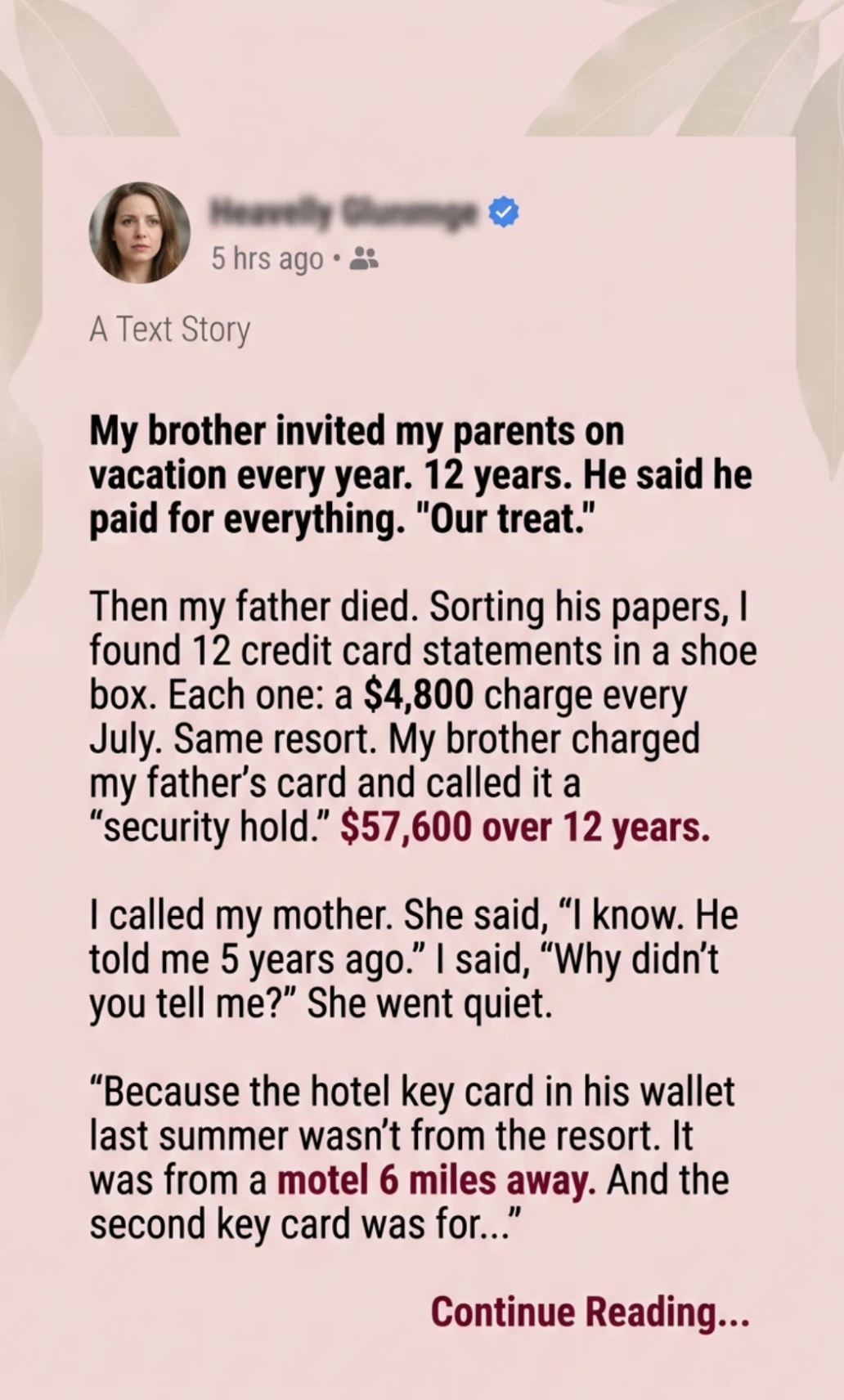
For twelve years, my brother Daniel invited our parents on a summer vacation to the same beautiful resort. Every July, he called them with the same cheerful announcement: “Pack your bags. Everything is taken care of. Our treat.”
My parents loved those trips. My father, Robert, especially enjoyed them. He would return home with photographs of the ocean, stories about the restaurants, and little souvenirs for my children. Whenever someone thanked Daniel for his generosity, he smiled modestly and said, “They raised us. It’s the least I can do.”
I believed him.
Daniel was older than me by four years, and he had always been the successful one. He owned a construction company, drove an expensive SUV, and lived in a large house with his wife, Vanessa. I worked as an accountant at a small company, raised two children, and carefully watched every dollar.
My brother often reminded me that he was fortunate enough to give our parents things I could not.
“Don’t worry about Mom and Dad,” he would say. “I’ve got them covered.”
I never questioned it.
Then, in March, our father died unexpectedly after suffering a massive heart attack while working in his garden.
The funeral was quiet and heartbreaking. My mother, Margaret, seemed to shrink inside her black dress. Daniel stood beside her throughout the service, holding her hand and telling everyone how much Dad had meant to him.
He cried when the pastor spoke about family.
I cried when they lowered the casket.
After the funeral, Daniel told me he would handle the funeral expenses and the paperwork because he had more time and better connections.
I appreciated the help. I was exhausted, grieving, and trying to keep my mother from feeling alone.
A week later, I went to my parents’ house to help Mom organize Dad’s documents. We needed to locate insurance policies, bank accounts, and the paperwork for the house.
The house smelled like his aftershave and the coffee he used to make every morning.
I found his old shoes lined up beside the garage door. His gardening gloves were still on the workbench. A half-finished birdhouse sat beside a jar of screws.
It was the kind of ordinary detail that made his death feel impossible.
While sorting through the desk in his bedroom, I discovered a small cardboard shoe box pushed behind a stack of old tax records.
Inside were twelve credit card statements.
One for every year of the vacations.
I began looking through them, expecting to find ordinary household expenses. Instead, I noticed the same charge appearing on every statement.
$4,800.
July.
The same resort.
The same amount, year after year.
I checked the dates again.
Twelve charges totaling $57,600.
My hands began to shake.
The card belonged to my father, but the account had been opened years earlier with Daniel listed as an authorized user.
I remembered Daniel telling everyone that he paid for the vacations himself.
I remembered my father thanking him.
I remembered my brother saying, “Our treat.”
The statements showed that my father had been paying for every single trip.
I called Daniel immediately.
“Did you know Dad was paying for the vacations?”
There was a long silence.
Then he said, “What are you talking about?”
“I found the credit card statements. Twelve charges. Forty-eight hundred dollars every July.”
He sighed.
“It was a security hold.”
“A security hold that stayed on the account for twelve years?”
“It was complicated. I was going to explain it.”
“Explain what?”
He became defensive.
“Dad knew about it. He was fine with it.”
I asked him why he had repeatedly told our parents that he was paying.
He said, “Because I wanted them to feel special. I didn’t want them worrying about money.”
I told him that was not generosity.
That was deception.
He hung up.
I sat at my parents’ kitchen table for nearly an hour, staring at the statements.
Then I called my mother.
“Mom, I found the vacation charges.”
She didn’t sound surprised.
“I know,” she said quietly. “Daniel told me five years ago.”
I felt something cold settle in my chest.
“Why didn’t you tell me?”
She went silent.
I could hear the clock ticking above the refrigerator.
Finally, she said, “Because the hotel key card in your father’s wallet last summer wasn’t from the resort.”
I leaned forward.
“What?”
“It was from a motel six miles away.”
My mother began crying.
“And the second key card was for a room under your brother’s name.”
I could barely breathe.
“Mom, what are you saying?”
She wiped her eyes and told me everything.
Five years earlier, Daniel had admitted that he was no longer paying for the vacations. He had been using Dad’s credit card to reserve the resort rooms, telling our parents the charges were temporary security holds.
But the charges were never released.
The money was being spent.
When my mother confronted him, Daniel promised to repay everything. He told her he had been struggling with his business and needed time.
He begged her not to tell Dad.
He said Dad would be heartbroken.
My mother agreed to keep the secret because she believed Daniel would eventually make things right.
But the motel key cards had changed everything.
During the last vacation, my father had accidentally found a receipt in Daniel’s suitcase. It showed that Daniel had booked a separate room at a motel near the resort.
Dad had asked him about it.
Daniel said the room was for a business associate who had missed a flight.
My father didn’t believe him.
That night, he followed Daniel when he left the resort.
He discovered that Daniel had been meeting a woman named Melissa, a former employee from his construction company.
My mother said Dad had returned to their room pale and shaken.
He didn’t tell her everything immediately.
But the following morning, he confronted Daniel privately.
Daniel admitted that he had been having an affair for several years.
He also admitted that the motel room had been paid for with the same credit card he had used for the vacations.
My father was devastated.
He had spent twelve years believing his son was a generous man who wanted to give his parents beautiful memories.
Instead, he had been unknowingly funding a lie.
My mother said Dad had asked Daniel to repay the money and end the affair before he told the family.
Daniel promised.
But he never repaid a single dollar.
And my father never got the chance to confront him again.
I sat at the kitchen table with my mother, trying to understand how my brother could have done something so cruel.
Then she reached into her purse and handed me a sealed envelope.
“Your father gave me this before he died,” she said. “He told me to give it to you if anything happened to him.”
My name was written on the front in Dad’s familiar handwriting.
Inside was a letter.
My father explained that he had discovered the truth about Daniel’s vacations and the affair during the previous summer.
He wrote that he had been ashamed—not because he had lost the money, but because he had allowed Daniel to make him feel grateful for something that had never been a gift.
He also wrote that he had been worried about my mother.
Daniel had convinced her that telling the truth would destroy the family.
Dad wanted me to know that he did not blame her.
Then I reached the final paragraph.
He wrote that he had contacted the credit card company and requested copies of every transaction.
He had also spoken with an attorney about the unauthorized use of his account.
The letter ended with a sentence that made me cry.
“Please don’t let your brother turn my silence into permission.”
I folded the letter carefully.
For the first time since Dad’s funeral, I felt something stronger than grief.
I felt determination.
The following morning, I contacted the credit card company and explained what I had found. They reviewed the account and confirmed that the charges had never been treated as temporary holds.
They were completed transactions.
Because Daniel had been an authorized user, the situation required legal review, but the account records clearly showed that my father had not been reimbursed.
I also contacted the attorney Dad had mentioned in his letter.
His name was Mr. Bennett, and he had already prepared a file containing the statements, correspondence, and copies of the resort reservations.
He told me that my father had been very careful.
“He wanted to resolve this without destroying the family,” Mr. Bennett said. “But he also wanted the truth documented.”
I asked whether the motel charges were included.
“Yes,” he said. “Your father kept the receipts.”
That afternoon, I called Daniel and asked him to meet me at Mom’s house.
He arrived wearing a navy suit, carrying a bouquet of flowers for our mother.
He looked completely confident.
“What’s this about?” he asked.
I placed the twelve credit card statements on the table.
Then I placed the motel receipts beside them.
Finally, I put Dad’s letter in front of him.
Daniel’s face changed.
He stared at the papers for several seconds before looking at me.
“Where did you get these?”
“Dad kept them.”
He picked up the letter but didn’t read it.
“You shouldn’t be going through his private things.”
I felt anger rising inside me.
“Private things? You used his credit card for twelve years. You told everyone you were paying for the vacations. You used the same account to pay for motel rooms while Mom and Dad believed they were enjoying a family trip.”
Daniel looked at our mother.
“Mom, tell her this was between Dad and me.”
My mother stood up.
“No,” she said. “It was never just between you and your father.”
Daniel opened his mouth, but she continued.
“You let me believe you were helping us. You let me thank you. You let your father feel guilty for questioning you.”
Her voice trembled.
“You made us feel like we owed you.”
Daniel lowered his eyes.
Then he tried to explain.
He said his business had been struggling. He said the affair had been a mistake. He said he had planned to repay the money when his company recovered.
He claimed he had never intended to hurt our parents.
I asked him one question.
“Why did you keep doing it after Dad confronted you?”
He had no answer.
The silence told us more than any confession could.
Mr. Bennett explained that the family could pursue repayment and that the records would be reviewed through the appropriate legal process.
Daniel immediately became angry.
“You’re going to sue your own brother?”
I looked at him.
“No. I’m asking you to take responsibility for what you did to our father.”
He left without taking the flowers.
For the next several weeks, the matter was handled through the attorney. Daniel eventually agreed to repay the $57,600, along with the additional documented charges associated with the motel reservations.
The repayment was arranged in writing.
He also agreed to remove himself from our mother’s financial accounts and return every document belonging to Dad.
It was not a happy ending between siblings.
Daniel sent several messages accusing me of humiliating him. He said I had destroyed the family over money.
I never answered those messages.
Because the money had never been the real issue.
The real issue was the twelve years he had stolen from our parents while pretending to give them something beautiful.
My mother eventually returned to the resort the following summer.
She asked me to go with her.
We stayed in the same room my parents had always booked, overlooking the ocean.
But this time, I paid for the trip myself.
Not because I wanted to prove anything.
Because I wanted her to experience a vacation without secrets, guilt, or the feeling that she owed someone for being loved.
On the last evening, we walked along the beach as the sun disappeared behind the water.
Mom held Dad’s old photograph in her hand.
“He would have liked this,” she whispered.
I looked at the ocean and thought about the twelve vacations, the twelve statements, and the twelve years my father had spent believing his son was giving him a gift.
Then I understood what Dad had wanted me to protect.
Not the money.
Not the family reputation.
The truth.
And from that day forward, whenever someone called something a gift, I remembered the difference between generosity and a debt disguised as love.
The End