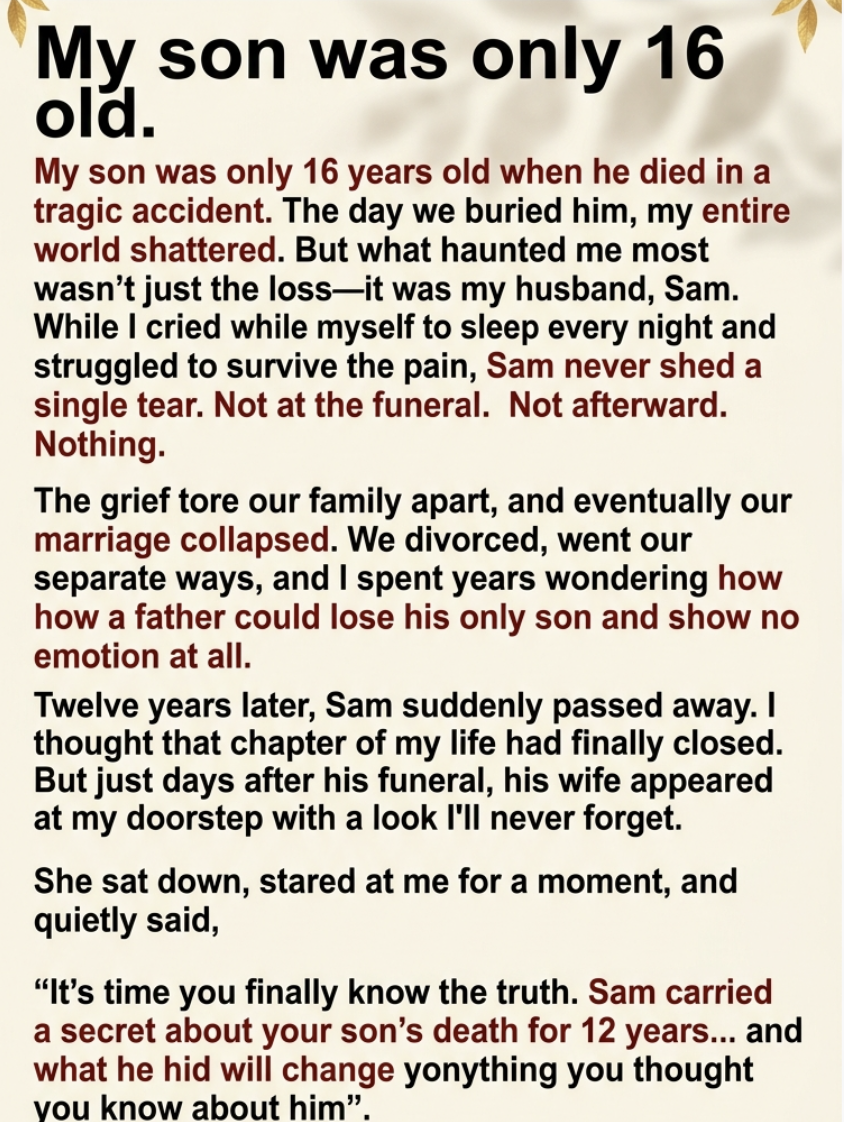
My son was only sixteen when he died in a tragic accident.
The day we buried him, my world ended.
Nothing prepares a parent for that kind of loss.
Nothing.
Every morning felt impossible.
Every night felt worse.
I cried until I couldn’t breathe.
I stopped sleeping.
Stopped eating.
Stopped recognizing the person staring back at me in the mirror.
But what haunted me most wasn’t just losing my son.
It was my husband, Sam.
He never cried.
Not once.
Not at the hospital.
Not at the funeral.
Not during the endless weeks that followed.
Nothing.
While I was falling apart, he sat quietly.
Calm.
Cold.
Emotionless.
At least that’s how it looked.
The resentment grew.
Then the distance.
Then the arguments.
Eventually, our marriage collapsed under the weight of grief.
We divorced.
Went our separate ways.
And for twelve years, I carried the same question:
How could a father lose his only son and not shed a single tear?
Then Sam died.
A heart attack.
Sudden.
Unexpected.
I attended the funeral out of respect.
Nothing more.
I thought that chapter of my life had finally closed.
I was wrong.
Three days later, there was a knock at my door.
When I opened it, I found Sam’s wife standing there.
Linda.
We’d only met twice.
Yet the look on her face immediately unsettled me.
She wasn’t angry.
She wasn’t grieving.
She looked burdened.
Like someone carrying something too heavy for too long.
I invited her inside.
She sat down at my kitchen table.
Stared at her hands.
Then finally looked up.
“It’s time you know the truth.”
A chill ran through me.
“What truth?”
She swallowed hard.
“Sam carried a secret about your son’s death for twelve years.”
My heart started pounding.
“What are you talking about?”
Linda opened her purse.
Removed a sealed envelope.
And placed it in front of me.
My name was written on the front.
In Sam’s handwriting.
My hands shook as I opened it.
Inside was a letter.
The first sentence nearly stopped my heart.
“If you’re reading this, I’m gone. And if I’m gone, I can finally tell you what happened that day.”
I continued reading.
“The accident wasn’t your son’s fault.”
I froze.
The official report had concluded otherwise.
For twelve years, we’d believed our son had made a reckless decision behind the wheel.
The guilt nearly destroyed me.
Then I read the next line.
“It was mine.”
The room spun.
According to the letter, the day before the accident, Sam had borrowed our son’s car.
While distracted on his phone, he clipped a guardrail.
Minor damage.
Nothing serious.
But he never told anyone.
Instead, he quickly repaired what he could and said nothing.
What he didn’t realize was that the impact had damaged part of the steering system.
The following day, while driving, our son lost control.
The vehicle left the road.
And he never came home.
My vision blurred.
I could barely continue.
Sam had discovered the truth weeks later.
An independent mechanic found evidence of the earlier collision.
Sam knew.
Without question.
He knew.
Yet he never told me.
Never told anyone.
Not because he wanted to avoid responsibility.
Because he couldn’t survive the guilt.
Linda quietly explained.
For years, Sam blamed himself every single day.
The reason he never cried wasn’t because he felt nothing.
It was because he felt too much.
He attended grief counseling in secret.
Visited our son’s grave every week.
Wrote letters he never mailed.
Hundreds of them.
Some apologizing.
Some begging forgiveness.
Some simply saying how much he missed him.
Then Linda handed me a small box.
Inside were dozens of notebooks.
Every page written by Sam.
Every page about our son.
I spent weeks reading them.
Page after page.
Year after year.
The entries revealed a man I no longer recognized.
Not cold.
Not indifferent.
Broken.
Completely broken.
One passage stayed with me.
“If I cry, I won’t stop. So I learned not to start.”
I read that sentence twenty times.
Because suddenly everything made sense.
His silence.
His distance.
His inability to talk.
Not strength.
Not indifference.
Shame.
Crushing shame.
For twelve years I believed my husband didn’t love our son enough to grieve.
The truth was almost the opposite.
He loved him so deeply that the guilt consumed every part of him.
Do I wish he’d told me sooner?
Absolutely.
Would it have changed our marriage?
Maybe.
Maybe not.
But at least we could have carried the burden together.
Instead, we carried separate versions of the same tragedy.
Alone.
Months later, I visited our son’s grave.
For the first time in years, I brought two flowers.
One for my son.
And one for Sam.
As I stood there, I realized something.
Grief doesn’t always look like tears.
Sometimes it looks like silence.
Sometimes it looks like distance.
And sometimes the people who seem the least affected are carrying the heaviest pain of all.
For twelve years, I thought I knew the truth.
But the truth had been buried alongside two people I loved.
One in a cemetery.
And one inside his own heart.